Autism Accommodations for a 504 Plan or IEP

These are options to discuss with your team, drawn from the standard accommodation taxonomy and read against Section 504 and IDEA. Read against Section 504, 34 CFR 104.33(b)(1) on July 19, 2026. Jump to sources

What accommodations help an autistic student?

Common school accommodations for an autistic student cluster around a few needs: predictable structure, clear presentation of directions, sensory comfort and room to communicate in the way that works best. An IEP or a 504 plan can carry these supports when the team agrees, from the evaluation, that they are needed. Autism is a named eligibility category under IDEA, so many autistic students have an IEP, though a 504 plan can hold accommodations when specialized instruction is not needed. Every child is different, so treat the list below as options to talk through with your team, never a fixed checklist.

How to use this list. This page uses identity-first wording (an autistic student), which many autistic people and advocates prefer; others prefer person-first (a student with autism), so use whatever fits your child and family. These are accommodation options to discuss with your child's IEP or 504 team, not a list the school is required to adopt and not medical, legal or educational advice. Every child is different, so the team decides what fits your child from the evaluation.

Common accommodation options for an autistic student, by type

Circle the ones that match what you see with your child and bring them to the team as a starting point, not a demand list. The team decides what fits from the evaluation.

Presentation

  • Directions broken into clear, single steps
  • Visual schedules and picture or written instructions
  • Advance notice and a visual warning before a transition
  • Key routines kept consistent and predictable

Setting

  • A quieter, lower-stimulation seating area
  • Access to a calm or quiet space when needed
  • Reduced background noise or visual clutter at the workspace
  • Agreed sensory tools that help the student focus

Timing and scheduling

  • Extra processing time before a response is expected
  • Short sensory or movement breaks built into the day
  • A predictable warning before an activity changes

Response

  • Room to communicate in the student's usual way, including a communication device or picture support where one is used
  • Answers typed or given orally where writing is a barrier
  • Different ways to show understanding beyond written work

Does this go in a 504 plan or an IEP?

Autism is one of the eligibility categories named in IDEA, so many autistic students have an IEP that can include both specialized instruction and accommodations. A 504 plan can carry accommodations alone when a child does not need specialized instruction. The IEP vs 504 guide walks through how the team decides.
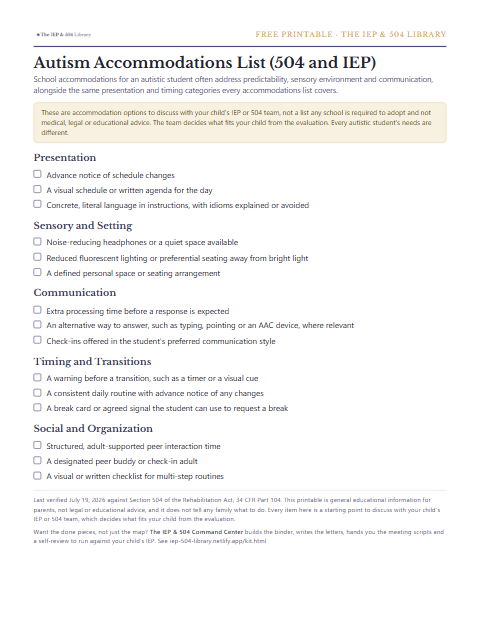
A preview of the free Autism Accommodations List (504 and IEP), one printable page

Get the free Autism Accommodations List (504 and IEP) (PDF)

The most common autism accommodation options grouped by type, to circle and bring to the team.

We email you the PDF, plus a note if the guidance on this topic changes. Unsubscribe anytime.
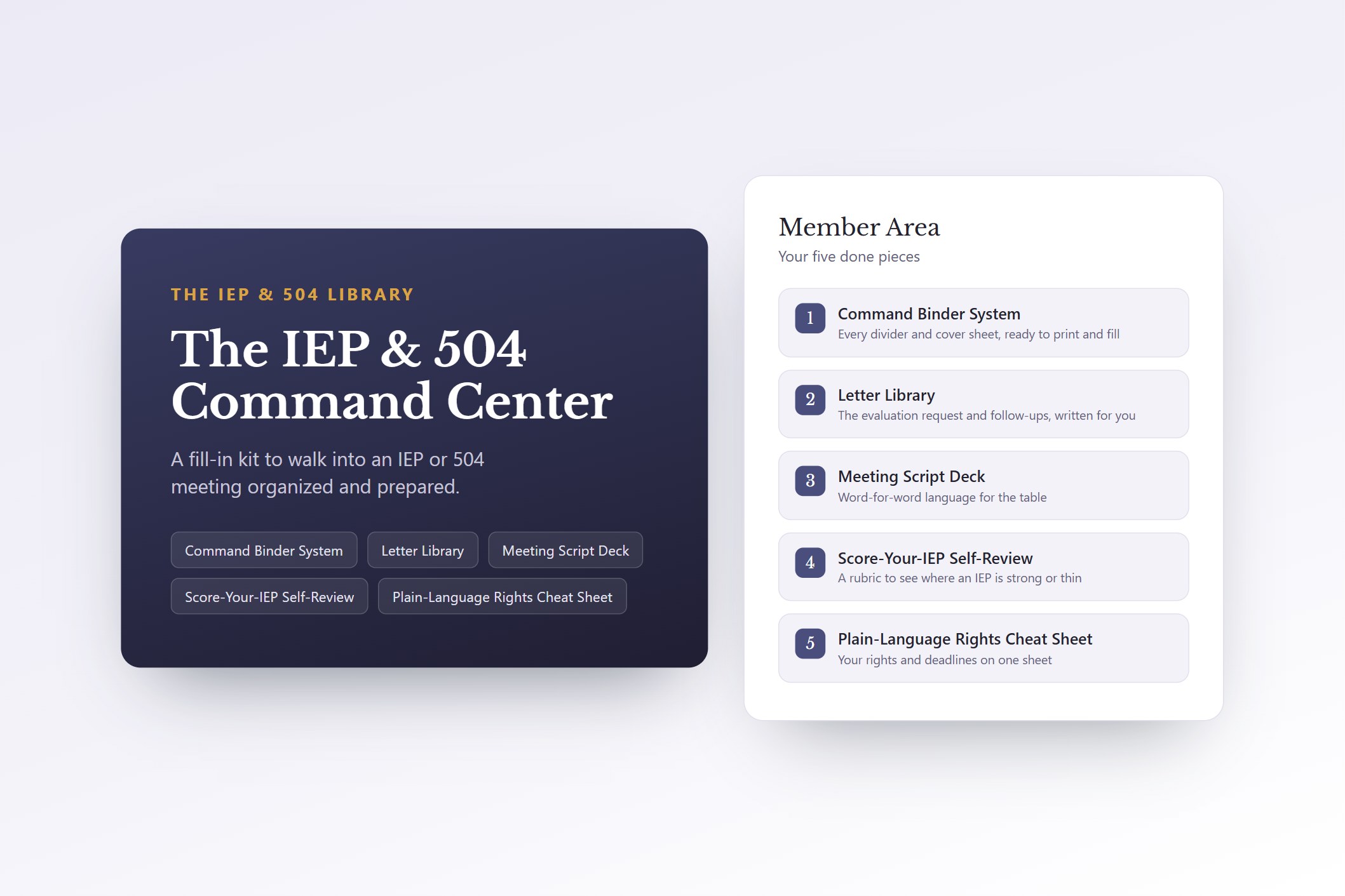
The IEP and 504 Command Center shown as a cover and a member area with its five parts: the Command Binder System, the Letter Library, the Meeting Script Deck, the Score-Your-IEP Self-Review and the Plain-Language Rights Cheat Sheet

From the team behind this library

The IEP & 504 Command Center

This page shows the options to discuss. The Command Center hands you the done pieces: the binder built, the letters written, the meeting scripts ready and a self-review that shows where your child's plan is strong or thin. The library stays free.

See the Command Center One-time $27. Yours to keep. 60-day money-back guarantee.

Questions parents ask

Can my child get sensory breaks at school?

Short sensory or movement breaks are a common support a team considers when the school environment affects a child's regulation or focus. Whether they fit your child, how often and where are the team's decisions from the evaluation. Bring what you notice at home as an option to discuss.

Are communication supports part of accommodations?

They can be. If your child uses a communication device, picture supports or extra processing time, the team can build room for that into the plan so your child can show what they know. What your child uses and where is decided together from the evaluation, not assumed from a diagnosis.

Will my child need an IEP or a 504 plan for autism?

It depends on what the evaluation shows. When a child needs specialized instruction, an IEP is usually the fit. Autism is one of the eligibility categories IDEA names. When a child mainly needs accommodations without specialized instruction, a 504 plan can carry them. The team decides together. The IEP vs 504 guide explains the difference.

Sources

What the facts on this page come from

This page is general educational information for parents, not legal or educational advice. It does not tell any family what to do. Every example here is a starting point to discuss and adapt with your child's IEP or 504 team, which decides what fits your child from the evaluation. Confirm anything time-sensitive with your school or district. For a genuinely contested situation, a special education advocate or an attorney who works in your state is the right person to ask.