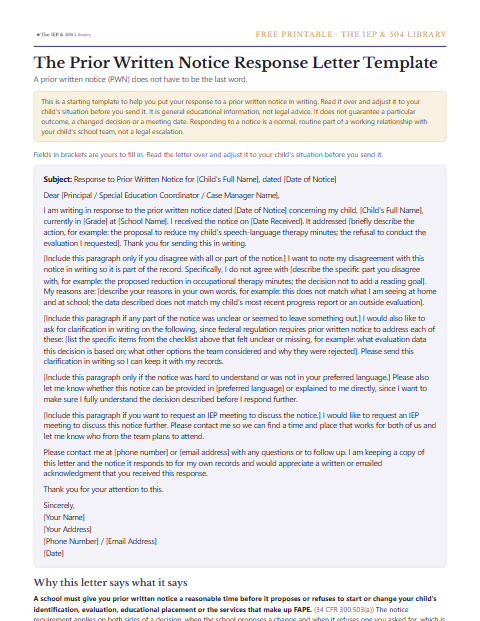
Prior Written Notice Explained: What It Is and What It Must Say
Prior written notice, often shortened to PWN, is the written explanation a school must give you a reasonable time before it proposes or refuses to start or change your child's identification, evaluation, educational placement or the special education and related services in the IEP. Federal regulation requires the notice to say what the school wants to do, why, what data the decision rests on and where to find help understanding your rights, so you are never left guessing at the reasoning behind a decision about your child.

What prior written notice actually is
PWN is the paper trail behind a specific decision. Every time the school proposes to start, change or refuse something about your child's identification, evaluation, placement or services, it has to put that decision in writing and give it to you before it takes effect.
Prior written notice is not a form letter or a routine update. It is the school's written record of a specific decision, tied to the exact action being proposed or refused. It has to reach you a reasonable time before the school acts on it (34 CFR 300.503(a)). The regulation covers four kinds of decisions: initiating or changing your child's identification, initiating or changing the evaluation, initiating or changing the educational placement and initiating or changing the provision of a free appropriate public education, which includes the services named in the IEP.
The underlying idea is that you should never learn about a change to your child's program secondhand or after the fact. A verbal update from a teacher, a note home or a meeting invitation is not the same thing as prior written notice, even if it covers similar ground. PWN is a distinct, required document tied to the specific decision.
When you can expect one
PWN is required on both sides of a decision: when the school proposes a change and when it refuses a change you asked for.
If the school wants to change something, such as adding or dropping a service, changing the placement or ending an evaluation, it owes you notice before making that change (34 CFR 300.503(a)(1)). If the school refuses something you asked for, such as a new evaluation, an added service or a placement change, it also owes you notice explaining the refusal (34 CFR 300.503(a)(2)). Parents sometimes expect PWN only when the news is bad, but a proposal you agree with still requires it.
This means PWN shows up more often than most parents expect once they know to look for it: at the end of an eligibility evaluation, whenever the team proposes changing a service or placement and any time the school declines a request you made in writing.
The seven things it has to say
The regulation requires seven specific elements every time, from a description of the action to a list of resources for understanding your rights.
Under 34 CFR 300.503(b), a complete notice describes the action the school proposes or refuses, explains why, describes each evaluation procedure, assessment, record or report the agency used as a basis for the decision, states that you have procedural safeguards and how to get a copy of them, lists sources for you to contact for help understanding the notice, describes any other options the team considered and why it rejected them and describes any other factors relevant to the decision.
A notice that skips one of these, for example an explanation that names the decision but never says what data it rests on, has not fully met the requirement. It is worth reading a notice against this list rather than assuming a short paragraph covers everything the law requires.
How PWN differs from your annual procedural safeguards notice
The procedural safeguards notice is the yearly overview of all your rights. PWN is the narrower, decision-specific notice tied to one action.
Schools have to give parents a copy of the procedural safeguards at least once a year, plus at specific trigger points such as an initial referral for evaluation, the first state complaint in a school year or a request from you (34 CFR 300.504). That document is the rulebook: independent evaluations, consent, records access, the complaint and hearing process, discipline placement rules and more, all in one place.
Prior written notice is different. It is issued every time a specific proposal or refusal happens and it is tied to that one decision rather than your rights overall. Think of the safeguards notice as the whole rulebook and PWN as the explanation for a single call made under it.
What to do when you get one
Read it against the seven required elements and keep it in your own file, since PWN builds a dated record of every decision made about your child's program.
Check that each of the seven elements is actually addressed, not just gestured at. If the explanation or the data described does not match what you remember from a meeting, that mismatch is worth raising with the school directly and in writing, since your own written follow up becomes part of the same record.
Keeping every PWN you receive in one place, alongside your evaluation reports and IEPs, gives you a chronological history of your child's program that is useful well beyond any single decision, including if you later want to see how services or placement changed over time.
If the school skips it
A missing or incomplete PWN is a documented procedural gap you can point to and ask the school to correct.
If the school makes or refuses a change without sending PWN, or sends a notice missing one of the seven required elements, that is a specific, nameable gap rather than a vague complaint. Ask in writing for the complete notice you should have received.
A missing PWN does not automatically undo the decision on its own, but a documented procedural gap like this is exactly what the dispute options in your procedural safeguards notice, such as a state complaint or a request for mediation, exist to address if the school does not correct it on request.
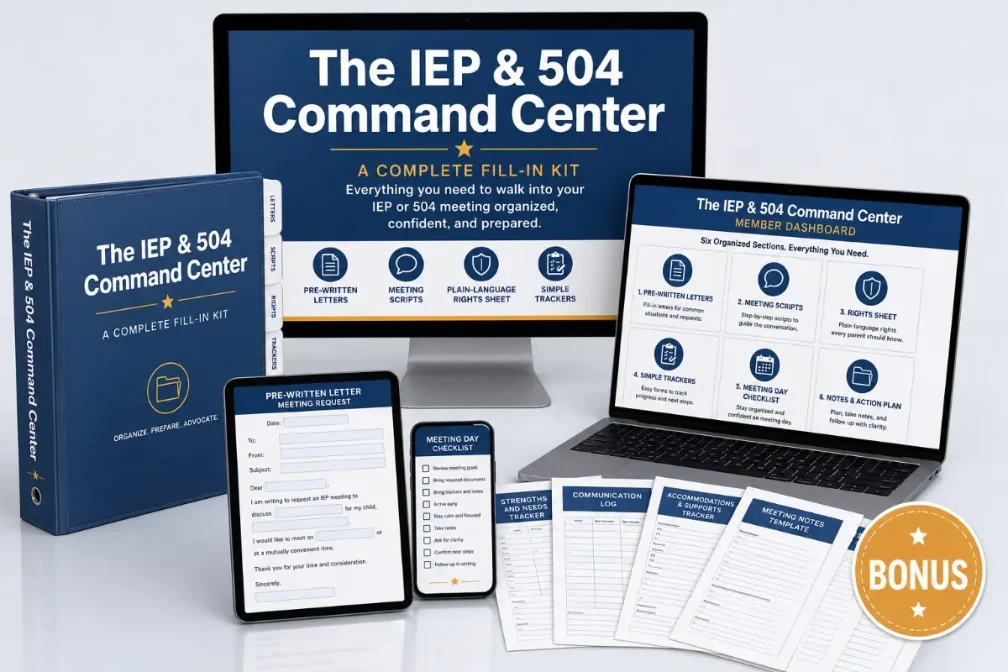
From the team behind this library
The IEP & 504 Command Center
This page shows the options to discuss. The Command Center hands you the done pieces: the binder built, the letters written, the meeting scripts ready and a self-review that shows where your child's plan is strong or thin. The library stays free.