The Parent's Library for IEP Goals and 504 Plans
Plain-language IEP goals by area and grade, plus the printables that get you ready for the meeting.
Popular: Reading goals Meeting checklist Accommodations

The goal bank
Pick your child's area of need for measurable sample goals by grade, what to ask your team and what makes a goal measurable. Every example is a starting point to discuss, never a target your child must meet.
Free printables
The checklist, the binder set, the accommodation lists, the evaluation-request letter, the goal tracker and more, each a free PDF that helps you walk in organized.
Every example goal here is a starting point to talk through with your child's IEP team, never a script to hand them.
We read the law against IDEA and Section 504. We write each goal to be measurable and respectfully worded. We date every page. Where a detail is not yet confirmed, we flag it on the page.
Every page carries the date we last read it against the law.
Where most parents start
The walkthrough of the meeting itself, the checklist to prepare with and the builder that shows you what makes a goal measurable.
 Most-opened guide
The IEP Meeting Walkthrough
The formal meeting where your child's team writes, reviews or updates the IEP, stage by stage.
Read the guide Free printable
IEP Meeting Checklist
The four-stage prep checklist, from a few weeks out through the follow-up, so nothing gets missed in a busy week.
Get the printable Free tool
The goal practice builder
Build a practice goal one part at a time and see what makes it measurable.
Try the builderGuides and references
Short, plain-language reads for the parts of the process that trip parents up, plus the one thing that really does vary by state.
IEP vs 504: What's the Difference
An IEP and a 504 plan come from two different federal laws and do two different jobs.
ReadThe IEP Meeting Walkthrough
An IEP meeting is the formal meeting where your child's IEP team writes, reviews or updates the Individualized Education Program, the document that sets your child's goals and the special education and related services the school will provide.
ReadHow to Request an IEP Evaluation
Either you or your child's school can request an initial special education evaluation at any time.
ReadPrior Written Notice Explained: What It Is and What It Must Say
Prior written notice, often shortened to PWN, is the written explanation a school must give you a reasonable time before it proposes or refuses to start or change your child's identification, evaluation, educational placement or the special education and related services in the IEP.
ReadWhat Qualifies a Student for a 504 Plan
A student qualifies for a 504 plan when the student has a physical or mental impairment that substantially limits one or more major life activities, based on an individual evaluation that draws on more than one source of information rather than a diagnosis alone.
ReadThe IEP Process, Start to Finish
The IEP process runs in a set order: identification through Child Find or a specific request, written consent, an evaluation completed within 60 days of that consent, a team decision on eligibility, an IEP written within 30 days of an eligibility decision, services beginning, a review at least once a year and a full reevaluation at least every three years.
ReadUnderstanding Your Child's Evaluation Report: Scores, Percentiles and What They Mean
Your child's evaluation report uses scores to compare performance in specific areas, such as reading, language or attention, against a large group of same-age peers called the norm group.
ReadHow to Request a 504 Plan
To request a 504 plan, put your request in writing to your child's school, usually the 504 coordinator, the principal or the school counselor, then ask the school to evaluate your child for a 504 plan.
ReadDoes a 504 Plan or IEP Follow You to College?
A 504 plan or an IEP does not automatically follow a student to college.
ReadThe 13 IDEA Disability Categories That Qualify for an IEP
IDEA lists thirteen disability categories a child can qualify under for an IEP: autism, deaf-blindness, deafness, emotional disturbance, hearing impairment, intellectual disability, multiple disabilities, orthopedic impairment, other health impairment, specific learning disability, speech or language impairment, traumatic brain injury and visual impairment including blindness (34 CFR 300.8).
ReadSchool Not Following the IEP: What to Do
If your child's IEP is not being followed, most families start with an informal conversation, follow up in writing and ask for an IEP team meeting before turning to one of three formal options IDEA Part B provides: a state complaint, mediation or a due process complaint.
ReadYou Disagree With the IEP: Your Options
When you disagree with something in your child's IEP, federal law gives you several options rather than just one.
ReadThe Dispute-Resolution Map: State Complaint, Mediation and Due Process
IDEA gives families and schools three formal ways to resolve a disagreement about a child's evaluation, placement or services: a state complaint investigated by the state education agency, voluntary mediation with a neutral mediator and a due process complaint that can lead to a hearing before an impartial hearing officer.
ReadDo You Need an Advocate or Attorney?
Most families can handle routine IEP and 504 meetings on their own with good preparation, since nothing in IDEA or Section 504 requires you to bring anyone else.
ReadSchool accommodations by need
Common accommodation options grouped by type, with ADHD, autism and dyslexia lists to bring to the team.
ReadEvaluation timelines by state
How your state's initial-evaluation window compares to the federal 60-day default, plus the three dispute routes.
ReadTools and state rules
All state pagesWhat is the difference between an IEP and a 504 plan?
An IEP comes from IDEA and provides specialized instruction plus related services under a plan of measurable goals, for a child who fits one of thirteen disability categories and needs special education because of it.
A 504 plan comes from Section 504 of the Rehabilitation Act, a civil rights law. It provides accommodations that give a child equal access to the general classroom, whether or not the child needs specialized instruction. A child who qualifies for an IEP is covered by Section 504 too, so a school does not usually write both.
Which one fits your child is the team's decision, made from the evaluation. Read the full IEP vs 504 guide.

Why this library exists
A small team keeps this library current. We built it because the honest answer to "how do I get ready for an IEP meeting?" sat scattered across a federal regulation, a district handout and a dozen parent blogs written for a different situation. No single place showed you what a measurable goal looks like in your child's area of need, in plain words, with the source on the page.
Every legal fact here is read straight from IDEA or Section 504 and its regulations, then dated on the page and re-checked when the rules change or a reader flags an error. Every sample goal is written to be measurable and observable, worded with respect for how your child is described.
The library stays free because a plain-language starting point should not sit behind a paywall. If a page ever drifts from the current rules, that is a mistake we want to fix, fast. Here is how this library is verified, in full.

From the team behind this library
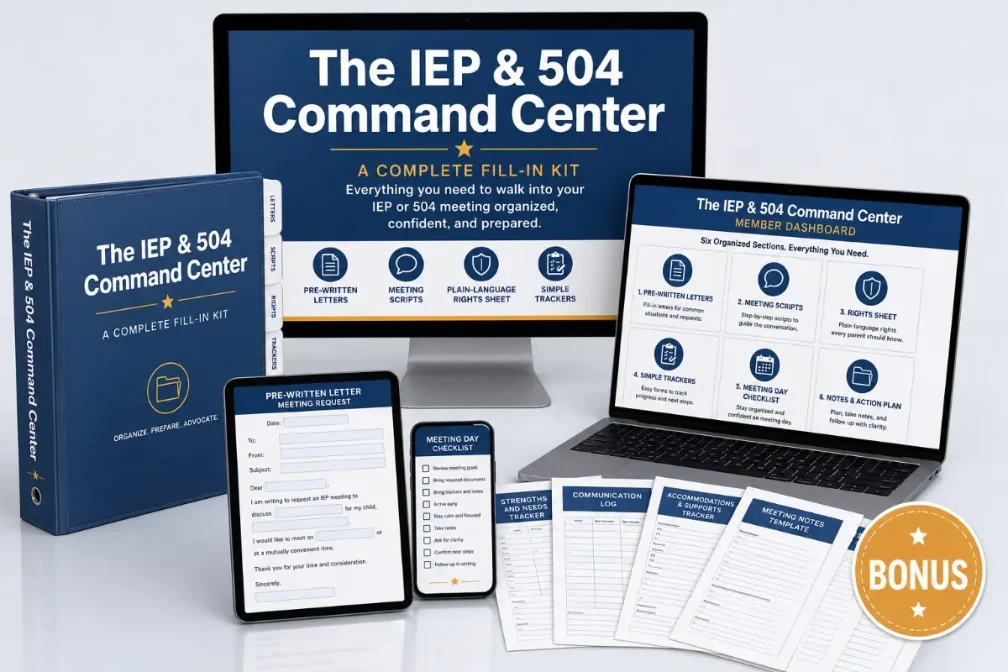
The IEP & 504 Command Center
The free library shows you what a measurable goal looks like and how to organize your paperwork. The Command Center hands you the done pieces for your meeting: The Command Binder System, The Letter Library, The Meeting Script Deck, The Score-Your-IEP Self-Review, The Plain-Language Rights Cheat Sheet. One evening of setup instead of many.
What we are tracking
IEP and 504 rules change through rulemaking and guidance and states adjust their evaluation timelines. We keep a dated log of the corrections we have made and the federal and state items we are actively confirming, so you can see what changed and what we are still checking.
Walk into the next meeting knowing what to ask for.
Open the goal bank for measurable sample goals in your child's area of need, each one a starting point to talk through with your team.