The IEP First-Notice Letter (Free Printable)
What is the IEP First-Notice Letter?
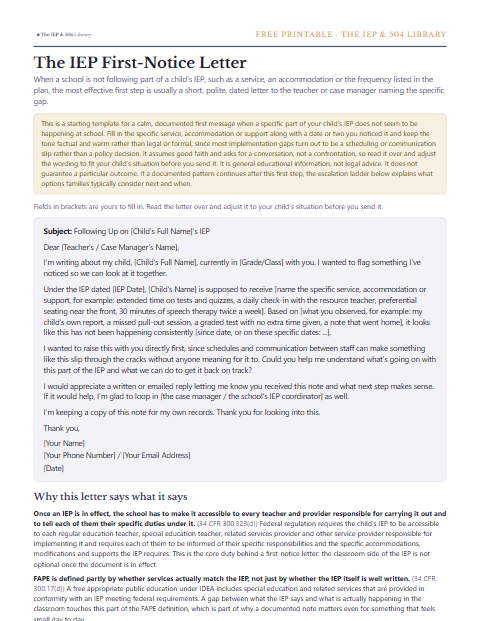
When a school is not following part of a child's IEP, such as a service, an accommodation or the frequency listed in the plan, the most effective first step is usually a short, polite, dated letter to the teacher or case manager naming the specific gap. Federal law requires the IEP to be accessible to every teacher and provider responsible for it and requires each of them to be informed of their specific duties and the specific supports the IEP requires (34 CFR 300.323(d)), so a documented note gives the school a clear, low-conflict chance to fix a mistake before any formal step is needed. This template gives you the letter itself plus a short escalation ladder for the rare cases where a documented pattern continues.

How to use it
What is on the printable
Fields in brackets are yours to fill in. Read the letter over and adjust it to your child's situation before you send it.
Why this letter says what it says
| Once an IEP is in effect, the school has to make it accessible to every teacher and provider responsible for carrying it out and to tell each of them their specific duties under it. 34 CFR 300.323(d) | Federal regulation requires the child's IEP to be accessible to each regular education teacher, special education teacher, related services provider and other service provider responsible for implementing it and requires each of them to be informed of their specific responsibilities and the specific accommodations, modifications and supports the IEP requires. This is the core duty behind a first-notice letter: the classroom side of the IEP is not optional once the document is in effect. |
|---|---|
| FAPE is defined partly by whether services actually match the IEP, not just by whether the IEP itself is well written. 34 CFR 300.17(d) | A free appropriate public education under IDEA includes special education and related services that are provided in conformity with an IEP meeting federal requirements. A gap between what the IEP says and what is actually happening in the classroom touches this part of the FAPE definition, which is part of why a documented note matters even for something that feels small day to day. |
| If the school proposes or refuses to change how a service in the IEP is provided, it owes you written notice explaining the decision. 34 CFR 300.503 | Prior written notice must describe the action the school proposes or refuses, explain the reasoning, describe the data behind it and list where to get help understanding your rights. It applies to a proposal or a refusal to change the identification, evaluation, placement or provision of FAPE, which includes the services named in the IEP. Asking directly, as this letter does, is often what surfaces whether the school considers this a proposal, a refusal or a simple oversight it can fix. |
| Mediation is a free, voluntary option for working through a disagreement with a neutral third party before any formal complaint. 34 CFR 300.506 | Mediation is voluntary for both sides and the state bears the full cost, including the mediator. It uses an impartial mediator trained in mediation techniques who cannot be an employee of the school district or the state agency involved in the child's education. The discussion itself stays confidential. Either a parent or a school can suggest it well before a formal complaint is filed. |
| Any parent, or another individual or organization, can file a signed written state complaint alleging the school violated a federal special education requirement, which covers not implementing the IEP as written. 34 CFR 300.153 | A written, signed complaint can be filed by an organization or an individual, which includes a parent. It must state that a public agency violated a requirement of IDEA Part B, give the facts the statement rests on and include the complainant's contact information. If it concerns a specific child, it names the child, the school and the problem along with a proposed resolution. The complaint has to allege something that happened within the year before the state receives it. |
| The state education agency generally has 60 days to investigate and resolve a written state complaint. 34 CFR 300.152(a)-(b) | The 60-day window covers investigating the complaint, giving the school a chance to respond (including proposing mediation), reviewing the information gathered and issuing a written decision that addresses each allegation with findings of fact and the reasons for the outcome. An extension is allowed only for exceptional circumstances or when both sides agree to use the extra time for mediation. |
| When a state complaint finds the school failed to provide appropriate services, the remedy can include specific fixes for the child, not just a general finding. 34 CFR 300.151(b) | If the state agency finds a failure to provide appropriate services, it has to address that failure with corrective action fitted to the child's needs, such as compensatory services or reimbursement, plus the appropriate future provision of services for all children with disabilities. This is the practical payoff of documenting a gap early: a confirmed implementation failure has a defined remedy built into the regulation. |
| A due process complaint is the formal hearing route for whether a child actually received FAPE, generally available within two years of when the gap was or should have been known. 34 CFR 300.507 | A due process complaint can raise a matter relating to identification, evaluation, educational placement or the provision of FAPE, which is the category an implementation gap falls under. It generally has to allege something that happened within two years of when the parent or the school knew or should have known about it, unless your state sets its own explicit filing deadline in state law. Many families bring in an advocate or attorney at this stage, though the option itself does not require one. |
Sending tips
- Send it in a way that gives you a dated record, such as email, a note sent through the school's parent portal or a hand-delivered copy with a signed and dated copy kept for your own file
- Keep a copy for yourself, dated the day you send it
- Note the specific dates or instances you noticed the gap, since a concrete example is more useful to the school and to you than a general impression
- Give the school a reasonable window to respond, since most scheduling or communication slips resolve within a week or two once someone flags them
- If you do not hear back, follow up in writing and reference the date of your original note before considering the next step on the ladder

From the team behind this library
The IEP & 504 Command Center
This printable is the map. The Command Center is the done pieces: The Command Binder System, The Letter Library, The Meeting Script Deck, The Score-Your-IEP Self-Review, The Plain-Language Rights Cheat Sheet, so you walk in organized, working from the same paperwork the team has.