School Not Following the IEP: What to Do
If your child's IEP is not being followed, most families start with an informal conversation, follow up in writing and ask for an IEP team meeting before turning to one of three formal options IDEA Part B provides: a state complaint, mediation or a due process complaint. Many gaps close at the first two steps, since a missed accommodation or a paused service is often something the school can fix once it is named in writing. The three formal routes are not strictly sequential. Each runs on its own federal timeline, from a 60-day state complaint decision to a 45-day due process hearing decision.
What it means when an IEP is not being followed
An IEP is not only a planning document. Federal law ties a free appropriate public education directly to the school actually providing what the IEP says, so a real gap between the plan and the classroom is a fixable problem with a documented path forward.
Free appropriate public education, or FAPE, is defined under IDEA to include special education and related services provided consistent with the child's IEP (34 CFR 300.17(d)). Once the IEP is written, the school must make the services available as soon as possible and provide them in accordance with what the document says (34 CFR 300.323(c)(2)). A missed accommodation, a related service that quietly stopped or a goal with no recent progress data behind it is not a small thing to raise. It is exactly the kind of gap this guide covers, step by step.
Federal regulation also requires the school to make the IEP itself accessible to every regular education teacher, special education teacher and related-service provider responsible for carrying it out. It also requires the school to make sure each of them understands their specific part in it (34 CFR 300.323(d)). In practice, a lot of what looks like a school ignoring the IEP traces back to that handoff: a substitute who never saw the document, a new provider who was not told about an accommodation or a schedule change that got lost between offices. Naming the gap clearly, which the next steps walk through, is usually what closes it, whatever the underlying cause turns out to be.
The path at a glance
Most families move through the same rough order: an informal conversation, a written note, then a request for an IEP team meeting, with three formal routes available at any point if the concern is not resolved.
Most families move through the same rough order: an informal conversation, a written note naming the concern, then a request for an IEP team meeting if the first two steps do not close the gap. From there, IDEA Part B provides three formal routes: a state complaint, mediation and a due process complaint.
Nothing in the law requires trying the informal steps first. A parent can file a state complaint or a due process complaint at any point. A serious or urgent concern is a reasonable reason to move straight to one of the formal routes rather than waiting through the earlier steps. The sections below cover each option's own timeline so you can weigh that choice.
Step 1: Start with an informal conversation
A direct conversation with the teacher, case manager or related-service provider is usually the fastest way to fix a gap, especially when the cause turns out to be a mix-up rather than a disagreement.
Reach out to whoever is closest to the issue, the classroom teacher, the case manager or the specific related-service provider. Describe exactly what you are seeing: which accommodation is not happening, which service session was missed or which goal has no recent data behind it. Specific, dated detail is more useful here than a general sense that something is off.
Ask directly what happened and when the service or support will resume. Jot down the date of the call or conversation and a short note on what you were told. That note costs you nothing to keep and becomes useful if the same gap shows up again, since the next step in this guide is putting the concern in writing.
Step 2: Put the concern in writing
If the conversation does not close the gap, a short written note to the case manager or the special education director creates a dated record and often gets a clearer response than a phone call did.
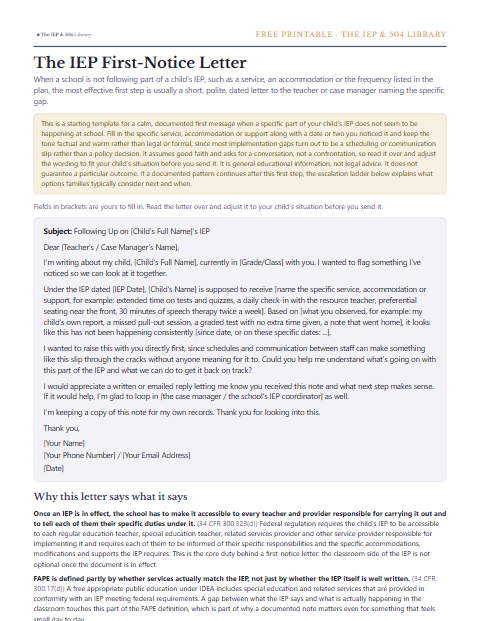
Email works well because it dates itself automatically. Name the specific part of the IEP involved, the date the gap started as best you can tell and what you are asking for, whether that is for the service to resume, for missed time to be made up or simply for the team to look into it. Keep the tone factual and specific. A note that names exactly what is missing gets a more useful response than one that describes a general worry.
A written request also puts the school in a position to respond formally. When a school decides to change something or to refuse a request you made in writing, federal law requires it to send you prior written notice explaining the decision, the reasons behind it and what the school considered (34 CFR 300.503). That notice, if one comes back, tells you exactly where the school stands and is worth reading closely. Our prior written notice guide walks through what it has to say.
Step 3: Ask for an IEP team meeting
You can ask for an IEP team meeting at any point outside the annual review. Information you provide as a parent is itself one of the reasons federal law requires the team to reconsider the plan.
The IEP team must review the plan periodically, not less than once a year, to check whether the annual goals are being met (34 CFR 300.324(b)(1)). The same regulation requires the team to revise the IEP as needed to address a lack of expected progress, new evaluation results, information about the child provided by the parents, the child's changing needs or other matters. A written concern that a service or accommodation is not happening is exactly the kind of parent-provided information this rule is built around, so it is a legitimate reason to ask for a meeting before the annual review comes around on its own.
Once a meeting is set, the school must send notice stating the meeting's purpose, time and location and who is expected to attend. It must also try to schedule the meeting at a time and place you both agree on (34 CFR 300.322). If the school refuses to hold the meeting you asked for, it owes you prior written notice explaining that refusal (34 CFR 300.503). The meeting itself is where you and the team can look at the data together, such as attendance or service logs and progress notes. It is also where you agree on what happens next. Our IEP meeting walkthrough and the meeting checklist printable on this site cover how to prepare for the meeting itself in more depth.
The three formal routes IDEA Part B provides
When the informal steps do not resolve things, IDEA gives three routes that cost nothing to file: a state complaint, mediation and a due process complaint. You are not limited to picking just one.
A state complaint is a written complaint your state's education agency investigates and rules on. Mediation is a voluntary session with a neutral third party who helps both sides look for common ground. A due process complaint opens the most formal route, a legal proceeding that can end in a hearing before an impartial officer. Each is explained in its own section below, with its own timeline and its own required content.
These three are not a strict ladder and none of them requires you to have tried the others first. Mediation in particular is available at any point, even before you file a state complaint or a due process complaint. It can also run alongside either one (34 CFR 300.506(a)). A state complaint and a due process complaint can also proceed at the same time on different issues, though any issue that is part of both gets set aside in the complaint process until the hearing on that issue is finished (34 CFR 300.152(c)).
Option A: File a state complaint
A state complaint is a signed written complaint filed with your state education agency alleging that the school violated a requirement of IDEA. The state has 60 calendar days from filing to investigate and issue a written decision.
Anyone, a parent, an organization or an individual, can file a state complaint (34 CFR 300.153). It must be in writing and signed. It can only allege a violation that happened within the year before the state receives it. A complete complaint states what the school did or failed to do, the facts behind that statement and, when the complaint concerns a specific child, the child's name, address and school, a description of the problem itself and a proposed fix to the extent you know one. It is filed with your state's education agency, not the local district, though the person filing it must also send a copy to the school district at the same time.
The state has 60 calendar days from the date it receives the complaint to investigate and issue a written decision (34 CFR 300.152). That deadline can be extended only if exceptional circumstances apply to the particular complaint, or if you and the school agree to extend it to try mediation or another form of dispute resolution first. If part of your complaint covers the same issue already in front of a due process hearing, that part is set aside until the hearing decision comes back. Any other issue in the same complaint still moves through the normal 60-day process.
Option B: Ask for mediation
Mediation is a voluntary, free session with a neutral, trained mediator. It is available at any point, even before you file anything else. It can never be used to deny or delay your right to a hearing.
Mediation has to be offered whenever a dispute comes up under IDEA, including before a state complaint or a due process complaint is ever filed (34 CFR 300.506(a)). It is voluntary for both sides, the school cannot make you use it and you cannot be made to give up your right to a hearing by trying it first. The state pays for the mediator, so it costs you nothing.
The mediator has to be qualified, trained and genuinely neutral, with no connection to the school district or state agency that could create a conflict of interest. What gets said in the room stays there. Mediation discussions are confidential and cannot be used as evidence later in a hearing or a court case, which is part of what makes it a low-risk place to try to work things out. If you and the school reach an agreement, you both sign it and it becomes a legally binding agreement enforceable in state or federal court (34 CFR 300.506).
Option C: File a due process complaint
A due process complaint is the formal legal route. It has to be filed within two years of when you knew or should have known about the problem, unless your state law sets its own deadline. It then moves through a required resolution period before a hearing decision is due.
A parent or the school can file a due process complaint over the identification, evaluation, placement or FAPE of a child with a disability (34 CFR 300.507). The complaint has to allege a violation that happened not more than two years before the date you knew or should have known about it, unless your state has set its own explicit filing deadline in law, in which case the state deadline controls (34 CFR 300.507(a)(2)). Two narrow exceptions can extend that window: the school specifically misrepresented that it had already resolved the problem, or the school withheld information from you that federal law required it to share (34 CFR 300.511(f)). If you file, the school also has to tell you about free or low-cost legal help available in your area (34 CFR 300.507).
Once your complaint is filed, the school has to set up a resolution meeting within 15 days, unless you and the school agree in writing to skip it or you both agree to use mediation instead. From the date the complaint was received, there is a 30-day resolution period. If the disagreement is not resolved to your satisfaction inside that window, the due process hearing can move forward (34 CFR 300.510).
A final hearing decision has to be reached and mailed to both sides within 45 days after that 30-day resolution period ends, though a hearing officer can grant either side a specific extension on request (34 CFR 300.515). If either side disagrees with the final decision, it can bring a civil action in state or federal court within 90 days, unless your state law sets a different deadline. In states where a state-level review of the hearing decision comes first, the 90 days runs from that review decision (34 CFR 300.516).
Keeping your own record along the way
A simple written record is what turns a general worry into something a school, a mediator or a hearing officer can act on. Dates, copies of everything you sent or received and specific notes on what is and is not happening all add up fast.
Keep everything about your child's IEP in one place: your copies of the IEP itself, evaluation reports, progress reports, any prior written notice you receive and notes from every conversation and meeting. The goal-tracking sheet, the binder printables and the meeting notes template on this site are built for exactly this kind of record.
Specific beats general every time. Instead of a general sense that things are not going well, a note that says which service, which date and which accommodation is what a school, a mediator or a hearing officer can actually work with.
Most concerns close well before a state complaint or a hearing ever gets filed. When the informal conversation is enough, that is a good outcome, not a smaller one. When it is not enough, the record you built along the way is what makes the more formal routes work.

From the team behind this library
The IEP & 504 Command Center
This page shows the options to discuss. The Command Center hands you the done pieces: the binder built, the letters written, the meeting scripts ready and a self-review that shows where your child's plan is strong or thin. The library stays free.