You Disagree With the IEP: Your Options
When you disagree with something in your child's IEP, federal law gives you several options rather than just one. You can limit what you consent to, ask for an independent educational evaluation at public expense, use prior written notice to see the school's reasoning and data, request mediation with a neutral third party or file a state complaint or a due process complaint depending on what the disagreement is about. Each one works differently, so which one fits depends on what you disagree with and what you want to happen next.
When you disagree with something in the IEP
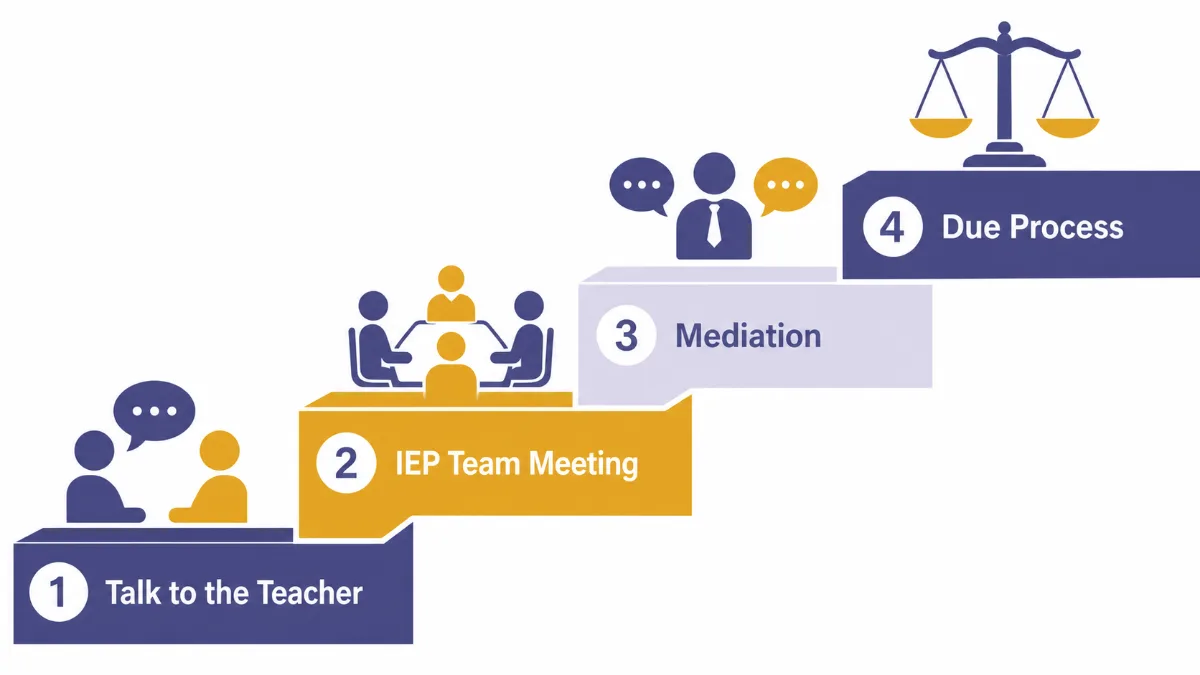
Disagreeing with part of an IEP is common and federal law gives you more than one way to respond to it, from a follow-up conversation to a set of formal options. Most disagreements get worked out before any formal step is needed.
A disagreement can be about almost any part of the IEP: whether your child qualifies at all, the goals the team wrote, the amount or type of a service, the placement or the data an evaluation relied on. None of that is unusual and IDEA does not expect every disagreement to turn into a legal dispute. Often the fastest path is the simplest one: ask the team to reconvene, put your concern in writing and ask specific questions about the reasoning behind a decision.
When a conversation does not settle it, federal law lays out a specific set of tools rather than a single required path. You can limit what you consent to, ask for an independent educational evaluation, use prior written notice to see exactly what the school's decision rests on, request mediation with a neutral person in the room or file a state complaint or a due process complaint. This guide walks through what each one actually does and how they compare, so you can bring an informed question to your child's team or to an advocate rather than guessing at your options.
Your consent has limits and that is one of your first tools
Consent under IDEA is not a single blanket yes. It has to describe the specific activity you are agreeing to, it is voluntary and you can revoke it at any time, which makes it one of the first tools available to you when you disagree with a proposed step.
A federal definition sets out exactly what a valid consent has to include. You have to be fully informed of what you are agreeing to in your own language, you have to agree in writing to that specific activity and you have to understand that your consent is voluntary and may be revoked at any time (34 CFR 300.9). That specificity matters when you disagree with something in the IEP, because your consent only covers what you actually agreed to, nothing more.
The clearest example is evaluation versus services. Agreeing to let the school evaluate your child is not the same as agreeing to any services that come out of that evaluation. The two require separate consent (34 CFR 300.300(a)(1)(ii) and 300.300(b)(1)). If you refuse consent for services or simply do not respond, the school cannot use mediation or a due process complaint to try to override that decision and it is not treated as failing to offer your child a free appropriate public education (34 CFR 300.300(b)(3)).
You can also revoke consent you already gave. Put the revocation in writing and the school has to send you a prior written notice before it stops the service, though revoking consent does not undo services your child already received (34 CFR 300.300(b)(4) and 300.9(c)(2)). A reevaluation works almost the same way with one difference. The school generally needs your consent again before it reevaluates your child and it can go ahead without an answer only if it shows it made reasonable efforts to reach you and you did not respond (34 CFR 300.300(c)(1)(i) and 300.300(c)(2)). If you refuse a reevaluation outright, the school may, but is not required to, use mediation or a due process hearing to ask to proceed anyway, a route the rules close off for initial services (34 CFR 300.300(c)(1)(ii)).
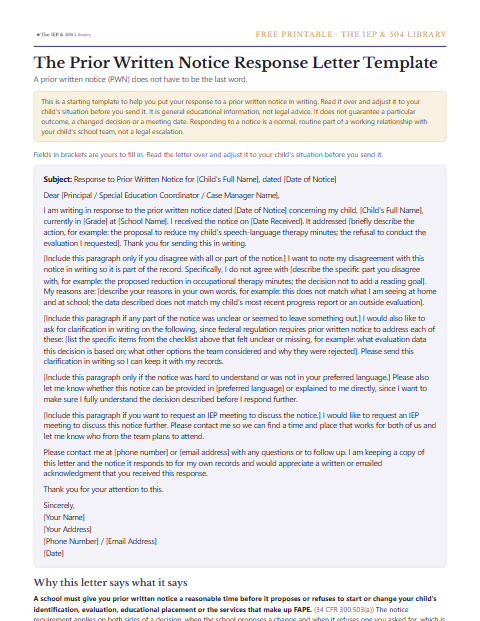
Prior written notice is usually where the disagreement comes into focus
Before the school can propose or refuse a change to your child's identification, evaluation, placement or services, it has to send you a written notice explaining what it wants to do, why and what data the decision rests on, which is often the document that shows you exactly what you disagree with.
Prior written notice is required a reasonable time before the school proposes or refuses to start or change your child's identification, evaluation, educational placement or the services in the IEP (34 CFR 300.503(a)). The regulation requires seven specific things in that notice, including a description of the action, the reasoning behind it, the evaluation data or records it relies on and any other options the team considered and rejected (34 CFR 300.503(b)). Our prior written notice guide walks through all seven elements in full.
When you disagree with a decision, prior written notice is usually the first place to look closely, because it is the school's own written account of the reasoning and the data behind that decision. Check whether the notice actually engages with your concern rather than restating the decision and check whether the data it names matches what you remember from the meeting. If the notice is missing one of the seven required elements or never arrives at all, that gap is a specific, nameable thing you can point to and ask the school to correct before you consider a more formal option.
Ask for an independent educational evaluation at public expense
If you disagree with an evaluation the school conducted, you can ask for an independent educational evaluation, meaning an evaluation by a qualified examiner who does not work for the school. Once you ask, the school must either pay for it or file for a due process hearing to defend its own evaluation instead (34 CFR 300.502).
You have the right to an independent educational evaluation, an evaluation conducted by a qualified examiner who is not employed by the school, whenever you disagree with an evaluation the school conducted (34 CFR 300.502(a)(1), 300.502(a)(3)(i) and 300.502(b)(1)).
Once you make the request, the school has two options: pay for the independent evaluation or file a due process complaint to show that its own evaluation was appropriate, without unnecessary delay either way (34 CFR 300.502(b)(2)). If the school wins that hearing, you can still get an independent evaluation, just not at public expense (34 CFR 300.502(b)(3)). You are entitled to one independent evaluation at public expense each time the school conducts an evaluation you disagree with (34 CFR 300.502(b)(5)).
The school can apply the same location and examiner-qualification criteria to your independent evaluation that it uses for its own evaluations, but it cannot add extra conditions or timelines on top of that (34 CFR 300.502(e)(1) and 300.502(e)(2)). Whatever the independent evaluation finds has to be considered by the team in any decision about your child's education, as long as it meets those criteria (34 CFR 300.502(c)(1)). If a hearing officer, rather than you, asks for an independent evaluation as part of a hearing, that evaluation is at public expense regardless (34 CFR 300.502(d)).
Mediation: working it out with a neutral person in the room
Mediation is a voluntary process where a trained and impartial mediator helps you and the school work through a disagreement. The state pays for it rather than you. It cannot be used to delay or take away your right to a due process hearing.
Every state has to make mediation available for IDEA disputes and it is voluntary on both sides, so neither you nor the school can be forced into it (34 CFR 300.506(a) and 300.506(b)(1)(i)). It has to be run by a mediator who is trained in mediation techniques and impartial, meaning not an employee of the school or state agency involved in your child's education and not anyone whose personal or professional interest conflicts with their objectivity, with the state bearing the cost rather than you (34 CFR 300.506(b)(1)(iii), 300.506(c)(1) and 300.506(b)(4)).
The rule is explicit that mediation cannot be used to deny or delay your right to a due process hearing, so opting in does not cost you the formal route if it does not resolve things (34 CFR 300.506(b)(1)(ii)). What is said during mediation stays confidential and cannot be used as evidence in a later due process hearing or civil proceeding (34 CFR 300.506(b)(8)) and any agreement you sign must state that confidentiality itself (34 CFR 300.506(b)(6)(i)). If you do reach an agreement, it gets written down and signed. That agreement is legally binding and enforceable in state or federal court (34 CFR 300.506(b)(6) and 300.506(b)(7)).
State complaint or due process complaint: an honest comparison
A state complaint and a due process complaint are both real options under IDEA and they work differently. A state complaint is a faster written review by your state education agency that can reach a broader range of IDEA violations. A due process complaint is a formal hearing limited to your child's identification, evaluation, placement or FAPE, ending in a legally binding decision either side can appeal to court.
A state complaint can be filed by any individual or organization, including one from another state. It can allege that a public agency violated any requirement of IDEA Part B (34 CFR 300.151(a)(1) and 300.153(b)(1)). A due process complaint is narrower on both counts. Only a parent or a public agency can file one and it has to concern the identification, evaluation or educational placement of a specific child, or the free appropriate public education that child is provided (34 CFR 300.507(a)(1)).
The two routes also run on different clocks. A state complaint has to allege something that happened within the last year (34 CFR 300.153(c)). A due process complaint reaches back further, generally two years from when you knew or should have known about the issue, unless your state law sets its own explicit time limit for filing (34 CFR 300.507(a)(2)).
The process itself looks different too. A state complaint moves through your state education agency on paper. It investigates if needed, lets both sides respond and issues a written decision addressing every allegation within 60 calendar days, extended only for exceptional circumstances on a particular complaint or if you and the school agree to extend it to try mediation (34 CFR 300.152(a) and 300.152(b)(1)). A due process complaint moves through a more legal-style process: a resolution meeting within 15 days that you and the school can waive or replace with mediation, then a 30-day resolution period, then up to 45 more days for a hearing officer's decision if the matter is not resolved. A contested due process case commonly runs about 75 days from filing to a decision even before any extension (34 CFR 300.510(a), 300.510(b) and 300.515(a)).
The outcomes differ too. A state complaint decision can order corrective action such as compensatory services or monetary reimbursement (34 CFR 300.151(b)), while IDEA's right to take a decision into court is written for due process hearing decisions rather than state complaint decisions (34 CFR 300.516(a)). A due process hearing decision is a binding ruling that either side can appeal into state or federal court, within 90 days of the decision unless your state law sets its own explicit deadline (34 CFR 300.516(a) and 300.516(b)). Filing a due process complaint also triggers what is often called stay put: your child generally remains in their current placement while the case is pending, unless you and the school agree otherwise (34 CFR 300.518(a)). If a state complaint and a due process complaint cover the same ground, the overlapping part of the state complaint is set aside until the hearing is resolved (34 CFR 300.152(c)(1)).
Putting the options together
None of these options requires you to try the others first and most families start with whichever step actually matches what the disagreement is about, not the most formal one available.
There is no required order and no rule that says you have to try mediation before a due process complaint or a state complaint before a hearing. What fits usually follows from what the disagreement is actually about. A question about the reasoning behind one decision often starts with prior written notice and a follow-up conversation. A disagreement with the evaluation data itself is exactly what the independent evaluation right exists for. A relationship with the team you want to preserve while still resolving the issue is what mediation is built for. A possible rule violation, or a decision about your child's placement or services that you need a binding answer on, is what the complaint routes are for.
The state complaint and due process routes differ enough to matter: who can file, how fast a decision comes and what kind of decision comes out the other end. It is worth reading the comparison above against your specific situation before choosing. A special education advocate or an attorney who works in your state can help you weigh which option actually fits your child's situation. None of this replaces that kind of individualized guidance.
From the team behind this library
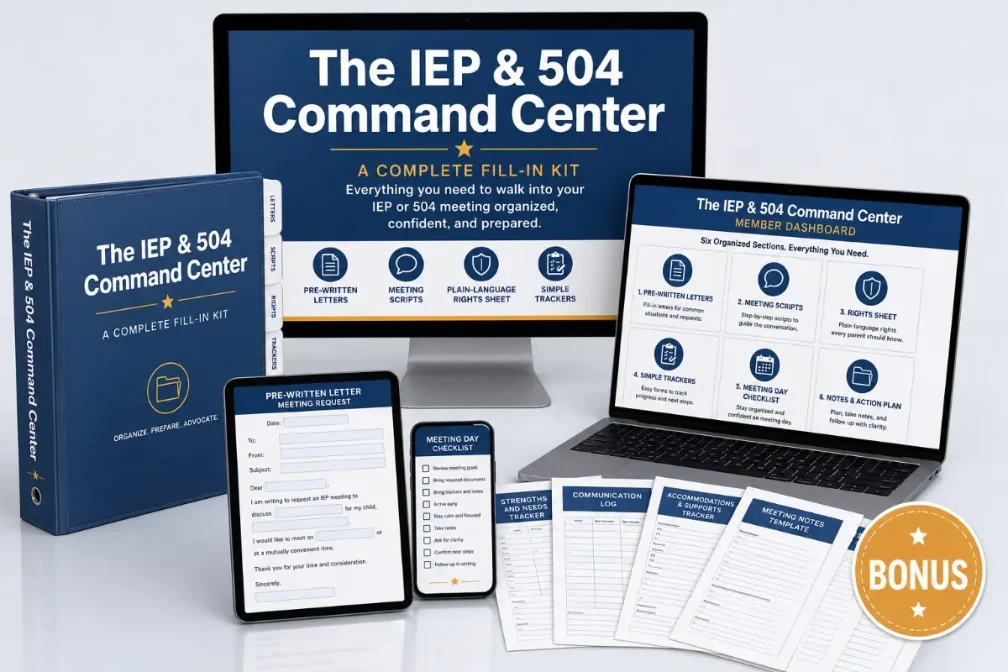
The IEP & 504 Command Center
This page shows the options to discuss. The Command Center hands you the done pieces: the binder built, the letters written, the meeting scripts ready and a self-review that shows where your child's plan is strong or thin. The library stays free.