IEP Evaluation Deadline Checker by State
Pick your state and this checker returns four things: the initial-evaluation window that state sets, the unit it is counted in, the event that starts the clock and who administers a dispute there.
How to use it
- Pick your state from the list. You will see its evaluation window, its unit and the event that starts the clock.
- Read the badge under your result. "Federal default" means your state uses the unchanged IDEA rule. "State-specific" means your state set its own number, unit or starting event.
- Check any confirm note before you rely on the figure. It names the agency to check the current figure with.
Alabama
60 calendar daysFederal default
Measured from parental consent to evaluate.
Alabama follows the federal 60 calendar day default measured from signed parental consent. The public agency then has 30 more calendar days after the evaluation is complete to determine initial eligibility.
- State complaint. Filed with the state education agency, which investigates and issues a written decision.
- Mediation. Voluntary and free. It never delays or denies your right to a hearing.
- Due process hearing. A formal proceeding before an impartial hearing officer.
Who administers disputes: Alabama State Department of Education.
Read the full Alabama page: timelines, dispute routes and who to contact.
Source: Ala. Admin. Code r. 290-8-9-.02 www.law.cornell.edu/regulations/alabama/Ala-Admi
Alaska
90 calendar daysState-specific
Measured from parental consent to evaluate.
Alaska sets its own timeline in place of the federal 60 calendar day default. One 90 calendar day window runs from the day a district receives signed parental consent. Inside that window the district evaluates the child, determines eligibility, develops the IEP where the child is eligible plus the family consents to services, then begins those services. The same 90 days covers a reevaluation of eligibility. A second state rule keeps the IEP itself due within 30 days of the eligibility decision, so an early eligibility decision does not push the IEP to the end of the window.
- State complaint. Filed with the state education agency, which investigates and issues a written decision.
- Mediation. Voluntary and free. It never delays or denies your right to a hearing.
- Due process hearing. A formal proceeding before an impartial hearing officer.
Who administers disputes: Alaska Department of Education and Early Development for state complaints and for appointing due process hearing officers by random selection from its own list; mediation is provided by a contractor the department names on its special education page, Alaska Special Education Mediation Services as of 2026-08-02.
Read the full Alaska page: timelines, dispute routes and who to contact.
Source: 4 AAC 52.115(a) (Timelines), with the 30 day IEP obligation at 4 AAC 52.115(b) plus AS 14.30.278 www.law.cornell.edu/regulations/alaska/4-AAC-52.
Arizona
60 calendar daysFederal default
Measured from parental consent to evaluate.
Arizona follows the federal 60 calendar day default. Schools must respond to a parent's evaluation request within 15 school days. The 60 day period can be extended by up to 30 more days if the parent and school agree in writing.
- State complaint. Filed with the state education agency, which investigates and issues a written decision.
- Mediation. Voluntary and free. It never delays or denies your right to a hearing.
- Due process hearing. A formal proceeding before an impartial hearing officer.
Who administers disputes: Arizona Department of Education (state complaints and mediation); due process hearings conducted by administrative law judges of the Arizona Office of Administrative Hearings.
Read the full Arizona page: timelines, dispute routes and who to contact.
Source: Ariz. Admin. Code R7-2-401(E)(3) www.law.cornell.edu/regulations/arizona/Ariz-Adm
Arkansas
60 calendar daysFederal default
Measured from parental consent to evaluate.
Arkansas follows the federal 60 day default for completing testing. A separate Evaluation and Programming Conference to determine eligibility must then be held within 30 calendar days of finishing the testing.
- State complaint. Filed with the state education agency, which investigates and issues a written decision.
- Mediation. Voluntary and free. It never delays or denies your right to a hearing.
- Due process hearing. A formal proceeding before an impartial hearing officer.
Who administers disputes: Arkansas Division of Elementary and Secondary Education, Office of Special Education (Dispute Resolution Section), which keeps state complaints plus the due process hearing system with hearing officers it contracts and assigns in rotation, while mediation and IEP facilitation are run for it by the Arkansas Special Education Mediation Project at the University of Arkansas at Little Rock William H. Bowen School of Law.
Read the full Arkansas page: timelines, dispute routes and who to contact.
Source: 6 CAR 130-603(a)(1) (Procedural Requirements and Program Standards, Subpart 6), with the 30 day Evaluation/Programming Conference at 6 CAR 130-606(a)(1) and both restated together at 6 CAR 130-804(b) dese.ade.arkansas.gov/Files/ADE_Spec._Ed._-_Eval
California
60 days (excludes school vacation periods longer than 5 days)State-specific
Measured from parental written consent for assessment.
California develops the IEP itself within 60 days of consent, not just the evaluation. The clock also pauses for school vacation periods longer than five days, so it does not run exactly like the federal calendar day default. If consent comes within the last 30 days of the school year, the IEP is due within 30 days after the next school year starts.
- State complaint. Filed with the state education agency, which investigates and issues a written decision.
- Mediation. Voluntary and free. It never delays or denies your right to a hearing.
- Due process hearing. A formal proceeding before an impartial hearing officer.
Who administers disputes: California Department of Education.
Read the full California page: timelines, dispute routes and who to contact.
Source: Cal. Educ. Code Section 56344 law.justia.com/codes/california/code-edc/title-2
Colorado
60 calendar daysFederal default
Measured from parental consent to evaluate.
Colorado follows the federal 60 calendar day default for completing the initial evaluation, counted from the written parental consent that starts the special education referral. The meeting that decides eligibility is held within a reasonable time after the evaluation is complete rather than on a day count of its own. For a child found eligible, the initial IEP is developed within 90 calendar days of that same consent date.
- State complaint. Filed with the state education agency, which investigates and issues a written decision.
- Mediation. Voluntary and free. It never delays or denies your right to a hearing.
- Due process hearing. A formal proceeding before an impartial hearing officer.
Who administers disputes: Colorado Department of Education (due process hearings are heard by an administrative law judge at the Office of Administrative Courts).
Read the full Colorado page: timelines, dispute routes and who to contact.
Source: 1 CCR 301-8, ECEA Rules 4.02(3)(c) for the 60 calendar days, 4.02(6)(a)(i) for the eligibility meeting and 4.03(1)(d)(i) for the 90 calendar day initial IEP, version effective May 15 2025 www.sos.state.co.us/CCR/GenerateRulePdf.do?ruleV
Connecticut
45 school daysState-specific
Measured from referral to the planning and placement team, excluding time to obtain consent.
Connecticut runs its own timeline rather than the federal 60 calendar day default. It requires the IEP to be implemented within 45 school days of referral, not just the evaluation completed. That window stretches to 60 school days when the placement is out of district or private.
- State complaint. Filed with the state education agency, which investigates and issues a written decision.
- Mediation. Voluntary and free. It never delays or denies your right to a hearing.
- Due process hearing. A formal proceeding before an impartial hearing officer.
Who administers disputes: Connecticut State Department of Education, Bureau of Special Education (state complaints investigated by the bureau, mediation through its Mediation Services Coordinator, due process filings through its Due Process Unit).
Read the full Connecticut page: timelines, dispute routes and who to contact.
Source: Regulations of Connecticut State Agencies Section 10-76d-13 portal.ct.gov/-/media/SDE/Performance/Data-Colle
Delaware
45 school days or 90 calendar days, whichever is lessState-specific
Measured from parental consent to evaluate.
Delaware counts its evaluation window two ways at once: 45 school days or 90 calendar days from receipt of written parental consent, whichever comes first. Forty-five school days is about nine school weeks, so in calendar time the binding leg usually runs past the federal 60 calendar day default, with the 90 calendar day leg acting as the outer cap across long breaks.
- State complaint. Filed with the state education agency, which investigates and issues a written decision.
- Mediation. Voluntary and free. It never delays or denies your right to a hearing.
- Due process hearing. A formal proceeding before an impartial hearing officer.
Who administers disputes: Delaware Department of Education, Exceptional Children Resources (state complaints go to the Director of Exceptional Children Resources; due process complaints go to the Secretary of Education, who appoints a 3 member hearing panel of an attorney, an educator plus a lay member from the Advisory Council for Exceptional Citizens list, with a single hearing officer from the department registry for expedited discipline cases; mediation and IEP facilitation are department funded and delivered by the Special Education Partnership for the Amicable Resolution of Conflict at the University of Delaware Conflict Resolution Program, with mediation requests going to the Director of Exceptional Children Resources).
Read the full Delaware page: timelines, dispute routes and who to contact.
Source: 14 Del. Admin. Code 925, Section 2.3 regulations.delaware.gov/AdminCode/title14/900/9
District of Columbia
60 calendar daysState-specific
Measured from parental consent for the evaluation, with a separate 30 calendar day window running from the referral for the school system to seek that consent.
The District counts the same 60 calendar days as the federal rule, measured from the date a parent gives consent, then asks more of that window: the school system evaluates the child and makes the eligibility decision inside the same 60 days, so the decision sits under the deadline rather than after it. A second count runs before that one. From the day a school system receives a referral it has 30 calendar days to make and document reasonable efforts to obtain consent, with those efforts starting no later than 10 business days after the referral date. Older material still quotes 120 days from referral, which was the rule in District law before July 1, 2018.
- State complaint. Filed with the state education agency, which investigates and issues a written decision.
- Mediation. Voluntary and free. It never delays or denies your right to a hearing.
- Due process hearing. A formal proceeding before an impartial hearing officer.
Who administers disputes: DC Office of the State Superintendent of Education (OSSE), split internally: the Office of Dispute Resolution runs mediation, facilitation and due process hearings with contracted independent hearing officers, while the State Complaint Office in the Office of Special Education within the Division of Systems and Supports, K-12 runs state complaints.
Read the full District of Columbia page: timelines, dispute routes and who to contact.
Source: 5-A DCMR Section 3005.4(a) and (b), with the calendar day definition at Section 3099.1; D.C. Code Section 38-2561.02(a)(2)(A) osse.dc.gov/sites/default/files/dc/sites/osse/se
Florida
60 calendar daysFederal default
Measured from parental consent to evaluate.
Florida follows the federal 60 calendar day default, with school holidays, breaks and summer vacation excluded from the count. The family and district can extend it by up to 30 more calendar days by written agreement.
- State complaint. Filed with the state education agency, which investigates and issues a written decision.
- Mediation. Voluntary and free. It never delays or denies your right to a hearing.
- Due process hearing. A formal proceeding before an impartial hearing officer.
Who administers disputes: Florida Department of Education.
Read the full Florida page: timelines, dispute routes and who to contact.
Source: Fla. Admin. Code R. 6A-6.0331(3)(g) www.flrules.org/gateway/RuleNo.asp?ID=6A-6.0331
Georgia
60 calendar daysFederal default
Measured from parental consent to evaluate.
Georgia follows the federal 60 calendar day default. The due date skips periods of 5 or more consecutive days when school is not in session, including summer break.
- State complaint. Filed with the state education agency, which investigates and issues a written decision.
- Mediation. Voluntary and free. It never delays or denies your right to a hearing.
- Due process hearing. A formal proceeding before an impartial hearing officer.
Who administers disputes: Georgia Department of Education (state complaints and mediation); due process hearings conducted by administrative law judges of the Office of State Administrative Hearings.
Read the full Georgia page: timelines, dispute routes and who to contact.
Source: Ga. Comp. R. & Regs. 160-4-7-.04 apps.gadoe.org/sboe/SBOE%20Rules/160-4-7-.04.pdf
Hawaii
60 calendar daysFederal default
Measured from parental consent to evaluate.
Hawaii, the only statewide school district in the country, follows the federal 60 day default, counted in calendar days. Two shorter state deadlines bracket it: written notice of the department's proposal or refusal to assess within 15 days of an evaluation request, then an IEP meeting within 15 days of a family consenting to the first services.
- State complaint. Filed with the state education agency, which investigates and issues a written decision.
- Mediation. Voluntary and free. It never delays or denies your right to a hearing.
- Due process hearing. A formal proceeding before an impartial hearing officer.
Who administers disputes: Hawaii State Department of Education for state complaints; Office of Dispute Resolution, Department of the Attorney General for due process hearings; Mediation Center of the Pacific for mediation.
Read the full Hawaii page: timelines, dispute routes and who to contact.
Source: Hawaii Administrative Rules section 8-60-33(c)(1) boe.hawaii.gov/wp-content/uploads/2024/07/60-Pro
Idaho
45 school daysState-specific
Measured from written parental consent for the initial assessment or evaluation.
Idaho counts 45 school days from written parental consent to the eligibility decision. That state timeline replaced the older 60 calendar day count on July 1, 2026. School days are days students attend for instruction, so weekends, holidays and summer sit outside the count rather than being carved out of a calendar day clock.
- State complaint. Filed with the state education agency, which investigates and issues a written decision.
- Mediation. Voluntary and free. It never delays or denies your right to a hearing.
- Due process hearing. A formal proceeding before an impartial hearing officer.
Who administers disputes: Idaho Department of Education, Special Education Dispute Resolution office.
Read the full Idaho page: timelines, dispute routes and who to contact.
Source: Idaho Special Education Manual 2025, Chapter 4, Section 3.F (Timeline), incorporated into Idaho rule at IDAPA 08.02.03.004.04 as the manual adopted by the State Board of Education on November 20, 2025, effective July 1, 2026; IDAPA 08.02.03.109, which carried the former 60 calendar day timeline at subsection .03, now reads reserved www.sde.idaho.gov/wp-content/uploads/2026/07/Ida
Illinois
60 school daysState-specific
Measured from parental consent to evaluate.
Illinois measures its 60 day window in school days rather than calendar days, which stretches the real-world window well beyond the federal 60 calendar days. If fewer than 60 school days remain in the year after consent, the eligibility meeting must happen before the next school year starts.
- State complaint. Filed with the state education agency, which investigates and issues a written decision.
- Mediation. Voluntary and free. It never delays or denies your right to a hearing.
- Due process hearing. A formal proceeding before an impartial hearing officer.
Who administers disputes: Illinois State Board of Education.
Read the full Illinois page: timelines, dispute routes and who to contact.
Source: 23 Ill. Admin. Code Section 226.110(d) www.law.cornell.edu/regulations/illinois/Ill-Adm
Indiana
50 instructional daysState-specific
Measured from receipt of written parental consent.
Indiana measures its evaluation window in instructional days rather than the federal 60 calendar days, so the count advances only on days school is in session. Fifty instructional days is about ten school weeks, which in calendar time usually runs longer than the federal 60 days rather than shorter.
- State complaint. Filed with the state education agency, which investigates and issues a written decision.
- Mediation. Voluntary and free. It never delays or denies your right to a hearing.
- Due process hearing. A formal proceeding before an impartial hearing officer.
Who administers disputes: Indiana Department of Education, Office of Special Education (state complaints and mediation); due process hearings conducted by administrative law judges of the Indiana Office of Administrative Law Proceedings for requests filed on or after July 1, 2025.
Read the full Indiana page: timelines, dispute routes and who to contact.
Source: 511 IAC 7-40-5(d) www.law.cornell.edu/regulations/indiana/511-IAC-
Iowa
60 calendar daysFederal default
Measured from parental consent to evaluate.
Iowa follows the federal 60 calendar day default for completing the evaluation and holding the eligibility meeting.
- State complaint. Filed with the state education agency, which investigates and issues a written decision.
- Mediation. Voluntary and free. It never delays or denies your right to a hearing.
- Due process hearing. A formal proceeding before an impartial hearing officer.
Who administers disputes: Iowa Department of Education for state complaints and mediation; due process hearings are held by the department with an impartial administrative law judge employed by the administrative hearings division of the Iowa Department of Inspections, Appeals and Licensing.
Read the full Iowa page: timelines, dispute routes and who to contact.
Source: Iowa Admin. Code r. 281-41.301(3)(a) www.legis.iowa.gov/docs/iac/rule/281.41.301.pdf
Kansas
60 school daysState-specific
Measured from receipt of informed written parental consent.
Kansas measures its 60 day window in school days rather than calendar days, which stretches the real-world window beyond the federal 60 calendar days. The clock runs through data gathering, the eligibility decision and on to when services begin.
- State complaint. Filed with the state education agency, which investigates and issues a written decision.
- Mediation. Voluntary and free. It never delays or denies your right to a hearing.
- Due process hearing. A formal proceeding before an impartial hearing officer.
Who administers disputes: Kansas State Department of Education (formal complaints and mediation); due process hearings conducted by a hearing officer appointed by the school district or cooperative named in the complaint from its own list of no more than three, with the Kansas State Board of Education appointing where the parent strikes every name, then appeals heard by a review officer appointed by the state board.
Read the full Kansas page: timelines, dispute routes and who to contact.
Source: K.A.R. 91-40-8(f), quoted in full in the KSDE Kansas Special Education Process Handbook, Chapter 3 www.ksde.gov/docs/default-source/sets/ph-ch03.pd
Kentucky
60 school daysState-specific
Measured from receipt of parental consent for evaluation.
Kentucky measures its 60 day window in school days rather than calendar days, so the count pauses whenever school is closed and the real-world window stretches well beyond the federal 60 calendar days. That same window covers more than testing. Where a child is found eligible, the Admissions and Release Committee meeting to develop the IEP falls within 30 days of the eligibility decision plus inside the same 60 school day period, with services starting under the IEP.
- State complaint. Filed with the state education agency, which investigates and issues a written decision.
- Mediation. Voluntary and free. It never delays or denies your right to a hearing.
- Due process hearing. A formal proceeding before an impartial hearing officer.
Who administers disputes: Kentucky Department of Education (formal written complaints through its Office of Special Education and Early Learning, Division of IDEA Monitoring and Results; mediators assigned through its Office of Legal Services); due process hearings run under KRS Chapter 13B before hearing officers assigned by the department, with appeals to the department's Exceptional Children Appeals Board.
Read the full Kentucky page: timelines, dispute routes and who to contact.
Source: 707 KAR 1:320, Section 2(3) apps.legislature.ky.gov/law/kar/titles/707/001/3
Louisiana
60 business daysState-specific
Measured from parental consent to evaluate.
Louisiana measures its 60 day window in business days rather than calendar days, which stretches the real-world window beyond the federal 60 calendar days.
- State complaint. Filed with the state education agency, which investigates and issues a written decision.
- Mediation. Voluntary and free. It never delays or denies your right to a hearing.
- Due process hearing. A formal proceeding before an impartial hearing officer.
Who administers disputes: Louisiana Department of Education, Legal Division (state complaints and mediation); Louisiana Division of Administrative Law (due process hearings).
Read the full Louisiana page: timelines, dispute routes and who to contact.
Source: LAC 28:CI.511(A) (Bulletin 1508, Pupil Appraisal Handbook), restated at LAC 28:XLIII.302(C)(1)(a) (Bulletin 1706), business day defined at LAC 28:XLIII.905 www.law.cornell.edu/regulations/louisiana/La-Adm
Maine
45 school daysState-specific
Measured from parental consent to evaluate.
Maine measures its 45 day window in school days rather than calendar days, so the count pauses whenever school is closed and the real-world window normally runs longer than the federal 60 calendar days rather than shorter. Forty five school days works out to about nine weeks with school in session, which lands further out wherever a vacation week or a run of storm days falls inside the count. The 45 school days apply to children 5 to 22 who are the responsibility of the public school system. Children in the Child Development Services System keep a 60 calendar day count. The same window also covers the eligibility decision, so the team determines whether the child qualifies inside it.
- State complaint. Filed with the state education agency, which investigates and issues a written decision.
- Mediation. Voluntary and free. It never delays or denies your right to a hearing.
- Due process hearing. A formal proceeding before an impartial hearing officer.
Who administers disputes: Maine Department of Education, Dispute Resolution Office in the Office of Special Services and Inclusive Education, which runs all three routes; hearings are conducted by the department itself using impartial hearing officers from its own list rather than by a separate tribunal.
Read the full Maine page: timelines, dispute routes and who to contact.
Source: Maine Unified Special Education Regulation (05-071 CMR Chapter 101), Section V.1.A(3)(a)(i) www.maine.gov/doe/sites/maine.gov.doe/files/inli
Maryland
60 days from consent, or 90 days from a written referralState-specific
Measured from parental consent to evaluate, with a second clock from written referral.
Maryland runs the federal 60 day default from consent but adds a second, stricter 90 day clock measured from the original written referral, which catches delays in getting to consent that the federal rule alone would not reach.
- State complaint. Filed with the state education agency, which investigates and issues a written decision.
- Mediation. Voluntary and free. It never delays or denies your right to a hearing.
- Due process hearing. A formal proceeding before an impartial hearing officer.
Who administers disputes: Maryland State Department of Education for State complaints; Office of Administrative Hearings for mediation and due process hearings.
Read the full Maryland page: timelines, dispute routes and who to contact.
Source: COMAR 13A.05.01.06A(1) mdrules.elaws.us/comar/13a.05.01.06
Massachusetts
30 school days for the evaluation, 45 school days to the eligibility Team meetingState-specific
Measured from parental consent to evaluate.
Massachusetts sets one of the shortest windows in the country: the evaluation itself is due within 30 school days of consent. The Team meeting that decides eligibility, placement and the IEP must happen within 45 school days of consent.
- State complaint. Filed with the state education agency, which investigates and issues a written decision.
- Mediation. Voluntary and free. It never delays or denies your right to a hearing.
- Due process hearing. A formal proceeding before an impartial hearing officer.
Who administers disputes: Massachusetts Department of Elementary and Secondary Education; mediation and due process hearings are run by the state's Bureau of Special Education Appeals (BSEA), a separate body from the department.
Read the full Massachusetts page: timelines, dispute routes and who to contact.
Source: 603 CMR 28.04; M.G.L. c. 71B, Section 3 www.doe.mass.edu/lawsregs/603cmr28.html?section=
Michigan
30 school daysState-specific
Measured from parental consent to evaluate.
Michigan shortens the federal default sharply to 30 school days, covering the evaluation and eligibility decision through the district's initial offer of services. A school day excludes snow days, teacher workdays and other non-instructional days.
- State complaint. Filed with the state education agency, which investigates and issues a written decision.
- Mediation. Voluntary and free. It never delays or denies your right to a hearing.
- Due process hearing. A formal proceeding before an impartial hearing officer.
Who administers disputes: Michigan Department of Education.
Read the full Michigan page: timelines, dispute routes and who to contact.
Source: Michigan Administrative Rules for Special Education (MARSE) R 340.1721 and R 340.1721b www.michigan.gov/-/media/Project/Websites/mde/sp
Minnesota
30 school daysState-specific
Measured from parental consent to evaluate.
Minnesota shortens the federal default sharply to 30 school days for the evaluation and the eligibility determination.
- State complaint. Filed with the state education agency, which investigates and issues a written decision.
- Mediation. Voluntary and free. It never delays or denies your right to a hearing.
- Due process hearing. A formal proceeding before an impartial hearing officer.
Who administers disputes: Minnesota Department of Education for state complaints and mediation; due process complaints are filed with the department then forwarded to the Court of Administrative Hearings (renamed from the Office of Administrative Hearings by Laws 2025, chapter 39, article 2, section 17).
Read the full Minnesota page: timelines, dispute routes and who to contact.
Source: Minn. R. 3525.2550, subp. 2 www.revisor.mn.gov/rules/3525.2550/
Mississippi
60 calendar daysFederal default
Measured from parental consent to evaluate.
Mississippi follows the federal 60 calendar day default, counted from the day the district receives signed parental consent. A shorter state clock sits in front of it. Once anyone asks for an evaluation, in writing or in conversation, the multidisciplinary evaluation team meets within 14 calendar days to decide whether to evaluate at all.
- State complaint. Filed with the state education agency, which investigates and issues a written decision.
- Mediation. Voluntary and free. It never delays or denies your right to a hearing.
- Due process hearing. A formal proceeding before an impartial hearing officer.
Who administers disputes: Mississippi Department of Education.
Read the full Mississippi page: timelines, dispute routes and who to contact.
Source: 7 Miss. Code R. Section 34:300.301(b) mdek12.org/sites/default/files/documents/vol-i-c
Missouri
60 calendar daysFederal default
Measured from parental consent to evaluate.
Missouri follows the federal 60 calendar day default and puts the eligibility decision inside that same window. The rule words the start point as parent consent or notice, whichever applies, so in the ordinary case the count begins at consent. The state rule also allows a delay for just cause, such as a summer or holiday break or a student illness, documented in the student's record.
- State complaint. Filed with the state education agency, which investigates and issues a written decision.
- Mediation. Voluntary and free. It never delays or denies your right to a hearing.
- Due process hearing. A formal proceeding before an impartial hearing officer.
Who administers disputes: Missouri Department of Elementary and Secondary Education (child complaints and mediation); due process hearings heard by a commissioner of the Administrative Hearing Commission, a separate tribunal assigned to the Missouri Office of Administration, with complaints filed through the department and forwarded within two business days.
Read the full Missouri page: timelines, dispute routes and who to contact.
Source: Missouri State Plan for Special Education, Regulation III (Identification and Evaluation), Section C (Procedures for Evaluation and Determination of Eligibility), under the heading Evaluation Timelines, incorporated by reference at 5 CSR 20-300.110 dese.mo.gov/media/pdf/regulation-iii-identificat
Montana
60 calendar daysFederal default
Measured from date written parental consent is returned.
Montana follows the federal 60 calendar day default. The state rule on the comprehensive educational evaluation process adopts 34 CFR 300.301 through 300.311 rather than setting a Montana day count, so the federal figure is the one that applies, counted from the date the district receives the signed Evaluation Plan form.
- State complaint. Filed with the state education agency, which investigates and issues a written decision.
- Mediation. Voluntary and free. It never delays or denies your right to a hearing.
- Due process hearing. A formal proceeding before an impartial hearing officer.
Who administers disputes: Montana Office of Public Instruction, through the Office of Public Instruction Legal Division Dispute Resolution Office (ARM 10.16.3660(2)); no separate hearing tribunal, the Superintendent of Public Instruction appoints mediators and impartial hearing officers from state maintained lists after each party ranks three proposed names.
Read the full Montana page: timelines, dispute routes and who to contact.
Source: Mont. Admin. R. 10.16.3321(1), which requires an evaluation to be conducted in accordance with 34 CFR 300.301 through 300.311, read with 34 CFR 300.301(c)(1)(i) www.law.cornell.edu/regulations/montana/Mont-Adm
Nebraska
45 school days, capped by the federal 60 calendar days, whichever is stricterState-specific
Measured from receipt of parental consent.
Nebraska's Rule 51 sets a 45 school day timeline, but the Nebraska Department of Education has clarified in guidance that this state timeline cannot be used to exceed the federal 60 calendar day limit, so a district must actually meet whichever deadline arrives first.
- State complaint. Filed with the state education agency, which investigates and issues a written decision.
- Mediation. Voluntary and free. It never delays or denies your right to a hearing.
- Due process hearing. A formal proceeding before an impartial hearing officer.
Who administers disputes: Nebraska Department of Education, Office of Special Education, for state complaints and for due process hearings, which the department assigns to hearing officers holding exclusive original jurisdiction under Neb. Rev. Stat. 79-1163; mediation is arranged by the Nebraska Office of Dispute Resolution, a judicial branch office established in the office of the State Court Administrator under Neb. Rev. Stat. 25-2904 and housed in the Administrative Office of the Courts and Probation, under 92 NAC 51-009.12A1a, with the department bearing the cost under 009.12E.
Read the full Nebraska page: timelines, dispute routes and who to contact.
Source: 92 NAC 51-009.04 www.education.ne.gov/wp-content/uploads/2023/08/
Nevada
45 school daysState-specific
Measured from parental consent to evaluate.
Nevada sets its own window of 45 school days instead of the federal 60 calendar days. The count is in school days, so weekends, school holidays and breaks sit outside it and 45 school days normally covers more calendar time than 60 calendar days do. On a public agency's request the Superintendent of Public Instruction can add up to 15 more school days.
- State complaint. Filed with the state education agency, which investigates and issues a written decision.
- Mediation. Voluntary and free. It never delays or denies your right to a hearing.
- Due process hearing. A formal proceeding before an impartial hearing officer.
Who administers disputes: Nevada Department of Education.
Read the full Nevada page: timelines, dispute routes and who to contact.
Source: Nev. Admin. Code Section 388.337 www.law.cornell.edu/regulations/nevada/NAC-388-3
New Hampshire
60 calendar daysFederal default
Measured from receipt of parental consent to evaluate.
New Hampshire follows the federal 60 calendar day default. Rule Ed 1107.01(c) requires the initial evaluation process to be completed within 60 days of receiving parental consent to evaluate. Some parent and advocacy guides circulate an older 45 day figure, but the current rule text sets 60 days.
- State complaint. Filed with the state education agency, which investigates and issues a written decision.
- Mediation. Voluntary and free. It never delays or denies your right to a hearing.
- Due process hearing. A formal proceeding before an impartial hearing officer.
Who administers disputes: New Hampshire Department of Education.
Read the full New Hampshire page: timelines, dispute routes and who to contact.
Source: N.H. Code Admin. R. Ed 1107.01(c) gc.nh.gov/rules/state_agencies/ed1100.html
New Jersey
90 calendar daysState-specific
Measured from parental written consent.
New Jersey sets a combined 90 calendar day window that covers the evaluation, the eligibility determination and, if the child qualifies, developing and starting the IEP, longer than the federal 60 days because it bundles more steps into one clock.
- State complaint. Filed with the state education agency, which investigates and issues a written decision.
- Mediation. Voluntary and free. It never delays or denies your right to a hearing.
- Due process hearing. A formal proceeding before an impartial hearing officer.
Who administers disputes: New Jersey Department of Education.
Read the full New Jersey page: timelines, dispute routes and who to contact.
Source: N.J.A.C. 6A:14-3.4(e) www.law.cornell.edu/regulations/new-jersey/N-J-A
New Mexico
60 calendar daysFederal default
Measured from parental consent to evaluate.
New Mexico follows the federal 60 calendar day default, measured by the actual number of calendar days between consent and the evaluation being completed.
- State complaint. Filed with the state education agency, which investigates and issues a written decision.
- Mediation. Voluntary and free. It never delays or denies your right to a hearing.
- Due process hearing. A formal proceeding before an impartial hearing officer.
Who administers disputes: New Mexico Public Education Department, Office of Special Education.
Read the full New Mexico page: timelines, dispute routes and who to contact.
Source: 6.31.2.10(F)(2) NMAC www.srca.nm.gov/parts/title06/06.031.0002.html
New York
60 school daysState-specific
Measured from receipt of signed parental consent.
New York measures its 60 day window in school days rather than calendar days, which stretches the real-world window beyond the federal 60 calendar days. The clock starts on the day the district receives signed consent, not on the day the family sends the initial referral letter.
- State complaint. Filed with the state education agency, which investigates and issues a written decision.
- Mediation. Voluntary and free. It never delays or denies your right to a hearing.
- Due process hearing. A formal proceeding before an impartial hearing officer.
Who administers disputes: New York State Education Department.
Read the full New York page: timelines, dispute routes and who to contact.
Source: 8 NYCRR 200.4 www.law.cornell.edu/regulations/new-york/8-NYCRR
North Carolina
90 calendar daysState-specific
Measured from receipt of a written referral.
North Carolina measures from the written referral rather than from consent and sets one combined 90 calendar day window covering the evaluation, the eligibility decision and, for an eligible child, developing the IEP and placement, longer than the federal 60 days because it starts earlier and bundles more steps into a single clock. The count does not stop for holidays, summer break or school closures.
- State complaint. Filed with the state education agency, which investigates and issues a written decision.
- Mediation. Voluntary and free. It never delays or denies your right to a hearing.
- Due process hearing. A formal proceeding before an impartial hearing officer.
Who administers disputes: North Carolina Department of Public Instruction.
Read the full North Carolina page: timelines, dispute routes and who to contact.
Source: NC Policies Governing Services for Children with Disabilities, Section 1503-2.3 disabilityrightsnc.org/resources/iep-referral-pr
North Dakota
60 calendar daysFederal default
Measured from parental consent to evaluate.
North Dakota keeps the federal 60 calendar day count and writes it into its own rule, then adds two extension grounds the federal regulation does not carry. N.D. Admin. Code 67-23-01-03 gives a district sixty calendar days after obtaining parental consent for the evaluation, unless an extension is necessary because of documented extreme weather that prevented or interfered with the evaluation, or unless either party establishes to the department's satisfaction that access to a qualified evaluator is so limited that the evaluation cannot occur in the initial sixty days. With any extension included, the evaluation period may not exceed ninety calendar days. The department's Guidelines: Evaluation Process counts those sixty days through school breaks and holidays and has a district that misses the timeline document the reasons for the delay.
- State complaint. Filed with the state education agency, which investigates and issues a written decision.
- Mediation. Voluntary and free. It never delays or denies your right to a hearing.
- Due process hearing. A formal proceeding before an impartial hearing officer.
Who administers disputes: North Dakota Department of Public Instruction, Office of Specially Designed Services, for state complaints and for mediation; a due process hearing request goes to the Director of Special Education at the department under N.D. Admin. Code 67-23-05-02(1), though the hearing itself is conducted by an administrative law judge from the North Dakota Office of Administrative Hearings under 67-23-05-02(2), the office created at NDCC 54-57-01 that describes itself as the state's central panel of administrative law judges, with the department paying that office's charges.
Read the full North Dakota page: timelines, dispute routes and who to contact.
Source: N.D. Admin. Code 67-23-01-03 ndlegis.gov/information/acdata/pdf/67-23-01.pdf
Ohio
60 calendar daysFederal default
Measured from parental consent to evaluate.
Ohio follows the federal 60 calendar day default. Before that clock starts, the district has a separate 30 day window to propose an evaluation and obtain consent.
- State complaint. Filed with the state education agency, which investigates and issues a written decision.
- Mediation. Voluntary and free. It never delays or denies your right to a hearing.
- Due process hearing. A formal proceeding before an impartial hearing officer.
Who administers disputes: Ohio Department of Education and Workforce.
Read the full Ohio page: timelines, dispute routes and who to contact.
Source: Ohio Admin. Code 3301-51-06(B)(4)(a) codes.ohio.gov/ohio-administrative-code/rule-330
Oklahoma
45 school daysState-specific
Measured from parental written consent.
Oklahoma sets its own window of 45 school days instead of the federal 60 calendar days, running from consent through the initial eligibility determination. School days are days students attend for instruction, so weekends, holidays and summer break fall outside the count, which stretches the real-world window beyond the federal 60 calendar days and can carry a spring consent into the following school year.
- State complaint. Filed with the state education agency, which investigates and issues a written decision.
- Mediation. Voluntary and free. It never delays or denies your right to a hearing.
- Due process hearing. A formal proceeding before an impartial hearing officer.
Who administers disputes: Oklahoma State Department of Education for state complaints and the state level appeal; the Special Education Resolution Center at Oklahoma State University for mediation, IEP facilitation and the due process hearing system.
Read the full Oklahoma page: timelines, dispute routes and who to contact.
Source: Oklahoma Special Education Policies and Procedures, 2026 edition, the Oklahoma Policies list item 3 with Chapter 5, Section 3, D.1 oklahoma.gov/content/dam/ok/en/osde/documents/se
Oregon
60 school daysState-specific
Measured from written parental consent.
Oregon measures its 60 day window in school days rather than calendar days, which stretches the real-world window beyond the federal 60 calendar days.
- State complaint. Filed with the state education agency, which investigates and issues a written decision.
- Mediation. Voluntary and free. It never delays or denies your right to a hearing.
- Due process hearing. A formal proceeding before an impartial hearing officer.
Who administers disputes: Oregon Department of Education (state complaints and mediation); due process hearings conducted by administrative law judges assigned by the Oregon Office of Administrative Hearings under an interagency agreement with the department.
Read the full Oregon page: timelines, dispute routes and who to contact.
Source: Or. Admin. R. 581-015-2110(5)(a) secure.sos.state.or.us/oard/view.action?ruleNumb
Pennsylvania
60 calendar days (summer break excluded from the count)State-specific
Measured from receipt of written parental consent.
Pennsylvania keeps the federal 60 calendar day number but excludes the entire summer break from the count, from the day after the spring term ends through the day before the fall term begins, which can extend the real-world window well past 60 days for a summer referral.
- State complaint. Filed with the state education agency, which investigates and issues a written decision.
- Mediation. Voluntary and free. It never delays or denies your right to a hearing.
- Due process hearing. A formal proceeding before an impartial hearing officer.
Who administers disputes: Pennsylvania Department of Education; mediation and due process hearings are run by the state's independent Office for Dispute Resolution (ODR), a separate body from the department.
Read the full Pennsylvania page: timelines, dispute routes and who to contact.
Source: 22 Pa. Code Section 14.123(b) www.pacodeandbulletin.gov/Display/pacode?file=/s
Rhode Island
63 calendar daysState-specific
Measured from receipt of written parental consent to evaluate.
Rhode Island left the federal 60 calendar day default on July 1 2026, when a 2024 act set the state figure at 63 calendar days from receipt of written parental consent, covering the evaluation and the eligibility meeting. The state regulation still prints 60 because the matching rule change has not been filed. Before that clock starts, a team meets within 10 school days of a referral to decide whether an evaluation is needed, then the evaluation begins within 10 school days of consent.
Day count corroborated by an official source; the exact rule subsection was not independently confirmed. Confirm the current figure with Rhode Island Department of Education.
- State complaint. Filed with the state education agency, which investigates and issues a written decision.
- Mediation. Voluntary and free. It never delays or denies your right to a hearing.
- Due process hearing. A formal proceeding before an impartial hearing officer.
Who administers disputes: Rhode Island Department of Education.
Read the full Rhode Island page: timelines, dispute routes and who to contact.
Source: R.I. Gen. Laws Section 16-24-1.1(g), with the underlying rule at 200-RICR-20-30-6.7.2(A)(1) webserver.rilegislature.gov/Statutes/TITLE16/16-
South Carolina
60 calendar daysFederal default
Measured from the district's receipt of written parental consent to evaluate.
South Carolina follows the federal 60 calendar day default, counted from the day the district receives written parental consent. State Board of Education Regulation 43-243 adopts the federal Part 300 rules in full and sets no separate state deadline. The state's published policies under IDEA add a step past the evaluation. An evaluation counts as concluded once the team verifies it has gathered everything needed to decide eligibility, then the eligibility decision follows within 15 days of that conclusion.
- State complaint. Filed with the state education agency, which investigates and issues a written decision.
- Mediation. Voluntary and free. It never delays or denies your right to a hearing.
- Due process hearing. A formal proceeding before an impartial hearing officer.
Who administers disputes: South Carolina Department of Education, Office of Special Education Services (state complaints and mediation); due process filings go to the department's Office of General Counsel, with first tier hearings held at the local district before a hearing officer the district appoints from the pool the department trains and the appeal decided by a state level administrative review officer the department appoints.
Read the full South Carolina page: timelines, dispute routes and who to contact.
Source: S.C. Code Regs. 43-243 sections I and II, which adopt 34 CFR Part 300 in full, read with 34 CFR 300.301(c)(1)(i) www.scstatehouse.gov/coderegs/Chapter%2043.pdf
South Dakota
25 school days for the evaluation, plus 30 calendar days to determine eligibilityState-specific
Measured from parental consent to evaluate.
South Dakota runs a two-part clock instead of the federal 60 calendar days. A district completes the initial evaluation within 25 school days of receiving signed parent consent to evaluate, then has 30 more calendar days from the end of that window to write the evaluation reports, determine eligibility and hold the IEP team meeting. Parents and school administration can agree in writing to a different evaluation window, in which case the 30 day count runs from the end of the window they agreed on. South Dakota's rules define a day as a calendar day unless a rule says business day or school day, so the second half of the clock includes weekends and breaks while the first half does not.
- State complaint. Filed with the state education agency, which investigates and issues a written decision.
- Mediation. Voluntary and free. It never delays or denies your right to a hearing.
- Due process hearing. A formal proceeding before an impartial hearing officer.
Who administers disputes: South Dakota Department of Education.
Read the full South Dakota page: timelines, dispute routes and who to contact.
Source: S.D. Admin. R. 24:05:25:03 sdlegislature.gov/Rules/Administrative/24:05:25:
Tennessee
60 calendar daysFederal default
Measured from receipt of parental consent for the initial evaluation.
Tennessee follows the federal 60 calendar day default. If the student is found eligible, the IEP team must finalize the IEP within 30 more calendar days.
- State complaint. Filed with the state education agency, which investigates and issues a written decision.
- Mediation. Voluntary and free. It never delays or denies your right to a hearing.
- Due process hearing. A formal proceeding before an impartial hearing officer.
Who administers disputes: Tennessee Department of Education.
Read the full Tennessee page: timelines, dispute routes and who to contact.
Source: Tenn. State Board of Education Rule 0520-01-09-.05(1)(f) www.tn.gov/content/dam/tn/education/legal/Timeli
Texas
45 school daysState-specific
Measured from receipt of parental written consent.
Texas measures its evaluation window in school days rather than the federal 60 calendar days, so weekends, holidays and school closures sit outside the count and 45 school days often covers more of the calendar than the federal 60 days do. If a student is absent 3 or more school days during the evaluation window, the deadline extends by that many days.
- State complaint. Filed with the state education agency, which investigates and issues a written decision.
- Mediation. Voluntary and free. It never delays or denies your right to a hearing.
- Due process hearing. A formal proceeding before an impartial hearing officer.
Who administers disputes: Texas Education Agency.
Read the full Texas page: timelines, dispute routes and who to contact.
Source: 19 Tex. Admin. Code Section 89.1011(d) spedsupport.tea.texas.gov/sites/default/files/20
Utah
45 school daysState-specific
Measured from parental consent to evaluate.
Utah measures its 45 day window in school days rather than the federal 60 calendar days, covering the evaluation and the eligibility determination. A school day counts only when students are in attendance for instructional purposes, so consent signed close to a long break lands the completion date further out on the calendar than 45 days would suggest.
- State complaint. Filed with the state education agency, which investigates and issues a written decision.
- Mediation. Voluntary and free. It never delays or denies your right to a hearing.
- Due process hearing. A formal proceeding before an impartial hearing officer.
Who administers disputes: Utah State Board of Education.
Read the full Utah page: timelines, dispute routes and who to contact.
Source: Utah State Board of Education Special Education Rules, Rule II.D www.schools.utah.gov/specialeducation/_specialed
Vermont
60 daysFederal default
Measured from parental consent to evaluate.
Vermont follows the federal 60 day default for completing the evaluation and issuing the report. A district has a separate 15 calendar days after a referral to respond with a consent request, a planning meeting or a written denial.
- State complaint. Filed with the state education agency, which investigates and issues a written decision.
- Mediation. Voluntary and free. It never delays or denies your right to a hearing.
- Due process hearing. A formal proceeding before an impartial hearing officer.
Who administers disputes: Vermont Agency of Education (administrative complaints decided by the Secretary of Education; mediation through the Agency's Special Education Mediation Service).
Read the full Vermont page: timelines, dispute routes and who to contact.
Source: Vermont Special Education Rules Section 2362.2.1 education.vermont.gov/sites/aoe/files/edu-vermon
Virginia
65 business daysState-specific
Measured from receipt of the referral.
Virginia measures from the referral rather than from consent, sets 65 business days rather than 60 calendar days and covers the whole path to the eligibility decision in one window, so it deviates on the start point, the unit and the length all at once.
- State complaint. Filed with the state education agency, which investigates and issues a written decision.
- Mediation. Voluntary and free. It never delays or denies your right to a hearing.
- Due process hearing. A formal proceeding before an impartial hearing officer.
Who administers disputes: Virginia Department of Education.
Read the full Virginia page: timelines, dispute routes and who to contact.
Source: 8 VAC 20-81-60 law.lis.virginia.gov/admincode/title8/agency20/c
Washington
35 school daysState-specific
Measured from receipt of written parental consent.
Washington measures its evaluation window in school days rather than the federal 60 calendar days. A district completes an initial evaluation within 35 school days of receiving written parental consent. Since June 11, 2026 a second deadline sits behind that one: the district gives the family a copy of the evaluation report by the 35th school day, then holds the eligibility determination meeting no sooner than five school days later and no later than the 40th school day after consent. A separate 25 school day period runs before all of it, from the day the district receives a request for an initial evaluation to the day it decides whether to evaluate at all.
A 2026 OSPI guidance document referencing ESHB 2557 suggests this timeline may have been touched by recent legislation. Confirm the current figure with Washington Office of Superintendent of Public Instruction (OSPI) before relying on it.
- State complaint. Filed with the state education agency, which investigates and issues a written decision.
- Mediation. Voluntary and free. It never delays or denies your right to a hearing.
- Due process hearing. A formal proceeding before an impartial hearing officer.
Who administers disputes: Washington Office of Superintendent of Public Instruction (OSPI); due process hearings conducted for OSPI by administrative law judges of the Office of Administrative Hearings.
Read the full Washington page: timelines, dispute routes and who to contact.
Source: WAC 392-172A-03005(2)(c) and (3)(a); RCW 28A.155.265(1), added by 2026 c 34 s 2 (ESHB 2557) app.leg.wa.gov/wac/default.aspx?cite=392-172A-03
West Virginia
80 calendar daysState-specific
Measured from parental consent to evaluate.
West Virginia sets a longer combined window of 80 calendar days from consent, covering the evaluation through the eligibility decision, longer than the federal 60 days.
- State complaint. Filed with the state education agency, which investigates and issues a written decision.
- Mediation. Voluntary and free. It never delays or denies your right to a hearing.
- Due process hearing. A formal proceeding before an impartial hearing officer.
Who administers disputes: West Virginia Department of Education.
Read the full West Virginia page: timelines, dispute routes and who to contact.
Source: West Virginia Policy 2419 (126CSR16), Chapter 3, Section 2.A (Initial Evaluation) apps.sos.wv.gov/adlaw/csr/ruleview.aspx?document
Wisconsin
60 calendar daysFederal default
Measured from parental consent to evaluate.
Wisconsin follows the federal 60 calendar day default for determining eligibility after consent.
- State complaint. Filed with the state education agency, which investigates and issues a written decision.
- Mediation. Voluntary and free. It never delays or denies your right to a hearing.
- Due process hearing. A formal proceeding before an impartial hearing officer.
Who administers disputes: Wisconsin Department of Public Instruction (state complaints and mediation); due process hearings conducted by administrative law judges of the Division of Hearings and Appeals under contract with the department.
Read the full Wisconsin page: timelines, dispute routes and who to contact.
Source: Wis. Stat. Section 115.78(3)(a) docs.legis.wisconsin.gov/statutes/statutes/115/v
Wyoming
60 calendar daysFederal default
Measured from parental consent to evaluate.
Wyoming follows the federal 60 calendar day default for the initial comprehensive evaluation.
- State complaint. Filed with the state education agency, which investigates and issues a written decision.
- Mediation. Voluntary and free. It never delays or denies your right to a hearing.
- Due process hearing. A formal proceeding before an impartial hearing officer.
Who administers disputes: Wyoming Department of Education.
Read the full Wyoming page: timelines, dispute routes and who to contact.
Source: Wyoming Chapter 7 Rules, Section 7-4 edu.wyoming.gov/wp-content/uploads/2025/02/WY-Ch
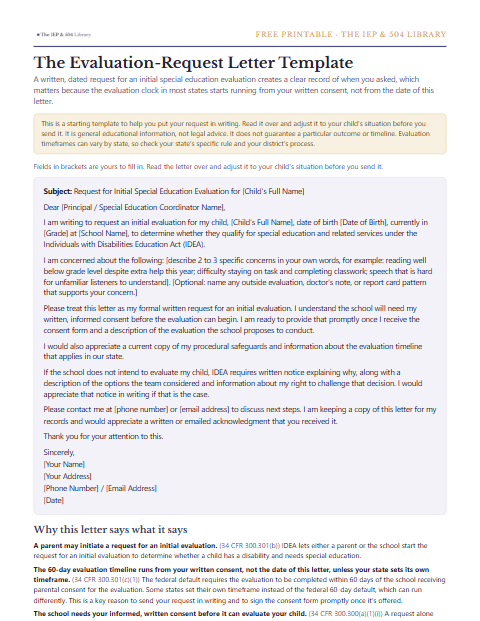
Get the free Evaluation-Request Letter Template (PDF)
A ready-to-adapt letter to request an evaluation in writing, with the dates that matter and the language to use. Checking a deadline usually means an evaluation request is next. We can email you the free letter that starts the clock, plus your state result.
Instant download, plus a note if the guidance on this topic changes. Unsubscribe anytime.
What this checker tells you
Pick your state and this checker returns four things: the initial-evaluation window that state sets, the unit it is counted in, the event that starts the clock and who administers a dispute there. Those four together are what tells you whether an evaluation is running on time, because a number on its own means nothing until you know what it counts and when it starts. Your state's own rule or code sits at the bottom of the result, with a link to the official text.
The short version of the federal rule: IDEA sets a default of 60 calendar days for an initial evaluation, measured from parental consent to evaluate (34 CFR 300.301(c)(1)), which a state may replace with its own timeframe. For the full explanation of where that default comes from, what a state is allowed to change about it and how the fifty-one jurisdictions group up, read IEP evaluation timelines by state, which carries the whole comparison in one table.
Who handles a dispute in your state
Your result above names the three IDEA dispute-resolution routes and the body that administers them where you live, which is the part that varies. Pennsylvania and Massachusetts run mediation and due process through a separately named office rather than the education department, so the agency line in your result is worth reading rather than assuming. What each of the three routes actually involves, with the federal citation for each, is set out on the timelines page.