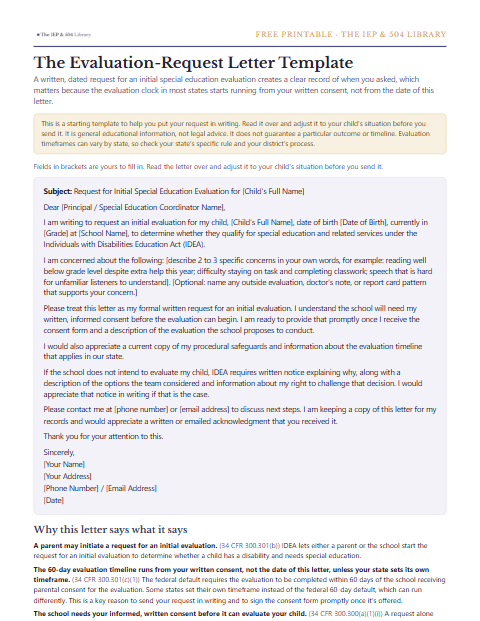
Hawaii IEP Evaluation Timeline, Dispute Routes and Parent Resources (2026)
- Evaluation window
- 60 calendar days
- The clock starts at
- Parental consent
- State complaint deadline
- Within one year
- Due process deadline
- Two years
How long does a school in Hawaii have to complete an IEP evaluation?
A school in Hawaii has 60 days from the day it receives written parental consent to finish an initial special education evaluation, the same count as the federal rule. Chapter 60 reads those as calendar days, since it defines a day as a calendar day unless a rule says otherwise. Two shorter Hawaii clocks sit on either side of that window: written notice of the department's proposal or refusal to assess within 15 days of an evaluation request, then an IEP meeting within 15 days of a family consenting to the first services. Hawaii is a single statewide district, so the same department runs the school and investigates a written complaint about it, under rules the state Board of Education adopts. The formal hearing route sits elsewhere, with hearings officers at the Office of Dispute Resolution in the Hawaii Department of the Attorney General.

The evaluation timeline in Hawaii
| Initial evaluation window | 60 calendar days |
|---|---|
| The clock starts at | parental consent to evaluate |
| Against the federal rule | The federal default, unchanged |
IDEA sets a default of 60 calendar days from parental consent for an initial evaluation (34 CFR 300.301(c)(1)). Hawaii keeps that default rather than setting a timeframe of its own.
Hawaii keeps the federal 60 day evaluation clock. Its rules count that in calendar days, because Chapter 60 defines a day as a calendar day unless a rule says otherwise. Hawaii then adds two shorter deadlines of its own around that clock. A family who requests an evaluation receives written notice of the department's proposal or refusal to assess within 15 days of the request. Once a family consents to the first special education services, the meeting to develop the IEP happens within 15 days of that consent.
Source: Hawaii Administrative Rules section 8-60-33(c)(1), read with the definition of day at section 8-60-2, the 15 day referral notice at section 8-60-10(d)(2) and the 15 day initial IEP meeting at section 8-60-47(c)(1) boe.hawaii.gov/wp-content/uploads/2024/07/60-Provision-of-a-Free-Appropriate-Public-Education-for-a-Student-with-a-Disability.pdf
The same window sits beside all fifty-one jurisdictions on the evaluation timelines by state table, which explains where the federal deadline comes from. To pull one state's window on its own, the evaluation deadline checker returns that single result.
Reevaluation and IEP review cadence in Hawaii
Hawaii does not set its own cadence here, so the federal defaults are what apply. A reevaluation happens at least once every three years unless the parent and the school agree one is not needed. It happens no more often than once a year unless they agree otherwise (34 CFR 300.303(b)). The IEP team reviews the IEP at least once a year to check progress against the annual goals (34 CFR 300.324(b)(1)).
If you disagree in Hawaii
IDEA gives families in every state the same three routes when a disagreement with the school does not resolve at the team table. What changes at the state line is who administers each route, how long you have to file and the local detail below.
The state complaint
Handled by Hawaii State Department of Education, Complaints Management Program, Monitoring and Compliance Branch. Time limit to file: Within one year of the alleged violation.
A signed written complaint goes to the Complaints Management Program in the Monitoring and Compliance Branch, by mail to P.O. Box 2360, Honolulu, HI 96804 or by email. Hawaii runs a single statewide district, so the complaint names the department itself or a public charter school rather than a separate local district. The program looks at whether the department or a public school met Part B of IDEA and Chapter 60, then issues a written decision with findings of fact within 60 calendar days. The department's own cover letter says that investigation report goes to the person who filed it, the school and the complex area. The rules allow an extension only where exceptional circumstances exist for that particular complaint or where both sides agree to more time for mediation or another form of alternative dispute resolution. An anonymous complaint gets investigated without a written decision at the end. The program states that it does not investigate allegations about Section 504, bullying, harassment, retaliation, abuse or neglect, civil rights or school policy.
Source: Hawaii State Department of Education, Special Education State Written Complaint Cover Letter, which carries the one year filing window, the 60 calendar day investigation report, the anonymous complaint practice and the excluded subject matter; Hawaii Administrative Rules sections 8-60-52 through 8-60-54 for the underlying rule, with the one year window at section 8-60-54(c), the 60 day written decision with findings of fact at section 8-60-53(a)(5) and the extension grounds at section 8-60-53(b)(1) hawaiipublicschools.org/DOE%20Forms/Special%20Education/WrittenComplaintCoverLetter.pdf
Mediation
Hawaii makes special education mediation available through the Mediation Center of the Pacific, a nonprofit community dispute resolution center in Honolulu that has run since 1979. Either the family or the school can ask for it when a disagreement comes up, in place of a resolution meeting after a due process complaint or alongside a state written complaint. Families can contact the center directly by phone or email or send the department's request form. Both sides have to agree to take part. The state carries the cost of the mediation process including the meetings, so there is no charge to the family or the school. A qualified impartial mediator guides the session, in person or by video, at a time and place that suits both sides. Any agreement gets written down and signed by the family plus someone with authority to bind the department. It is enforceable in a state court or a federal district court. What people say during mediation stays confidential and cannot be used as evidence in a later hearing or civil proceeding.
Source: Hawaii State Department of Education, Special Education Mediation brochure, which names the Mediation Center of the Pacific, the no cost sessions, the request routes and the in person or video session; Hawaii Administrative Rules section 8-60-60, with voluntary participation at section 8-60-60(b)(1), the qualified impartial mediator at section 8-60-60(b)(3), the state paying the cost at section 8-60-60(b)(4), the timely scheduling in a location convenient to both parties at section 8-60-60(b)(5), the signed binding agreement at section 8-60-60(b)(6), enforceability at section 8-60-60(b)(7) and confidentiality at section 8-60-60(b)(8); Hawaii State Department of Education, Special Education Impartial Due Process Hearing Cover Letter for mediation in place of the resolution meeting hawaiipublicschools.org/DOE%20Forms/Special%20Education/Mediation.pdf
A due process hearing
Time limit to file: Two years from when the parent or the department knew or should have known about the alleged action, with a separate 180 calendar day window for a private placement reimbursement request.
A request for an impartial due process hearing goes to three places at once: the complex area superintendent for the child's complex, the Complaints Management Program in the Monitoring and Compliance Branch and the Office of Dispute Resolution. That last office sits in the Hawaii Department of the Attorney General rather than the education department. The Attorney General's own annual report to the legislature, filed December 22, 2025, describes the office as adjudicating IDEA and Section 504 administrative proceedings, with two administrative hearings officers who took 43 hearing requests in fiscal year 2024 to 2025. It assigns the hearings officer, who opens with a prehearing conference that pins down the exact issues to be heard. The two year lookback drops away where the department misrepresented that it had resolved the problem or withheld information IDEA required it to give the family. Hawaii's statute adds a separate window for one situation: a family who places a child in a private school or facility and then asks for the cost back has 180 calendar days from the child's first day of attendance to request a hearing. After a decision, either side has 30 calendar days from the date of the decision to bring a civil action in a state court or a federal district court, where the federal regulation's default is 90 days for a state that sets no window of its own. Hawaii publishes redacted hearings officer decisions by school year.
Source: Hawaii State Department of Education, Special Education Impartial Due Process Hearing Cover Letter, which carries the three filing addresses, the Office of Dispute Resolution assigning the hearings officer, the two year lookback with its two exceptions and the 30 day appeal; Hawaii Revised Statutes section 302A-443(a)(1) for the two year limit and section 302A-443(a)(2) for the 180 calendar day placement reimbursement limit; Hawaii Administrative Rules section 8-60-61(a)(2) for the placement clock starting on the first day of attendance, section 8-60-65(e) for the prehearing conference, section 8-60-65(f) and (g) for the two year timeline and its exceptions and section 8-60-70(b) for the 30 day civil action window; Hawaii Department of the Attorney General, Goals and Objectives annual report of December 22, 2025, for the Office of Dispute Resolution sitting in that department with its two hearings officers hawaiipublicschools.org/DOE%20Forms/Special%20Education/RequestImpartialDueProcessHearing-CoverLetter.pdf
From the team behind this library
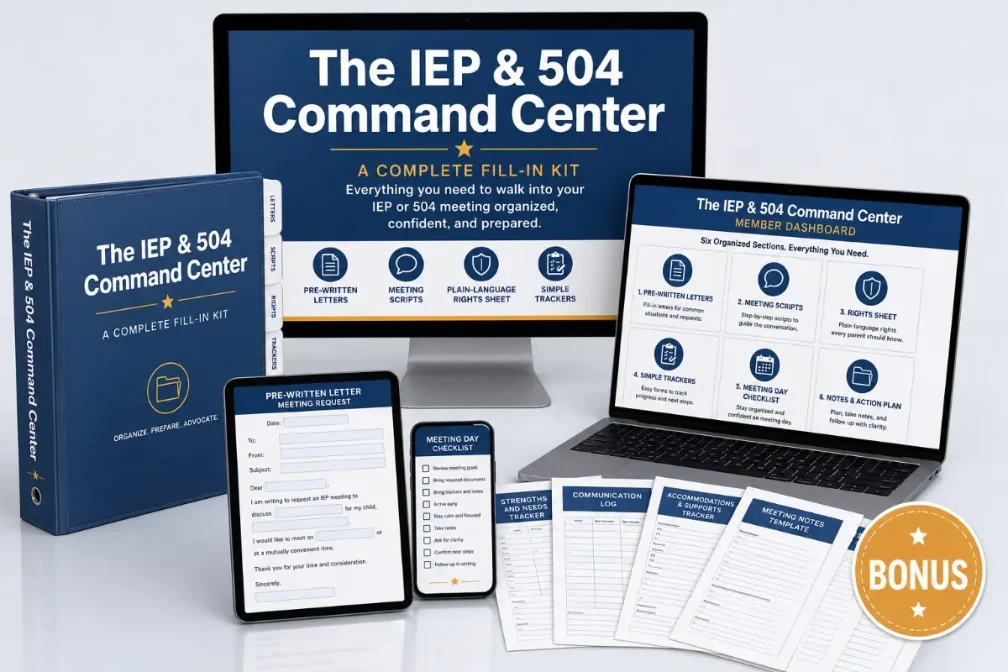
The IEP & 504 Command Center
This page shows you the deadlines and the contacts for your state. The Command Center hands you the done pieces: the binder built, the letters written, the meeting scripts ready and a self-review that shows where your child's IEP is strong or thin before you walk in. The library stays free.
Who to contact in Hawaii

- The state special education office. Hawaii State Department of Education, Exceptional Support Branch, Office of Student Support Services. This is the office that answers questions about Hawaii rules and receives a state complaint.
- Your rights in writing. Procedural Safeguards Notice for Parents and Students Under the Individuals with Disabilities Education Act and Hawaii Law and Regulations (May 2022). Every district hands parents this notice at least once a year (34 CFR 300.504). It is the plain summary of what you can ask for at each step.
- Parent training and information center. Leadership in Disabilities and Achievement of Hawaii. A parent center is free and federally funded under IDEA. Staff there talk families through the process in their own state at no cost.
- The state rules themselves. Hawaii Administrative Rules, Title 8, Chapter 60, Provision of a Free Appropriate Public Education for a Student with a Disability, adopted by the Hawaii State Board of Education under Hawaii Revised Statutes section 302A-1112, with the age range at section 8-60-3(a); Hawaii State Legislature, HB1894 (2026) and its conference draft text, for Act 243, read with Hawaii Revised Statutes section 302A-442.5 for the eligible student definition the act adopts. Chapter 60 is the rule chapter Hawaii's public schools run special education by. It reaches students with disabilities aged three to twenty who live in the state, covering child find and referral, evaluation and eligibility, IEPs, placement, services for children whose parents enrolled them in private schools, discipline, state complaints, mediation and due process hearings. One 2026 change sits alongside it. Act 243, signed July 13, 2026 with an effective date of July 1, 2026, added a braille services part to Hawaii Revised Statutes chapter 302A. The act applies to a student it calls an eligible low vision or blind student, a term it defines by pointing at Hawaii Revised Statutes section 302A-442.5: a student eligible for services under IDEA who is also approved as an eligible person under the federal Copyright Act and who attends a department school, a chapter 302C private school, a public charter school or an approved alternative education program. For that student the act places on the department the duty to make sure the IEP or Section 504 plan offers the chance to receive braille educational services. It also requires braille instruction and braille instructional materials under an IEP unless the team documents from reading and writing media assessments that they are not appropriate.
Child Find in Hawaii
One department carries child find for the whole state, so no separate local district office runs it. Chapter 60 puts the duty to identify, locate and evaluate on the department for every child with a disability living in Hawaii, including children experiencing homelessness, children who are wards of the state, highly mobile children such as children in migrant families, children who are advancing from grade to grade and children whose parents enrolled them in a private school. Hawaii adds a deadline the federal rules leave open. Within 15 days of a request for an evaluation, the family receives prior written notice of the department's proposal to assess along with the consent form and the safeguards notice, or prior written notice that the department is declining to assess. The safeguards notice comes with a refusal too. The department's own Chapter 60 guidance counts those 15 calendar days from the day the department receives the request rather than the day the child's home school sees it. The same guidance says a request can reach the home school in person, by phone, in a letter, by fax, by email or on the state Request for Evaluation form. For a child under three, it routes community agencies and preschools to the Department of Health early intervention program it names H-KISS.
Source: Hawaii Administrative Rules Chapter 60 Guidelines, which reprint sections 8-60-10 and 8-60-21 beside the department's own clarification that the 15 day referral clock at section 8-60-10(d)(2) starts when the department receives the request rather than when the home school does www.hawaiipublicschools.org/DOE%20Forms/Special%20Education/Ch60Guidelines.pdf