The Dispute-Resolution Map: State Complaint, Mediation and Due Process
IDEA gives families and schools three formal ways to resolve a disagreement about a child's evaluation, placement or services: a state complaint investigated by the state education agency, voluntary mediation with a neutral mediator and a due process complaint that can lead to a hearing before an impartial hearing officer. Each one runs on its own timeline, its own cost structure and its own kind of outcome, from a written state finding to a signed mediation agreement to a binding hearing decision. The three are not mutually exclusive. Which agency actually runs each route in your state is listed on our state-by-state table.
The three routes and what each is for
IDEA names three ways to formally challenge a school decision about your child: a state complaint for a written agency investigation, mediation for a facilitated conversation toward a signed agreement and a due process complaint for a formal hearing decision.
A state complaint is the least formal of the three. Any individual or organization, not only a parent, can file one with the state education agency, alleging that a school violated a requirement of IDEA Part B. The agency then investigates and issues a written decision (34 CFR 300.151 through 300.153).
Mediation sits in the middle. It is a voluntary sit-down with a neutral, trained mediator who helps the family and the school try to reach their own agreement, available for a dispute at any stage, even before a due process complaint is filed (34 CFR 300.506).
A due process complaint is the most formal route and the only one of the three that can produce a binding, appealable legal decision from an impartial hearing officer. It is limited to disputes over a child's identification, evaluation, educational placement or the provision of a free appropriate public education, narrower ground than a state complaint can cover (34 CFR 300.507 through 300.516).
The state complaint
A state complaint asks the state education agency to investigate and rule on whether a school broke a specific IDEA rule, on a 60-day clock, at no filing cost.
The state education agency runs a state complaint from filing to decision. Unlike the other two routes, the complainant does not have to be the child's parent. Any organization or individual, including one from another state, may file a signed written complaint (34 CFR 300.153(a)).
The complaint has to name the rule it says the school broke and the facts behind that claim. When it concerns a specific child, it also needs the child's name, school and a description of the problem, with a proposed resolution if one is known. It can only allege something that happened within the year before the state receives it (34 CFR 300.153(b) and (c)).
The state agency has 60 calendar days from the filing date to investigate, let both sides respond, review the evidence and issue a written decision addressing every allegation. That clock only extends for exceptional circumstances tied to the specific complaint, or when the parent and the school agree to extend it to pursue mediation or another dispute-resolution process the state offers (34 CFR 300.152(a) and (b)).
Filing costs nothing beyond your own time. The regulation sets no filing fee. Because a complaint is investigated on the papers by the state agency rather than argued at a hearing, it typically does not carry a mediator's or hearing officer's cost the way the other two routes can.
If the state agency finds a violation, its decision has to address the specific failure with corrective action for the child affected, such as compensatory services or reimbursement. It also has to address whether the same failure could affect other children going forward, so the fix is not limited to one case (34 CFR 300.151(b)).
Mediation
Mediation is a free, voluntary meeting with a neutral mediator that only produces an agreement if both sides actually agree to one. It can never be used to delay or take away your right to a hearing.
A qualified, impartial mediator runs the session, trained in mediation technique and selected from the state's roster on a random, rotational or otherwise impartial basis. A mediator cannot be an employee of the state or school agency involved in your child's education. A mediator also cannot carry any personal or professional interest that conflicts with doing the job fairly (34 CFR 300.506(b) and (c)).
Either side can decline mediation or stop partway through. A school cannot use it to delay or deny your right to a due process hearing (34 CFR 300.506(b)(1)(ii)).
There is no fixed federal deadline for mediation. The regulation only requires sessions to be scheduled in a timely manner and held at a location convenient to both sides, so the pace depends on your state's process and both parties' availability (34 CFR 300.506(b)(5)).
Mediation is free to families. The state has to bear the cost of the process, including the cost of the mediation sessions themselves (34 CFR 300.506(b)(4)).
A successful mediation ends in a written agreement signed by the parent and an agency representative with the authority to bind the agency, legally binding and enforceable in state or federal court. What was said during the mediation itself stays confidential and cannot be used as evidence in any later due process hearing or civil proceeding (34 CFR 300.506(b)(6) through (8)).
Filing a due process complaint and the resolution period
Filing a due process complaint starts a clock: a resolution meeting within the first 15 days, then up to 30 days total to settle before a hearing can happen.
A parent or the public agency can file a due process complaint over the same four kinds of decisions covered by prior written notice: a child's identification, evaluation, educational placement or the provision of a free appropriate public education. It generally has to allege something the filer knew or should have known about within the past two years, unless your state sets its own timeline in that rule's place. Two narrow exceptions can extend that window: when the school specifically misrepresented that it had resolved the problem, or when it withheld information from you that it was required to share (34 CFR 300.507(a), 300.511(e) and (f)).
The complaint has to name the child, describe the problem with the facts behind it and propose a resolution if one is known. It stays confidential between the parties, though a copy has to reach the state education agency. The other side has 15 days to challenge whether it contains everything required. If it does, a hearing officer decides whether the complaint is sufficient within 5 more days (34 CFR 300.508).
States have to publish a model form to help with this, but nobody is required to use it. Any document that covers the same required content works just as well (34 CFR 300.509).
Once a parent's complaint is filed, the school generally has to convene a resolution meeting within 15 days, bringing a representative with real decision-making authority and the IEP team members with firsthand knowledge of the facts. If the disagreement is not settled to the parent's satisfaction within 30 days of the filing, the case can move to a hearing (34 CFR 300.510(a) and (b)).
The 45-day hearing timeline usually starts the day after that 30-day period ends. It can start earlier if both sides put a waiver of the meeting in writing, or if they agree in writing before day 30 that no agreement is possible (34 CFR 300.510(c)).
Because this is the most formal of the three routes, the school has to tell you about free or low-cost legal help in your area, either when you ask or as soon as a complaint is filed (34 CFR 300.507(b)).
The hearing, the decision and what comes after
A due process hearing is run by an impartial hearing officer, follows a formal set of rights for both sides and ends in a written decision that is final unless it is appealed or taken to court.
The hearing is conducted by the state education agency or by whichever public agency state law makes responsible for a child's education. Either way, the hearing officer cannot work for that agency and cannot carry a conflict of interest that compromises objectivity. The officer also has to know IDEA and its regulations well enough to run the hearing and write a decision the way a court would (34 CFR 300.511).
Both sides can bring a lawyer or an expert, present evidence, cross-examine witnesses and compel a witness to attend. Both sides can obtain a full verbatim record of the hearing and the written findings and decision. Parents get both at no cost, in electronic form if they prefer. Evidence and evaluations generally have to be shared with the other side at least five business days before the hearing, or a party risks having that evidence excluded (34 CFR 300.512).
The hearing officer decides the substantive question of whether the child received a free appropriate public education. A procedural mistake by itself only counts against the school if it actually impeded the child's education, seriously limited the parent's part in the decision or cost the child educational benefit (34 CFR 300.513(a)).
The decision is final unless a party appeals it. Whether there is a further state-level appeal depends on who ran the hearing. If a public agency other than the state agency itself ran it, an aggrieved party can appeal to the state agency for an independent review. That review has to be decided within 30 days of the request (34 CFR 300.514 and 300.515(b)).
Once the administrative process ends, either side can bring the dispute to state or federal court. That civil action generally has to be filed within 90 days of the final decision (34 CFR 300.516).
Comparing the three, side by side
Laid side by side, the three routes trade formality for reach: a state complaint is fastest to file and covers the broadest ground, mediation is the only one built around agreement rather than a ruling and a due process hearing is the only one that ends in a legally binding decision on an individual child's FAPE.
Who decides: a state education agency official investigates and rules on a state complaint. A neutral mediator facilitates mediation but never decides anything for you, since only a signed agreement from both sides settles it. An impartial hearing officer rules on a due process complaint, sometimes followed by a state-level reviewer if a different public agency ran the original hearing.
Timeline: a state complaint gets a written decision within 60 days of filing. Mediation has no fixed federal deadline and moves at whatever pace both sides allow. A due process complaint runs a 15-day resolution meeting inside a 30-day settlement window, then typically a 45-day clock to a hearing decision after that, so the administrative process alone can run up to about 75 days from filing to a hearing decision, roughly ten to eleven weeks, before any appeal or court action.
Cost: mediation is free by rule, since the state pays for the mediator and the session. A state complaint has no filing fee and no hearing apparatus to pay for. A due process hearing is the most likely of the three to involve paid legal help, which is exactly why the rule requires the school to point you toward free or low-cost legal resources when a complaint is filed.
Outcome: a state complaint produces a written agency finding with corrective action if a violation is found. Mediation produces a signed agreement only if both sides actually reach one, or nothing binding if they do not. A due process hearing produces a binding decision on the FAPE question, enforceable and appealable, the only one of the three built to resolve a dispute the two sides cannot settle on their own.
Choosing between the routes and using more than one
The three routes are not mutually exclusive. OSEP's own guidance on these procedures encourages families and schools to work out a disagreement together whenever they can.
Nothing stops a family from using more than one route, or using the same route twice for separate issues. A parent can file a new due process complaint on an issue separate from one already filed. Mediation also stays available at any stage, including while a due process complaint is pending (34 CFR 300.506(a), 300.513(c)).
The routes do interact procedurally. If your state complaint raises the same issue as a due process hearing that is already underway, the state agency has to set that part of the complaint aside until the hearing decision comes out. It then has to treat that decision as binding on the same issue (34 CFR 300.152(c)).
OSEP's own guidance on these dispute-resolution procedures encourages parents and schools to work collaboratively, in the best interests of the child, to resolve disagreements, which is generally also the fastest and least adversarial path for everyone involved.
A 504 plan runs a related but separate safeguard system, not these three IDEA routes. It gives a family the right to an impartial hearing under the school's own 504 procedures, plus the separate option of a complaint to the Department of Education's Office for Civil Rights, which enforces Section 504 (34 CFR 104.36). Our guide on requesting a 504 plan and our IEP vs 504 guide both explain which set of rights applies to your child.
Every state runs these three routes through its own agency or agencies. Sometimes that is the state department of education itself. Other times it is a separate board built specifically for special education hearings, such as a dedicated office of dispute resolution. Our state-by-state table lists which agency administers each route where you live, alongside the initial-evaluation timeline for your state.
From the team behind this library
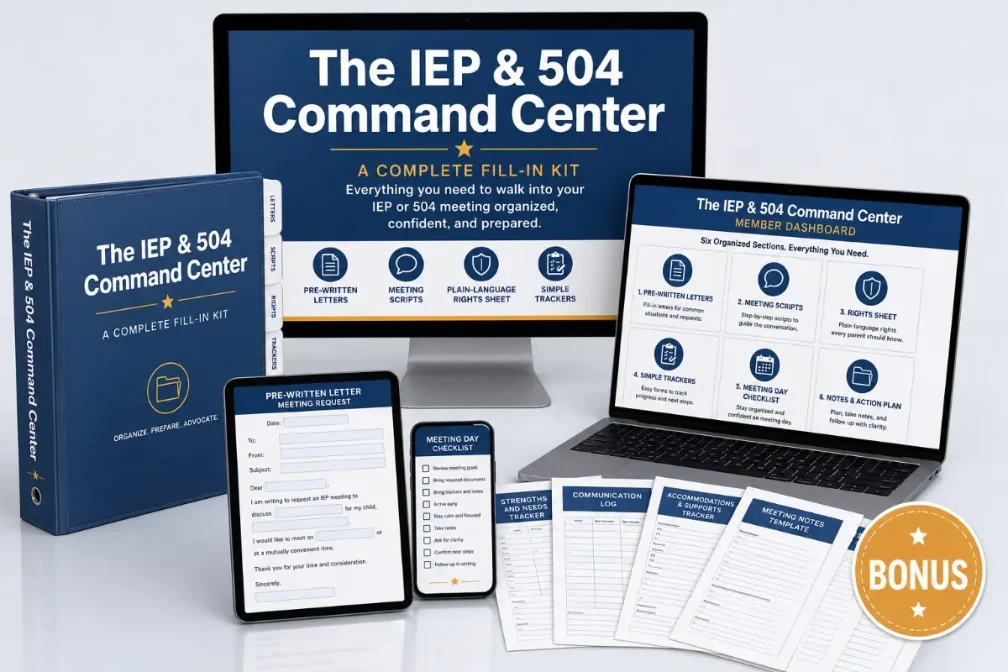
The IEP & 504 Command Center
This page shows the options to discuss. The Command Center hands you the done pieces: the binder built, the letters written, the meeting scripts ready and a self-review that shows where your child's plan is strong or thin. The library stays free.