Do You Need an Advocate or Attorney?
Most families can handle routine IEP and 504 meetings on their own with good preparation, since nothing in IDEA or Section 504 requires you to bring anyone else. A special education advocate is a non-attorney who knows the process well and can prepare with you, review documents and sit beside you at a meeting, typically for $50 to $300 or more an hour or a flat fee per meeting. An attorney can do everything an advocate does, plus file a formal legal complaint, represent you at a due process hearing or in court and pursue legal remedies, typically for $200 to $500 or more an hour. Reach for an attorney once a dispute has hardened into a formal legal proceeding or a real disagreement over money or a specific remedy. Call your state's free Parent Training and Information Center before you pay anyone at all.
What a special education advocate actually does
A special education advocate is a non-attorney who knows the IEP and 504 process well and helps you prepare for it, most often by reviewing records, explaining what a document means and sitting beside you at a meeting as your invited support person.
IDEA gives you the legal seat for this. The IEP Team includes, at the discretion of the parent or the agency, other individuals who have knowledge or special expertise regarding the child (34 CFR 300.321(a)(6)). That is the provision that lets you bring an advocate, a family member, a doctor or anyone else you choose into the room.
In practice, an advocate typically reviews your child's evaluation and IEP or 504 draft before a meeting, helps you understand what a measurable goal or an appropriate accommodation looks like, coaches you on what to ask and attends the meeting itself as a second set of ears. Some advocates also help you draft a letter or organize your paperwork. An advocate is not a lawyer and cannot file a legal complaint, represent you in court or guarantee a legal outcome.
Special education advocacy is not a licensed profession the way law is. There is no federal license and, in most states, no state license or certification required to call yourself a special education advocate, so the field runs on reputation, training and referrals rather than a credential the state issues. A few advocates complete a voluntary training program, such as the one the Council of Parent Attorneys and Advocates (COPAA) offers, but that training is not a legal requirement. Ask any advocate you are considering about their specific experience with your child's disability and with your school district before you hire them.
What an attorney does that an advocate cannot
A special education attorney can do everything an advocate does, plus the things only a licensed lawyer can do: file a formal legal complaint, represent you in a due process hearing or in court and negotiate or litigate a legal remedy like compensatory services or reimbursement for a private placement.
Both an attorney and a non-attorney advocate may accompany and advise you at a due process hearing (34 CFR 300.512(a)(1)). Whether a non-attorney advocate can go further and actually represent you at the hearing, questioning witnesses and arguing your case the way a lawyer would, is a question state law decides. States have not landed in the same place. New Jersey allows non-lawyer representation in due process hearings (N.J.A.C. 1:1-5.4); a 2000 Delaware Supreme Court decision found that IDEA does not create a clear federal right to lay representation, so Delaware's own bar rules controlled instead (In re Arons, 756 A.2d 867 (Del. 2000)). Ask your state's due process office or your hearing officer which rule applies where you live before you count on an advocate to formally represent you.
An attorney can also pursue remedies an advocate cannot, including a formal due process complaint, a lawsuit in federal court and legal claims under Section 504 or the Americans with Disabilities Act. You are not required to hire a lawyer to do any of this yourself. The Supreme Court held in Winkelman v. Parma City School District that IDEA gives parents their own independent, enforceable rights, so a parent can bring an IDEA case, including the core right to a free appropriate public education, on their own behalf without a lawyer (550 U.S. 516 (2007)).
What advocates and attorneys typically cost
Advocates commonly charge somewhere between $50 and $300 or more an hour, or a flat fee per meeting. Attorneys commonly charge $200 to $500 or more an hour with a retainer of $1,500 to $5,000 or more. These are market rates, not government-set fees, so get a specific quote before you commit.
Independent special education advocates most often charge somewhere in the $100 to $300 an hour range: entry-level or rural advocates often closer to $100 to $125 an hour, certified mid-career advocates around $150 to $200 an hour and experienced advocates in major metro areas $250 to $300 an hour or more. Advocates employed by a nonprofit agency often charge less, sometimes as low as $25 to $50 an hour. Many advocates also offer a flat package instead of hourly billing: commonly around $900 to $1,000 for a record review plus preparation and attendance at one meeting, $2,500 or more for fuller case representation, $3,000 to $5,000 or more for a full, complicated case or a monthly retainer of roughly $300 to $500 for ongoing support. These figures come from advocacy-cost pages published and updated in 2024 through 2026 (see Sources) rather than from any government rate schedule, since no government body sets or publishes advocate fees, so treat them as a starting range to confirm with anyone you are considering.
Special education attorneys most often charge somewhere in the $200 to $500 an hour range, sometimes higher for an attorney who specializes in due process hearings. An initial retainer of $1,500 to $5,000 is common. A case that settles early may cost a few thousand dollars. A case that goes through a full due process hearing commonly runs $10,000 or more. A case that goes further, to a federal court appeal, can cost significantly more still. Many attorneys offer a free or low-cost initial consultation. Some work on a partial contingency or a sliding scale based on income, so ask directly rather than assuming.
If you win a due process hearing or a lawsuit, IDEA lets a court award your reasonable attorney's fees from the school district (20 U.S.C. 1415(i)(3); 34 CFR 300.517). Three things about that right matter and are easy to miss. First, it covers attorney's fees only. The Supreme Court held in Arlington Central School District Board of Education v. Murphy that the same law does not let even a prevailing parent recover the cost of an expert or a non-attorney advocate (548 U.S. 291 (2006)). Second, it is not automatic. Fees can be reduced or denied if you unreasonably dragged out the case, if the fee is above the going rate in your community or if you turned down an earlier settlement offer that was at least as good as what you ultimately won. Third, it does not cover an attorney's time at an ordinary IEP Team meeting, only work connected to an administrative proceeding or a court action. Do not plan your budget around getting fully reimbursed.
When the kit-and-preparation path is enough
Most routine IEP and 504 situations (an annual review, a first evaluation, a request for an accommodation, a disagreement that has not hardened into a standoff) are handled well by a prepared parent with no advocate and no attorney at all, since nothing in IDEA or Section 504 requires you to bring anyone else to the table.
You are already a required member of the IEP Team by law (34 CFR 300.321(a)(1)). Your observations count as evidence the team has to consider. A parent who walks in with the evaluation read, the goals understood and a clear written list of questions is often the best-prepared person in the room, advocate or not.
Before you pay anyone, call your state's Parent Training and Information Center. These centers are federally funded. One serves every state and every territory. IDEA requires them to help you understand your child's disability and educational needs, participate in developing the IEP, understand your procedural safeguards and understand mediation and dispute resolution, all at no cost to you (20 U.S.C. 1471-1473). Most families have never heard of this resource. It is the closest thing to a free advocate the law actually funds.
If a disagreement does surface, most of the paths to resolve it are free and do not require an attorney. Under IDEA, mediation is voluntary and the state bears the cost, including the cost of the meetings themselves (34 CFR 300.506). A written state complaint goes directly to your state education agency, with no hearing required. It can lead to a corrective action like compensatory services (34 CFR 300.151). Under Section 504, a parent can file a complaint with the U.S. Department of Education's Office for Civil Rights at no cost, or request the school's own impartial hearing process (34 CFR 104.36). None of these routes requires you to hire anyone.
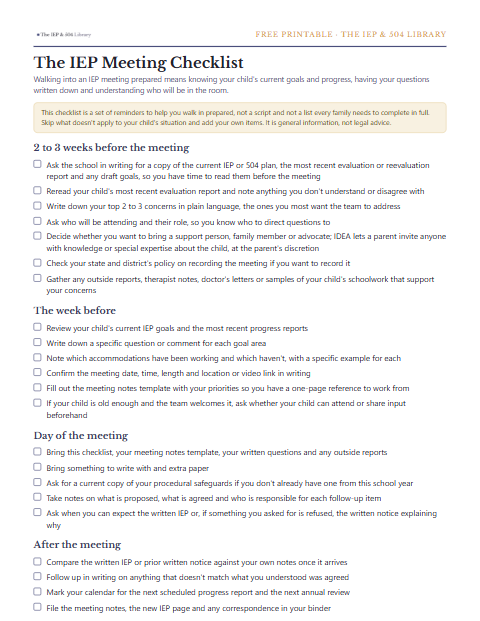
Good preparation covers a lot of the same ground paid advocacy time covers: understanding the evaluation, writing a clear request, tracking goals and walking into the meeting with a plan. Our meeting checklist, evaluation-request letter template and rights cheat sheet are built for exactly that starting point.
When a lawyer is genuinely the right call
Bring in an attorney when the dispute has moved past a disagreement at the team level into a real legal proceeding, when serious money or a significant remedy is on the table or when you suspect discrimination or retaliation, since those are situations an advocate cannot legally handle for you.
A few situations call for a lawyer rather than an advocate specifically. You are filing or responding to a formal due process complaint, since that is a legal proceeding with real deadlines and rules of evidence. The district has brought its own attorney into a resolution meeting, which can only happen if you brought yours too (34 CFR 300.510(a)(1)(ii)), so a district attorney at the table is itself a signal worth noticing. You are seeking a specific legal remedy, like reimbursement for a private placement or compensatory services for a documented denial of a free appropriate public education, rather than a change to the plan going forward. You believe your child faced discrimination, retaliation or a disability-based exclusion, which can raise claims under Section 504 or the Americans with Disabilities Act that reach beyond what an IEP dispute alone covers.
None of this means you must reach a hearing before an attorney is worth a conversation. Many special education attorneys offer a free or low-cost consultation specifically to help you judge whether your situation needs one. A single consultation before things harden into a dispute can be worth the cost even if you never retain the attorney beyond it.
How to decide and find real help
Start free, get specific about what kind of help the situation actually calls for and confirm any advocate's or attorney's direct experience with your child's disability and your district before you pay.
A reasonable order to work through: prepare yourself first using the free printables and your rights, call your state's Parent Training and Information Center, then decide between an advocate and an attorney only if a real sticking point remains. An advocate is usually the right first paid step for a meeting you are dreading or an evaluation you cannot make sense of. An attorney is the right step once the situation has become, or is about to become, a formal legal proceeding.
Whichever you choose, ask direct questions before you pay a dollar. Ask how many cases like your child's they have handled, whether they know your specific school district, what a typical engagement costs from start to finish and, if you are asking an attorney, whether they take special education due process cases regularly rather than occasionally. The Council of Parent Attorneys and Advocates (COPAA) keeps a public directory of both attorneys and advocates by state. Your Parent Training and Information Center can usually point you to well-regarded local names as well.
Needing paid help at some point does not mean you failed at the process. Not needing it does not mean you did not care enough to look. Most IEP and 504 disagreements get resolved at the team level. The goal of this guide is simply to help you tell, honestly, which kind of situation you are in.

From the team behind this library
The IEP & 504 Command Center
This page shows the options to discuss. The Command Center hands you the done pieces: the binder built, the letters written, the meeting scripts ready and a self-review that shows where your child's plan is strong or thin. The library stays free.