The Measurable IEP Goal Practice Builder
Pick an area and grade to see example goals and build a practice scaffold to discuss with your child's team.
How to use it
- Choose your child's area of need and grade band. You will see real example goals from that area, broken into their four parts.
- Pick a starting phrase in each slot, or type your own. Adjust the condition, target skill, criterion and measurement to fit your child.
- Fill in the measurement plan, then copy or print the sheet. Baseline, where the data comes from, how often, who collects it and when it is reported home. A starting point to discuss with your child's team, never a goal to hand the school.
Pick an area and grade to practice
Choose your child's area of need and grade band. You will see real example goals from that area broken into their four parts. From those parts you can assemble a practice scaffold to see how a measurable goal fits together.
Build a practice scaffold. Pick a starting phrase in each slot from real example goals in this area, then adjust the wording. This is a practice scaffold to help you see the shape of a measurable goal, never a goal to hand the school.
The measurement plan
IDEA has the IEP say how progress toward each annual goal will be measured and when periodic reports go home (34 CFR 300.320(a)(3)). These are the fields to check the plan actually names. Your child's team fills them in from the evaluation and the present levels, so treat each one as a question to ask rather than an answer to supply.
Objectives or benchmarks optional
Short-term objectives or benchmarks are the steps between the baseline and the annual goal. IDEA requires them for a child who takes an alternate assessment aligned to alternate academic achievement standards (34 CFR 300.320(a)(2)(ii)). A team can include them for any child. Fill in one or two to see the shape.
Your scaffold and its measurement plan
Everything above on one sheet to copy, print or take to the meeting. It stays a practice scaffold, never a goal to hand the school.
This sheet is a practice scaffold, not an IEP goal and not a goal to hand the school. It is educational information, not legal or educational advice. Your child's team writes the actual goals from the evaluation and the present levels, then decides how progress is measured and when it is reported. Bring this as a starting point for that conversation.
Worked examples, broken into their parts
Showing the area and grade band you picked above. Each example is a real, verified goal split into its condition, target skill, criterion and measurement.
IEP Reading Goals
Each goal below is an example to discuss and adapt with your team, never a target your child must meet. The specific rates and percentages are illustrations of what a measurable goal looks like.
Example · Phonics and decoding · Lower elementary (K-2)
Given a list of grade-level consonant-vowel-consonant (CVC) words, [student] will read them aloud with 90 percent accuracy on 4 of 5 trials by the annual review date, as measured by weekly teacher-recorded decoding probes.
- Condition Given a list of grade-level consonant-vowel-consonant (CVC) words
- Target skill read them aloud
- Criterion with 90 percent accuracy on 4 of 5 trials
- Timeframe by the annual review date
- Measurement Weekly teacher-recorded decoding probes
What to ask your team: Ask what baseline the goal starts from and what type of words the school will use to check it.
Example · Fluency · Lower elementary (K-2)
Given a first-grade decodable passage, [student] will read aloud at 60 words correct per minute with at least 95 percent accuracy on 4 of 5 trials by the annual review date, as measured by curriculum-based fluency probes.
- Condition Given a first-grade decodable passage
- Target skill read aloud
- Criterion at 60 words correct per minute with at least 95 percent accuracy on 4 of 5 trials
- Timeframe by the annual review date
- Measurement Curriculum-based fluency probes
What to ask your team: Ask whether the passage level matches what your child is being taught and how the starting rate was measured.
Example · Comprehension · Lower elementary (K-2)
After reading or listening to a grade-level story, [student] will retell the key details (characters, setting and one main event) with 80 percent accuracy across 4 of 5 sessions by the annual review date, as measured by a teacher-recorded retell checklist.
- Condition After reading or listening to a grade-level story
- Target skill retell the key details (characters, setting and one main event)
- Criterion with 80 percent accuracy across 4 of 5 sessions
- Timeframe by the annual review date
- Measurement Teacher-recorded retell checklist
What to ask your team: Ask whether the goal is measured on text your child reads or on text read to them and why.
Example · Phonics and decoding · Upper elementary (3-5)
Given a list of grade-level multisyllabic words, [student] will decode them aloud using syllable-division patterns with 85 percent accuracy on 4 of 5 trials by the annual review date, as measured by teacher-recorded decoding probes.
- Condition Given a list of grade-level multisyllabic words
- Target skill decode them aloud using syllable-division patterns
- Criterion with 85 percent accuracy on 4 of 5 trials
- Timeframe by the annual review date
- Measurement Teacher-recorded decoding probes
What to ask your team: Ask how the goal moves beyond single-syllable words and what decoding strategy is being taught.
Example · Fluency · Upper elementary (3-5)
Given a third-grade passage, [student] will read aloud at 90 words correct per minute with no more than 5 errors on 4 of 5 trials by the annual review date, as measured by curriculum-based fluency probes.
- Condition Given a third-grade passage
- Target skill read aloud
- Criterion at 90 words correct per minute with no more than 5 errors on 4 of 5 trials
- Timeframe by the annual review date
- Measurement Curriculum-based fluency probes
What to ask your team: Ask whether the passage level matches your child's instructional level and how often the probe is run.
Example · Comprehension · Upper elementary (3-5)
Given a grade-level informational passage, [student] will state the main idea and two supporting details with 80 percent accuracy across 4 of 5 passages by the annual review date, as measured by curriculum-based comprehension probes.
- Condition Given a grade-level informational passage
- Target skill state the main idea and two supporting details
- Criterion with 80 percent accuracy across 4 of 5 passages
- Timeframe by the annual review date
- Measurement Curriculum-based comprehension probes
What to ask your team: Ask what kind of text the goal is measured on and whether it matches what your child reads in class.
Example · Phonics and decoding · Middle school (6-8)
Given grade-level multisyllabic words built from common prefixes, suffixes and roots, [student] will read them aloud and identify the meaning-bearing word parts with 85 percent accuracy on 4 of 5 trials by the annual review date, as measured by teacher-recorded word-analysis probes.
- Condition Given grade-level multisyllabic words built from common prefixes, suffixes and roots
- Target skill read them aloud and identify the meaning-bearing word parts
- Criterion with 85 percent accuracy on 4 of 5 trials
- Timeframe by the annual review date
- Measurement Teacher-recorded word-analysis probes
What to ask your team: Ask whether an older reader who still finds long words hard is getting structured word study as part of the plan.
Example · Fluency · Middle school (6-8)
Given a sixth-grade passage, [student] will read aloud at 130 words correct per minute with at least 95 percent accuracy on 4 of 5 trials by the annual review date, as measured by curriculum-based fluency probes.
- Condition Given a sixth-grade passage
- Target skill read aloud
- Criterion at 130 words correct per minute with at least 95 percent accuracy on 4 of 5 trials
- Timeframe by the annual review date
- Measurement Curriculum-based fluency probes
What to ask your team: Ask whether a fluency goal still fits at this grade or whether the need has shifted toward comprehension.
Example · Comprehension · Middle school (6-8)
Given a grade-level text, [student] will cite two pieces of textual evidence to support a stated inference with 80 percent accuracy across 4 of 5 assignments by the annual review date, as measured by scored short-answer responses.
- Condition Given a grade-level text
- Target skill cite two pieces of textual evidence to support a stated inference
- Criterion with 80 percent accuracy across 4 of 5 assignments
- Timeframe by the annual review date
- Measurement Scored short-answer responses
What to ask your team: Ask how the evidence responses are scored and what counts as a correct answer.
Example · Comprehension · Middle school (6-8)
Given a grade-level passage, [student] will write a summary that states the central idea and three key details, scoring 3 of 4 or higher on a summary rubric on 4 of 5 trials by the annual review date, as measured by scored written summaries.
- Condition Given a grade-level passage
- Target skill write a summary that states the central idea and three key details
- Criterion scoring 3 of 4 or higher on a summary rubric on 4 of 5 trials
- Timeframe by the annual review date
- Measurement Scored written summaries against a shared rubric
What to ask your team: Ask to see the rubric so you know how a passing summary is judged.
Example · Comprehension · High school (9-12)
Given a grade-level text, [student] will determine the central idea and explain how it develops across the text, citing three pieces of supporting evidence, scoring 3 of 4 or higher on an analysis rubric on 4 of 5 assignments by the annual review date, as measured by scored written responses.
- Condition Given a grade-level text
- Target skill determine the central idea and explain how it develops across the text, citing three pieces of supporting evidence
- Criterion scoring 3 of 4 or higher on an analysis rubric on 4 of 5 assignments
- Timeframe by the annual review date
- Measurement Scored written responses against a shared rubric
What to ask your team: Ask how this goal connects to the reading demands of your child's actual classes.
Example · Fluency · High school (9-12)
Given a ninth-grade passage, [student] will read aloud at 150 words correct per minute with at least 95 percent accuracy on 4 of 5 trials by the annual review date, as measured by curriculum-based fluency probes.
- Condition Given a ninth-grade passage
- Target skill read aloud
- Criterion at 150 words correct per minute with at least 95 percent accuracy on 4 of 5 trials
- Timeframe by the annual review date
- Measurement Curriculum-based fluency probes
What to ask your team: Ask whether a fluency goal is the right focus at this age or whether comprehension and vocabulary matter more for your child.
Example · Phonics and decoding · High school (9-12)
Given a list of grade-level multisyllabic and technical words, [student] will read them aloud accurately using root, prefix and suffix patterns with 85 percent accuracy on 4 of 5 trials by the annual review date, as measured by teacher-recorded word-reading probes.
- Condition Given a list of grade-level multisyllabic and technical words
- Target skill read them aloud accurately using root, prefix and suffix patterns
- Criterion with 85 percent accuracy on 4 of 5 trials
- Timeframe by the annual review date
- Measurement Teacher-recorded word-reading probes
What to ask your team: Ask what support is planned if decoding long words is still a barrier at this grade and how it fits the class work.
See every reading example by grade band on the full IEP Reading Goals page.
IEP Writing Goals
Each goal below is an example to discuss and adapt with your team, never a target your child must meet. The specific rates and percentages are illustrations of what a measurable goal looks like.
Example · Written expression: sentence writing · Lower elementary (K-2)
Given a picture prompt and a sentence starter, [student] will write a complete sentence with a capital letter at the beginning and correct end punctuation on 4 of 5 writing samples by the annual review date, as measured by scored classroom writing samples.
- Condition Given a picture prompt and a sentence starter
- Target skill write a complete sentence with a capital letter at the beginning and correct end punctuation
- Criterion on 4 of 5 writing samples
- Timeframe by the annual review date
- Measurement Scored classroom writing samples
What to ask your team: Ask what [student] can do today, so the goal starts from a clear baseline and the target sentence fits where they are now.
Example · Spelling: high-frequency words · Lower elementary (K-2)
Given a weekly list of grade-level high-frequency words, [student] will spell 8 of 10 words correctly on 4 of 5 weekly probes by the annual review date, as measured by teacher-recorded spelling probes.
- Condition Given a weekly list of grade-level high-frequency words
- Target skill spell
- Criterion 8 of 10 words correctly on 4 of 5 weekly probes
- Timeframe by the annual review date
- Measurement Weekly teacher-recorded spelling probes
What to ask your team: Ask which word list the goal draws from and how those words are chosen for [student].
Example · Written expression: paragraph writing · Upper elementary (3-5)
Given a writing prompt and a graphic organizer, [student] will write a paragraph that has a topic sentence, at least three supporting details and a closing sentence, scoring 3 of 4 on the class writing rubric on 4 of 5 samples by the annual review date, as measured by rubric-scored writing samples.
- Condition Given a writing prompt and a graphic organizer
- Target skill write a paragraph that has a topic sentence, at least three supporting details and a closing sentence
- Criterion scoring 3 of 4 on the class writing rubric on 4 of 5 samples
- Timeframe by the annual review date
- Measurement Rubric-scored writing samples
What to ask your team: Ask to see the rubric the goal is scored against so you know what each score stands for.
Example · Spelling: accuracy in writing · Upper elementary (3-5)
Given a piece [student] has written, [student] will spell 90 percent of the words correctly on 4 of 5 writing samples by the annual review date, as measured by teacher analysis of spelling accuracy in [student]'s own writing.
- Condition Given a piece [student] has written
- Target skill spell
- Criterion 90 percent of the words correctly on 4 of 5 writing samples
- Timeframe by the annual review date
- Measurement Teacher analysis of spelling accuracy in [student]'s own writing
What to ask your team: Ask whether spelling is measured on a word list, inside [student]'s own writing or both.
Example · Written expression: multi-paragraph composition · Middle school (6-8)
Given a writing assignment and a planning template, [student] will produce a multi-paragraph composition with a clear introduction, a body and a conclusion, scoring at least 4 of 6 on the school writing rubric on 3 of 4 assignments by the annual review date, as measured by rubric-scored writing assignments.
- Condition Given a writing assignment and a planning template
- Target skill produce a multi-paragraph composition with a clear introduction, a body and a conclusion, scoring
- Criterion at least 4 of 6 on the school writing rubric on 3 of 4 assignments
- Timeframe by the annual review date
- Measurement Rubric-scored writing assignments
What to ask your team: Ask how the rubric weighs ideas against mechanics so the goal targets the area [student] needs most.
Example · Written expression: editing and revising · Middle school (6-8)
Given a first draft and an editing checklist, [student] will revise the draft for complete sentences, capitalization and end punctuation, correcting 80 percent of the marked errors on 4 of 5 drafts by the annual review date, as measured by a comparison of the drafts before and after editing.
- Condition Given a first draft and an editing checklist
- Target skill revise the draft for complete sentences, capitalization and end punctuation, correcting
- Criterion 80 percent of the marked errors on 4 of 5 drafts
- Timeframe by the annual review date
- Measurement Comparison of drafts before and after editing
What to ask your team: Ask how the team will record which errors [student] corrected on their own and which needed a prompt.
Example · Written expression: text-based response · High school (9-12)
Given a text-based prompt, [student] will write a response that states a claim and supports it with at least two pieces of evidence from the text, scoring 3 of 4 on the assignment rubric on 3 of 4 tasks by the annual review date, as measured by rubric-scored written responses.
- Condition Given a text-based prompt
- Target skill write a response that states a claim and supports it with at least two pieces of evidence from the text
- Criterion scoring 3 of 4 on the assignment rubric on 3 of 4 tasks
- Timeframe by the annual review date
- Measurement Rubric-scored written responses
What to ask your team: Ask how this goal connects to the reading and the coursework [student] is doing right now.
Example · Spelling and mechanics: using tools · High school (9-12)
Given a word-processing tool with spell-check, [student] will turn in a final draft with no more than three uncorrected spelling errors per page on 4 of 5 assignments by the annual review date, as measured by teacher review of the final drafts.
- Condition Given a word-processing tool with spell-check
- Target skill turn in a final draft with no more than three uncorrected spelling errors per page
- Criterion on 4 of 5 assignments
- Timeframe by the annual review date
- Measurement Teacher review of final drafts
What to ask your team: Ask whether tools like spell-check are part of [student]'s plan and how the goal accounts for them.
See every writing example by grade band on the full IEP Writing Goals page.
IEP Math Goals
Each goal below is an example to discuss and adapt with your team, never a target your child must meet. The specific rates and percentages are illustrations of what a measurable goal looks like.
Example · Computation (addition and subtraction facts) · Lower elementary (K-2)
Given 20 single-digit addition and subtraction facts within 10, [student] will solve with 80 percent accuracy on 4 of 5 trials by the annual review date, as measured by weekly teacher-scored math probes.
- Condition Given 20 single-digit addition and subtraction facts within 10
- Target skill solve
- Criterion with 80 percent accuracy on 4 of 5 trials
- Timeframe by the annual review date
- Measurement Weekly teacher-scored math probes
What to ask your team: Ask what baseline the goal starts from, meaning how many facts your child solves now. Then ask how the school will collect data between meetings.
Example · Problem-solving (single-step word problems) · Lower elementary (K-2)
Given a single-step addition or subtraction word problem within 20, [student] will choose the correct operation and solve with 70 percent accuracy on 4 of 5 trials by the annual review date, as measured by teacher-recorded work samples.
- Condition Given a single-step addition or subtraction word problem within 20
- Target skill choose the correct operation and solve
- Criterion with 70 percent accuracy on 4 of 5 trials
- Timeframe by the annual review date
- Measurement Teacher-recorded work samples
What to ask your team: Ask whether the word problem is read aloud to your child or read independently, since that changes what the goal is really measuring.
Example · Computation (multiplication facts) · Upper elementary (3-5)
Given 30 multiplication facts through the tens, [student] will solve with 85 percent accuracy on 4 of 5 trials by the annual review date, as measured by curriculum-based math probes.
- Condition Given 30 multiplication facts through the tens
- Target skill solve
- Criterion with 85 percent accuracy on 4 of 5 trials
- Timeframe by the annual review date
- Measurement Curriculum-based math probes
What to ask your team: Ask whether the probe is timed, since a timed target measures fluency and an untimed one measures accuracy.
Example · Problem-solving (multi-step word problems) · Upper elementary (3-5)
Given a two-step word problem using addition, subtraction or multiplication, [student] will solve and show each step with 70 percent accuracy on 3 of 4 trials by the annual review date, as measured by scored classroom work samples.
- Condition Given a two-step word problem using addition, subtraction or multiplication
- Target skill solve and show each step
- Criterion with 70 percent accuracy on 3 of 4 trials
- Timeframe by the annual review date
- Measurement Scored classroom work samples
What to ask your team: Ask how partial credit is handled, so a child who sets the problem up correctly gets credit for the reasoning even when the final answer is off.
Example · Computation (fractions and decimals) · Middle school (6-8)
Given 15 problems adding and subtracting fractions with unlike denominators, [student] will solve with 80 percent accuracy on 4 of 5 trials by the annual review date, as measured by teacher-scored unit probes.
- Condition Given 15 problems adding and subtracting fractions with unlike denominators
- Target skill solve
- Criterion with 80 percent accuracy on 4 of 5 trials
- Timeframe by the annual review date
- Measurement Teacher-scored unit probes
What to ask your team: Ask whether a reference sheet or a calculator is allowed, since that accommodation changes which skill the goal is measuring.
Example · Problem-solving (ratios and percentages) · Middle school (6-8)
Given a real-world word problem involving a ratio or a percentage, [student] will set up and solve the problem with 70 percent accuracy on 3 of 4 trials by the annual review date, as measured by scored work samples.
- Condition Given a real-world word problem involving a ratio or a percentage
- Target skill set up and solve the problem
- Criterion with 70 percent accuracy on 3 of 4 trials
- Timeframe by the annual review date
- Measurement Scored work samples
What to ask your team: Ask how this goal connects to the grade-level standards your child is working toward and what supports come with it.
Example · Computation (one-variable equations) · High school (9-12)
Given 10 one-variable linear equations, [student] will solve for the variable with 80 percent accuracy on 4 of 5 trials by the annual review date, as measured by teacher-scored problem sets.
- Condition Given 10 one-variable linear equations
- Target skill solve for the variable
- Criterion with 80 percent accuracy on 4 of 5 trials
- Timeframe by the annual review date
- Measurement Teacher-scored problem sets
What to ask your team: Ask how the goal supports the math class your child is enrolled in and the credits they need toward graduation.
Example · Problem-solving (functional money math) · High school (9-12)
Given a real-world budgeting task with a set amount of money, [student] will calculate the total cost and the money remaining with 85 percent accuracy on 4 of 5 trials by the annual review date, as measured by scored functional-math tasks.
- Condition Given a real-world budgeting task with a set amount of money
- Target skill calculate the total cost and the money remaining
- Criterion with 85 percent accuracy on 4 of 5 trials
- Timeframe by the annual review date
- Measurement Scored functional-math tasks
What to ask your team: Ask how the team weighed a grade-level math goal against a functional-math goal for your child's plans after high school.
See every math example by grade band on the full IEP Math Goals page.
IEP Communication and Speech-Language Goals
Each goal below is an example to discuss and adapt with your team, never a target your child must meet. The specific rates and percentages are illustrations of what a measurable goal looks like.
Example · Receptive language: following directions · Lower elementary (K-2)
Given a two-step direction with an unrelated pair of actions (for example, 'Put your book away and line up at the door'), [student] will carry out both steps in the correct order on 4 of 5 opportunities across three consecutive sessions by the annual review date, as measured by therapist data collection during structured classroom routines.
- Condition Given a two-step direction with an unrelated pair of actions (for example, 'Put your book away and line up at the door')
- Target skill carry out both steps in the correct order
- Criterion on 4 of 5 opportunities across three consecutive sessions
- Timeframe by the annual review date
- Measurement Therapist data during classroom routines, 4 of 5 opportunities across three sessions
What to ask your team: Ask what the current baseline is (how many steps [student] follows now) and whether the direction should include a visual or a gesture cue at first.
Example · Expressive language: building complete sentences · Lower elementary (K-2)
Given a picture prompt and a sentence starter, [student] will produce a grammatically complete sentence of at least four words to describe the picture on 8 of 10 trials across three sessions by the annual review date, as measured by a language sample scored by the speech-language pathologist.
- Condition Given a picture prompt and a sentence starter
- Target skill produce a grammatically complete sentence of at least four words to describe the picture
- Criterion on 8 of 10 trials across three sessions
- Timeframe by the annual review date
- Measurement Scored language sample, 8 of 10 trials across three sessions
What to ask your team: Ask how the team will fade the sentence starter over the year and what counts as a complete sentence for scoring.
Example · Expressive language: retelling and narrative · Upper elementary (3-5)
Given a short story read aloud, [student] will retell the story including the character, the setting, the problem and the resolution in the correct sequence on 4 of 5 retells by the annual review date, as measured by a story-retell rubric scored by the speech-language pathologist.
- Condition Given a short story read aloud
- Target skill retell the story including the character, the setting, the problem and the resolution in the correct sequence
- Criterion on 4 of 5 retells
- Timeframe by the annual review date
- Measurement Story-retell rubric, 4 of 5 retells
What to ask your team: Ask whether the story length matches [student]'s instructional level and whether a story map is allowed as a support at first.
Example · Receptive language: answering comprehension questions · Upper elementary (3-5)
Given a grade-level passage read aloud, [student] will answer literal who, what, where and when questions with 80 percent accuracy across three consecutive data sessions by the annual review date, as measured by therapist-recorded comprehension probes.
- Condition Given a grade-level passage read aloud
- Target skill answer literal who, what, where and when questions
- Criterion with 80 percent accuracy across three consecutive data sessions
- Timeframe by the annual review date
- Measurement Therapist-recorded comprehension probes, 80 percent across three sessions
What to ask your team: Ask what data the school collects between meetings and whether the passages come from the classroom curriculum.
Example · Expressive language: organized oral explanation · Middle school (6-8)
Given a curriculum topic, [student] will give a two- to three-sentence oral explanation that states a main idea and one supporting detail on 4 of 5 opportunities across three sessions by the annual review date, as measured by a rubric scored by the speech-language pathologist.
- Condition Given a curriculum topic
- Target skill give a two- to three-sentence oral explanation that states a main idea and one supporting detail
- Criterion on 4 of 5 opportunities across three sessions
- Timeframe by the annual review date
- Measurement Explanation rubric, 4 of 5 opportunities across three sessions
What to ask your team: Ask what supports help [student] organize the explanation and how the team plans to build toward longer summaries.
Example · Receptive language: understanding figurative language · Middle school (6-8)
Given a short passage containing an idiom or figurative expression, [student] will explain its intended meaning using context clues with 80 percent accuracy across three consecutive sessions by the annual review date, as measured by therapist-recorded probes.
- Condition Given a short passage containing an idiom or figurative expression
- Target skill explain its intended meaning using context clues
- Criterion with 80 percent accuracy across three consecutive sessions
- Timeframe by the annual review date
- Measurement Therapist-recorded probes, 80 percent across three sessions
What to ask your team: Ask whether the examples come from texts [student] reads in class and how the team will build from single sentences to longer passages.
Example · Expressive language: stating a request or question in the moment · High school (9-12)
Given a classroom or workplace scenario, [student] will state a request or ask a clarifying question in a complete, organized sentence on 4 of 5 role-play opportunities across three sessions by the annual review date, as measured by a rubric scored by the speech-language pathologist.
- Condition Given a classroom or workplace scenario
- Target skill state a request or ask a clarifying question in a complete, organized sentence
- Criterion on 4 of 5 role-play opportunities across three sessions
- Timeframe by the annual review date
- Measurement Role-play rubric, 4 of 5 opportunities across three sessions
What to ask your team: Ask how this goal connects to [student]'s transition plan and what real settings the skill will be practiced in.
Example · Receptive language: following multi-step task directions · High school (9-12)
Given a three- to four-step set of oral directions for an academic or vocational task, [student] will complete all steps in order on 4 of 5 opportunities across three sessions by the annual review date, as measured by therapist and teacher data.
- Condition Given a three- to four-step set of oral directions for an academic or vocational task
- Target skill complete all steps in order
- Criterion on 4 of 5 opportunities across three sessions
- Timeframe by the annual review date
- Measurement Therapist and teacher data, 4 of 5 opportunities across three sessions
What to ask your team: Ask whether the directions match the tasks [student] meets in class or on the job and what cue is allowed if a step is missed.
See every communication and speech-language example by grade band on the full IEP Communication and Speech-Language Goals page.
IEP Behavior and Self-Regulation Goals
Each goal below is an example to discuss and adapt with your team, never a target your child must meet. The specific rates and percentages are illustrations of what a measurable goal looks like.
Example · Self-regulation and calming strategies · Lower elementary (K-2)
Given a visual choice of calming strategies when [student] notices a strong feeling, [student] will choose and use one strategy from the card, such as taking deep breaths or asking for a short break, then return to the activity within 5 minutes on 4 of 5 observed occasions by the annual review date, as measured by teacher observation records.
- Condition Given a visual choice of calming strategies when [student] notices a strong feeling
- Target skill choose and use one strategy from the card, such as taking deep breaths or asking for a short break, then return to the activity
- Criterion within 5 minutes on 4 of 5 observed occasions
- Timeframe by the annual review date
- Measurement Teacher observation records kept during the school day
What to ask your team: Ask which calming strategies your child already responds to at home so the choices on the card match what works for them.
Example · Following classroom routines · Lower elementary (K-2)
Given a picture schedule and one reminder, [student] will begin an assigned task within 2 minutes and stay with it for 10 minutes on 4 of 5 opportunities by the annual review date, as measured by teacher-recorded time-on-task data.
- Condition Given a picture schedule and one reminder
- Target skill begin an assigned task
- Criterion within 2 minutes and stay with it for 10 minutes on 4 of 5 opportunities
- Timeframe by the annual review date
- Measurement Teacher-recorded time-on-task data
What to ask your team: Ask what supports, like the picture schedule, help your child start a task so the goal builds on them.
Example · Impulse control and self-monitoring · Upper elementary (3-5)
Given a self-monitoring checklist during class discussion, [student] will raise a hand and wait to be called on before speaking on 8 of 10 opportunities across two weeks by the annual review date, as measured by a self-monitoring checklist reviewed with the teacher.
- Condition Given a self-monitoring checklist during class discussion
- Target skill raise a hand and wait to be called on before speaking
- Criterion on 8 of 10 opportunities across two weeks
- Timeframe by the annual review date
- Measurement A self-monitoring checklist the student and teacher review together
What to ask your team: Ask how the checklist is introduced so your child sees it as a support they own, not a report card.
Example · Frustration tolerance · Upper elementary (3-5)
When faced with a difficult task, [student] will use a taught coping strategy, such as asking for help, taking a short break or using positive self-talk, to keep working on 4 of 5 observed occasions by the annual review date, as measured by teacher observation and a shared coping-strategy log.
- Condition When faced with a difficult task
- Target skill use a taught coping strategy, such as asking for help, taking a short break or using positive self-talk, to keep working
- Criterion on 4 of 5 observed occasions
- Timeframe by the annual review date
- Measurement Teacher observation plus a shared coping-strategy log
What to ask your team: Ask which coping strategies your child has been taught so the goal names ones they have actually practiced.
Example · Recognizing and managing feelings · Middle school (6-8)
Given instruction in noticing early signs of frustration, [student] will name the feeling and choose a regulation strategy before a situation escalates on 4 of 5 observed occasions across a grading period by the annual review date, as measured by teacher and student check-in records.
- Condition Given instruction in noticing early signs of frustration
- Target skill name the feeling and choose a regulation strategy before a situation escalates
- Criterion on 4 of 5 observed occasions across a grading period
- Timeframe by the annual review date
- Measurement Teacher and student check-in records
What to ask your team: Ask how the check-ins happen during the day so they fit your child's schedule and feel private.
Example · Task initiation and work completion · Middle school (6-8)
Given a written checklist and a timer, [student] will start assigned classwork within 5 minutes and turn in completed work for 80 percent of assignments across a grading period by the annual review date, as measured by a work-completion log.
- Condition Given a written checklist and a timer
- Target skill start assigned classwork
- Criterion within 5 minutes and turn in completed work for 80 percent of assignments across a grading period
- Timeframe by the annual review date
- Measurement A work-completion log kept across the grading period
What to ask your team: Ask what gets in the way of starting work for your child so the plan targets the real sticking point.
Example · Self-regulation and using a break · High school (9-12)
When [student] feels overwhelmed in class, [student] will use a pre-arranged break or self-regulation strategy and return to the task within 10 minutes on 4 of 5 observed occasions across a grading period by the annual review date, as measured by teacher observation and student self-report.
- Condition When [student] feels overwhelmed in class
- Target skill use a pre-arranged break or self-regulation strategy and return to the task
- Criterion within 10 minutes on 4 of 5 observed occasions across a grading period
- Timeframe by the annual review date
- Measurement Teacher observation paired with student self-report
What to ask your team: Ask how your child can signal for the break discreetly so using it does not draw attention.
Example · Self-management and progress tracking · High school (9-12)
Given a self-management plan, [student] will track a chosen self-regulation behavior each day and meet the agreed target on 80 percent of school days across a grading period by the annual review date, as measured by the student's own data chart reviewed weekly with a staff member.
- Condition Given a self-management plan
- Target skill track a chosen self-regulation behavior each day and meet the agreed target
- Criterion on 80 percent of school days across a grading period
- Timeframe by the annual review date
- Measurement The student's own daily data chart, reviewed weekly with a staff member
What to ask your team: Ask whether your child helped choose the behavior to track so the plan builds their ownership and self-advocacy.
See every behavior and self-regulation example by grade band on the full IEP Behavior and Self-Regulation Goals page.
IEP Social-Emotional and Social Skills Goals
Each goal below is an example to discuss and adapt with your team, never a target your child must meet. The specific rates and percentages are illustrations of what a measurable goal looks like.
Example · Recognizing and naming emotions (self-awareness) · Lower elementary (K-2)
Given a visual feelings chart and a check-in prompt from an adult, [student] will name the emotion they are feeling and choose one listed calming strategy in 4 of 5 observed check-ins across a two-week sample by the annual review date, as measured by teacher observation records.
- Condition Given a visual feelings chart and a check-in prompt from an adult
- Target skill name the emotion they are feeling and choose one listed calming strategy
- Criterion in 4 of 5 observed check-ins across a two-week sample
- Timeframe by the annual review date
- Measurement Teacher observation records logged across a two-week sample
What to ask your team: Ask what [student] can already do on their own today so the goal starts from a real baseline rather than from zero.
Example · Turn-taking and sharing (relationship skills) · Lower elementary (K-2)
During a structured small-group activity, [student] will take turns and share materials with a peer while waiting for their turn, in 4 of 5 activities over a grading period by the annual review date, as measured by a teacher-recorded participation checklist.
- Condition During a structured small-group activity
- Target skill take turns and share materials with a peer while waiting for their turn
- Criterion in 4 of 5 activities over a grading period
- Timeframe by the annual review date
- Measurement Teacher-recorded participation checklist during small-group activities
What to ask your team: Ask how much adult prompting is built into the baseline so you can see the goal is asking for genuine growth.
Example · Using a coping strategy (self-management) · Upper elementary (3-5)
When [student] feels frustrated during class, [student] will use a self-selected coping strategy from their plan, such as asking for a break or using a breathing exercise, before the frustration escalates, in 4 of 5 observed instances across one month by the annual review date, as measured by a shared behavior tracking log.
- Condition When [student] feels frustrated during class
- Target skill use a self-selected coping strategy from their plan, such as asking for a break or using a breathing exercise, before the frustration escalates
- Criterion in 4 of 5 observed instances across one month
- Timeframe by the annual review date
- Measurement Shared behavior tracking log kept by the classroom team
What to ask your team: Ask which coping strategies [student] helped choose, because a strategy they picked is one they are more likely to reach for.
Example · Joining and maintaining peer interaction (relationship skills) · Upper elementary (3-5)
Given a structured recess or group setting, [student] will start a conversation with a peer and keep it going for at least three back-and-forth exchanges, in 4 of 5 opportunities over a grading period by the annual review date, as measured by teacher or aide observation.
- Condition Given a structured recess or group setting
- Target skill start a conversation with a peer and keep it going for at least three back-and-forth exchanges
- Criterion in 4 of 5 opportunities over a grading period
- Timeframe by the annual review date
- Measurement Teacher or aide observation during recess and group settings
What to ask your team: Ask whether the setting named in the goal matches where [student] actually finds social moments hardest.
Example · Perspective-taking (social awareness) · Middle school (6-8)
During a structured discussion or role-play, [student] will describe another person's point of view in a situation and name one feeling that person might have, in 4 of 5 opportunities across a grading period by the annual review date, as measured by teacher-recorded discussion notes.
- Condition During a structured discussion or role-play
- Target skill describe another person's point of view in a situation and name one feeling that person might have
- Criterion in 4 of 5 opportunities across a grading period
- Timeframe by the annual review date
- Measurement Teacher-recorded discussion and role-play notes
What to ask your team: Ask how the team will make sure the goal reflects [student]'s own words rather than a memorized script.
Example · Resolving conflict (responsible decision-making) · Middle school (6-8)
When a disagreement with a peer comes up, [student] will use a taught problem-solving step, such as stating the problem calmly and suggesting one solution, rather than leaving the situation, in 4 of 5 observed conflicts across a semester by the annual review date, as measured by a shared incident and resolution log.
- Condition When a disagreement with a peer comes up
- Target skill use a taught problem-solving step, such as stating the problem calmly and suggesting one solution, rather than leaving the situation
- Criterion in 4 of 5 observed conflicts across a semester
- Timeframe by the annual review date
- Measurement Shared incident and resolution log kept by staff
What to ask your team: Ask what support the adults will offer in the moment so the goal measures a skill [student] is building rather than one they are expected to have already.
Example · Self-advocacy (self-management) · High school (9-12)
In classes where [student] needs support, [student] will notice when they are becoming overwhelmed and ask for a specific accommodation or break in their own words, in 4 of 5 observed opportunities across a grading period by the annual review date, as measured by student self-monitoring paired with teacher confirmation.
- Condition In classes where [student] needs support
- Target skill notice when they are becoming overwhelmed and ask for a specific accommodation or break in their own words
- Criterion in 4 of 5 observed opportunities across a grading period
- Timeframe by the annual review date
- Measurement Student self-monitoring log confirmed by teacher records
What to ask your team: Ask how the goal builds toward the independence [student] will need after high school, which is what the IEP's transition planning is meant to support.
Example · Managing stress in group work (responsible decision-making) · High school (9-12)
During group projects, [student] will recognize rising stress and choose a self-management strategy, such as taking a brief planned break or using a script to ask for help, instead of disengaging, in 4 of 5 observed group tasks across a semester by the annual review date, as measured by a shared teacher and student tracking record.
- Condition During group projects
- Target skill recognize rising stress and choose a self-management strategy, such as taking a brief planned break or using a script to ask for help, instead of disengaging
- Criterion in 4 of 5 observed group tasks across a semester
- Timeframe by the annual review date
- Measurement Shared teacher and student tracking record across group tasks
What to ask your team: Ask whether the strategies listed are ones [student] finds realistic to use in front of classmates.
See every social-emotional and social skills example by grade band on the full IEP Social-Emotional and Social Skills Goals page.
IEP Executive Functioning and Organization Goals
Each goal below is an example to discuss and adapt with your team, never a target your child must meet. The specific rates and percentages are illustrations of what a measurable goal looks like.
Example · Organization of materials · Lower elementary (K-2)
Given a visual checklist and a daily routine, [student] will independently put personal materials in the correct place (backpack, cubby and take-home folder) in 4 of 5 daily opportunities across two weeks by the annual review date, as measured by a teacher-kept routine checklist.
- Condition Given a visual checklist and a daily routine
- Target skill independently put personal materials in the correct place (backpack, cubby and take-home folder)
- Criterion in 4 of 5 daily opportunities across two weeks
- Timeframe by the annual review date
- Measurement Teacher-kept daily routine checklist
What to ask your team: Ask what visual supports the classroom already uses and how the baseline was set.
Example · Following multi-step directions · Lower elementary (K-2)
Given a two-step direction paired with a visual cue, [student] will start the first step within one minute and complete both steps in 4 of 5 opportunities by the annual review date, as measured by teacher observation records.
- Condition Given a two-step direction paired with a visual cue
- Target skill start the first step within one minute and complete both steps
- Criterion in 4 of 5 opportunities
- Timeframe by the annual review date
- Measurement Teacher observation records
What to ask your team: Ask whether directions are paired with a visual and how the one-minute start will be timed.
Example · Task initiation · Upper elementary (3-5)
Given an independent assignment and a printed start-up checklist, [student] will begin working within two minutes of the direction in 4 of 5 observed work periods by the annual review date, as measured by teacher-recorded time-to-start data.
- Condition Given an independent assignment and a printed start-up checklist
- Target skill begin working within two minutes of the direction
- Criterion in 4 of 5 observed work periods
- Timeframe by the annual review date
- Measurement Teacher-recorded time-to-start data
What to ask your team: Ask what counts as beginning work and how often the data will be collected.
Example · Assignment tracking · Upper elementary (3-5)
Given a daily planner and an end-of-class prompt, [student] will record each assignment and its due date for 4 of 5 school days per week across one month by the annual review date, as measured by a weekly planner check.
- Condition Given a daily planner and an end-of-class prompt
- Target skill record each assignment and its due date
- Criterion for 4 of 5 school days per week across one month
- Timeframe by the annual review date
- Measurement Weekly planner check by the case manager or teacher
What to ask your team: Ask who will run the planner check and how the prompt is faded over time.
Example · Planning and prioritizing · Middle school (6-8)
Given a multi-step assignment and a planning organizer, [student] will break the assignment into steps with a target date for each step in 3 of 4 assignments by the annual review date, as measured by a review of the completed organizers.
- Condition Given a multi-step assignment and a planning organizer
- Target skill break the assignment into steps with a target date for each step
- Criterion in 3 of 4 assignments
- Timeframe by the annual review date
- Measurement Review of the completed planning organizers
What to ask your team: Ask whether the organizer is provided every time or gradually faded across the year.
Example · Organization of materials · Middle school (6-8)
Given a binder-and-folder system and a weekly sorting routine, [student] will keep materials organized so a requested item is found within one minute in 4 of 5 weekly checks by the annual review date, as measured by a weekly organization rubric.
- Condition Given a binder-and-folder system and a weekly sorting routine
- Target skill keep materials organized so a requested item is found within one minute
- Criterion in 4 of 5 weekly checks
- Timeframe by the annual review date
- Measurement Weekly organization rubric
What to ask your team: Ask what the rubric scores and whether it includes digital files as well as paper.
Example · Time management · High school (9-12)
Given a long-term assignment and a backward-planning template, [student] will set interim deadlines and meet them for 3 of 4 major assignments per grading period by the annual review date, as measured by a teacher-kept deadline log.
- Condition Given a long-term assignment and a backward-planning template
- Target skill set interim deadlines and meet them
- Criterion for 3 of 4 major assignments per grading period
- Timeframe by the annual review date
- Measurement Teacher-kept deadline log
What to ask your team: Ask how interim deadlines are set and what support is offered if one is missed.
Example · Self-monitoring · High school (9-12)
Given a rubric or an assignment checklist, [student] will self-check completed work and flag or fix any missing parts before submitting in 4 of 5 assignments by the annual review date, as measured by a comparison of the student's self-check against the teacher's review.
- Condition Given a rubric or an assignment checklist
- Target skill self-check completed work and flag or fix any missing parts before submitting
- Criterion in 4 of 5 assignments
- Timeframe by the annual review date
- Measurement Comparison of the student's self-check against the teacher's review
What to ask your team: Ask how self-monitoring will be taught and practiced before it is measured.
See every executive functioning and organization example by grade band on the full IEP Executive Functioning and Organization Goals page.
IEP Attention and Focus Goals
Each goal below is an example to discuss and adapt with your team, never a target your child must meet. The specific rates and percentages are illustrations of what a measurable goal looks like.
Example · Task initiation · Upper elementary (3-5)
Given a written assignment and a personal task checklist, [student] will start work within 2 minutes of the direction to begin on 4 of 5 opportunities by the annual review date, as measured by teacher-recorded start-time data.
- Condition Given a written assignment and a personal task checklist
- Target skill start work
- Criterion within 2 minutes of the direction to begin on 4 of 5 opportunities
- Timeframe by the annual review date
- Measurement Teacher-recorded start-time data
What to ask your team: Ask what tends to help your child begin (a checklist, a quiet cue or a first-step model) and which one the team will build in.
Example · Self-monitoring attention · Upper elementary (3-5)
Given a self-monitoring checklist and a discreet signal, [student] will check whether they are on task and redirect themselves when needed on 4 of 5 recorded intervals by the annual review date, as measured by matched student self-checks and teacher observation.
- Condition Given a self-monitoring checklist and a discreet signal
- Target skill check whether they are on task and redirect themselves when needed
- Criterion on 4 of 5 recorded intervals
- Timeframe by the annual review date
- Measurement Matched student self-checks and teacher observation
What to ask your team: Ask how the team will teach the self-check first, so the goal builds a skill rather than expecting it to appear on its own.
Example · Work completion · Middle school (6-8)
Given a class assignment and the standard class period, [student] will complete at least 80 percent of the assigned work on 4 of 5 assignments across a grading period by the annual review date, as measured by a work-completion log.
- Condition Given a class assignment and the standard class period
- Target skill complete
- Criterion at least 80 percent of the assigned work on 4 of 5 assignments across a grading period
- Timeframe by the annual review date
- Measurement Work-completion log across the grading period
What to ask your team: Ask whether the amount of work or the time is the barrier, so the goal targets the right one.
Example · Sustained attention during instruction · Middle school (6-8)
During whole-group instruction, [student] will demonstrate on-task behavior (following along with the lesson, using the materials, responding when prompted) for at least 12 of 15 minutes on 4 of 5 observed lessons by the annual review date, as measured by teacher interval recording.
- Condition During whole-group instruction
- Target skill demonstrate on-task behavior (following along with the lesson, using the materials, responding when prompted)
- Criterion for at least 12 of 15 minutes on 4 of 5 observed lessons
- Timeframe by the annual review date
- Measurement Teacher interval recording during instruction
What to ask your team: Ask what on-task behavior looks like for your child specifically, so the observer knows what they are counting.
Example · Attention across a multi-part task · High school (9-12)
Given a multi-part assignment and a task-planning sheet, [student] will break the task into steps and complete each step by its planned checkpoint on 4 of 5 assignments across a grading period by the annual review date, as measured by the completed planning sheets and teacher review.
- Condition Given a multi-part assignment and a task-planning sheet
- Target skill break the task into steps and complete each step by its planned checkpoint
- Criterion on 4 of 5 assignments across a grading period
- Timeframe by the annual review date
- Measurement Completed planning sheets and teacher review
What to ask your team: Ask how this goal connects to the skills your child will need after high school, so it builds toward independence.
Example · Self-managed refocusing · High school (9-12)
When [student] notices their attention has drifted during independent work, they will use a chosen refocusing strategy (a short break, a checklist or a movement reset) and return to the task within 2 minutes on 4 of 5 self-recorded occasions by the annual review date, as measured by a student strategy log reviewed with the teacher.
- Condition When [student] notices their attention has drifted during independent work
- Target skill use a chosen refocusing strategy (a short break, a checklist or a movement reset) and return to the task
- Criterion within 2 minutes on 4 of 5 self-recorded occasions
- Timeframe by the annual review date
- Measurement Student strategy log reviewed with the teacher
What to ask your team: Ask that your child helps choose the strategies, since a strategy they pick is one they are more likely to use.
Example · Sustained attention during independent work · Early elementary (K-2)
Given a 10-minute independent work task and a visual timer, [student] will stay on task (materials in use, work being attempted) for at least 8 of the 10 minutes on 4 of 5 observed sessions by the annual review date, as measured by teacher time-sampling records.
- Condition Given a 10-minute independent work task and a visual timer
- Target skill stay on task (materials in use, work being attempted)
- Criterion for at least 8 of the 10 minutes on 4 of 5 observed sessions
- Timeframe by the annual review date
- Measurement Weekly teacher time-sampling during independent work
What to ask your team: Ask what counts as 'on task' for your child and how the teacher will record it during a busy classroom.
Example · Attending to directions · Early elementary (K-2)
Given a two-step verbal direction paired with a visual cue, [student] will begin the first step within 1 minute on 4 of 5 opportunities across a school week by the annual review date, as measured by teacher observation logs.
- Condition Given a two-step verbal direction paired with a visual cue
- Target skill begin the first step
- Criterion within 1 minute on 4 of 5 opportunities across a school week
- Timeframe by the annual review date
- Measurement Teacher observation logs across the week
What to ask your team: Ask whether a visual cue or a check-in helps your child start and which one the team will try first.
See every attention and focus example by grade band on the full IEP Attention and Focus Goals page.
IEP Adaptive and Functional Life Skills Goals
Each goal below is an example to discuss and adapt with your team, never a target your child must meet. The specific rates and percentages are illustrations of what a measurable goal looks like.
Example · Self-care and dressing · Lower elementary (K-2)
Given the needed clothing items and one verbal reminder, [student] will put on and fasten a coat independently on 4 of 5 opportunities across two weeks by the annual review date, as measured by teacher observation records.
- Condition Given the needed clothing items and one verbal reminder
- Target skill put on and fasten a coat independently
- Criterion on 4 of 5 opportunities across two weeks
- Timeframe by the annual review date
- Measurement Teacher observation records kept during arrival and dismissal routines
What to ask your team: Ask what level of help the goal assumes at the start and how the team plans to fade the prompts over the year.
Example · Following a classroom routine · Lower elementary (K-2)
Given a picture schedule and one verbal reminder, [student] will complete the arrival routine of unpacking, hanging the bag and joining morning meeting with no more than one adult prompt on 4 of 5 school days across two consecutive weeks by the annual review date, as measured by a daily routine checklist.
- Condition Given a picture schedule and one verbal reminder
- Target skill complete the arrival routine of unpacking, hanging the bag and joining morning meeting with no more than one adult prompt
- Criterion on 4 of 5 school days across two consecutive weeks
- Timeframe by the annual review date
- Measurement A daily routine checklist completed by the classroom staff
What to ask your team: Ask how many prompts your child needs now, so the goal moves forward from where they are rather than from zero.
Example · Functional money skills · Upper elementary (3-5)
Given coins and bills up to five dollars and a set of purchase cards, [student] will choose enough money to pay the amount shown with 80 percent accuracy on 4 of 5 trials by the annual review date, as measured by teacher-scored money-skills probes.
- Condition Given coins and bills up to five dollars and a set of purchase cards
- Target skill choose enough money to pay the amount shown
- Criterion with 80 percent accuracy on 4 of 5 trials
- Timeframe by the annual review date
- Measurement Teacher-scored money-skills probes using real coins and bills
What to ask your team: Ask whether the goal uses real money and everyday tasks, so the skill carries over outside the worksheet.
Example · Organizing personal materials · Upper elementary (3-5)
Given a homework folder and an end-of-day checklist, [student] will pack the materials needed for home with 90 percent accuracy on 4 of 5 school days across two weeks by the annual review date, as measured by a staff-completed packing checklist.
- Condition Given a homework folder and an end-of-day checklist
- Target skill pack the materials needed for home
- Criterion with 90 percent accuracy on 4 of 5 school days across two weeks
- Timeframe by the annual review date
- Measurement A staff-completed end-of-day packing checklist
What to ask your team: Ask what support, such as a visual checklist or a set reminder time, the school will put in place while the skill is still building.
Example · Following a daily schedule · Middle school (6-8)
Given a personal schedule and a watch or phone timer, [student] will arrive at the correct room for each class period before the bell on 4 of 5 school days across two consecutive weeks by the annual review date, as measured by a period-by-period tracking sheet.
- Condition Given a personal schedule and a watch or phone timer
- Target skill arrive at the correct room for each class period before the bell
- Criterion on 4 of 5 school days across two consecutive weeks
- Timeframe by the annual review date
- Measurement A period-by-period tracking sheet kept by the case manager
What to ask your team: Ask how the team defines on time and how they will collect the data without singling your child out in front of classmates.
Example · Self-advocacy and asking for help · Middle school (6-8)
Given a task that is too hard or unclear, [student] will use a taught strategy to ask an adult for help, such as showing a help card or stating the need, on 4 of 5 observed opportunities across a grading period by the annual review date, as measured by teacher tally records.
- Condition Given a task that is too hard or unclear
- Target skill use a taught strategy to ask an adult for help, such as showing a help card or stating the need
- Criterion on 4 of 5 observed opportunities across a grading period
- Timeframe by the annual review date
- Measurement Teacher tally records kept across academic classes
What to ask your team: Ask which self-advocacy strategy the school will teach and practice, so the goal names a skill your child is shown rather than one they are expected to already have.
Example · Functional reading for safety and community · High school (9-12)
Given common community and workplace signs such as exit, restroom, caution and bus route numbers, [student] will read the sign and state what it means with 90 percent accuracy on 4 of 5 trials by the annual review date, as measured by teacher-recorded functional-reading probes.
- Condition Given common community and workplace signs such as exit, restroom, caution and bus route numbers
- Target skill read the sign and state what it means
- Criterion with 90 percent accuracy on 4 of 5 trials
- Timeframe by the annual review date
- Measurement Teacher-recorded functional-reading probes using real signage or photographs
What to ask your team: Ask whether the goal is practiced in real community settings and not only in the classroom, so the skill holds up where it is actually used.
Example · Daily living and preparing a snack · High school (9-12)
Given a simple visual recipe and the needed supplies, [student] will complete the steps to prepare a two-step snack with no more than two adult prompts on 4 of 5 opportunities by the annual review date, as measured by a task-analysis data sheet.
- Condition Given a simple visual recipe and the needed supplies
- Target skill complete the steps to prepare a two-step snack with no more than two adult prompts
- Criterion on 4 of 5 opportunities
- Timeframe by the annual review date
- Measurement A task-analysis data sheet scored during the life-skills routine
What to ask your team: Ask how the team will fade the prompts over time, so the goal builds toward doing the routine independently and not just finishing it with help.
See every adaptive and functional life skills example by grade band on the full IEP Adaptive and Functional Life Skills Goals page.
IEP Fine Motor and Handwriting Goals
Each goal below is an example to discuss and adapt with your team, never a target your child must meet. The specific rates and percentages are illustrations of what a measurable goal looks like.
Example · Handwriting legibility · Upper elementary (3-5)
Given a two-sentence writing prompt and single-lined paper, [student] will produce handwriting that a reader who did not watch it being written can read at 90 percent word legibility on 4 of 5 trials by the annual review date, as measured by a legibility check scored by two staff members.
- Condition Given a two-sentence writing prompt and single-lined paper
- Target skill produce handwriting that a reader who did not watch it being written can read
- Criterion at 90 percent word legibility on 4 of 5 trials
- Timeframe by the annual review date
- Measurement Legibility checks scored independently by two staff members
What to ask your team: Ask how legibility is scored and who scores it, so the measure is not one person's opinion.
Example · Keyboarding as an alternative to handwriting · Upper elementary (3-5)
Given a keyboarding program and a short passage to copy, [student] will type at 15 words per minute with 90 percent accuracy on 4 of 5 trials by the annual review date, as measured by the program's recorded typing rate.
- Condition Given a keyboarding program and a short passage to copy
- Target skill type
- Criterion at 15 words per minute with 90 percent accuracy on 4 of 5 trials
- Timeframe by the annual review date
- Measurement Typing rate and accuracy recorded by the keyboarding program
What to ask your team: Ask whether keyboarding is meant to sit alongside handwriting or become your child's main way to write, so everyone agrees on the plan.
Example · Letter formation · Early elementary (K-2)
Given a model and primary-lined paper, [student] will form the lowercase letters of their first name using the correct starting point and stroke order on 4 of 5 trials by the annual review date, as measured by teacher-scored handwriting samples.
- Condition Given a model and primary-lined paper
- Target skill form the lowercase letters of their first name using the correct starting point and stroke order
- Criterion on 4 of 5 trials
- Timeframe by the annual review date
- Measurement Monthly handwriting samples scored against a letter-formation rubric
What to ask your team: Ask what baseline the goal starts from and whether the occupational therapist helped set the target.
Example · Scissor and tool use · Early elementary (K-2)
Given child-safe scissors and a printed straight line, [student] will cut along the line staying within one-quarter inch of it on 4 of 5 trials by the annual review date, as measured by scored classroom cutting samples.
- Condition Given child-safe scissors and a printed straight line
- Target skill cut along the line staying within one-quarter inch of it
- Criterion on 4 of 5 trials
- Timeframe by the annual review date
- Measurement Classroom cutting samples scored against a simple accuracy guide
What to ask your team: Ask how this skill connects to what your child actually does in class, so the goal stays functional rather than a drill for its own sake.
Example · Functional note-taking · Middle and high school (6-12)
Given a graphic organizer and a five-minute note-taking task, [student] will record legible notes that capture at least 4 key points on 4 of 5 trials by the annual review date, as measured by teacher review of the notes.
- Condition Given a graphic organizer and a five-minute note-taking task
- Target skill record legible notes that capture
- Criterion at least 4 key points on 4 of 5 trials
- Timeframe by the annual review date
- Measurement Teacher review of the notes against a short key-points checklist
What to ask your team: Ask what tools are allowed during the task, since a laptop or a note-taking app may fit your child better than handwriting.
Example · Choosing and using the right writing tool · Middle and high school (6-12)
Given a writing assignment and access to both handwriting and a word processor, [student] will choose and use the tool that fits the task and finish the assignment on 4 of 5 assignments by the annual review date, as measured by a teacher-kept task log.
- Condition Given a writing assignment and access to both handwriting and a word processor
- Target skill choose and use the tool that fits the task and finish the assignment
- Criterion on 4 of 5 assignments
- Timeframe by the annual review date
- Measurement A teacher-kept log of the tool chosen and the assignment finished
What to ask your team: Ask how this goal builds your child's independence, so it reads as a skill they own rather than something done to them.
See every fine motor and handwriting example by grade band on the full IEP Fine Motor and Handwriting Goals page.
IEP Transition and Post-Secondary Goals
Each goal below is an example to discuss and adapt with your team, never a target your child must meet. The specific rates and percentages are illustrations of what a measurable goal looks like.
Example · Self-advocacy and self-determination · When transition planning begins (by age 16, or earlier if your state or team decides)
Given a mock IEP or transition meeting, [student] will describe their disability in their own words, name two personal strengths and state two accommodations that help them, in 4 of 5 practice meetings by the annual review date, as measured by a teacher-recorded self-advocacy checklist.
- Condition Given a mock IEP or transition meeting
- Target skill describe their disability in their own words, name two personal strengths and state two accommodations that help them
- Criterion in 4 of 5 practice meetings
- Timeframe by the annual review date
- Measurement Teacher-recorded self-advocacy checklist across practice meetings
What to ask your team: Ask how your child will get chances to practice speaking up for themselves before they help lead part of their own meeting.
Example · Career exploration (employment) · When transition planning begins (by age 16, or earlier if your state or team decides)
Given a completed interest inventory and access to career-research tools, [student] will identify three careers that match their interests and list the education or training each one needs, on 2 of 2 attempts by the annual review date, as measured by a teacher-scored career-exploration rubric.
- Condition Given a completed interest inventory and access to career-research tools
- Target skill identify three careers that match their interests and list the education or training each one needs
- Criterion on 2 of 2 attempts
- Timeframe by the annual review date
- Measurement Teacher-scored career-exploration rubric
What to ask your team: Ask what age-appropriate transition assessment the team used and how its results shaped this goal.
Example · Postsecondary education and training readiness · Building skills through high school (around ages 16-17)
Given the admission checklist for a chosen college or training program, [student] will list each application step and its deadline, with 100 percent accuracy on 2 of 2 attempts by the annual review date, as measured by a transition counselor's application-readiness checklist.
- Condition Given the admission checklist for a chosen college or training program
- Target skill list each application step and its deadline
- Criterion with 100 percent accuracy on 2 of 2 attempts
- Timeframe by the annual review date
- Measurement Transition counselor application-readiness checklist
What to ask your team: Ask how this annual goal connects to the measurable postsecondary goal for education or training.
Example · Independent living and daily living skills · Building skills through high school (around ages 16-17)
Given a sample monthly income and a list of fixed expenses, [student] will calculate the money left after expenses and identify one expense they could adjust, with 90 percent accuracy on 4 of 5 trials by the annual review date, as measured by teacher-recorded budgeting probes.
- Condition Given a sample monthly income and a list of fixed expenses
- Target skill calculate the money left after expenses and identify one expense they could adjust
- Criterion with 90 percent accuracy on 4 of 5 trials
- Timeframe by the annual review date
- Measurement Teacher-recorded budgeting probes
What to ask your team: Ask whether independent living skills belong in your child's plan, since IDEA includes them where the team finds them appropriate.
Example · Employment and work-based learning · Approaching graduation and the transfer of rights (around ages 17-18 and up)
During a supervised work-based learning placement, [student] will arrive on time and complete assigned tasks with no more than one prompt per shift, on 8 of 10 shifts by the annual review date, as measured by a job coach's weekly performance log.
- Condition During a supervised work-based learning placement
- Target skill arrive on time and complete assigned tasks with no more than one prompt per shift
- Criterion on 8 of 10 shifts
- Timeframe by the annual review date
- Measurement Job coach weekly performance log
What to ask your team: Ask what community or work experiences the transition services include, since IDEA lists these as part of a coordinated set of activities.
Example · Self-advocacy for the age-of-majority handoff · Approaching graduation and the transfer of rights (around ages 17-18 and up)
Given a plain-language summary of the rights that transfer at the age of majority, [student] will explain in their own words two decisions that will become theirs and name one adult who can support them, on 2 of 2 attempts by the annual review date, as measured by a teacher-recorded discussion rubric.
- Condition Given a plain-language summary of the rights that transfer at the age of majority
- Target skill explain in their own words two decisions that will become theirs and name one adult who can support them
- Criterion on 2 of 2 attempts
- Timeframe by the annual review date
- Measurement Teacher-recorded discussion rubric
What to ask your team: Ask when the team will inform your child, one year before the age of majority in your state, that these rights will transfer to them.
See every transition and post-secondary example by grade band on the full IEP Transition and Post-Secondary Goals page.
IEP Goals for ADHD
Each goal below is an example to discuss and adapt with your team, never a target your child must meet. The specific rates and percentages are illustrations of what a measurable goal looks like.
Example · Attention and focus · Lower elementary (K-2)
Given a teacher cue and a 10-minute independent task, [student] will stay engaged with the task, working on the assigned materials, for at least 8 of the 10 minutes on 4 of 5 observed sessions by the annual review date, as measured by teacher time-sampling records.
- Condition Given a teacher cue and a 10-minute independent task
- Target skill stay engaged with the task, working on the assigned materials
- Criterion for at least 8 of the 10 minutes on 4 of 5 observed sessions
- Timeframe by the annual review date
- Measurement Weekly teacher time-sampling during independent work
What to ask your team: Ask what on-task looks like in your child's classroom and what the current baseline number of minutes is.
Example · Task initiation and materials · Lower elementary (K-2)
Given a visual step-by-step checklist, [student] will gather the materials needed to begin an assigned task within 2 minutes of the direction on 4 of 5 trials by the annual review date, as measured by teacher observation logs.
- Condition Given a visual step-by-step checklist
- Target skill gather the materials needed to begin an assigned task
- Criterion within 2 minutes of the direction on 4 of 5 trials
- Timeframe by the annual review date
- Measurement Teacher observation logs recorded during daily transitions
What to ask your team: Ask whether a visual checklist is already in use and what starting point the goal is measured from.
Example · Self-regulation · Lower elementary (K-2)
Given a taught calm-down strategy and a visual reminder, [student] will use the strategy to return to the activity within 5 minutes of becoming frustrated on 4 of 5 observed occasions by the annual review date, as measured by teacher-recorded behavior logs.
- Condition Given a taught calm-down strategy and a visual reminder
- Target skill use the strategy to return to the activity
- Criterion within 5 minutes of becoming frustrated on 4 of 5 observed occasions
- Timeframe by the annual review date
- Measurement Teacher-recorded behavior logs
What to ask your team: Ask which calm-down strategy the school will teach and how they will track its use.
Example · Self-monitored attention · Upper elementary (3-5)
Given a written assignment and a self-monitoring checklist, [student] will redirect back to the task after a distraction, without an adult prompt, on 4 of 5 observed opportunities by the annual review date, as measured by teacher observation and the student's self-monitoring record.
- Condition Given a written assignment and a self-monitoring checklist
- Target skill redirect back to the task after a distraction, without an adult prompt
- Criterion on 4 of 5 observed opportunities
- Timeframe by the annual review date
- Measurement Teacher observation paired with a student self-monitoring checklist
What to ask your team: Ask how the school will teach self-monitoring so your child can use it independently.
Example · Organization and homework routines · Upper elementary (3-5)
Given a daily planner and a folder checklist, [student] will record each homework assignment and place completed work in the correct folder on 4 of 5 school days across two consecutive weeks by the annual review date, as measured by planner and folder checks.
- Condition Given a daily planner and a folder checklist
- Target skill record each homework assignment and place completed work in the correct folder
- Criterion on 4 of 5 school days across two consecutive weeks
- Timeframe by the annual review date
- Measurement Weekly planner and folder checks by the teacher
What to ask your team: Ask who checks the planner each day and how the result is shared with you.
Example · Time management and multi-step tasks · Middle school (6-8)
Given a multi-step assignment broken into a checklist with checkpoint dates, [student] will complete each step by its checkpoint date on 4 of 5 assignments across a grading period by the annual review date, as measured by a shared assignment tracker.
- Condition Given a multi-step assignment broken into a checklist with checkpoint dates
- Target skill complete each step by its checkpoint date
- Criterion on 4 of 5 assignments across a grading period
- Timeframe by the annual review date
- Measurement A shared assignment tracker reviewed each grading period
What to ask your team: Ask how long-term assignments get broken into steps and who helps set the checkpoint dates.
Example · Sustained attention in class · Middle school (6-8)
Given a note-taking template, [student] will record at least 3 key points during each class period on 4 of 5 monitored lessons by the annual review date, as measured by a review of the student's notes.
- Condition Given a note-taking template
- Target skill record
- Criterion at least 3 key points during each class period on 4 of 5 monitored lessons
- Timeframe by the annual review date
- Measurement Teacher review of the student's notes
What to ask your team: Ask whether the note-taking support matches the way your child learns best.
Example · Independent planning and self-advocacy · High school (9-12)
Given a weekly planning routine and a checklist, [student] will break each long-term assignment into steps with due dates and log progress on 4 of 5 assignments per grading period by the annual review date, as measured by the planner and teacher check-ins.
- Condition Given a weekly planning routine and a checklist
- Target skill break each long-term assignment into steps with due dates and log progress
- Criterion on 4 of 5 assignments per grading period
- Timeframe by the annual review date
- Measurement Planner review and periodic teacher check-ins
What to ask your team: Ask how the school will help your child move from prompted planning to doing it independently.
Example · Self-regulation and coping · High school (9-12)
Given a taught self-regulation strategy, [student] will notice rising frustration and apply the strategy to stay in class on 4 of 5 observed occasions by the annual review date, as measured by student self-report and teacher observation.
- Condition Given a taught self-regulation strategy
- Target skill notice rising frustration and apply the strategy to stay in class
- Criterion on 4 of 5 observed occasions
- Timeframe by the annual review date
- Measurement Student self-report paired with teacher observation
What to ask your team: Ask how success is defined here so it centers your child's own coping, not just compliance.
See every adhd example by grade band on the full IEP Goals for ADHD page.
IEP Goals for Autism
Each goal below is an example to discuss and adapt with your team, never a target your child must meet. The specific rates and percentages are illustrations of what a measurable goal looks like.
Example · Communication · Lower elementary (K-2)
Given a visual choice board or an AAC device and a motivating activity, [student] will independently make a request (using a word, sign, symbol or device) in 8 of 10 opportunities across 3 consecutive sessions by the annual review date, as measured by teacher and speech-language data logs.
- Condition Given a visual choice board or an AAC device and a motivating activity
- Target skill independently make a request (using a word, sign, symbol or device)
- Criterion in 8 of 10 opportunities across 3 consecutive sessions
- Timeframe by the annual review date
- Measurement Teacher and speech-language data logs across weekly sessions
What to ask your team: Ask that the goal count any reliable way your child communicates (spoken, signed, symbol or device), not spoken words alone.
Example · Social · Lower elementary (K-2)
Given a structured small-group activity and a visual prompt, [student] will take a turn with a peer (passing an item, adding to a shared task or responding to a peer's turn) in 4 of 5 activities by the annual review date, as measured by teacher observation records.
- Condition Given a structured small-group activity and a visual prompt
- Target skill take a turn with a peer (passing an item, adding to a shared task or responding to a peer's turn)
- Criterion in 4 of 5 activities
- Timeframe by the annual review date
- Measurement Weekly teacher observation records during structured group time
What to ask your team: Ask what level of adult prompting the goal starts from and how the team will fade it over the year.
Example · Self-regulation · Lower elementary (K-2)
When [student] shows early signs of overwhelm, [student] will use a taught self-regulation strategy (requesting a break, moving to a calm space or using a sensory tool) in 4 of 5 observed instances by the annual review date, as measured by a teacher-recorded behavior log.
- Condition When [student] shows early signs of overwhelm
- Target skill use a taught self-regulation strategy (requesting a break, moving to a calm space or using a sensory tool)
- Criterion in 4 of 5 observed instances
- Timeframe by the annual review date
- Measurement Teacher-recorded behavior log across the school day
What to ask your team: Ask whether the strategies in the goal are ones your child chooses and finds calming, not ones imposed on them.
Example · Communication · Upper elementary (3-5)
Given a familiar conversation partner and a preferred topic, [student] will maintain a back-and-forth exchange for 3 or more reciprocal turns in 4 of 5 opportunities by the annual review date, as measured by speech-language session data.
- Condition Given a familiar conversation partner and a preferred topic
- Target skill maintain a back-and-forth exchange
- Criterion for 3 or more reciprocal turns in 4 of 5 opportunities
- Timeframe by the annual review date
- Measurement Speech-language session data
What to ask your team: Ask whether the goal values your child's communication style rather than a fixed script of what to say.
Example · Social · Upper elementary (3-5)
During a cooperative classroom activity, [student] will initiate an interaction with a peer (asking to join, offering an item or making a comment) at least twice per activity in 4 of 5 activities by the annual review date, as measured by teacher observation.
- Condition During a cooperative classroom activity
- Target skill initiate an interaction with a peer (asking to join, offering an item or making a comment) at least twice per activity
- Criterion in 4 of 5 activities
- Timeframe by the annual review date
- Measurement Teacher observation during cooperative activities
What to ask your team: Ask how the goal accounts for days when your child prefers to work alone, so a quiet day is not scored as a failure.
Example · Self-regulation · Upper elementary (3-5)
Given a check-in tool or emotion scale, [student] will identify their current level of regulation and name one strategy that helps in 4 of 5 check-ins by the annual review date, as measured by a teacher-recorded self-monitoring chart.
- Condition Given a check-in tool or emotion scale
- Target skill identify their current level of regulation and name one strategy that helps
- Criterion in 4 of 5 check-ins
- Timeframe by the annual review date
- Measurement Teacher-recorded self-monitoring chart
What to ask your team: Ask what data the school collects between meetings so progress is measured, not guessed at the next review.
Example · Communication · Middle school (6-8)
In a general education class, [student] will ask for clarification or help when a task is unclear (raising a hand, using a help signal or messaging the teacher) in 4 of 5 observed opportunities by the annual review date, as measured by teacher data collection.
- Condition In a general education class
- Target skill ask for clarification or help when a task is unclear (raising a hand, using a help signal or messaging the teacher)
- Criterion in 4 of 5 observed opportunities
- Timeframe by the annual review date
- Measurement Teacher data collection across content classes
What to ask your team: Ask whether the goal offers more than one way to ask for help, so your child can use the one that fits them.
Example · Social · Middle school (6-8)
During a small-group assignment, [student] will contribute an idea and acknowledge a group member's idea (building on it, agreeing or respectfully offering a different view) in 4 of 5 group sessions by the annual review date, as measured by a teacher-completed group-participation rubric.
- Condition During a small-group assignment
- Target skill contribute an idea and acknowledge a group member's idea (building on it, agreeing or respectfully offering a different view)
- Criterion in 4 of 5 group sessions
- Timeframe by the annual review date
- Measurement Teacher-completed group-participation rubric
What to ask your team: Ask that the goal measure genuine participation, not eye contact or a specific body posture.
Example · Self-regulation · Middle school (6-8)
When a routine changes with little warning, [student] will use a coping strategy from their plan and return to the activity within 5 minutes in 4 of 5 observed instances by the annual review date, as measured by a teacher-recorded log.
- Condition When a routine changes with little warning
- Target skill use a coping strategy from their plan and return to the activity
- Criterion within 5 minutes in 4 of 5 observed instances
- Timeframe by the annual review date
- Measurement Teacher-recorded log of transition events
What to ask your team: Ask whether the plan includes advance warning of changes where possible, since predictability often prevents the overwhelm the goal addresses.
Example · Communication · High school (9-12) and transition
In a self-advocacy setting, [student] will describe one of their own support needs and request the matching accommodation (in person or in writing) in 4 of 5 structured opportunities by the annual review date, as measured by counselor or case-manager data.
- Condition In a self-advocacy setting
- Target skill describe one of their own support needs and request the matching accommodation (in person or in writing)
- Criterion in 4 of 5 structured opportunities
- Timeframe by the annual review date
- Measurement Counselor or case-manager data across the term
What to ask your team: Ask how this goal connects to the transition plan and life after high school, where self-advocacy carries the most weight.
Example · Social · High school (9-12) and transition
In a group or community-based task, [student] will complete an assigned role and coordinate one hand-off with a partner in 4 of 5 tasks by the annual review date, as measured by a supervisor or teacher checklist.
- Condition In a group or community-based task
- Target skill complete an assigned role and coordinate one hand-off with a partner
- Criterion in 4 of 5 tasks
- Timeframe by the annual review date
- Measurement Supervisor or teacher checklist
What to ask your team: Ask that the goal reflect the student's own post-school interests, since transition goals must be based on their preferences.
Example · Self-regulation · High school (9-12) and transition
Across the school day, [student] will independently recognize rising stress and apply a self-selected regulation strategy before it affects the task in 4 of 5 observed instances by the annual review date, as measured by a self-monitoring log reviewed with the case manager.
- Condition Across the school day
- Target skill independently recognize rising stress and apply a self-selected regulation strategy before it affects the task
- Criterion in 4 of 5 observed instances
- Timeframe by the annual review date
- Measurement Student self-monitoring log reviewed with the case manager
What to ask your team: Ask how the strategies transfer to a job, college or independent living, not just the classroom.
See every autism example by grade band on the full IEP Goals for Autism page.
IEP Goals for Dyslexia
Each goal below is an example to discuss and adapt with your team, never a target your child must meet. The specific rates and percentages are illustrations of what a measurable goal looks like.
Example · Phonological awareness · Lower elementary (K-2)
Given a spoken single-syllable word, [student] will orally segment it into its separate sounds and blend separate sounds back into a word with 90 percent accuracy on 4 of 5 trials by the annual review date, as measured by teacher-recorded phonological-awareness probes.
- Condition Given a spoken single-syllable word
- Target skill orally segment it into its separate sounds and blend separate sounds back into a word
- Criterion with 90 percent accuracy on 4 of 5 trials
- Timeframe by the annual review date
- Measurement Weekly teacher-recorded phonological-awareness probes
What to ask your team: Ask which sound skills the baseline shows are already secure, so the goal targets the next step and not one your child has already mastered.
Example · Phonics and decoding · Lower elementary (K-2)
Given a list of grade-level words with short vowels and consonant blends, [student] will read them aloud with 90 percent accuracy on 4 of 5 trials by the annual review date, as measured by teacher-recorded decoding probes.
- Condition Given a list of grade-level words with short vowels and consonant blends
- Target skill read them aloud
- Criterion with 90 percent accuracy on 4 of 5 trials
- Timeframe by the annual review date
- Measurement Weekly teacher-recorded decoding probes
What to ask your team: Ask what reading method the school will use to teach these patterns and whether it builds skills in a planned, step-by-step order.
Example · Multisyllabic decoding · Upper elementary (3-5)
Given a list of grade-level multisyllabic words, [student] will decode them using taught syllable-division patterns with 85 percent accuracy on 4 of 5 trials by the annual review date, as measured by curriculum-based decoding probes.
- Condition Given a list of grade-level multisyllabic words
- Target skill decode them using taught syllable-division patterns
- Criterion with 85 percent accuracy on 4 of 5 trials
- Timeframe by the annual review date
- Measurement Curriculum-based decoding probes
What to ask your team: Ask how this goal connects to the words your child meets in class, so the practice transfers to real schoolwork.
Example · Spelling and encoding · Upper elementary (3-5)
Given a list of words that follow taught spelling patterns, [student] will spell them correctly with 80 percent accuracy on 4 of 5 trials by the annual review date, as measured by teacher-recorded spelling probes.
- Condition Given a list of words that follow taught spelling patterns
- Target skill spell them correctly
- Criterion with 80 percent accuracy on 4 of 5 trials
- Timeframe by the annual review date
- Measurement Weekly teacher-recorded spelling probes
What to ask your team: Ask whether reading and spelling are taught together, since the same sound and letter patterns support both.
Example · Reading fluency · Middle school (6-8)
Given a grade-level passage at the instructional level, [student] will read aloud at 120 words correct per minute with no more than 5 errors on 4 of 5 trials by the annual review date, as measured by curriculum-based oral reading fluency probes.
- Condition Given a grade-level passage at the instructional level
- Target skill read aloud
- Criterion at 120 words correct per minute with no more than 5 errors on 4 of 5 trials
- Timeframe by the annual review date
- Measurement Curriculum-based oral reading fluency probes
What to ask your team: Ask whether the passage level matches your child's current reading level and how often the probe is run, so the rate is measured fairly.
Example · Reading comprehension · Middle school (6-8)
Given a grade-level informational passage read with any supports listed in the IEP, [student] will answer literal and inferential comprehension questions with 80 percent accuracy on 4 of 5 trials by the annual review date, as measured by curriculum-based comprehension assessments.
- Condition Given a grade-level informational passage read with any supports listed in the IEP
- Target skill answer literal and inferential comprehension questions
- Criterion with 80 percent accuracy on 4 of 5 trials
- Timeframe by the annual review date
- Measurement Curriculum-based comprehension assessments
What to ask your team: Ask whether comprehension is measured with the reading supports your child actually uses, so the score reflects real classroom conditions.
Example · Comprehension with strategy use · High school (9-12)
Given a grade-level text and a taught comprehension strategy such as summarizing or question-generation, [student] will identify the main idea and two supporting details with 80 percent accuracy across 4 of 5 assignments by the annual review date, as measured by scored classroom assignments using a shared rubric.
- Condition Given a grade-level text and a taught comprehension strategy such as summarizing or question-generation
- Target skill identify the main idea and two supporting details
- Criterion with 80 percent accuracy across 4 of 5 assignments
- Timeframe by the annual review date
- Measurement Scored classroom assignments using a shared rubric
What to ask your team: Ask how progress will be tracked across real assignments and not only on a separate test, so the goal reflects daily coursework.
Example · Self-advocacy and assistive technology · High school (9-12)
Given a classroom task where a support would help, [student] will independently choose and use an appropriate tool such as text-to-speech or extended time in 4 of 5 observed opportunities by the annual review date, as measured by a teacher-kept observation log.
- Condition Given a classroom task where a support would help
- Target skill independently choose and use an appropriate tool such as text-to-speech or extended time
- Criterion in 4 of 5 observed opportunities
- Timeframe by the annual review date
- Measurement Teacher-kept observation log of self-advocacy opportunities
What to ask your team: Ask how the team will help your teen practice asking for supports, since self-advocacy matters more as school gets less hands-on.
See every dyslexia example by grade band on the full IEP Goals for Dyslexia page.
A completed tracking table
The examples above show what a measurable goal looks like on the page. This shows what the same goal looks like once a year of progress reports has been logged against it, so the four measurement fields have something concrete to point at.
The goal being tracked
Given a list of grade-level words, [student] will read aloud with 90 percent accuracy on 4 of 5 trials by the annual review date, as measured by weekly teacher-recorded decoding probes.
- Baseline today 62 percent accuracy on the same probe, recorded the week of the IEP meeting
- Where the data comes from Weekly teacher-recorded decoding probes
- How often it is collected Weekly
- Who collects it The reading specialist named on the services page of the IEP
- When progress is reported home Each quarter, with the report card
| Reporting period | Date reported | Data reported | Distance from the baseline | What the parent wrote in the notes column |
|---|---|---|---|---|
| Baseline, from the present levels | Week of the IEP meeting | 62 percent accuracy | The starting point | Asked for the baseline in the same units as the 90 percent criterion, so the two numbers can be compared later. |
| First periodic progress report | October 17, with the report card | 65 percent accuracy | Up 3 points | Small move in the first period. Asked whether the probe used the same word list as the baseline. |
| Second periodic progress report | November 8, with the report card | 71 percent accuracy | Up 9 points | Up 6 points in one period. Asked what changed in the instruction between October and November. |
| Third periodic progress report | January 30, with the report card | 79 percent accuracy | Up 17 points | Two strong periods in a row. Asked whether the criterion still fits or whether the team wants to raise it. |
| At the annual review | March 4 | 86 percent accuracy on 3 of 5 trials | Up 24 points | Short of the 90 percent criterion and well above the baseline. Asked the team to say in the meeting whether the goal is met, continued or rewritten, then to write the reason into the new goal. |
Read the rows against the baseline rather than against the target. This example ends below its 90 percent criterion and 24 points above where it started, which is the kind of result that makes a specific question possible at the meeting instead of a general worry.
The free IEP Goal-Tracking Sheet is the blank version of this table, one page per goal.
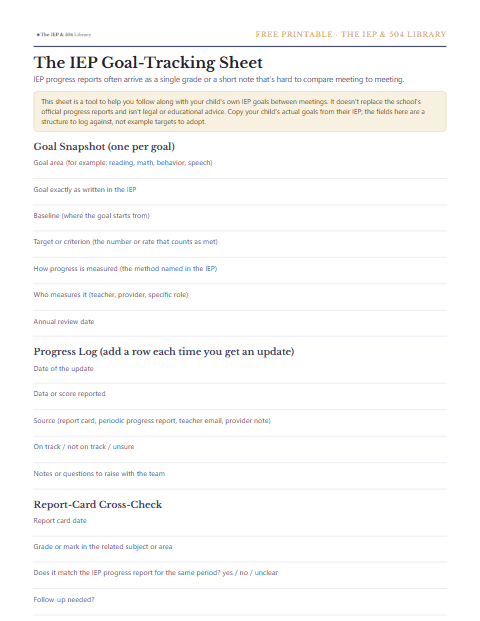
Get the free IEP Goal-Tracking Sheet (PDF)
One page per goal to log the baseline, the target and every progress update, so you see a pattern across the year. Building a scaffold here? We can email it to you with the free tracker, captioned as a practice scaffold to discuss with your team.
Instant download, plus a note if the guidance on this topic changes. Unsubscribe anytime.
What are the parts of a measurable IEP goal?
A measurable IEP goal names four things: a condition (what your child is given), a target skill your child does that can be observed, a criterion (a rate, a percentage or a count) and a way progress is measured, usually by the annual review. This builder helps you recognize that shape before a meeting so you can tell a strong goal from a vague one. It does not write a goal for your child and it is not a goal to hand the school. The team writes the actual goals from your child's evaluation.