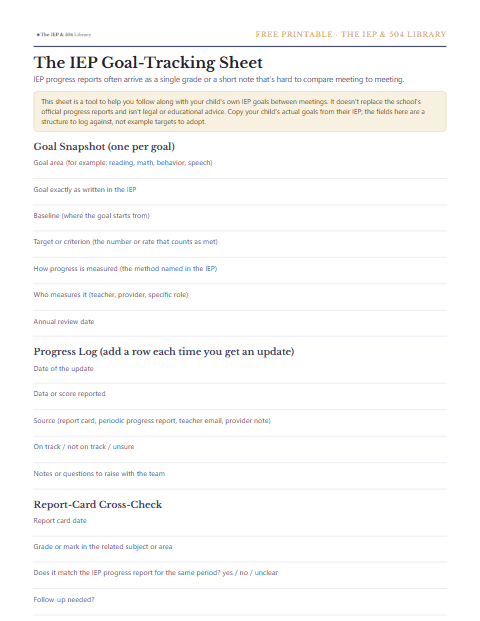
IEP Reading Goals
What are IEP reading goals?
IEP reading goals usually cover three areas: phonics and decoding (sounding out words), fluency (reading smoothly and at a comfortable pace) and comprehension (understanding what was read). A well-written reading goal names a baseline, a measurable target and a way to measure it, so progress is something the team can see rather than guess. The examples below are starting points to shape with your child's team, not goals to copy.

What a measurable reading goal looks like
A measurable annual reading goal names four things the way IEP goal-writing guides describe them: the condition (what the child is given, such as a grade-level passage), the target skill or behavior (read aloud, answer questions), the criterion (a rate, a percentage or a count) and the timeframe (usually by the annual review). IDEA requires annual goals to be measurable (34 CFR 300.320(a)(2)) and requires the IEP to describe how progress toward them is measured and reported (34 CFR 300.320(a)(3)), so a goal like 'will improve reading' is not enough. A measurable goal names words correct per minute, an accuracy percentage or a comprehension-question rate and states how progress is checked.
The skills within Reading
Phonics and decoding
Sounding out words by matching letters and letter patterns to sounds, from single-syllable words to longer words built from prefixes, suffixes and roots.
What good looks like. A measurable decoding goal names the type of word (CVC words, blends, multisyllabic words), the accuracy target and how it is checked, so the team can see whether the child is reading more words correctly over time.
Measured by. Accuracy on a word list or word-reading probe (a percentage), usually across a set number of trials.
Fluency
Reading connected text accurately, at a comfortable pace and with expression, so that sounding out words no longer takes all of the child's attention.
What good looks like. A measurable fluency goal names the passage level, a rate (words correct per minute) and an accuracy floor, measured with curriculum-based passages (short reading checks drawn from the child's own classroom material), so growth in reading rate is visible on a chart.
Measured by. Words correct per minute on a grade-level passage, paired with an accuracy percentage.
Comprehension
Understanding and using what was read: retelling, finding the main idea, answering questions, drawing inferences and citing evidence from the text.
What good looks like. A measurable comprehension goal names the task (retell, main idea, inference, evidence), the accuracy or rubric target and how often it is checked, so understanding is measured rather than assumed.
Measured by. Accuracy on comprehension questions, a rubric score on a written response, or a count of correct retell elements.
Example goals by grade band
Each goal below is an example to discuss and adapt with your team, never a target your child must meet. The specific rates and percentages are illustrations of what a measurable goal looks like. To see how the parts fit together, try the goal practice builder.
Lower elementary (K-2)
Example · Phonics and decoding
Given a list of grade-level consonant-vowel-consonant (CVC) words, [student] will read them aloud with 90 percent accuracy on 4 of 5 trials by the annual review date, as measured by weekly teacher-recorded decoding probes.
What to ask your team: Ask what baseline the goal starts from and what type of words the school will use to check it.
Example · Fluency
Given a first-grade decodable passage, [student] will read aloud at 60 words correct per minute with at least 95 percent accuracy on 4 of 5 trials by the annual review date, as measured by curriculum-based fluency probes.
What to ask your team: Ask whether the passage level matches what your child is being taught and how the starting rate was measured.
Example · Comprehension
After reading or listening to a grade-level story, [student] will retell the key details (characters, setting and one main event) with 80 percent accuracy across 4 of 5 sessions by the annual review date, as measured by a teacher-recorded retell checklist.
What to ask your team: Ask whether the goal is measured on text your child reads or on text read to them and why.
Upper elementary (3-5)
Example · Phonics and decoding
Given a list of grade-level multisyllabic words, [student] will decode them aloud using syllable-division patterns with 85 percent accuracy on 4 of 5 trials by the annual review date, as measured by teacher-recorded decoding probes.
What to ask your team: Ask how the goal moves beyond single-syllable words and what decoding strategy is being taught.
Example · Fluency
Given a third-grade passage, [student] will read aloud at 90 words correct per minute with no more than 5 errors on 4 of 5 trials by the annual review date, as measured by curriculum-based fluency probes.
What to ask your team: Ask whether the passage level matches your child's instructional level and how often the probe is run.
Example · Comprehension
Given a grade-level informational passage, [student] will state the main idea and two supporting details with 80 percent accuracy across 4 of 5 passages by the annual review date, as measured by curriculum-based comprehension probes.
What to ask your team: Ask what kind of text the goal is measured on and whether it matches what your child reads in class.
Middle school (6-8)
Example · Phonics and decoding
Given grade-level multisyllabic words built from common prefixes, suffixes and roots, [student] will read them aloud and identify the meaning-bearing word parts with 85 percent accuracy on 4 of 5 trials by the annual review date, as measured by teacher-recorded word-analysis probes.
What to ask your team: Ask whether an older reader who still finds long words hard is getting structured word study as part of the plan.
Example · Fluency
Given a sixth-grade passage, [student] will read aloud at 130 words correct per minute with at least 95 percent accuracy on 4 of 5 trials by the annual review date, as measured by curriculum-based fluency probes.
What to ask your team: Ask whether a fluency goal still fits at this grade or whether the need has shifted toward comprehension.
Example · Comprehension
Given a grade-level text, [student] will cite two pieces of textual evidence to support a stated inference with 80 percent accuracy across 4 of 5 assignments by the annual review date, as measured by scored short-answer responses.
What to ask your team: Ask how the evidence responses are scored and what counts as a correct answer.
Example · Comprehension
Given a grade-level passage, [student] will write a summary that states the central idea and three key details, scoring 3 of 4 or higher on a summary rubric on 4 of 5 trials by the annual review date, as measured by scored written summaries.
What to ask your team: Ask to see the rubric so you know how a passing summary is judged.
High school (9-12)
Example · Comprehension
Given a grade-level text, [student] will determine the central idea and explain how it develops across the text, citing three pieces of supporting evidence, scoring 3 of 4 or higher on an analysis rubric on 4 of 5 assignments by the annual review date, as measured by scored written responses.
What to ask your team: Ask how this goal connects to the reading demands of your child's actual classes.
Example · Fluency
Given a ninth-grade passage, [student] will read aloud at 150 words correct per minute with at least 95 percent accuracy on 4 of 5 trials by the annual review date, as measured by curriculum-based fluency probes.
What to ask your team: Ask whether a fluency goal is the right focus at this age or whether comprehension and vocabulary matter more for your child.
Example · Phonics and decoding
Given a list of grade-level multisyllabic and technical words, [student] will read them aloud accurately using root, prefix and suffix patterns with 85 percent accuracy on 4 of 5 trials by the annual review date, as measured by teacher-recorded word-reading probes.
What to ask your team: Ask what support is planned if decoding long words is still a barrier at this grade and how it fits the class work.
What makes a goal measurable
- Names a measurable criterion (a rate such as words correct per minute, a percentage or a count), not just 'will improve'
- Names the condition, the target skill and the timeframe, the way IEP goal-writing guides describe a complete goal
- States how progress is measured and how often it is checked
- Starts from the child's current baseline and sets an ambitious but realistic target the team agrees on
- Is written in person-first language that describes the skill being built, not the child
- Is a starting point for the team to shape, never a fixed prescription
Common mistakes to watch for
- A goal with no baseline, so there is no way to judge whether the child is making progress
- The same goal copied from year to year with no change in the target
- A vague goal like 'will become a better reader' that names no rate, percentage or count
- Deficit-first wording that describes the child by what they cannot do instead of the skill being built
- A single reading goal used when the evaluation shows separate decoding and comprehension needs
A reading goals bank organized by strand
The goals bank below groups measurable reading examples by strand rather than by grade band, so a family whose sticking point is one part of reading can read the examples that match it: early decoding, longer words, fluency then comprehension. IDEA requires annual goals to be measurable (34 CFR 300.320(a)(2)) and requires the IEP to say how progress toward each one is measured (34 CFR 300.320(a)(3)), which is why every example names a criterion and the record the school keeps.
These are examples to individualize with your child's team, never goals to copy. The rates and percentages illustrate what measurable looks like. The right target starts from the baseline in your child's present levels statement rather than from anything on a page like this one.
Phonological awareness and early decoding
An early decoding goal should name the kind of word and the sound pattern being taught, since reading more words can mean almost anything. Ask which reading instruction the goal is practiced in.
Example · Hearing and blending sounds
Given 10 spoken words of three to four sounds each, [student] will blend the sounds into the whole word with 80 percent accuracy on 4 of 5 probes by the annual review date, as measured by teacher-recorded phonological awareness probes.
Example · Reading words with blends and digraphs
Given a list of 20 single-syllable words containing taught consonant blends and digraphs, [student] will read them aloud with 85 percent accuracy on 4 of 5 trials by the annual review date, as measured by teacher-recorded word-reading probes.
Example · Reading the words that break the pattern
Given a set of 20 taught irregular high-frequency words, [student] will read each one aloud within three seconds with 90 percent accuracy on 4 of 5 trials by the annual review date, as measured by teacher-recorded sight-word probes.
Decoding longer words
A reader who stalls only on long words needs a goal about word parts rather than a slower version of the early decoding goal. Ask what syllable or word-part instruction sits behind it.
Example · Splitting a word into syllables
Given a list of 20 two-syllable and three-syllable words, [student] will divide each word into syllables and read it aloud with 85 percent accuracy on 4 of 5 trials by the annual review date, as measured by teacher-recorded syllable-division probes.
Example · Reading words built from prefixes and suffixes
Given 20 grade-level words built from taught prefixes, suffixes and roots, [student] will read each word and state the meaning its parts carry with 80 percent accuracy on 4 of 5 trials by the annual review date, as measured by teacher-scored word-analysis probes.
Example · Fixing a word that came out wrong
Given a passage read aloud, [student] will notice and self-correct a misread word within the same sentence on 8 of 10 marked errors by the annual review date, as measured by teacher-recorded running records.
Reading fluency
A fluency goal is only as good as the passage it is measured on. Ask what level of text the probe uses and whether it matches what your child is taught from.
Example · Reading a passage at a steady rate
Given an instructional-level passage of about 200 words, [student] will read it aloud at 100 words correct per minute on 4 of 5 weekly probes by the annual review date, as measured by curriculum-based fluency probes.
Example · Accuracy while reading aloud
Given a passage at the level being taught, [student] will read it aloud with no more than 4 errors per 100 words on 4 of 5 trials by the annual review date, as measured by teacher-scored running records.
Example · Reading with phrasing and expression
Given a rehearsed passage, [student] will read it aloud in meaningful phrases that follow the punctuation, scoring 3 of 4 or higher on a shared reading-expression rubric on 4 of 5 readings by the annual review date, as measured by rubric-scored oral reading.
Comprehension: retelling, main idea and evidence
A comprehension goal should say what the child does with the text and how a correct answer is judged. Ask to see the rubric or the question set the school will use.
Example · Answering questions about what was read
Given a grade-level passage and five literal and inferential questions, [student] will answer them with 80 percent accuracy on 4 of 5 passages by the annual review date, as measured by curriculum-based comprehension probes.
Example · Using the text to back an answer
Given a grade-level text and a written question, [student] will quote or paraphrase one line from the text that supports the answer on 4 of 5 assignments by the annual review date, as measured by teacher-scored short-answer responses.
Example · Noticing when the meaning breaks down
Given a passage containing two unfamiliar words, [student] will mark each one and use a taught fix-up strategy to work out its meaning with 75 percent accuracy on 4 of 5 passages by the annual review date, as measured by a teacher-reviewed strategy log.
From the team behind this library
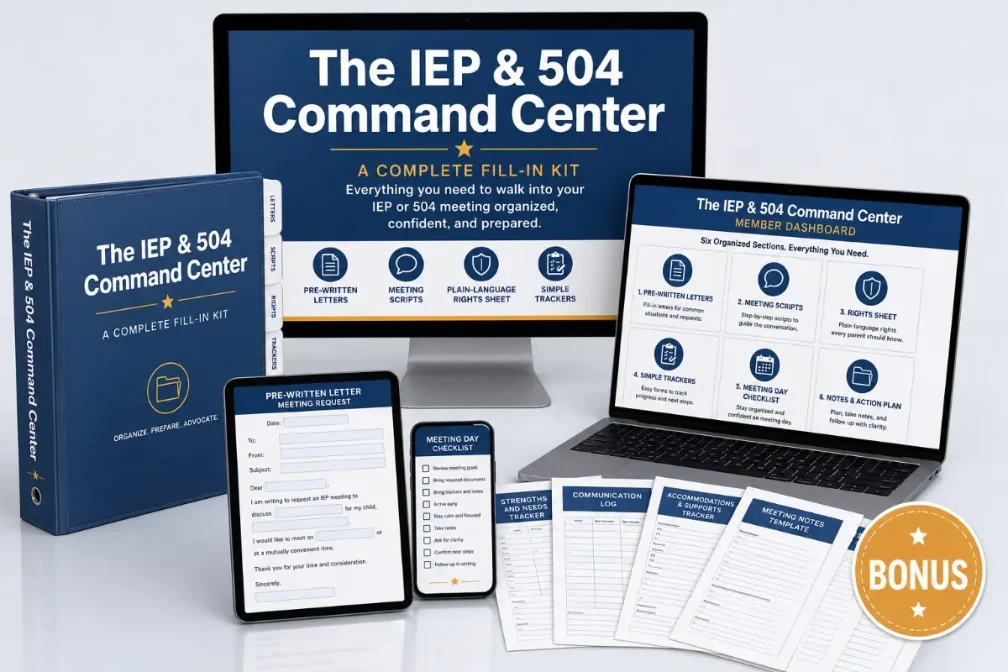
The IEP & 504 Command Center
This page shows what a measurable goal looks like. The Command Center hands you the done pieces: the binder built, the letters written, the meeting scripts ready and a self-review that shows where your child's IEP is strong or thin before you walk in. The library stays free.