The IEP Goal-Tracking Sheet (Free Printable)

A free printable read against IDEA and Section 504, written to help you walk in prepared. Last reviewed . Read against IDEA, 34 CFR 300.320(a)(2). Jump to sources

What is the IEP Goal-Tracking Sheet?

IEP progress reports often arrive as a single grade or a short note that's hard to compare meeting to meeting. This tracker gives you one page per goal to log the baseline, the target and every progress update as it comes in, so you can see a pattern over the year instead of one report in isolation. IDEA requires the IEP to state how progress will be measured and when periodic reports will go home, often on the same schedule as report cards, which is exactly the rhythm this sheet is built around.
How to use this printable. This sheet is a tool to help you follow along with your child's own IEP goals between meetings. It doesn't replace the school's official progress reports and isn't legal or educational advice. Copy your child's actual goals from their IEP; the fields here are a structure to log against, not example targets to adopt.
A flat illustration of a ruled grid sheet with a soft gold progress line rising gently across its rows

How to use it

Fill in one Goal Snapshot section per IEP goal, copying the exact wording, baseline and target straight from the IEP. Each time a progress report, report card or informal update comes home, add a row to the Progress Log for that goal. Bring the filled sheet to the next meeting as your own record to compare against what the school reports.
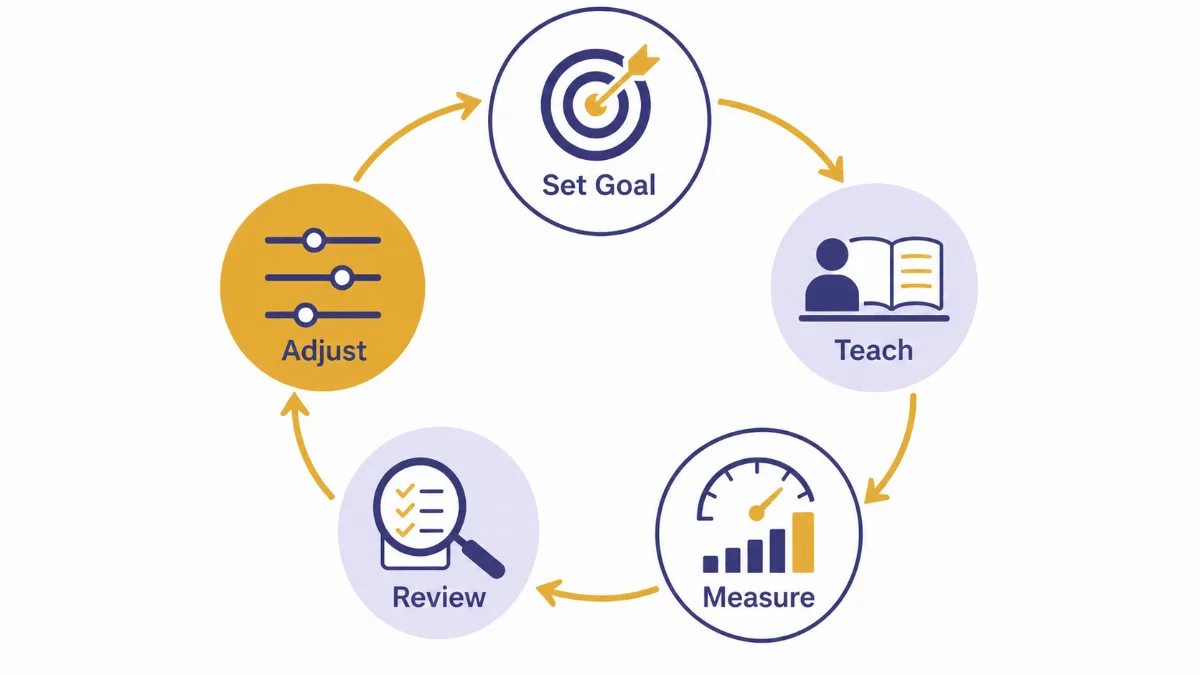
An infographic of five circles joined by curved arrows in a loop labeled set goal, teach, measure, review and adjust
The cycle an IEP goal moves through across the year. The tracking sheet keeps the measure step in one place, ready for the review conversation.

What is on the printable

Goal Snapshot (one per goal)

  • Goal area (for example: reading, math, behavior, speech)
  • Goal exactly as written in the IEP
  • Baseline (where the goal starts from)
  • Target or criterion (the number or rate that counts as met)
  • How progress is measured (the method named in the IEP)
  • Who measures it (teacher, provider, specific role)
  • Annual review date

Progress Log (add a row each time you get an update)

  • Date of the update
  • Data or score reported
  • Source (report card, periodic progress report, teacher email, provider note)
  • On track / not on track / unsure
  • Notes or questions to raise with the team

Report-Card Cross-Check

  • Report card date
  • Grade or mark in the related subject or area
  • Does it match the IEP progress report for the same period? yes / no / unclear
  • Follow-up needed?
IDEA requires the IEP to state when periodic progress reports will be provided, such as through quarterly reports concurrent with report cards. Use each report-card period as your floor for logging an update and add a row any time you get informal news in between.

What a filled-in sheet looks like

Here is one goal logged the way the sheet is meant to be used, so the blank fields have something to compare against. The goal, the numbers and the dates are examples of the shape rather than targets for any child.

Goal areaReading (decoding)
Goal exactly as written in the IEPGiven a list of grade-level words, [student] will read aloud with 90 percent accuracy on 4 of 5 trials by the annual review date, as measured by weekly teacher-recorded decoding probes.
Baseline (where the goal starts from)62 percent accuracy on the same probe, recorded the week of the IEP meeting
Target or criterion90 percent accuracy on 4 of 5 trials
How progress is measuredWeekly teacher-recorded decoding probes
Who measures itThe reading specialist named on the services page of the IEP
Annual review dateMarch 4

The Goal Snapshot, filled in once from the IEP and then left alone.

Date of the updateNovember 8
Data or score reported71 percent accuracy
SourceSecond-quarter periodic progress report, sent home with the report card
On track / not on track / unsureOn track: up 9 points from the baseline with two quarters still to go
Notes or questions to raise with the teamAsk whether the November probe used the same word list as the baseline, since a different list would make the two numbers hard to compare.

One Progress Log row, added the day the progress report came home.
What to ask your team. Ask for the baseline in the same units as the target. A target of 90 percent accuracy means one thing from a baseline of 62 percent and something quite different from a baseline of 85 percent. The baseline is the part most often missing from a draft.
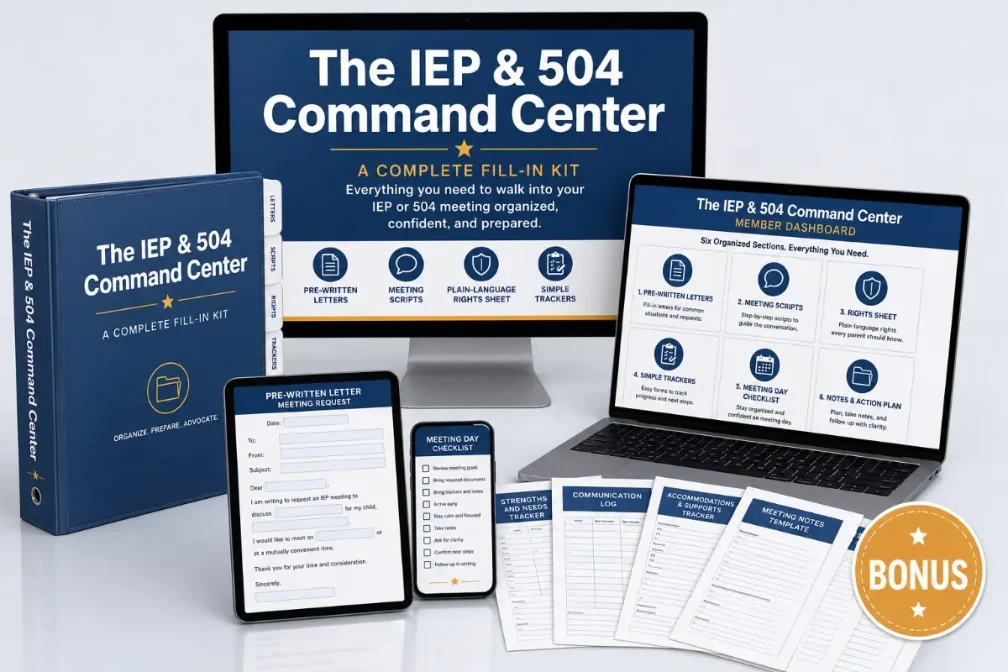
The IEP and 504 Command Center shown across a tabbed binder, a desktop screen, a laptop open at the member dashboard, a tablet holding a pre-written letter, a phone showing a meeting-day checklist and printed tracker and notes pages

From the team behind this library

The IEP & 504 Command Center

This printable is the map. The Command Center is the done pieces: The Command Binder System, The Letter Library, The Meeting Script Deck, The Score-Your-IEP Self-Review, The Plain-Language Rights Cheat Sheet, so you walk in organized, working from the same paperwork the team has.
See the Command Center One-time $27. Yours to keep. 60-day money-back guarantee.
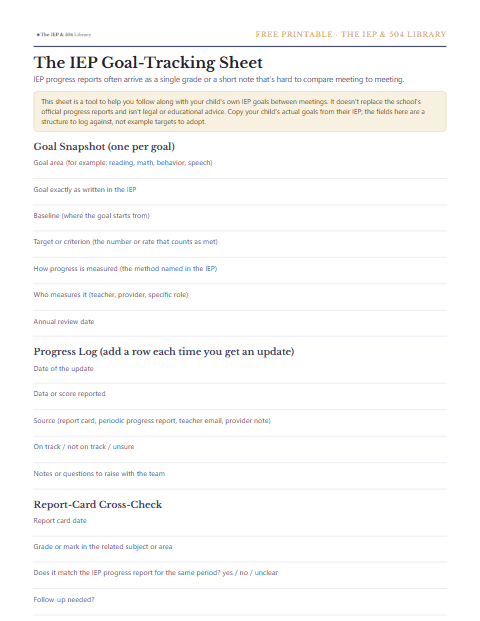
A preview of the free IEP Goal-Tracking Sheet, one printable page

Get the free IEP Goal-Tracking Sheet (PDF)

One page per goal to log the baseline, the target and every progress update, so you see a pattern across the year.

Instant download, plus a note if the guidance on this topic changes. Unsubscribe anytime.

Questions parents ask

How often should the school report progress on IEP goals?

The IEP itself states the schedule. IDEA requires periodic progress reports, often described as quarterly or other periodic reports issued alongside report cards (34 CFR 300.320(a)(3)). If you aren't sure what schedule your child's IEP sets, check the goals page of the IEP or ask at the next meeting.

What if the progress report doesn't match what I'm seeing at home or on the report card?

Note the difference in the Progress Log and bring it up with the team. A mismatch between the IEP progress report and the report card is a reasonable, specific thing to ask about rather than something to assume is wrong.

Do I need a separate sheet for every goal?

Yes, one Goal Snapshot section per goal keeps the baseline, target and measurement method clear for each area. You can track multiple goals in the same binder tab; just fill out a fresh copy of the sheet for each one.

Can I use this instead of the school's official progress reports?

No. This is your own record to help you follow along and prepare questions. The school's official progress reports and the IEP itself remain the record of what was agreed and reported.

What do I do if a progress report skips one of the goals?

Note the gap in the Progress Log with the date and ask about it. IDEA requires the IEP to describe how progress toward each annual goal will be measured and when periodic reports will be provided (34 CFR 300.320(a)(3)), so a goal with no data for a reporting period is a reasonable and specific thing to raise. Asking in November is much easier than reconstructing it in May.

How do I tell whether my child is on track partway through the year?

Compare the update against the baseline rather than against the target. A goal that moves from a baseline of 62 percent to 71 percent by the second quarter has covered roughly a third of the distance in roughly half the year, which is a fair thing to ask about without assuming anything has gone wrong. The value of the sheet is that it puts those three numbers side by side instead of in three separate envelopes.

Can I use this sheet for a 504 plan?

A 504 plan usually carries accommodations rather than measurable annual goals, so most of the Goal Snapshot fields will not apply. What does carry over is the habit: log the date, what happened and what you want to ask about, so the next review has something concrete in it rather than a general impression of how the year has gone.

The exact reporting cadence (quarterly, trimester, or another period) is set by each child's own IEP, not by a fixed federal number; the sheet is designed to follow whatever cadence the child's actual IEP states rather than assuming a specific schedule.

Sources

What the facts on this page come from

Last reviewed . That is the day this page was last read against the sources above, not the day the site was rebuilt. How this library is verified

This page is general educational information for parents, not legal or educational advice. It does not tell any family what to do. Every example here is a starting point to discuss and adapt with your child's IEP or 504 team, which decides what fits your child from the evaluation. Confirm anything time-sensitive with your school or district. For a genuinely contested situation, a special education advocate or an attorney who works in your state is the right person to ask.