IEP Adaptive and Functional Life Skills Goals
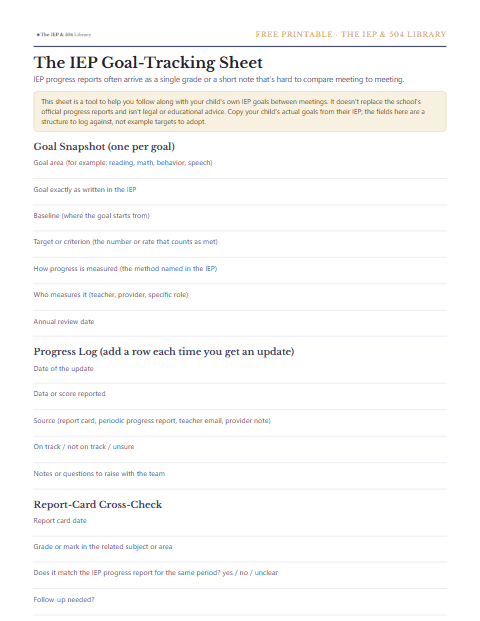
What are IEP adaptive and functional life skills goals?
Adaptive and functional goals cover the everyday skills that help a child take part in school and grow more independent. They include self-care and daily routines, functional academics like money and time, safety and community skills and the self-management skills of following a schedule, staying organized and asking for help. IDEA names functional goals right alongside academic ones, so an IEP can carry them when the evaluation shows a need. A well-written functional goal names where the child is starting, a measurable target and how progress is checked, so the team can see growth rather than guess at it. The examples below are starting points to shape with your child's team, not goals to copy.
What a measurable adaptive and functional life skills goal looks like
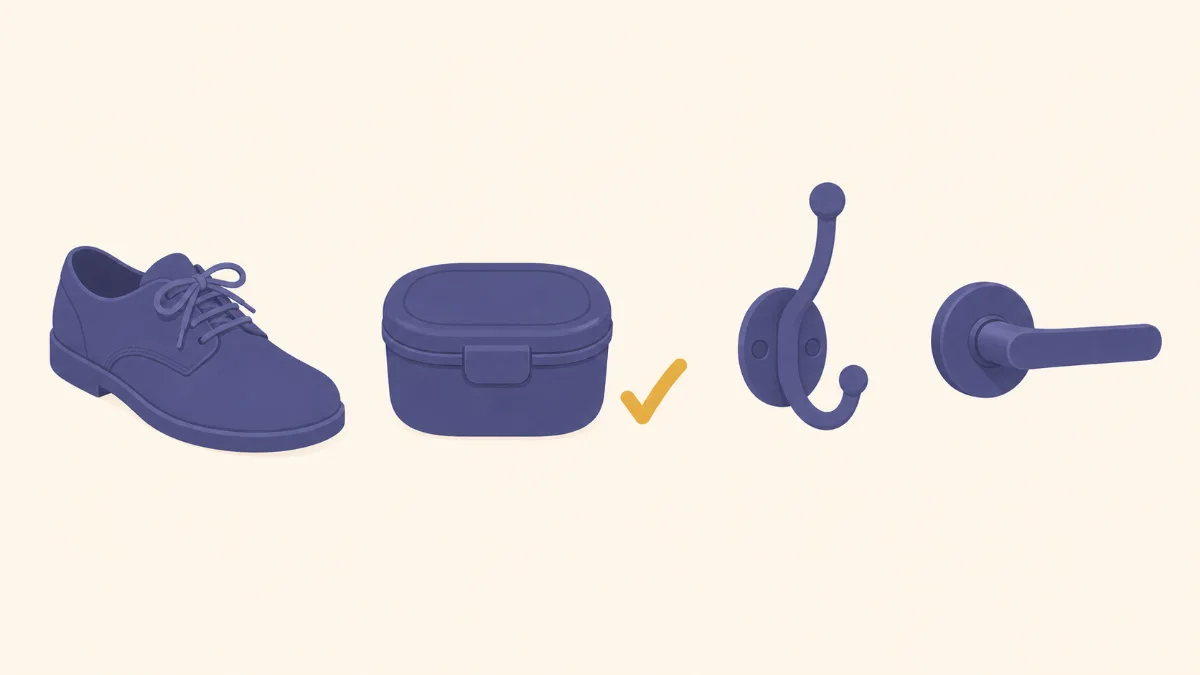
A measurable functional goal names the skill, the condition, the criterion and how it is measured. IDEA requires annual goals to be measurable and lists functional goals alongside academic ones (34 CFR 300.320(a)(2)), so a goal like 'will be more independent' is not enough; a strong goal names what the child will do, how well (a percentage, a count or a level of prompting) and how the team will check it. Because functional skills are used in real places like the hallway, the cafeteria and the community, the best goals also say where the skill is practiced and measured, not only on a worksheet.
How one functional goal comes together
Say the evaluation notes that a middle schooler needs an adult to walk them through the morning routine on most days and gets to first period after the bell about half the time. That is the baseline. Here is the same information turned into the four parts a measurable goal names.
| Condition (what the student is given) | A personal schedule taped inside the locker plus a phone or watch timer set for the passing period. |
|---|---|
| Target skill (what the student does) | Gets to first period and is in their seat before the bell. |
| Criterion (how well and how consistently) | On 4 of 5 school days across two consecutive weeks. The baseline is about half of days, so the target is a step up that is still reachable inside the year. |
| Measurement (how the school will know) | A period-by-period tracking sheet kept by the case manager and checked weekly. |
The four parts, assembled
Given a personal schedule and a timer set for the passing period, [student] will arrive at first period and be seated before the bell on 4 of 5 school days across two consecutive weeks by the annual review date, as measured by a period-by-period tracking sheet kept by the case manager.
Functional goals tend to go wrong in one particular way: they name a state rather than an action. A goal to be more independent in the morning cannot be counted by anyone, however much everyone agrees with it. Naming the support, the observable action, how often it has to happen and who records it turns the same intention into something the team can report on. Because functional skills are used in real places, it is also worth checking that the goal is measured where the skill is used, in the hallway itself rather than on a worksheet about hallways.
Example goals by grade band
Each goal below is an example to discuss and adapt with your team, never a target your child must meet. The specific rates and percentages are illustrations of what a measurable goal looks like. To see how the parts fit together, try the goal practice builder.
Lower elementary (K-2)
Example · Self-care and dressing
Given the needed clothing items and one verbal reminder, [student] will put on and fasten a coat independently on 4 of 5 opportunities across two weeks by the annual review date, as measured by teacher observation records.
What to ask your team: Ask what level of help the goal assumes at the start and how the team plans to fade the prompts over the year.
Example · Following a classroom routine
Given a picture schedule and one verbal reminder, [student] will complete the arrival routine of unpacking, hanging the bag and joining morning meeting with no more than one adult prompt on 4 of 5 school days across two consecutive weeks by the annual review date, as measured by a daily routine checklist.
What to ask your team: Ask how many prompts your child needs now, so the goal moves forward from where they are rather than from zero.
Upper elementary (3-5)
Example · Functional money skills
Given coins and bills up to five dollars and a set of purchase cards, [student] will choose enough money to pay the amount shown with 80 percent accuracy on 4 of 5 trials by the annual review date, as measured by teacher-scored money-skills probes.
What to ask your team: Ask whether the goal uses real money and everyday tasks, so the skill carries over outside the worksheet.
Example · Organizing personal materials
Given a homework folder and an end-of-day checklist, [student] will pack the materials needed for home with 90 percent accuracy on 4 of 5 school days across two weeks by the annual review date, as measured by a staff-completed packing checklist.
What to ask your team: Ask what support, such as a visual checklist or a set reminder time, the school will put in place while the skill is still building.
Middle school (6-8)
Example · Following a daily schedule
Given a personal schedule and a watch or phone timer, [student] will arrive at the correct room for each class period before the bell on 4 of 5 school days across two consecutive weeks by the annual review date, as measured by a period-by-period tracking sheet.
What to ask your team: Ask how the team defines on time and how they will collect the data without singling your child out in front of classmates.
Example · Self-advocacy and asking for help
Given a task that is too hard or unclear, [student] will use a taught strategy to ask an adult for help, such as showing a help card or stating the need, on 4 of 5 observed opportunities across a grading period by the annual review date, as measured by teacher tally records.
What to ask your team: Ask which self-advocacy strategy the school will teach and practice, so the goal names a skill your child is shown rather than one they are expected to already have.
High school (9-12)
Example · Functional reading for safety and community
Given common community and workplace signs such as exit, restroom, caution and bus route numbers, [student] will read the sign and state what it means with 90 percent accuracy on 4 of 5 trials by the annual review date, as measured by teacher-recorded functional-reading probes.
What to ask your team: Ask whether the goal is practiced in real community settings and not only in the classroom, so the skill holds up where it is actually used.
Example · Daily living and preparing a snack
Given a simple visual recipe and the needed supplies, [student] will complete the steps to prepare a two-step snack with no more than two adult prompts on 4 of 5 opportunities by the annual review date, as measured by a task-analysis data sheet.
What to ask your team: Ask how the team will fade the prompts over time, so the goal builds toward doing the routine independently and not just finishing it with help.
What makes a goal measurable
- Names a measurable criterion (a percentage, a count, a rate or a level of prompting), not just 'will improve'
- States how progress is measured and how often
- Names the real setting where the skill is used and checked, since functional skills have to transfer beyond the classroom
- Is written in person-first, respectful language
- Is a starting point for the team, never a fixed prescription
Common mistakes to watch for
- A vague goal like 'will become more independent' with no baseline and no way to measure it
- Copying a goal that does not match the skills the evaluation actually flagged
- Deficit-first wording that describes the child by what they cannot do instead of the skill they are building
- A goal practiced only on a worksheet, so the skill never transfers to the real routine where it matters
A functional skills goals bank organized by strand
The goals bank below groups measurable functional examples by strand: functional academics, self-care and daily routines, safety and community skills and the self-management that holds a day together. IDEA names functional goals alongside academic ones (34 CFR 300.320(a)(2)), so an IEP can carry them when the evaluation shows a need. The grade-band examples above show how the same skills grow across the years.
Each of these is an example to individualize with your child's team, not a prescription and not a checklist of what a child this age should be doing. Where a functional goal is measured matters as much as the number in it, so read the setting each example names.

Functional academics: money, time and reading for daily life
Functional academics goals earn their place when the skill is one your child will actually use. Ask what real task sits behind each target.
Example · Money in a real purchase
Given a menu with prices and a set amount of money, [student] will choose an item they can afford and state the change they should get back, with 80 percent accuracy on 4 of 5 trials by the annual review date, as measured by teacher-scored functional-math probes.
Example · Time and what comes next
Given a digital clock, an analog clock and their daily schedule, [student] will state the time and name the activity that comes next with 90 percent accuracy on 4 of 5 trials by the annual review date, as measured by teacher-recorded time-telling probes.
Example · Reading a label or a set of instructions
Given a package label or a short set of written instructions, [student] will state 2 pieces of information it gives, such as how long to heat it and how many servings it makes, with 80 percent accuracy on 4 of 5 trials by the annual review date, as measured by teacher-scored functional-reading probes.
Self-care and daily routines
Routine goals usually move first in the amount of help needed rather than in the skill itself. Ask what counts as a prompt and how the prompts get reduced.
Example · A hygiene routine in order
Given a visual sequence card and the supplies they need, [student] will complete the handwashing routine in order with no more than one prompt on 4 of 5 opportunities across two weeks by the annual review date, as measured by a task-analysis data sheet.
Example · Managing a meal independently
Given a lunch tray and the cafeteria routine, [student] will open their own food packaging using the tools available and clear their space, with no more than one prompt on 4 of 5 school days by the annual review date, as measured by a lunch-routine observation record.
Example · Dressing for the day
Given the day's weather forecast and the outer clothing they have at school, [student] will choose clothing that matches the conditions on 4 of 5 opportunities by the annual review date, as measured by a staff-kept observation record.
Safety, travel and the community
Community goals belong to the community, so a goal practiced only on a worksheet measures the worksheet. Ask where the data will be collected.
Example · Crossing safely
Given a crossing with a pedestrian signal, [student] will wait for the walk signal and check both directions before stepping out, on 10 of 10 opportunities across a supervised community outing by the annual review date, as measured by a staff-completed community-safety checklist.
Example · Finding the way to a destination
Given a school or community building map and a destination, [student] will find the route and arrive there independently on 4 of 5 trials by the annual review date, as measured by staff-recorded navigation data.
Example · Getting help when something goes wrong
Given a scenario in which they are lost or need help in the community, [student] will identify a safe person to approach and state their name and what they need, on 4 of 5 role-play trials by the annual review date, as measured by a teacher-scored safety rubric.
Managing the day and asking for help
These are the skills that make the rest of the plan run without an adult beside your child. Ask which one would change their day most.
Example · Handling a change to the schedule
Given a visual schedule with a change marked on it, [student] will follow the changed schedule with no more than one prompt on 4 of 5 opportunities by the annual review date, as measured by a staff-kept schedule-tracking sheet.
Example · Working through a short task list
Given a 3-step task list and a check-off sheet, [student] will mark each step as it is finished and report when the list is done, on 4 of 5 tasks by the annual review date, as measured by a review of the completed check-off sheets.
Example · Starting a job without a reminder
Given a classroom job that repeats each week, [student] will start it at the scheduled time without an adult reminder on 4 of 5 weeks by the annual review date, as measured by a staff-kept classroom-job log.
From the team behind this library
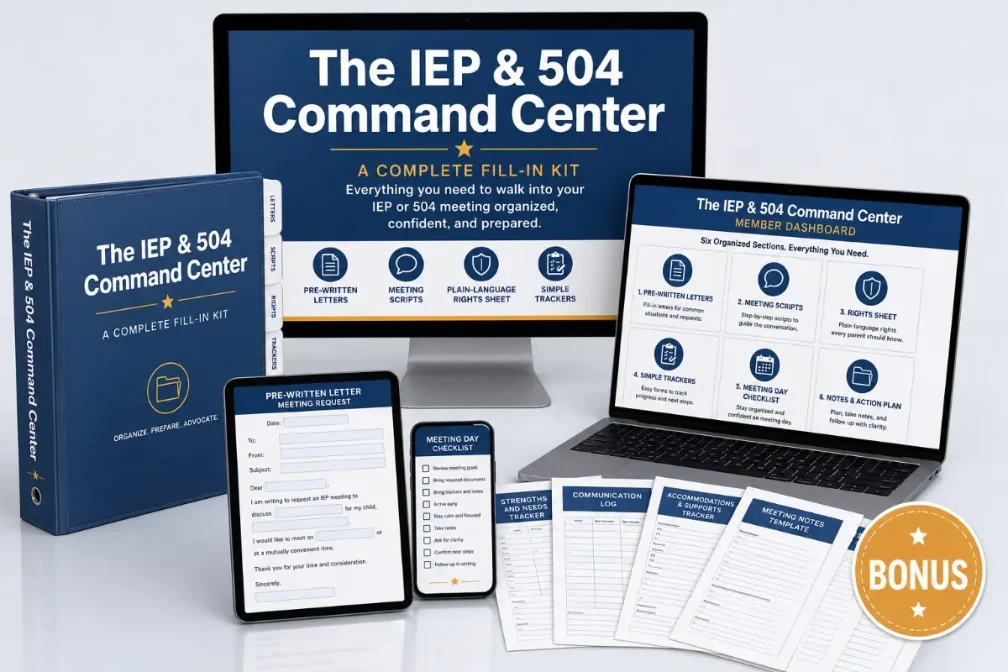
The IEP & 504 Command Center
This page shows what a measurable goal looks like. The Command Center hands you the done pieces: the binder built, the letters written, the meeting scripts ready and a self-review that shows where your child's IEP is strong or thin before you walk in. The library stays free.