IEP Transition and Post-Secondary Goals
What are IEP transition and post-secondary goals?
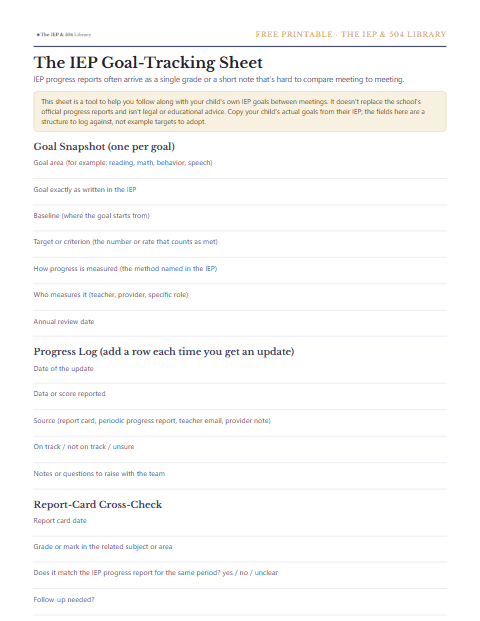
IEP transition goals plan for life after high school. Beginning with the first IEP in effect when your child turns 16 (some states or teams start earlier), the IEP adds measurable postsecondary goals in education or training, employment and, where appropriate, independent living, plus the transition services and courses of study needed to reach them (34 CFR 300.320(b)). Those big-picture goals are built from age-appropriate transition assessment and from your child's own strengths, preferences and interests. Underneath them sit annual goals, measured during the year, that build the skills step by step. The examples below are starting points to shape with your child's team, not goals to copy.
What a measurable transition and post-secondary goal looks like
IDEA asks for two connected things once transition planning begins. First, measurable postsecondary goals: short statements of what your child will do after high school in education or training, in employment and, where the team finds it appropriate, in independent living. These are based on age-appropriate transition assessment (34 CFR 300.320(b)). A measurable postsecondary goal names an observable outcome, for example 'after high school, [student] will enroll in a welding certificate program' or 'after high school, [student] will work part-time with support from a job coach'. Second, measurable annual goals: what your child works on and the team measures during the year to move toward that outcome, each naming a criterion and how it is measured, the same bar IDEA sets for every annual goal (34 CFR 300.320(a)(2)). The examples below are annual transition goals, written as starting points to shape with your team.
Example goals by grade band
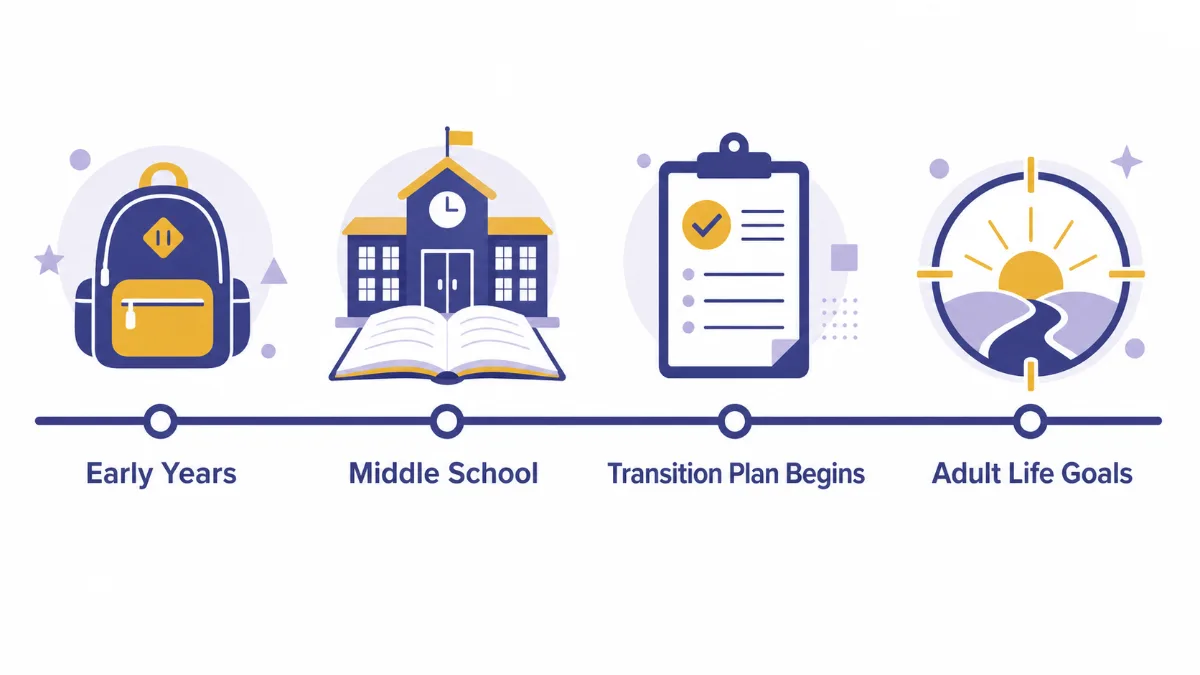
Each goal below is an example to discuss and adapt with your team, never a target your child must meet. The specific rates and percentages are illustrations of what a measurable goal looks like. To see how the parts fit together, try the goal practice builder.
When transition planning begins (by age 16, or earlier if your state or team decides)
Example · Self-advocacy and self-determination
Given a mock IEP or transition meeting, [student] will describe their disability in their own words, name two personal strengths and state two accommodations that help them, in 4 of 5 practice meetings by the annual review date, as measured by a teacher-recorded self-advocacy checklist.
What to ask your team: Ask how your child will get chances to practice speaking up for themselves before they help lead part of their own meeting.
Example · Career exploration (employment)
Given a completed interest inventory and access to career-research tools, [student] will identify three careers that match their interests and list the education or training each one needs, on 2 of 2 attempts by the annual review date, as measured by a teacher-scored career-exploration rubric.
What to ask your team: Ask what age-appropriate transition assessment the team used and how its results shaped this goal.
Building skills through high school (around ages 16-17)
Example · Postsecondary education and training readiness
Given the admission checklist for a chosen college or training program, [student] will list each application step and its deadline, with 100 percent accuracy on 2 of 2 attempts by the annual review date, as measured by a transition counselor's application-readiness checklist.
What to ask your team: Ask how this annual goal connects to the measurable postsecondary goal for education or training.
Example · Independent living and daily living skills
Given a sample monthly income and a list of fixed expenses, [student] will calculate the money left after expenses and identify one expense they could adjust, with 90 percent accuracy on 4 of 5 trials by the annual review date, as measured by teacher-recorded budgeting probes.
What to ask your team: Ask whether independent living skills belong in your child's plan, since IDEA includes them where the team finds them appropriate.
Approaching graduation and the transfer of rights (around ages 17-18 and up)
Example · Employment and work-based learning
During a supervised work-based learning placement, [student] will arrive on time and complete assigned tasks with no more than one prompt per shift, on 8 of 10 shifts by the annual review date, as measured by a job coach's weekly performance log.
What to ask your team: Ask what community or work experiences the transition services include, since IDEA lists these as part of a coordinated set of activities.
Example · Self-advocacy for the age-of-majority handoff
Given a plain-language summary of the rights that transfer at the age of majority, [student] will explain in their own words two decisions that will become theirs and name one adult who can support them, on 2 of 2 attempts by the annual review date, as measured by a teacher-recorded discussion rubric.
What to ask your team: Ask when the team will inform your child, one year before the age of majority in your state, that these rights will transfer to them.
What makes a goal measurable
- Names a measurable criterion (a percentage, a count or a rate), not just 'will explore' or 'will improve'
- States how progress is measured and how often
- Connects the annual goal to a measurable postsecondary goal for education or training, employment or independent living
- Is built on the student's own strengths, preferences and interests, drawn from age-appropriate transition assessment
- Is written in person-first language and is a starting point for the team, never a fixed prescription
Common mistakes to watch for
- A postsecondary goal written as a vague hope, like 'wants a good job', with no observable outcome the team can see after school
- Transition planning that starts after age 16 has already passed, instead of by the first IEP in effect when the child turns 16
- Annual goals set without the student's own preferences and interests, so the plan is done to them rather than with them
- Deficit-first wording that describes the young person by what they cannot do rather than the skill they are building
A transition goals bank organized by strand
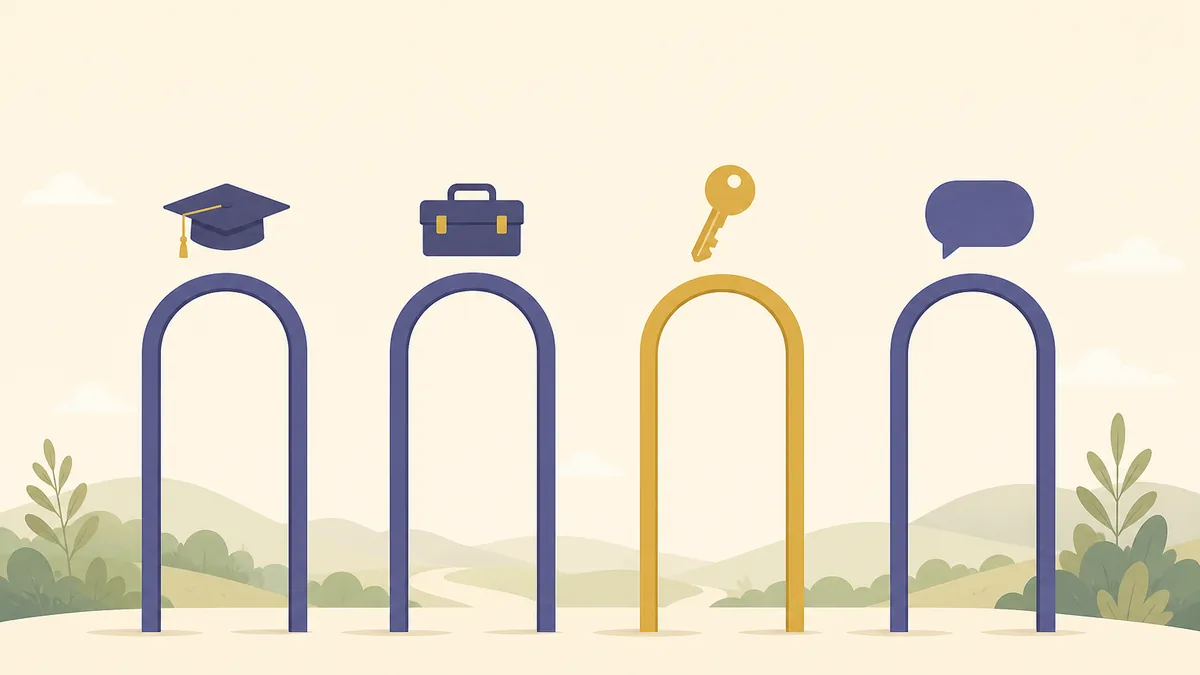
The goals bank below groups measurable transition examples by the areas IDEA asks the team to plan for once transition planning begins: education or training after high school, employment and, where the team finds it appropriate, independent living, plus the self-determination skills that run through all three (34 CFR 300.320(b)). The grade-band examples above show the same shape across the years. This set is for reading one strand at a time.
Every goal here is an annual goal written as a starting point to individualize with your child's team. The rates and counts illustrate what measurable looks like, never targets your child has to meet. Which strand belongs in the plan is a decision that comes from age-appropriate transition assessment rather than from a list.
Education and training after high school
These build the steps between a postsecondary education goal and the application that makes it real. Ask which of them your child's own stated goal actually needs.
Example · Comparing programs
Given three postsecondary programs and their published entry requirements, [student] will compare them on cost, length and entry requirements and state which one fits the goal they have named, on 2 of 2 attempts by the annual review date, as measured by a transition counselor's scored comparison worksheet.
Example · Disability services in a college or training program
Given the disability services page of a college or training provider, [student] will name the documentation the office asks for and the steps to register with it, with 90 percent accuracy on 3 of 4 attempts by the annual review date, as measured by a transition counselor's scored checklist.
Example · Learning from a campus or program visit
Given a campus or program visit and a question list they prepared, [student] will ask at least 3 of their own questions of a staff member and record the answers, on 2 of 2 visits by the annual review date, as measured by a completed visit-notes form reviewed by the transition counselor.
Employment and work skills
Employment goals work best when they are practiced in a real or closely simulated setting. Ask where each one would be measured before you picture it in the plan.
Example · Completing an application
Given a blank job application and their own personal information sheet, [student] will complete every required field accurately with no more than 2 prompts, on 4 of 5 practice applications by the annual review date, as measured by a teacher-scored application rubric.
Example · Interview practice
Given a practice interview built from 5 common questions, [student] will answer each one with a relevant response that names a strength or an example from their own experience, on 4 of 5 questions across 3 practice interviews by the annual review date, as measured by an interview rubric scored by the transition teacher.
Example · Checking understanding at work
Given a workplace task whose instructions are unclear, [student] will ask the supervisor a clarifying question before starting, on 4 of 5 observed opportunities across a 6-week placement by the annual review date, as measured by a job coach's observation log.
Independent living and daily life
IDEA includes independent living goals where the team finds them appropriate, so this strand belongs in some plans and not others. Ask what your child's own transition assessment showed before deciding.
Example · Planning a trip on public transport
Given a transit route map and a destination, [student] will identify the correct route, the stop to board and the stop to exit, with 100 percent accuracy on 4 of 5 trials by the annual review date, as measured by teacher-scored travel-planning probes.
Example · Keeping a personal calendar
Given 5 appointment scenarios, [student] will enter each one in a phone or paper calendar with its date, time and location, on 4 of 5 scenarios by the annual review date, as measured by a review of the completed calendar entries.
Example · Planning a shop within a budget
Given a simple recipe, a shopping list template and a set spending limit, [student] will list the items needed and estimate the total within 2 dollars of the real cost, on 4 of 5 trials by the annual review date, as measured by teacher-recorded shopping-planning probes.
Self-determination and self-advocacy
This strand runs underneath the other three, because the plan after high school is one your child carries themselves. Ask how each skill will be taught and practiced before it is measured.
Example · Taking part in their own meeting
Given a draft of their own IEP and an outline they prepared, [student] will present 2 of their own goals and 1 accommodation they find useful, at the meeting or in a recorded practice run, on 2 of 2 occasions by the annual review date, as measured by a teacher-completed participation rubric.
Example · Asking for an accommodation
Given a scenario in which an accommodation they use is not in place, [student] will state the accommodation they need and name who to ask about it, on 4 of 5 role-play opportunities by the annual review date, as measured by a teacher-recorded self-advocacy tally.
Example · Knowing the adult services in their area
Given a list of adult service agencies in their area, [student] will name 2 that connect to the outcome in their own postsecondary goal and describe what each one does, on 2 of 2 attempts by the annual review date, as measured by a transition counselor's scored review.
From the team behind this library
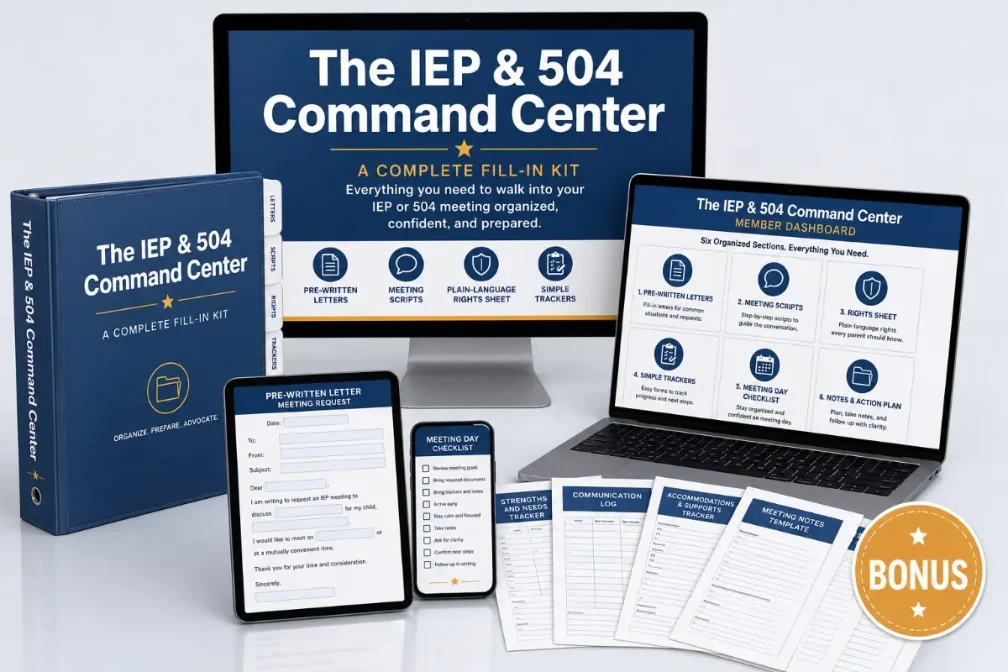
The IEP & 504 Command Center
This page shows what a measurable goal looks like. The Command Center hands you the done pieces: the binder built, the letters written, the meeting scripts ready and a self-review that shows where your child's IEP is strong or thin before you walk in. The library stays free.