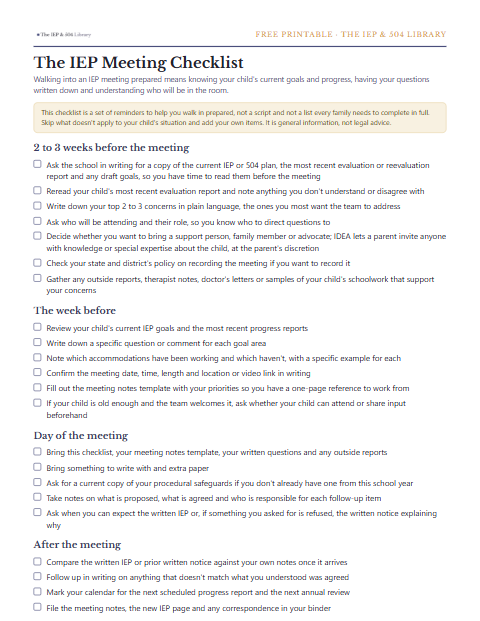
The IEP Meeting Walkthrough
An IEP meeting is the formal meeting where your child's IEP team writes, reviews or updates the Individualized Education Program, the document that sets your child's goals and the special education and related services the school will provide. Federal law requires this meeting at least once a year, names who must be in the room and gives you the right to real notice and a real say. Knowing the required team members, the notice rules and your own rights before you walk in turns the meeting from something that happens to you into something you take part in.

What an IEP meeting actually is
An IEP meeting is where your child's IEP team meets to develop a new IEP, review an existing one or revise one, based on your child's evaluation results, present levels of performance and needs.
The Individualized Education Program, or IEP, is the written plan that names your child's measurable goals and the special education and related services the school agrees to provide. The IEP meeting is where that document gets built and later checked. The team must review the IEP periodically and not less than once a year to decide whether your child is meeting the annual goals and whether the plan still fits (34 CFR 300.324(b)(1)).
A first IEP meeting and a later annual review meeting cover similar ground, even though the first one happens right after your child is found eligible: the team looks at where your child is now, what the goals should be and what services get your child there. When a child is newly found to need special education, the school must hold the meeting to develop the IEP within 30 days of that eligibility decision. Services must start as soon as possible after the IEP is written (34 CFR 300.323(c)).
Who is required to be in the room
Federal law requires a specific list of people on the IEP team: you, a regular education teacher if your child is or may be in a regular education setting, a special education teacher or provider, a school representative who can commit district resources, someone who can explain what the evaluation results mean and, when appropriate, your child.
The required team, under 34 CFR 300.321, is the parent or parents; not less than one regular education teacher of the child if the child is or may be participating in the regular education environment; not less than one special education teacher or provider; a representative of the public agency who is qualified to provide or supervise specially designed instruction and who knows the general curriculum and the resources available; an individual who can interpret the instructional implications of evaluation results; other individuals with knowledge or special expertise about the child, brought in at the discretion of either you or the school. Your child attends whenever appropriate.
A required member can skip the meeting only if you and the school agree in writing that the member's subject area is not being discussed, or if the member submits written input before the meeting and both you and the school agree in writing to the excusal. The school cannot excuse a member on its own.
How the meeting gets scheduled and what the notice must say
The school must send you notice early enough for you to attend, stating the meeting's purpose, time and location and who will be there. It must try to schedule the meeting at a time and place you both agree on.
Under 34 CFR 300.322, the notice must state the meeting's purpose, time and location and who is expected to attend. The school must schedule the meeting at a mutually agreed time and place. If you cannot attend in person, the school must use other ways to include you, such as an individual or a conference phone call.
A meeting can go forward without you only if the school keeps a detailed record of its attempts to reach you: call logs, letters sent and received, visits to your home or workplace. After the meeting, the school must give you a copy of the IEP at no cost (34 CFR 300.322(f)).
What typically happens during the meeting
A typical meeting works through your child's strengths, your concerns as a parent, the evaluation results and your child's needs, then moves into writing or reviewing the goals and deciding on services, all grounded in what the evaluation shows.
IDEA requires the team to consider four things when it develops or reviews an IEP: the strengths of the child, the concerns of the parents for enhancing their child's education, the results of the most recent evaluation and the child's academic, developmental and functional needs (34 CFR 300.324(a)(1)). Most meetings walk through this same ground even though the exact order and format vary by school and by state.
If your child's behavior affects learning, the team must consider positive behavioral interventions and supports (34 CFR 300.324(a)(2)(i)). Depending on your child's needs, the team also weighs language needs for an English learner, Braille instruction, communication needs for a child who is deaf or hard of hearing and whether assistive technology is needed.
When the school proposes or refuses to start, change or stop an identification, evaluation, placement or service, it must give you prior written notice explaining the action, the reasons for it and what other options the team considered (34 CFR 300.503). This notice is one of your strongest tools for understanding a decision after the meeting ends.
How often this meeting happens
The team reviews the IEP not less than once a year. A full reevaluation happens at least once every three years unless you and the school agree it is not needed.
Annual review is a floor, not a ceiling. The team must review the IEP not less than annually (34 CFR 300.324(b)(1)). Either you or the school can call a meeting sooner if something changes.
Reevaluation runs on its own separate timeline. It must happen at least once every three years unless you and the school agree a reevaluation is unnecessary. It cannot happen more than once a year unless you and the school agree otherwise (34 CFR 300.303).
Your rights going into the meeting
You can invite anyone with knowledge or special expertise about your child, you get real notice and a real chance to attend, you get a copy of the IEP at no cost and you get written notice any time the school proposes or refuses a change.
Bringing another person, a relative, a private therapist, an advocate, is your right under 34 CFR 300.321(a)(6). The school does not approve or veto who you bring. It only needs to know who is coming so it can plan the room and the time.
Federal law does not say whether you can record the meeting. IDEA's Part B regulations are silent on recording devices, so whether you can bring a recorder depends on your state's law and your district's policy. Ask about the policy before the day of the meeting if recording matters to you.
If you disagree with what the team proposes, say so in the meeting and ask for it noted. The prior written notice the school owes you when it proposes or refuses an action (34 CFR 300.503) puts the reasoning in writing. IDEA's procedural safeguards give you further ways to raise a disagreement beyond the meeting itself.
Practical ways to walk in prepared
None of this is required by law, but reading the evaluation report before the meeting, writing your questions down in advance and bringing your own notes on what you see at home all help you use the meeting time well.
Ask for a copy of the evaluation report and any draft goals before the meeting date, so you are reading them for the first time at home and not for the first time in the room. Write down what you want to ask about in your own words, so a full agenda does not crowd out your questions.
Bring specific, concrete notes on what you see at home: how long homework takes, what a hard morning looks like, what your child says about school. Specific examples carry more weight in the discussion than a general worry. The meeting checklist and the binder printables on this site walk through this preparation step by step.
What happens after the meeting
The IEP the team agrees on goes into effect, you keep your own copy for reference and any point where the school proposed or refused something comes with written notice you can revisit later.
Once the IEP is finalized, the school must have it in effect at the start of the school year, or as soon as possible after a meeting held during the year (34 CFR 300.323(a)). The school implements the goals and services the team agreed on and reports your child's progress toward each goal on the schedule stated in the IEP.
Agreeing to an IEP in the room is not your only chance to weigh in. You can ask for another meeting if something is not working. The annual review is a built-in checkpoint to look again at whether the plan still fits.

From the team behind this library
The IEP & 504 Command Center
This page shows the options to discuss. The Command Center hands you the done pieces: the binder built, the letters written, the meeting scripts ready and a self-review that shows where your child's plan is strong or thin. The library stays free.