The Home Observation Log (Free Printable)

A free printable read against IDEA and Section 504, written to help you walk in prepared. Last reviewed . Read against IDEA, 34 CFR 300.305(a)(1)(i). Jump to sources

What is the Home Observation Log?

A dated log of what you're seeing at home turns a general sense that something feels off into a specific record a team can actually use. Federal law directs the team to review information provided by the parents as part of the evaluation record, as part of an initial evaluation where appropriate and as part of any reevaluation, so a log naming the date, what happened, how long it lasted, the setting and what it changed about homework or daily living gives you something concrete to bring instead of a memory from three months ago. This printable gives you a simple structure to log entries as they happen and a short summary to fill in once a pattern shows up.

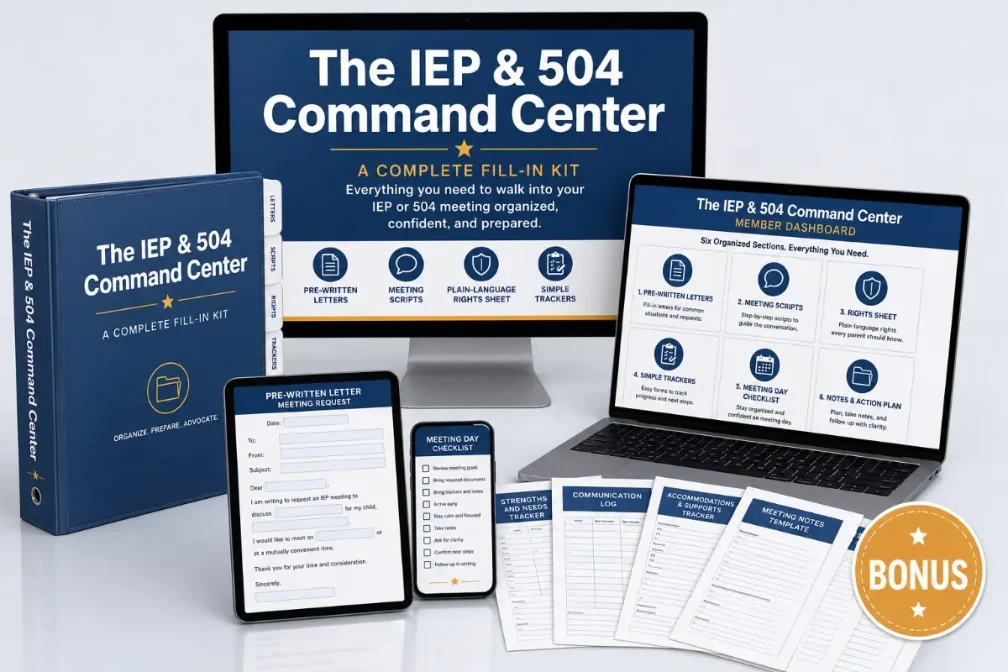
How to use this printable. This log is your own dated record of what you're seeing at home, kept in plain, factual language. It's a tool to help you notice patterns and share them with your child's team, not a diagnosis, a formal evaluation or legal or educational advice. Describe what happened rather than labeling your child, since specific and factual details are more useful to a team than a general impression from memory. Treat every entry as a starting point to bring to the team rather than a conclusion on its own.

How to use it

Log an entry every time you notice the behavior or concern happening, as close to the moment as you can. Fill in the date, when it started, how long it lasted, what you actually saw or heard, where it happened and what it changed about homework or daily living. After a few weeks, fill in the Pattern Summary section once, then bring the filled pages to the meeting or attach them to your evaluation request.

What is on the printable

Before You Start (fill in once)

  • The behavior or concern you're watching for, described in specific, observable terms
  • How often you'd guess it's happening right now, before you start logging
  • Why you're keeping this log (an upcoming evaluation, an upcoming meeting or a pattern you want the team to see)

Observation Log (add a new entry each time you notice it)

  • Date
  • Time it started and how long it lasted
  • What happened, in specific, factual terms (what you saw or heard, not a label)
  • Where it happened (homework time, a specific room, in the car, a transition)
  • What was happening right before, if you noticed something
  • Impact on homework or daily living (a task not finished, a routine that took longer, a delay to bedtime or a meal)
  • Who observed it

Pattern Summary (fill in after a few entries)

  • Number of entries logged and the date range they cover
  • Most common time of day or setting
  • Most common trigger, if one shows up across entries
  • Overall effect on homework or daily living across this stretch
  • Questions this pattern raises for your child's team
There's no fixed federal rule for how often to log at home. A useful pattern many parents use is logging every time the behavior or concern happens for two to four weeks before a meeting or evaluation, since a dated, specific record over time tends to be more useful to a team than a single description from memory. Federal law requires the team's review of existing evaluation data to include information provided by the parents, as part of an initial evaluation where appropriate and as part of any reevaluation, so a log you've kept over time becomes part of that record.
A preview of the free Home Observation Log, one printable page

Get the free Home Observation Log (PDF)

A simple log for what you see at home, so the pattern you describe at the meeting has dates and detail behind it.

Instant download, plus a note if the guidance on this topic changes. Unsubscribe anytime.

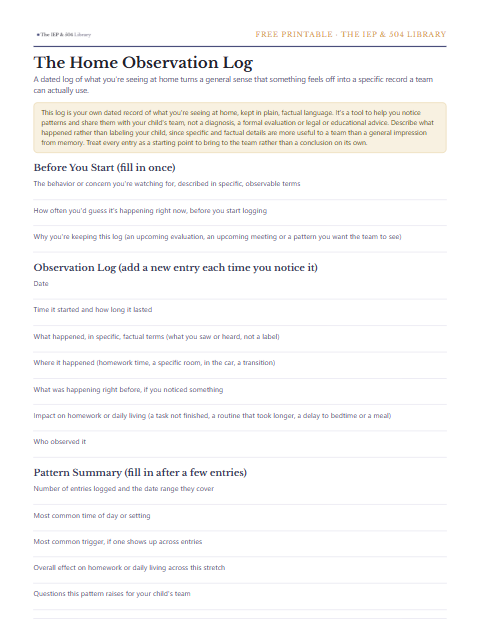
The IEP and 504 Command Center shown as a cover and a member area with its five parts: the Command Binder System, the Letter Library, the Meeting Script Deck, the Score-Your-IEP Self-Review and the Plain-Language Rights Cheat Sheet

From the team behind this library

The IEP & 504 Command Center

This printable is the map. The Command Center is the done pieces: The Command Binder System, The Letter Library, The Meeting Script Deck, The Score-Your-IEP Self-Review, The Plain-Language Rights Cheat Sheet, so you walk in organized, working from the same paperwork the team has.
See the Command Center One-time $27. Yours to keep. 60-day money-back guarantee.

Questions parents ask

Is a home log the same as a functional behavioral assessment (FBA)?

No. An FBA is a formal, structured assessment process the school conducts. Federal law requires one only in specific discipline situations, mainly when behavior that led to a disciplinary change of placement is found to be a manifestation of the child's disability, with an FBA provided as appropriate in certain other removals (34 CFR 300.530). Your home log is your own record, not a substitute for that formal process. If the team is discussing or conducting an FBA, your dated entries can still be useful context to share.

Does the school have to accept or use my log?

The team decides what evaluation data it needs and how to weigh what you bring. Federal law requires every evaluation to gather information provided by the parent (34 CFR 300.304(b)(1)) and requires the review of existing evaluation data to include what parents provide (34 CFR 300.305), so a specific, dated log is a reasonable thing to offer. The team still makes the call on how it factors in alongside everything else.

How long should I log before bringing this to a meeting?

There's no fixed federal number. A few weeks of specific, dated entries usually shows a clearer pattern than a single description from memory, so logging steadily in the weeks leading up to a meeting or evaluation tends to be more useful than one entry written the night before.

What if I can't catch every single instance?

A partial record is still useful. Log what you're able to catch as close to when it happens as you can, since specific and dated beats complete and remembered later.

Should I describe the behavior or use a label like 'meltdown' or 'defiant'?

Describe it. Write what you actually saw or heard, for example 'threw the workbook and left the table for about 10 minutes,' rather than a label like 'meltdown' or 'refused.' Specific, observable language is more useful to the team and keeps the log about what happened, not a judgment about your child.

This log is a documentation tool, not a formal functional behavioral assessment and not a request for evaluation on its own. If you want the school to start an evaluation, pair this log with a written request; see the evaluation-request letter template. Districts vary in how they prefer to receive parent-provided documentation like this log (attached to an email, brought to the meeting or added to the file directly), so it's worth asking your team how they'd like it.

Sources

What the facts on this page come from

  • IDEA, 34 CFR 300.305(a)(1)(i) (review of existing evaluation data must include evaluations and information provided by the parents, as part of an initial evaluation if appropriate and as part of any reevaluation) sites.ed.gov/idea/regs/b/d/300.305
  • IDEA, 34 CFR 300.304(b)(1) (evaluation must use a variety of assessment tools and strategies, including information provided by the parent) sites.ed.gov/idea/regs/b/d/300.304
  • IDEA, 34 CFR 300.304(b)(2) (no single measure or assessment as the sole criterion for an eligibility or program decision) sites.ed.gov/idea/regs/b/d/300.304
  • IDEA, 34 CFR 300.324(a)(1)(ii) (in developing the IEP the team must consider the concerns of the parents for enhancing the education of their child; at review the IEP is revised as appropriate to address information provided to or by the parents, 300.324(b)(1)(ii)(C)) sites.ed.gov/idea/regs/b/d/300.324
  • IDEA, 34 CFR 300.324(a)(2)(i) (IEP Team must consider positive behavioral interventions and supports when behavior impedes the child's learning or that of others) sites.ed.gov/idea/regs/b/d/300.324
  • Section 504, 34 CFR 104.35(c) (placement decisions must draw on information from a variety of sources, documented and considered) www.ecfr.gov/current/title-34/subtitle-B/chapter-I/part-104/subpart-D/section-104.35
  • IDEA, 34 CFR 300.530 (functional behavioral assessment required under (f)(1)(i) when conduct tied to a disciplinary change of placement is found to be a manifestation of the disability, unless one was already done, provided as appropriate in certain other removals under (d)(1)(ii), not a general requirement) sites.ed.gov/idea/regs/b/e/300.530

Last reviewed . That is the day this page was last read against the sources above, not the day the site was rebuilt. How this library is verified

This page is general educational information for parents, not legal or educational advice. It does not tell any family what to do. Every example here is a starting point to discuss and adapt with your child's IEP or 504 team, which decides what fits your child from the evaluation. Confirm anything time-sensitive with your school or district. For a genuinely contested situation, a special education advocate or an attorney who works in your state is the right person to ask.