How to Request an IEP Evaluation
Either you or your child's school can request an initial special education evaluation at any time. The request works best in writing. Once you give informed consent, the school generally has 60 days to complete the evaluation, though some states set their own timeline in place of the federal default. The evaluation itself has to draw on more than one source of information and cover every area where your child might need help, so the team can decide whether your child qualifies for an IEP and, if so, what it should include.

Who can request an evaluation
You can request an initial evaluation for your child at any time. So can the school itself. Neither side needs the other's permission to start the request, only to move forward with the evaluation itself.
Under 34 CFR 300.301, a parent of a child or a public agency may initiate a request for an initial evaluation to determine whether the child is a child with a disability. You do not need a diagnosis in hand or a teacher's recommendation to ask. A documented struggle at school, academic, behavioral, social or physical, is reason enough to request that the school look.
Schools also carry an independent duty. Under IDEA's child find requirement, states must identify, locate and evaluate every child with a disability who needs special education, including children who are still advancing from grade to grade (34 CFR 300.111). A child who is struggling does not have to be failing outright for the school's child find duty to apply.
How to make the request
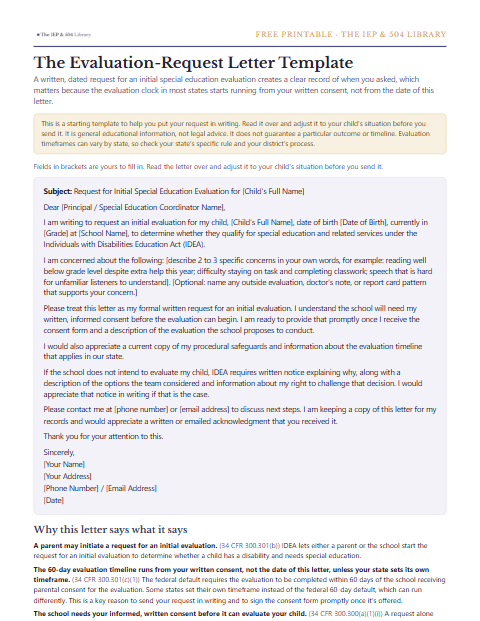
A written request, dated and sent to the school or district's special education office, creates a clear record of when you asked, which matters because it starts the clock on the response and the evaluation timeline.
IDEA does not require the request to take a specific form, but putting it in writing, even a short email or letter, gives you a dated record if the timeline ever becomes a question. Name your child, state that you are requesting an initial special education evaluation and briefly describe what you are seeing that concerns you: a teacher's comment, a pattern of struggle at home, a family history of a related condition.
Send the request to your child's school principal or, if you know it, the special education coordinator or director. Ask for written confirmation that the request was received and keep a copy for your own records.
Consent and the evaluation timeline
Before any evaluation begins, the school must get your informed written consent. Once you give consent, the school generally has 60 days to complete the evaluation, unless your state sets its own timeframe in place of that federal default.
Requesting an evaluation and consenting to one are two separate steps. The school must obtain your informed consent before conducting the evaluation (34 CFR 300.300(a)(1)). It must get a separate consent later before starting any special education services (34 CFR 300.300(b)(1)).
Once you sign consent, the school must complete the evaluation within 60 days, unless your state has established its own timeframe for completing an evaluation, in which case the state's timeframe applies instead (34 CFR 300.301(c)(1)). This is one of the few places where states genuinely vary from the federal default, so check your own state's timeline rather than assuming the 60-day figure applies where you live.
Two situations extend the clock: when you repeatedly fail or refuse to make your child available for the evaluation, or when your child transfers to a new school after the clock has started and the new school is making sufficient progress toward finishing it with an agreed completion date (34 CFR 300.301(d)).
What a comprehensive evaluation has to cover
The evaluation has to use more than one tool, look at every area where your child might need help rather than only the area you first raised. It can never rely on a single test score to decide eligibility.
The school must use a variety of assessment tools and strategies to gather relevant functional, developmental and academic information. It cannot use any single measure or assessment as the sole basis for deciding whether your child has a disability (34 CFR 300.304(b)). The evaluation has to be comprehensive enough to identify all of your child's special education and related service needs, not only the one that prompted the request (34 CFR 300.304(c)(6)). It must assess specific areas of educational need rather than produce only a single general intelligence score (34 CFR 300.304(c)(2)).
Depending on what is being evaluated, that can mean looking at health, vision and hearing, social and emotional status, general intelligence, academic performance, communication and motor abilities. A group of qualified professionals and you, as the parent, together decide eligibility from that evaluation data. The school must give you a free copy of both the evaluation report and the eligibility decision (34 CFR 300.306).
If the school refuses to evaluate
If the school decides not to evaluate your child, it has to tell you in writing, explain why and describe what other options it considered, using the same prior written notice rule that applies to every other proposal or refusal under IDEA.
A refusal to evaluate is still a decision the school has to explain. Prior written notice under 34 CFR 300.503 requires the school to describe the action it is refusing to take, explain the reasons, list the evaluation data or other information it relied on and describe any other options the team considered and why it rejected them.
That written notice is your starting point if you want to take the matter further. It also tells you what evidence the school says it is missing, often the fastest way to figure out what additional information, a teacher's data, an outside provider's report or your own written observations, would change the answer.
If you disagree with the evaluation results
You have the right to an independent educational evaluation at public expense if you disagree with the school's evaluation, though the school can instead go to a due process hearing to defend its own evaluation as appropriate.
Under 34 CFR 300.502(b), if you disagree with an evaluation the school obtained, you can ask for an independent educational evaluation (IEE) at public expense. The school then has two options: pay for the independent evaluation, or file a due process complaint to try to show its own evaluation was appropriate. If the school wins that hearing, you still have the right to an independent evaluation, just not at the school's cost.
You are entitled to one publicly funded independent evaluation each time the school conducts an evaluation you disagree with. The school cannot require you to explain your disagreement before honoring the request or filing for a hearing (34 CFR 300.502(b)(4) and (b)(5)).

From the team behind this library
The IEP & 504 Command Center
This page shows the options to discuss. The Command Center hands you the done pieces: the binder built, the letters written, the meeting scripts ready and a self-review that shows where your child's plan is strong or thin. The library stays free.