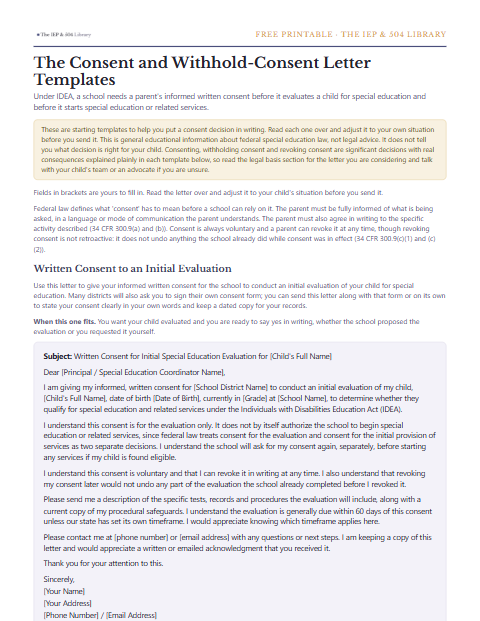
The Consent and Withhold-Consent Letter Templates (Free Printable)
What are the Consent and Withhold-Consent Letter Templates?
Under IDEA, a school needs a parent's informed written consent before it evaluates a child for special education and before it starts special education or related services. A parent can withhold that consent or revoke it later in writing. This page has three letter templates: giving written consent to an initial evaluation, withholding or declining consent to an initial evaluation and revoking consent for special education and related services your child is already receiving. Each template states the legally load-bearing sentences in plain language and cites the federal regulation behind them, so you know exactly what you are agreeing to, declining or ending before you send it.

How to use it
Pick the template that matches your situation, fill in the bracketed details in your own words and remove anything that does not apply. Read the legal basis notes under each template before you send it, since consenting, withholding and revoking each carry their own, genuinely different consequences. Send whichever letter you choose in a way that gives you a dated record (email, certified mail or a hand-delivered copy signed by the school) and keep a copy for yourself.
What is on the printable
Fields in brackets are yours to fill in. Read the letter over and adjust it to your child's situation before you send it.
Written Consent to an Initial Evaluation
Use this letter to give your informed written consent for the school to conduct an initial evaluation of your child for special education. Many districts will also ask you to sign their own consent form; you can send this letter along with that form or on its own to state your consent clearly in your own words and keep a dated copy for your records.
| A school must obtain a parent's informed written consent before conducting an initial evaluation. 34 CFR 300.300(a)(1)(i) | Before evaluating a child for the first time, the school has to give the parent notice and then get informed consent in writing. Without that consent, the evaluation cannot go forward. |
|---|---|
| Consent for the initial evaluation is not the same as consent for special education and related services. 34 CFR 300.300(a)(1)(ii) | Saying yes to the evaluation only agrees to the testing and assessment process. The school has to come back and ask for separate written consent before it can actually start special education or related services, even if the evaluation finds your child eligible. |
| Consent is voluntary and can be revoked at any time, though revoking it later does not undo evaluation steps already completed. 34 CFR 300.9(c)(1) and (c)(2) | Federal law builds voluntariness into the definition of consent itself. You can change your mind after giving consent, but that change only affects what happens going forward. It does not cancel testing that already took place while your consent was in effect. |
| The evaluation is generally due within 60 days of consent, unless the state has set its own timeframe. 34 CFR 300.301(c)(1) | The federal default gives the school 60 calendar days from the date it receives your written consent to complete the evaluation. A number of states set their own timeframe instead, so it is worth confirming which rule your state and district follow. |
Before you send this one
- This letter states your consent in your own words. Many districts will still want their own consent form signed too, so ask whether one is needed alongside this letter.
- Saying yes to the evaluation does not commit you to saying yes to services afterward. That is a separate decision you make once you see the evaluation results.
- Keep a signed and dated copy of whatever consent form or letter you send. The evaluation timeline usually starts counting from the date the school receives your consent.
Withholding or Declining Consent to an Initial Evaluation
Use this letter if you do not want the school to move forward with a proposed initial evaluation right now, or if you want to formally decline consent after a referral. You do not have to give a reason, though many parents choose to explain their thinking.
| A school needs a parent's informed written consent before it can conduct an initial evaluation. 34 CFR 300.300(a)(1)(i) | Without your consent, the evaluation itself cannot happen, so withholding consent is enough on its own to stop the evaluation from moving forward unless the school pursues an override. |
|---|---|
| If a parent does not consent, the school may try to override that decision through mediation or a due process hearing, but it is not required to. 34 CFR 300.300(a)(3)(i) | Federal law gives the school this option. It does not require the school to use it. Whether a district pursues an override is a district-level decision. This option does not apply where it would be inconsistent with your own state's consent law. It also exists only for a child enrolled in public school or seeking to be enrolled in public school; if your child is home schooled or placed in private school at your own expense, the district may not use these override procedures at all (34 CFR 300.300(d)(4)). |
| A school does not violate its evaluation or child-find obligations by choosing not to pursue an override when a parent withholds consent. 34 CFR 300.300(a)(3)(ii) | If the district decides not to seek an override, that decision itself is not treated as a legal violation. In practice, that generally means the evaluation simply does not happen unless you ask again or the school pursues the override option. |
| Consent is voluntary. Withholding it now does not waive the right to request an evaluation again later. 34 CFR 300.9(c)(1) | Nothing about withholding consent today closes the door permanently. You can request an evaluation again whenever you are ready. |
| Either a parent or the school can start a new request for an initial evaluation at any time. 34 CFR 300.301(b) | Requesting an evaluation is not a one-time opportunity. If your thinking changes later, you or the school can start a new request the same way the first one started. |
Before you send this one
- You do not have to give a reason for withholding consent. A brief explanation can help keep the conversation with the school open if you are willing to share one.
- Withholding consent is not the same as never being able to request an evaluation. You can ask again whenever you are ready, in writing.
- If you are unsure rather than fully decided, consider asking for a meeting to discuss your concerns before you decide. Unless the district pursues the override route described above, the school cannot evaluate without your consent, so there is no rush forced on you by federal law alone, though your state's own process may have its own steps worth knowing about.
Revoking Consent for Continued Special Education and Related Services
Use this letter if your child is already receiving special education and related services under an IEP and you want to formally stop those services going forward. This is a significant decision. Read the legal basis section below carefully before you send it.
| A parent who previously consented to services can revoke that consent in writing at any time for the continued provision of special education and related services. 34 CFR 300.300(b)(4) | This is the specific provision that lets a parent stop services the child is already receiving. It is separate from the rules about consenting to services in the first place. |
|---|---|
| Once the school receives a written revocation, it may not continue the services, but it must send prior written notice before actually ceasing them. 34 CFR 300.300(b)(4)(i) and 34 CFR 300.503 | The school cannot simply stop services the moment it reads your letter. It has to send you a written notice first, explaining the change, before services actually end. |
| The school cannot use mediation or a due process hearing to try to keep providing services after a parent revokes consent in writing. 34 CFR 300.300(b)(4)(ii) | This runs the opposite direction from the initial-evaluation rule, where the school is allowed to try an override. Here, the school is specifically barred from trying to override your written revocation through those procedures. |
| Stopping services after a written revocation is not treated as the school failing to provide a free appropriate public education. 34 CFR 300.300(b)(4)(iii) | This provision protects the school from being found in violation for stopping services you asked it to stop in writing. |
| The school does not have to hold an IEP meeting or write a new IEP for further services once a parent revokes consent. 34 CFR 300.300(b)(4)(iv) | The usual annual IEP meeting cycle does not continue for services that are no longer being provided at the parent's written request. |
| Revoking consent is not retroactive. 34 CFR 300.9(c)(2) | Whatever your child received before this letter stays as part of their educational history. This revocation only changes what happens from the effective date forward. It does not undo anything that already happened. |
| The school is not required to amend the child's educational records to remove references to their past special education services because a parent revoked consent. 34 CFR 300.9(c)(3) | Revoking consent stops future services. It does not erase the record that your child received special education and related services in the past, so do not expect old IEPs or service records to disappear from your child's file. |
Before you send this one
- This is one of the more significant letters on this page. Once the school acts on it, your child's IEP team is not required to meet or write a new IEP to keep services going. Consider talking it through with your child's team, an advocate or another trusted source before you send it, even though you are not required to.
- Revoking consent stops services from the date you choose forward. It does not erase your child's history of receiving special education or remove that history from their file.
- If you change your mind later, you can ask for services again in writing. The district may treat that as a fresh look rather than simply restarting the old IEP, so be ready for that step even if your child was found eligible before.
- If only one parent wants to revoke consent and the other does not agree, that is a family decision to work through together or through your own legal channels. Ask the school how it handles a written revocation from one parent when parents do not agree, since that is worth raising with the district directly rather than assuming an answer.
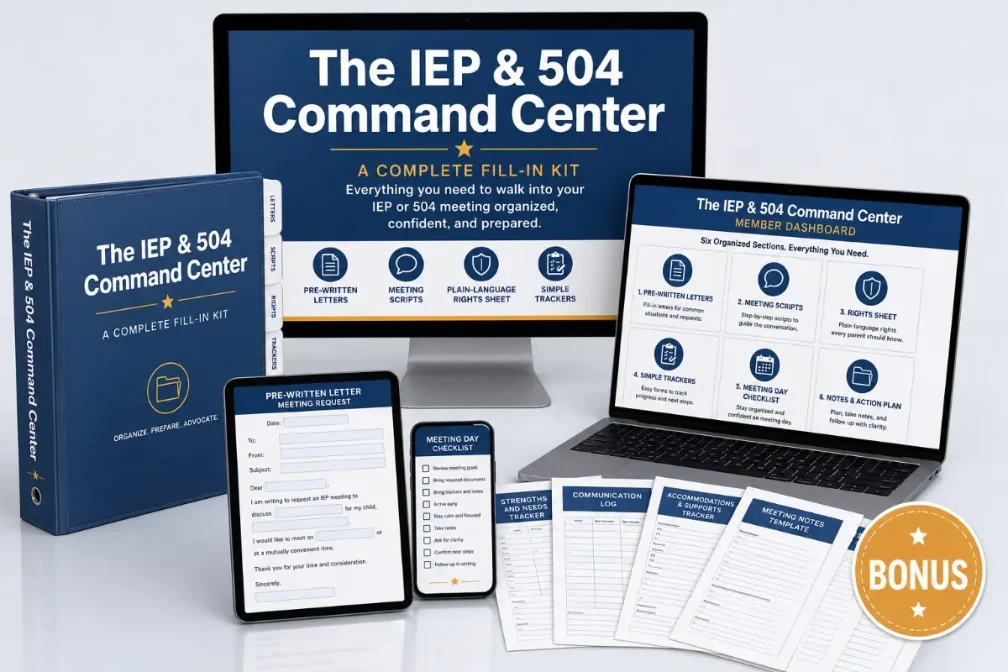
From the team behind this library
The IEP & 504 Command Center
This printable is the map. The Command Center is the done pieces: The Command Binder System, The Letter Library, The Meeting Script Deck, The Score-Your-IEP Self-Review, The Plain-Language Rights Cheat Sheet, so you walk in organized, working from the same paperwork the team has.