The Accommodation Selector
Filter 105 accommodation options by the barrier you see, the task it shows up in and where it happens, then build a short list to raise with your child's team.
How to use it
- Narrow the list with the three filters. The barrier you see, the task it shows up in and the setting it happens in. Leave any of them on All.
- Tick the options worth raising. Each one carries the fields a plan has to fill in beside it: who would carry it out, where and how often.
- Set a review date, then copy or print your list. Take it to the meeting as a starting point. The team decides what fits your child.
Narrow the options
Pick whichever filters fit. Anything left on All stays wide open.
Private by design. Every option is already in this page when it loads, so the filtering and the ticking happen in your browser. Nothing you tick or type is transmitted or stored. The only thing that ever leaves this page is an email address you choose to type into the free-printable form below.
The options, grouped by type
Showing the options that match your filters. Tick any of them to build your list.
Presentation
Directions given one step at a time, repeated or written down
- Who would carry it out
- The classroom teacher
- Where and how often
- In every class where multi-step directions are given, every day
- Review date
- A date the team sets, then checks against
Where this option is described: This library's own verified accommodations pages, where this option is already published with its sources
A printed copy of board notes, slides or a study guide, so less has to be copied down
- Who would carry it out
- The subject teacher, prepared before the lesson
- Where and how often
- In each subject where notes are given from the board
- Review date
- A date the team sets, then checks against
Where this option is described: This library's own verified accommodations pages, where this option is already published with its sources
Text read aloud or provided in audio, including audiobooks and text-to-speech
- Who would carry it out
- The classroom teacher, with whoever sets up accessible materials at the school
- Where and how often
- In every subject where the reading load is the barrier
- Review date
- A date the team sets, then checks against
Where this option is described: This library's own verified accommodations pages, where this option is already published with its sources
Fewer items on a page, larger print or key text highlighted
- Who would carry it out
- The teacher who prepares the material
- Where and how often
- On worksheets, tests and any dense handout
- Review date
- A date the team sets, then checks against
Where this option is described: This library's own verified accommodations pages, where this option is already published with its sources
A visual schedule, a written agenda or a graphic organizer for new material
- Who would carry it out
- The classroom teacher
- Where and how often
- Posted daily, then again for each new topic
- Review date
- A date the team sets, then checks against
Where this option is described: This library's own verified accommodations pages, where this option is already published with its sources
A written or visual checklist beside spoken instructions for a multi-step task
- Who would carry it out
- The classroom teacher
- Where and how often
- For any task with more than two steps
- Review date
- A date the team sets, then checks against
Where this option is described: This library's own verified accommodations pages, where this option is already published with its sources
Long assignments broken into smaller steps, each with its own due date
- Who would carry it out
- The subject teacher, agreed with the student
- Where and how often
- On every project longer than one lesson
- Review date
- A date the team sets, then checks against
Where this option is described: This library's own verified accommodations pages, where this option is already published with its sources
Concrete, literal wording in instructions, with idioms explained
- Who would carry it out
- Every adult who gives the student instructions
- Where and how often
- All day, every day
- Review date
- A date the team sets, then checks against
Where this option is described: This library's own verified accommodations pages, where this option is already published with its sources
Advance notice and a visual warning before a transition or a change to the schedule
- Who would carry it out
- The classroom teacher, with the front office for whole-school changes
- Where and how often
- Before every transition, plus as soon as a schedule change is known
- Review date
- A date the team sets, then checks against
Where this option is described: This library's own verified accommodations pages, where this option is already published with its sources
The teacher checks for understanding before independent work starts
- Who would carry it out
- The classroom teacher
- Where and how often
- At the start of independent work in each lesson
- Review date
- A date the team sets, then checks against
Where this option is described: This library's own verified accommodations pages, where this option is already published with its sources
Key routines kept consistent and predictable
- Who would carry it out
- The classroom teacher and any adult covering the class
- Where and how often
- Every day, including on days with a substitute
- Review date
- A date the team sets, then checks against
Where this option is described: This library's own verified accommodations pages, where this option is already published with its sources
A reading guide or a highlighter strip to keep track of the line
- Who would carry it out
- The classroom teacher, with a copy kept at home
- Where and how often
- For any extended reading
- Review date
- A date the team sets, then checks against
Where this option is described: This library's own verified accommodations pages, where this option is already published with its sources
Test directions clarified, simplified or repeated before the test starts
- Who would carry it out
- The test administrator
- Where and how often
- At the start of every test session, including state assessments
- Review date
- A date the team sets, then checks against
Where this option is described: National Center on Educational Outcomes (University of Minnesota), Accommodations Toolkit (the research and state-policy summaries for individual testing accommodations)
Response
Answers typed rather than handwritten where handwriting is the barrier
- Who would carry it out
- The subject teacher, with the school device contact
- Where and how often
- On written work in every subject
- Review date
- A date the team sets, then checks against
Where this option is described: This library's own verified accommodations pages, where this option is already published with its sources
Speech-to-text, dictation or a scribe where writing is the barrier
- Who would carry it out
- The subject teacher, or a named adult acting as scribe
- Where and how often
- On longer written work and on tests, agreed subject by subject
- Review date
- A date the team sets, then checks against
Where this option is described: This library's own verified accommodations pages, where this option is already published with its sources
Answers given out loud in place of written ones on some assignments
- Who would carry it out
- The subject teacher
- Where and how often
- On assignments the teacher and student agree in advance
- Review date
- A date the team sets, then checks against
Where this option is described: This library's own verified accommodations pages, where this option is already published with its sources
Answers marked in the test booklet instead of on a separate answer sheet
- Who would carry it out
- The test administrator
- Where and how often
- On every test with a separate answer sheet
- Review date
- A date the team sets, then checks against
Where this option is described: This library's own verified accommodations pages, where this option is already published with its sources
Spelling not counted on work that is not testing spelling
- Who would carry it out
- Each subject teacher, written into how the work is marked
- Where and how often
- On all written work outside spelling assessments
- Review date
- A date the team sets, then checks against
Where this option is described: This library's own verified accommodations pages, where this option is already published with its sources
A calculator, spell checker, word bank or word-prediction tool where it does not change what is being measured
- Who would carry it out
- The subject teacher, with the test administrator for assessments
- Where and how often
- In class and on tests, named tool by tool
- Review date
- A date the team sets, then checks against
Where this option is described: This library's own verified accommodations pages, where this option is already published with its sources
A graphic organizer or a template provided for writing tasks
- Who would carry it out
- The subject teacher
- Where and how often
- On every extended piece of writing
- Review date
- A date the team sets, then checks against
Where this option is described: This library's own verified accommodations pages, where this option is already published with its sources
Room to answer in the student's usual way of communicating, including a communication device or picture support
- Who would carry it out
- Every adult who works with the student, with the speech-language provider
- Where and how often
- All day, in every setting
- Review date
- A date the team sets, then checks against
Where this option is described: This library's own verified accommodations pages, where this option is already published with its sources
Different ways to show understanding beyond written work
- Who would carry it out
- The subject teacher
- Where and how often
- At least once per unit, agreed in advance
- Review date
- A date the team sets, then checks against
Where this option is described: This library's own verified accommodations pages, where this option is already published with its sources
Extra processing time before an answer is expected
- Who would carry it out
- Every adult who asks the student questions
- Where and how often
- All day, every day
- Review date
- A date the team sets, then checks against
Where this option is described: This library's own verified accommodations pages, where this option is already published with its sources
The student reads the test aloud to themselves in a space where that does not disturb others
- Who would carry it out
- The test administrator, with a separate room booked
- Where and how often
- On tests where reading is the barrier
- Review date
- A date the team sets, then checks against
Where this option is described: National Center on Educational Outcomes (University of Minnesota), Accommodations Toolkit (the research and state-policy summaries for individual testing accommodations)
Setting
Seating away from high-traffic or high-distraction areas
- Who would carry it out
- The classroom teacher, reviewed when the seating plan changes
- Where and how often
- In every classroom, all year
- Review date
- A date the team sets, then checks against
Where this option is described: This library's own verified accommodations pages, where this option is already published with its sources
Seating near the teacher for easy check-ins
- Who would carry it out
- The classroom teacher
- Where and how often
- In every classroom, all year
- Review date
- A date the team sets, then checks against
Where this option is described: This library's own verified accommodations pages, where this option is already published with its sources
A reduced-distraction or separate space for tests
- Who would carry it out
- The test administrator, with the room booked in advance
- Where and how often
- On every test, including state and district assessments
- Review date
- A date the team sets, then checks against
Where this option is described: This library's own verified accommodations pages, where this option is already published with its sources
Small-group or individual test administration
- Who would carry it out
- The test administrator
- Where and how often
- On every test, named on the plan
- Review date
- A date the team sets, then checks against
Where this option is described: This library's own verified accommodations pages, where this option is already published with its sources
A quieter, lower-stimulation seating area
- Who would carry it out
- The classroom teacher
- Where and how often
- All day, in each room the student uses
- Review date
- A date the team sets, then checks against
Where this option is described: This library's own verified accommodations pages, where this option is already published with its sources
Access to a calm or quiet space when it is needed
- Who would carry it out
- A named adult who holds the space, with every teacher told the arrangement
- Where and how often
- Available all day, on the student's request
- Review date
- A date the team sets, then checks against
Where this option is described: This library's own verified accommodations pages, where this option is already published with its sources
Reduced background noise or visual clutter at the workspace
- Who would carry it out
- The classroom teacher
- Where and how often
- All year, checked when the room is rearranged
- Review date
- A date the team sets, then checks against
Where this option is described: This library's own verified accommodations pages, where this option is already published with its sources
Noise-reducing headphones available
- Who would carry it out
- The classroom teacher, with the school or the family supplying the pair
- Where and how often
- Available all day, used at the student's choice
- Review date
- A date the team sets, then checks against
Where this option is described: This library's own verified accommodations pages, where this option is already published with its sources
Less intense lighting, or seating away from bright or flickering light
- Who would carry it out
- The classroom teacher, with the facilities team where a fitting has to change
- Where and how often
- In each room the student uses
- Review date
- A date the team sets, then checks against
Where this option is described: Mallory C and Keehn B, Implications of Sensory Processing and Attentional Differences Associated With Autism in Academic Settings: An Integrative Review, Frontiers in Psychiatry (August 27, 2021). Peer-reviewed research rather than agency guidance
A defined personal space or an agreed seating arrangement
- Who would carry it out
- The classroom teacher
- Where and how often
- All year
- Review date
- A date the team sets, then checks against
Where this option is described: This library's own verified accommodations pages, where this option is already published with its sources
A room divider or an individual screen at the workspace
- Who would carry it out
- The classroom teacher
- Where and how often
- During independent work and tests
- Review date
- A date the team sets, then checks against
Where this option is described: Mallory C and Keehn B, Implications of Sensory Processing and Attentional Differences Associated With Autism in Academic Settings: An Integrative Review, Frontiers in Psychiatry (August 27, 2021). Peer-reviewed research rather than agency guidance
A desk placed so the student is not facing windows or other outside distractions
- Who would carry it out
- The classroom teacher
- Where and how often
- In every room, all year
- Review date
- A date the team sets, then checks against
Where this option is described: Mallory C and Keehn B, Implications of Sensory Processing and Attentional Differences Associated With Autism in Academic Settings: An Integrative Review, Frontiers in Psychiatry (August 27, 2021). Peer-reviewed research rather than agency guidance
Flexible or alternative seating where it helps the student settle
- Who would carry it out
- The classroom teacher, with the occupational therapist where one is involved
- Where and how often
- All day, in each room the student uses
- Review date
- A date the team sets, then checks against
Where this option is described: Mallory C and Keehn B, Implications of Sensory Processing and Attentional Differences Associated With Autism in Academic Settings: An Integrative Review, Frontiers in Psychiatry (August 27, 2021). Peer-reviewed research rather than agency guidance
A locker placed away from the busiest stretch of hallway
- Who would carry it out
- The front office, when lockers are assigned
- Where and how often
- For the school year
- Review date
- A date the team sets, then checks against
Where this option is described: Mallory C and Keehn B, Implications of Sensory Processing and Attentional Differences Associated With Autism in Academic Settings: An Integrative Review, Frontiers in Psychiatry (August 27, 2021). Peer-reviewed research rather than agency guidance
Noise reduction in the test room
- Who would carry it out
- The test administrator
- Where and how often
- On every test session
- Review date
- A date the team sets, then checks against
Where this option is described: National Center on Educational Outcomes (University of Minnesota), Accommodations Toolkit (the research and state-policy summaries for individual testing accommodations)
A test given by an adult the student already knows
- Who would carry it out
- The test administrator, named in advance
- Where and how often
- On every test session where it is agreed
- Review date
- A date the team sets, then checks against
Where this option is described: National Center on Educational Outcomes (University of Minnesota), Accommodations Toolkit (the research and state-policy summaries for individual testing accommodations)
Timing and scheduling
Extended time on tests and quizzes
- Who would carry it out
- The subject teacher and the test administrator
- Where and how often
- On every test, with the amount of extra time written down rather than left open
- Review date
- A date the team sets, then checks against
Where this option is described: This library's own verified accommodations pages, where this option is already published with its sources
Extended time on written work and reading assignments
- Who would carry it out
- Each subject teacher
- Where and how often
- On assignments in every subject
- Review date
- A date the team sets, then checks against
Where this option is described: This library's own verified accommodations pages, where this option is already published with its sources
Short movement or reset breaks between tasks
- Who would carry it out
- The classroom teacher
- Where and how often
- At agreed points in the day, or on the student's signal
- Review date
- A date the team sets, then checks against
Where this option is described: This library's own verified accommodations pages, where this option is already published with its sources
A long task or a test split across sessions rather than one long block
- Who would carry it out
- The subject teacher and the test administrator
- Where and how often
- On long tasks and any test over one period
- Review date
- A date the team sets, then checks against
Where this option is described: This library's own verified accommodations pages, where this option is already published with its sources
A test taken over more than one day where the rules for that assessment allow it
- Who would carry it out
- The test administrator, checked against the assessment's own rules
- Where and how often
- On long assessments, confirmed before the test window
- Review date
- A date the team sets, then checks against
Where this option is described: National Center on Educational Outcomes (University of Minnesota), Accommodations Toolkit (the research and state-policy summaries for individual testing accommodations)
A break card or an agreed signal the student can use to ask for a break
- Who would carry it out
- Every teacher the student works with, told about the signal
- Where and how often
- Available all day, in every class
- Review date
- A date the team sets, then checks against
Where this option is described: This library's own verified accommodations pages, where this option is already published with its sources
A predictable daily schedule with advance notice of any change
- Who would carry it out
- The classroom teacher, with the office for whole-school changes
- Where and how often
- Every day
- Review date
- A date the team sets, then checks against
Where this option is described: This library's own verified accommodations pages, where this option is already published with its sources
A visible timer or a countdown cue before a transition
- Who would carry it out
- The classroom teacher
- Where and how often
- Before every transition
- Review date
- A date the team sets, then checks against
Where this option is described: This library's own verified accommodations pages, where this option is already published with its sources
Flexibility on a homework deadline when it is needed
- Who would carry it out
- Each subject teacher, with how it is requested written down
- Where and how often
- As needed, within limits the team agrees
- Review date
- A date the team sets, then checks against
Where this option is described: This library's own verified accommodations pages, where this option is already published with its sources
Extended time between classes
- Who would carry it out
- The front office, with every teacher told the arrangement
- Where and how often
- At every passing time
- Review date
- A date the team sets, then checks against
Where this option is described: U.S. Department of Education, Office for Civil Rights, The Civil Rights of Students With Hidden Disabilities and Section 504 (last reviewed August 21, 2025)
A class schedule adjusted to leave time for regular counseling or therapy
- Who would carry it out
- The counselor or the person who builds the timetable
- Where and how often
- For the term or the year, reviewed when the appointment pattern changes
- Review date
- A date the team sets, then checks against
Where this option is described: U.S. Department of Education, Office for Civil Rights, The Civil Rights of Students With Hidden Disabilities and Section 504 (last reviewed August 21, 2025)
A schedule adjusted around medical treatment, with a plan for the work that is missed
- Who would carry it out
- The school nurse and the classroom teacher together
- Where and how often
- For as long as the treatment runs
- Review date
- A date the team sets, then checks against
Where this option is described: U.S. Department of Education, Office for Civil Rights, The Civil Rights of Students With Hidden Disabilities and Section 504 (last reviewed August 21, 2025)
An agreed adjustment for a long test or a competitive activity where stress is a trigger for the student's condition
- Who would carry it out
- The subject teacher and the school nurse, agreed before the activity
- Where and how often
- Named activity by activity, ahead of time
- Review date
- A date the team sets, then checks against
Where this option is described: U.S. Department of Education, Office for Civil Rights, The Civil Rights of Students With Hidden Disabilities and Section 504 (last reviewed August 21, 2025)
A temporary reduction in the thinking load while a student recovers, stepped back up as they improve
- Who would carry it out
- The subject teachers, with the school nurse tracking the recovery
- Where and how often
- Reviewed weekly while recovery lasts
- Review date
- A date the team sets, then checks against
Where this option is described: American Academy of Pediatrics, HealthyChildren.org, After a Concussion: When to Return to School (last updated December 5, 2024)
The plan says what happens on the days the condition is active, not only on the day the plan was written
- Who would carry it out
- The whole team, written into the plan
- Where and how often
- Standing, for as long as the plan runs
- Review date
- A date the team sets, then checks against
Organization and materials
A daily or weekly planner or assignment checklist, checked by an adult
- Who would carry it out
- A named adult at school, with the family checking at home
- Where and how often
- Checked at the end of each day
- Review date
- A date the team sets, then checks against
Where this option is described: This library's own verified accommodations pages, where this option is already published with its sources
A second set of textbooks or materials kept at home
- Who would carry it out
- The subject teacher, arranged at the start of the year
- Where and how often
- For the school year
- Review date
- A date the team sets, then checks against
Where this option is described: This library's own verified accommodations pages, where this option is already published with its sources
A designated adult who checks in on organization and materials
- Who would carry it out
- One named adult, with a backup named for absences
- Where and how often
- At an agreed point each day
- Review date
- A date the team sets, then checks against
Where this option is described: This library's own verified accommodations pages, where this option is already published with its sources
A consistent system for turning in completed work
- Who would carry it out
- Each subject teacher, using the same system across subjects
- Where and how often
- Every assignment
- Review date
- A date the team sets, then checks against
Where this option is described: This library's own verified accommodations pages, where this option is already published with its sources
A home-school communication log for assignments and deadlines
- Who would carry it out
- The classroom teacher, with the family replying
- Where and how often
- Daily or weekly, at a cadence the team sets
- Review date
- A date the team sets, then checks against
Where this option is described: This library's own verified accommodations pages, where this option is already published with its sources
A designated peer buddy or check-in partner
- Who would carry it out
- The classroom teacher, with the partner agreed rather than assigned
- Where and how often
- Reviewed each term
- Review date
- A date the team sets, then checks against
Where this option is described: This library's own verified accommodations pages, where this option is already published with its sources
Structured, adult-supported time with other students
- Who would carry it out
- The counselor or the classroom teacher
- Where and how often
- At an agreed point each week
- Review date
- A date the team sets, then checks against
Where this option is described: This library's own verified accommodations pages, where this option is already published with its sources
Agreed sensory tools, a fidget, a standing desk or a wobble seat where they help
- Who would carry it out
- The classroom teacher, with the occupational therapist where one is involved
- Where and how often
- Available all day
- Review date
- A date the team sets, then checks against
Where this option is described: This library's own verified accommodations pages, where this option is already published with its sources
Communication access
A qualified interpreter working in the student's own language and communication mode
- Who would carry it out
- The district staff member who books interpreters
- Where and how often
- Every lesson and every school activity where speech carries the content
- Review date
- A date the team sets, then checks against
Where this option is described: U.S. Department of Education and U.S. Department of Justice, Frequently Asked Questions on Effective Communication for Students with Hearing, Vision, or Speech Disabilities in Public Elementary and Secondary Schools (the joint list of auxiliary aids and services)
Real-time captioning of instruction, sometimes called CART
- Who would carry it out
- The district staff member who arranges the service
- Where and how often
- In every class where instruction is spoken
- Review date
- A date the team sets, then checks against
Where this option is described: U.S. Department of Education and U.S. Department of Justice, Frequently Asked Questions on Effective Communication for Students with Hearing, Vision, or Speech Disabilities in Public Elementary and Secondary Schools (the joint list of auxiliary aids and services)
A note taker, or written copies of what is delivered out loud
- Who would carry it out
- The subject teacher, with the note taker named
- Where and how often
- In every class with spoken instruction
- Review date
- A date the team sets, then checks against
Where this option is described: U.S. Department of Education and U.S. Department of Justice, Frequently Asked Questions on Effective Communication for Students with Hearing, Vision, or Speech Disabilities in Public Elementary and Secondary Schools (the joint list of auxiliary aids and services)
An assistive listening system in the classroom, with staff trained to use it
- Who would carry it out
- The subject teacher wearing the microphone, with the educational audiologist setting it up
- Where and how often
- Every lesson, checked at the start of each term
- Review date
- A date the team sets, then checks against
Where this option is described: U.S. Department of Education and U.S. Department of Justice, Frequently Asked Questions on Effective Communication for Students with Hearing, Vision, or Speech Disabilities in Public Elementary and Secondary Schools (the joint list of auxiliary aids and services)
Open or closed captions on every video used in class
- Who would carry it out
- The teacher who chooses the video, checked before the lesson
- Where and how often
- Every video, every time
- Review date
- A date the team sets, then checks against
Where this option is described: U.S. Department of Education and U.S. Department of Justice, Frequently Asked Questions on Effective Communication for Students with Hearing, Vision, or Speech Disabilities in Public Elementary and Secondary Schools (the joint list of auxiliary aids and services)
An exchange of written material where speaking is the barrier
- Who would carry it out
- Every adult who works with the student
- Where and how often
- Whenever information is given out loud
- Review date
- A date the team sets, then checks against
Where this option is described: U.S. Department of Education and U.S. Department of Justice, Frequently Asked Questions on Effective Communication for Students with Hearing, Vision, or Speech Disabilities in Public Elementary and Secondary Schools (the joint list of auxiliary aids and services)
Chances to talk directly with classmates and staff in the student's own language and communication mode, not only through an adult
- Who would carry it out
- The whole team, considered when the placement is decided
- Where and how often
- Across the school day, reviewed at each meeting
- Review date
- A date the team sets, then checks against
Where this option is described: U.S. Department of Education, OSEP Dear Colleague Letter on Meeting the Communication Needs of Students with Hearing, Vision, or Speech Disabilities (November 12, 2014)
A test delivered in sign
- Who would carry it out
- The test administrator, with a qualified interpreter booked
- Where and how often
- On every test, checked against that assessment's rules
- Review date
- A date the team sets, then checks against
Where this option is described: National Center on Educational Outcomes (University of Minnesota), Accommodations Toolkit (the research and state-policy summaries for individual testing accommodations)
Accessible formats and technology
Large-print materials and a large-print test form
- Who would carry it out
- Whoever produces accessible materials at the school, ordered ahead of time
- Where and how often
- Every handout and every test
- Review date
- A date the team sets, then checks against
Where this option is described: U.S. Department of Education and U.S. Department of Justice, Frequently Asked Questions on Effective Communication for Students with Hearing, Vision, or Speech Disabilities in Public Elementary and Secondary Schools (the joint list of auxiliary aids and services)
Braille materials, a refreshable braille display or tactile graphics
- Who would carry it out
- The teacher of students with visual impairments, with materials ordered ahead of the unit
- Where and how often
- Every text and every test, with lead time agreed
- Review date
- A date the team sets, then checks against
Where this option is described: U.S. Department of Education and U.S. Department of Justice, Frequently Asked Questions on Effective Communication for Students with Hearing, Vision, or Speech Disabilities in Public Elementary and Secondary Schools (the joint list of auxiliary aids and services)
Instruction in braille and the use of braille, unless the team decides from the evaluation that it is not appropriate for this child
- Who would carry it out
- The teacher of students with visual impairments
- Where and how often
- On the schedule the team writes into the plan
- Review date
- A date the team sets, then checks against
Where this option is described: American Foundation for the Blind, Educating Blind and Visually Impaired Students: Policy Guidance from OSERS (the braille presumption, assistive technology consideration and orientation and mobility instruction)
Screen reader or magnification software on the device the student uses
- Who would carry it out
- The school technology contact, with the teacher checking it works in each subject
- Where and how often
- On every device the student uses, checked each term
- Review date
- A date the team sets, then checks against
Where this option is described: U.S. Department of Education and U.S. Department of Justice, Frequently Asked Questions on Effective Communication for Students with Hearing, Vision, or Speech Disabilities in Public Elementary and Secondary Schools (the joint list of auxiliary aids and services)
Audio recordings of the assigned material, paired with the print text
- Who would carry it out
- Whoever sources accessible materials, ordered before the unit starts
- Where and how often
- For each text the class is set
- Review date
- A date the team sets, then checks against
Where this option is described: U.S. Department of Education and U.S. Department of Justice, Frequently Asked Questions on Effective Communication for Students with Hearing, Vision, or Speech Disabilities in Public Elementary and Secondary Schools (the joint list of auxiliary aids and services)
A qualified reader for material that is not available in an accessible format
- Who would carry it out
- A named adult, with a backup named for absences
- Where and how often
- Whenever an accessible copy is not ready
- Review date
- A date the team sets, then checks against
Where this option is described: U.S. Department of Education and U.S. Department of Justice, Frequently Asked Questions on Effective Communication for Students with Hearing, Vision, or Speech Disabilities in Public Elementary and Secondary Schools (the joint list of auxiliary aids and services)
Higher color contrast on printed and on-screen material
- Who would carry it out
- The teacher who prepares the material, with the technology contact for device settings
- Where and how often
- On every handout and every screen the student uses
- Review date
- A date the team sets, then checks against
Where this option is described: National Center on Educational Outcomes (University of Minnesota), Accommodations Toolkit (the research and state-policy summaries for individual testing accommodations)
Assistive technology devices and services considered by the team, including use of a school device at home where the team decides the student needs it
- Who would carry it out
- The whole team, with the technology contact setting it up
- Where and how often
- Considered at every review, reviewed when the device or the need changes
- Review date
- A date the team sets, then checks against
Where this option is described: American Foundation for the Blind, Educating Blind and Visually Impaired Students: Policy Guidance from OSERS (the braille presumption, assistive technology consideration and orientation and mobility instruction)
Text-to-speech, speech-to-text and word prediction available in class and on tests where they do not change what is being measured
- Who would carry it out
- The technology contact, with the test administrator confirming what is allowed
- Where and how often
- Every day in class, plus on tests where the rules allow it
- Review date
- A date the team sets, then checks against
Where this option is described: This library's own verified accommodations pages, where this option is already published with its sources
Instruction and materials aligned to a structured-literacy approach where the school offers one
- Who would carry it out
- The reading specialist or the classroom teacher
- Where and how often
- On the schedule written into the plan
- Review date
- A date the team sets, then checks against
Where this option is described: This library's own verified accommodations pages, where this option is already published with its sources
Content-area material at a manageable reading level that covers the same content as the rest of the class
- Who would carry it out
- The subject teacher, prepared before the unit
- Where and how often
- In each content subject
- Review date
- A date the team sets, then checks against
Where this option is described: This library's own verified accommodations pages, where this option is already published with its sources
Math charts, tables or manipulatives on work and on tests where they do not change what is being measured
- Who would carry it out
- The math teacher, with the test administrator confirming what is allowed
- Where and how often
- In class every day, plus on tests where the rules allow it
- Review date
- A date the team sets, then checks against
Where this option is described: National Center on Educational Outcomes (University of Minnesota), Accommodations Toolkit (the research and state-policy summaries for individual testing accommodations)
Health and safety
Enough staff trained to check blood glucose and to give insulin and glucagon, so someone is always available
- Who would carry it out
- The school nurse, who arranges and records the training
- Where and how often
- All day, every day the student is at school or at a school activity
- Review date
- A date the team sets, then checks against
Where this option is described: American Diabetes Association, Section 504 Plan (what a 504 plan for a student with diabetes typically provides)
Every adult who works with the student knows how to recognize and respond to high and low blood glucose
- Who would carry it out
- The school nurse, briefing each adult at the start of the year
- Where and how often
- All year, repeated when staff change
- Review date
- A date the team sets, then checks against
Where this option is described: American Diabetes Association, Section 504 Plan (what a 504 plan for a student with diabetes typically provides)
A student who is capable manages their own care anywhere in the school and keeps their supplies with them
- Who would carry it out
- Written into the plan, with every teacher told
- Where and how often
- All day, everywhere in the school
- Review date
- A date the team sets, then checks against
Where this option is described: American Diabetes Association, Section 504 Plan (what a 504 plan for a student with diabetes typically provides)
Permission to eat whenever and wherever it is needed, including lunch at a suitable time
- Who would carry it out
- Written into the plan, with the cafeteria and every teacher told
- Where and how often
- All day, every day
- Review date
- A date the team sets, then checks against
Where this option is described: American Diabetes Association, Section 504 Plan (what a 504 plan for a student with diabetes typically provides)
Extra access to the bathroom and to water
- Who would carry it out
- Written into the plan, with every teacher told
- Where and how often
- All day, without asking each time
- Review date
- A date the team sets, then checks against
Where this option is described: American Diabetes Association, Section 504 Plan (what a 504 plan for a student with diabetes typically provides)
Absences for medical appointments recorded without penalty, with a plan for the work that is missed
- Who would carry it out
- The attendance office and the subject teachers together
- Where and how often
- All year
- Review date
- A date the team sets, then checks against
Where this option is described: American Diabetes Association, Section 504 Plan (what a 504 plan for a student with diabetes typically provides)
Immediate access to emergency medication, including on field trips and at school events
- Who would carry it out
- The school nurse, with the medication going with the student
- Where and how often
- Every day, plus on every trip or event
- Review date
- A date the team sets, then checks against
Where this option is described: American Academy of Pediatrics, Seizure Management in Schools (last updated April 21, 2023)
A seizure action plan, or the equivalent plan for the condition, shared with every adult who works with the student
- Who would carry it out
- The school nurse, from the plan the treating clinician writes
- Where and how often
- Reviewed at the start of each year and after any change in treatment
- Review date
- A date the team sets, then checks against
Where this option is described: American Academy of Pediatrics, Seizure Management in Schools (last updated April 21, 2023)
Basic training for all staff on recognizing the condition and what to do in an emergency
- Who would carry it out
- The school nurse
- Where and how often
- At the start of each year, repeated when staff change
- Review date
- A date the team sets, then checks against
Where this option is described: American Academy of Pediatrics, Seizure Management in Schools (last updated April 21, 2023)
A written care plan from the treating clinician that the school plan is built on
- Who would carry it out
- The family and the treating clinician, given to the school nurse
- Where and how often
- Updated each year and whenever treatment changes
- Review date
- A date the team sets, then checks against
Where this option is described: National Institute of Diabetes and Digestive and Kidney Diseases, Helping the Student with Diabetes Succeed: A Guide for School Personnel (last reviewed May 2020)
Supplies and equipment kept where they can be reached quickly
- Who would carry it out
- The school nurse, with the location written into the plan
- Where and how often
- All day, everywhere the student goes
- Review date
- A date the team sets, then checks against
Where this option is described: National Institute of Diabetes and Digestive and Kidney Diseases, Helping the Student with Diabetes Succeed: A Guide for School Personnel (last reviewed May 2020)
Getting around and taking part
A class moved to a room or a building the student can get into
- Who would carry it out
- The person who assigns rooms, before the timetable is set
- Where and how often
- For the school year, checked when the timetable changes
- Review date
- A date the team sets, then checks against
Where this option is described: Section 504, 34 CFR 104.22 (program accessibility in existing facilities, including redesigned equipment, classes reassigned to accessible buildings and aides assigned where the building itself cannot be changed)
Equipment redesigned or adapted so the student can use it
- Who would carry it out
- The subject teacher with the facilities team
- Where and how often
- Wherever the equipment is used
- Review date
- A date the team sets, then checks against
Where this option is described: Section 504, 34 CFR 104.22 (program accessibility in existing facilities, including redesigned equipment, classes reassigned to accessible buildings and aides assigned where the building itself cannot be changed)
An adult assigned to help with access where the building itself cannot be changed
- Who would carry it out
- A named adult, with a backup named for absences
- Where and how often
- At the times of day access is the problem
- Review date
- A date the team sets, then checks against
Where this option is described: Section 504, 34 CFR 104.22 (program accessibility in existing facilities, including redesigned equipment, classes reassigned to accessible buildings and aides assigned where the building itself cannot be changed)
A parking space close to the entrance the student uses
- Who would carry it out
- The front office
- Where and how often
- For the school year
- Review date
- A date the team sets, then checks against
Where this option is described: U.S. Department of Education, Office for Civil Rights, The Civil Rights of Students With Hidden Disabilities and Section 504 (last reviewed August 21, 2025)
A modified physical education program
- Who would carry it out
- The physical education teacher, with the adapted PE specialist where the school has one
- Where and how often
- Every PE lesson
- Review date
- A date the team sets, then checks against
Where this option is described: U.S. Department of Education, Office for Civil Rights, The Civil Rights of Students With Hidden Disabilities and Section 504 (last reviewed August 21, 2025)
Games and activities adapted by staff who have been prepared to do it, rather than left to improvise
- Who would carry it out
- The physical education teacher, with the training arranged by the district
- Where and how often
- Every PE lesson and every practice
- Review date
- A date the team sets, then checks against
Where this option is described: U.S. Department of Education, OSERS, Creating Equitable Opportunities for Children and Youth with Disabilities to Access Physical Education and Extracurricular Athletics (August 25, 2011)
Modified or specialized equipment for physical education and sport
- Who would carry it out
- The physical education teacher, ordered before the unit
- Where and how often
- In every unit where the standard equipment is the barrier
- Review date
- A date the team sets, then checks against
Where this option is described: U.S. Department of Education, OSERS, Creating Equitable Opportunities for Children and Youth with Disabilities to Access Physical Education and Extracurricular Athletics (August 25, 2011)
A playing or play surface a wheelchair can cross, rather than one that stops it
- Who would carry it out
- The facilities team, with the timeline written down
- Where and how often
- Standing, checked when a surface is replaced
- Review date
- A date the team sets, then checks against
Where this option is described: U.S. Department of Education, OSERS, Creating Equitable Opportunities for Children and Youth with Disabilities to Access Physical Education and Extracurricular Athletics (August 25, 2011)
The same chance to try out for and take part in clubs, teams and interest groups as everyone else
- Who would carry it out
- The activity lead, with the plan naming the support that travels with the student
- Where and how often
- Every season and every activity
- Review date
- A date the team sets, then checks against
Where this option is described: Section 504, 34 CFR 104.37 (nonacademic services: counseling, physical recreational athletics, transportation, health services, recreational activities and school-sponsored clubs, provided so that students with disabilities have an equal opportunity to take part)
Transport and health support arranged so a field trip or an away fixture is genuinely open
- Who would carry it out
- The trip organizer, with the school nurse, planned when the trip is booked rather than the week before
- Where and how often
- Every trip and every away event
- Review date
- A date the team sets, then checks against
Where this option is described: Section 504, 34 CFR 104.37 (nonacademic services: counseling, physical recreational athletics, transportation, health services, recreational activities and school-sponsored clubs, provided so that students with disabilities have an equal opportunity to take part)
Reasonable changes to how an activity runs, short of changing what the activity fundamentally is
- Who would carry it out
- The activity lead, agreed with the team before the season starts
- Where and how often
- Every season, reviewed if the activity changes
- Review date
- A date the team sets, then checks against
Where this option is described: U.S. Department of Education, Disability Discrimination: Equal Access to Opportunities (equal access to field trips, extracurricular activities and nonacademic services; last reviewed September 23, 2025)
Your list to take to the meeting
Every line comes from the options you ticked. The review date is yours to propose. Nothing here is a decision the school has made.
This list is educational information, not legal, medical or educational advice. It does not come from a school district or a government agency. It is a set of options to discuss, never a plan and never a list any school is required to adopt. Your child's team decides what fits your child from the evaluation, names the person responsible and sets the review date.
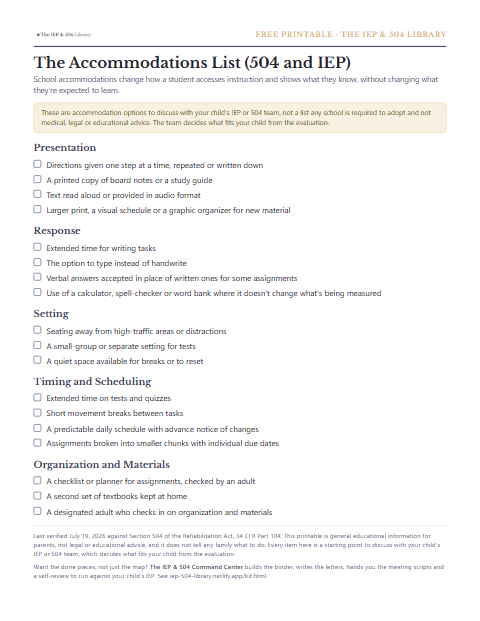
Get the free Accommodations List (504 and IEP) (PDF)
The common accommodation options grouped by type, to circle and bring to the team as a starting point.
Instant download, plus a note if the guidance on this topic changes. Unsubscribe anytime.
What this selector does
An accommodation changes how a student gets at the material or shows what they know, without changing what they are expected to learn. Choosing one is only half the job. A plan also has to say who carries it out, where and how often it applies and when the team will look at it again, because an accommodation nobody owns and nobody reviews is the one that quietly stops happening. This selector filters the options by the barrier, the task and the setting, then shows those fields beside each one so the conversation at the meeting can be about the specifics.
The three fields beside every option
Who would carry it out. The roles named here are the ones plans commonly use. Your team decides who is responsible and writes the actual name or role into the plan, so treat this column as the question to ask rather than the answer.
Where and how often. Where and how often an accommodation applies is part of what the team writes down. The lines here are starting points for that conversation, not settings any school has agreed to.
The review date. Section 504 has districts set up procedures for periodic reevaluation of students receiving services (34 CFR 104.35(d)). IDEA has the IEP team review the IEP at least once a year (34 CFR 300.324(b)(1)). A review date on each accommodation turns that into something concrete: a date to check whether this one is being used and whether it is still the right one.
The options themselves sit on the accommodations by need pages, each one beside the reasoning for it. The free Accommodations List covers the same ground as a printable to circle by hand.
This selector builds your short list. The free Accommodations List is the printable version. The common options grouped by type, to circle at the kitchen table and bring to the meeting. It stays free.