What Qualifies a Student for a 504 Plan

Every load-bearing legal fact on this page is read against IDEA or Section 504 and dated. Read against Section 504, 34 CFR 104.3(j) on July 19, 2026. Jump to sources

A student qualifies for a 504 plan when the student has a physical or mental impairment that substantially limits one or more major life activities, based on an individual evaluation that draws on more than one source of information rather than a diagnosis alone. There is no fixed list of qualifying conditions. The question the team asks is always whether the impairment substantially limits a major life activity such as learning, concentrating, reading, communicating or another major function, considered without the effect of medication, devices or other measures that help manage it.

Before you read on. This guide explains the legal eligibility test for a 504 plan in plain language. It is educational information, not legal advice. It does not diagnose your child or predict how your child's specific evaluation will turn out. Eligibility is always an individual, evidence based decision your child's school team makes.

Section 504 defines a covered student by what the impairment actually limits, not by what label a diagnosis carries.

Section 504's regulation defines a person with a disability as someone who has a physical or mental impairment that substantially limits one or more major life activities (34 CFR 104.3(j)(1)). That is a functional test built around real-world limitation, not a list of approved diagnoses. Two students with the same diagnosis can land on different sides of that line depending on how much the impairment actually limits them day to day.

This is a broader standard than IDEA's, which additionally requires that the disability create a need for specialized instruction. Section 504 asks only whether a major life activity is substantially limited, which is why more students can qualify for a 504 evaluation than for an IEP evaluation.

The three-part test

The regulation actually covers three separate groups of students, though most 504 plans are written for the first group.

The first and most common group is a student who currently has an impairment that substantially limits a major life activity. The second is a student with a documented record of such an impairment, even if it is not currently limiting them day to day. The third is a student who is regarded as having such an impairment by others, whether or not that impairment actually exists or limits them (34 CFR 104.3(j)(1)).

The second and third categories exist mainly to protect a student from discrimination based on a past condition or an assumption about them, rather than to trigger services. A current, active 504 plan is built around the first category: real, present, substantial limitation.

What counts as a major life activity

The regulation names functions like learning, seeing, hearing, speaking, breathing and working. The list is illustrative rather than closed.

The regulation lists functions such as caring for oneself, performing manual tasks, walking, seeing, hearing, speaking, breathing, learning and working (34 CFR 104.3(j)(2)(ii)). In a school context, learning, concentrating, reading, thinking and communicating come up constantly, since those are the functions most directly tied to a student's ability to access the classroom.

The list is illustrative rather than a closed set, so a substantial limitation to another significant function of daily living can also count, even if it is not spelled out by name. The evaluation team looks at your child's actual functioning, not just whether the activity in question appears on the list.

What a diagnosis does and does not do

A diagnosis is one piece of evidence the team considers. It is never the deciding factor by itself.

Federal evaluation rules require the school to draw on more than one source of information, including tests, teacher input, the student's physical condition and social or cultural background, then document how that information was weighed (34 CFR 104.35(c)). A physician's diagnosis is one input among several, not an automatic ticket to a 504 plan.

This runs in both directions. A student without a formal diagnosis can still qualify if the evaluation shows a substantial limitation to a major life activity. A student with a diagnosis can still be found not to qualify if the evaluation does not show that kind of limitation at school. The determination has to be made on the basis of an individual inquiry into that specific student.

Why medication and other supports do not disqualify a student

Since the ADA Amendments Act of 2008, schools generally cannot point to successful medication, devices or coping strategies as a reason a student does not qualify.

Before 2008, a school could sometimes argue that a student's medication, glasses, hearing aid or similar measure controlled the impairment well enough that it no longer substantially limited a major life activity, which kept some students out of Section 504 coverage. The ADA Amendments Act of 2008 changed that: mitigating measures such as medication, prosthetic devices, assistive technology or learned coping strategies can no longer be considered when deciding whether an impairment substantially limits a major life activity. Congress also directed that the definition of disability be construed broadly.

A student who manages a significant allergy with medication, for example, can still qualify for Section 504 protection if the allergy would substantially limit a major life activity without that medication. Once a student is found eligible, mitigating measures can become relevant again when the team decides what services or accommodations that student actually needs.

If your child already has an IEP

A child found eligible for an IEP under IDEA does not also need a separate 504 plan, because the IEP already satisfies Section 504's FAPE requirement.

Section 504 requires a free appropriate public education for a qualified student, consisting of regular or special education and related aids and services designed to meet that student's needs as adequately as the needs of nondisabled students are met (34 CFR 104.33). An IEP already meets that standard for a student who has one.

The two plans exist for different populations rather than stacking on top of each other for the same child. A child moves from one to the other only if the team's eligibility decision changes, for example if a student with a 504 plan is later evaluated and found to need specialized instruction under IDEA.

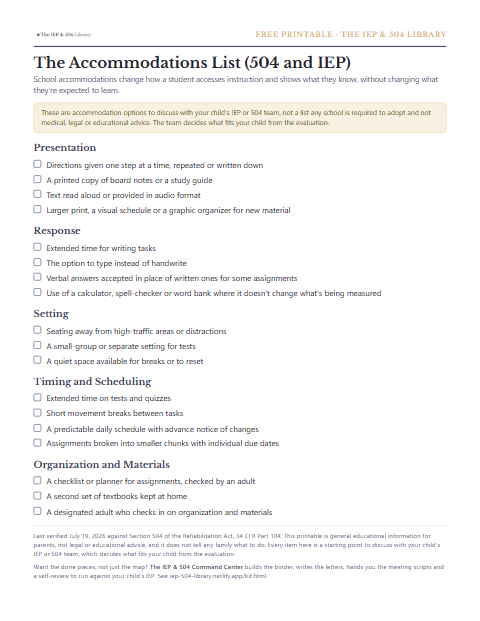
A preview of the free Accommodations List (504 and IEP), one printable page

Get the free Accommodations List (504 and IEP) (PDF)

The common accommodation options grouped by type, to circle and bring to the team as a starting point.

We email you the PDF, plus a note if the guidance on this topic changes. Unsubscribe anytime.

The IEP and 504 Command Center shown as a cover and a member area with its five parts: the Command Binder System, the Letter Library, the Meeting Script Deck, the Score-Your-IEP Self-Review and the Plain-Language Rights Cheat Sheet

From the team behind this library

The IEP & 504 Command Center

This page shows the options to discuss. The Command Center hands you the done pieces: the binder built, the letters written, the meeting scripts ready and a self-review that shows where your child's plan is strong or thin. The library stays free.
See the Command Center One-time $27. Yours to keep. 60-day money-back guarantee.

Questions parents ask

Does ADHD automatically qualify a student for a 504 plan?

No diagnosis is automatic. A student with ADHD may qualify if the evaluation shows the condition substantially limits a major life activity such as concentrating or learning, but that is an individual determination based on the student's actual functioning, not a rule tied to the diagnosis alone.

Does a food allergy or asthma qualify a student?

It can, if the evaluation shows the condition substantially limits a major life activity, such as breathing, when considered without the effect of medication or other management. Many students with significant allergies or asthma do have 504 plans, most often covering things like medication access and an emergency response plan, though it still depends on the individual evaluation.

Can a student who is doing well academically still qualify?

Yes. The test is substantial limitation to a major life activity, not failing grades. A student who is managing to keep grades up despite real difficulty concentrating or reading, for example, can still qualify if the underlying limitation is substantial.

Who decides whether a student qualifies for a 504 plan?

A group of people knowledgeable about the student, the evaluation data and the placement options makes the decision together, drawing on more than one source of information, not a single teacher or administrator acting alone.

What are the components of a 504 plan?

Section 504 does not fix a single national template, but a workable 504 plan usually names four things: the disability and how it substantially limits a major life activity, the specific accommodations, who is responsible for each one and how and when the plan is reviewed. A short example plan might grant extended time on tests, preferential seating and a break pass, with a named teacher and counselor responsible for each.

What documentation do you need for a 504 plan?

Schools weigh a range of information rather than requiring one document. That can include teacher observations, grades and test data, discipline or attendance records and any outside evaluations or medical notes you choose to share. A formal diagnosis can help but is not always required, because the 504 team decides eligibility from the whole picture of how the condition affects the child at school.

Is there a downside to a 504 plan?

A 504 plan is a civil-rights protection, not a mark on a record. It does not lower expectations or change the diploma a student earns. Some families note that a 504 plan provides accommodations but not the specialized instruction and measurable goals an IEP carries, so if a child needs specially designed instruction, an IEP evaluation may be the better fit. The right document depends on the child's needs, which the evaluation clarifies.

Who writes a 504 plan?

A group of people who know the child, the evaluation data and the accommodation options develops the plan, usually a 504 coordinator or counselor together with teachers and you as the parent. Section 504 calls for a knowledgeable group rather than one person deciding alone (34 CFR 104.35). You are part of that group.

Does a 504 plan expire or need renewing?

A 504 plan does not expire on a fixed federal timetable the way some parents expect. Section 504 calls for periodic re-evaluation. Most schools review a 504 plan each year and re-evaluate periodically or before a significant change in placement. Ask your school how often it reviews the plan so you know when to expect the next check-in.

Does a 504 plan cover autism, anxiety, dyslexia, or depression?

It can. A 504 plan is not limited to a list of conditions. Any condition qualifies if it substantially limits a major life activity such as learning, concentrating, reading or caring for oneself, so autism, an anxiety disorder, dyslexia and depression can each support a 504 plan when they have that kind of impact at school. The team decides from your child's own evaluation, not from the diagnosis label alone.

Can a 504 plan address behavior or include modifications?

A 504 plan can include behavior supports such as a check-in routine, a break pass or a behavior plan when the disability affects behavior at school. Section 504 centers on accommodations, which change how a student accesses the same material, rather than modifications that change what is taught or expected. Where a child needs the curriculum itself changed, that usually points toward an IEP.

Do 504 plans include services, goals, or a diagnosis?

A 504 plan provides accommodations and related aids rather than the measurable annual goals and specially designed instruction an IEP carries, so it usually has no goal pages. A formal diagnosis is helpful but not strictly required, because the team decides eligibility from how the condition substantially limits a major life activity. If your child needs measurable goals and specialized instruction, an IEP evaluation is the route to ask about.

Sources

What the facts on this page come from

This page is general educational information for parents, not legal or educational advice. It does not tell any family what to do. Every example here is a starting point to discuss and adapt with your child's IEP or 504 team, which decides what fits your child from the evaluation. Confirm anything time-sensitive with your school or district. For a genuinely contested situation, a special education advocate or an attorney who works in your state is the right person to ask.