The 504 Plan Template (Free Printable)

A free printable read against IDEA and Section 504, written to help you walk in prepared. Last reviewed . Read against Section 504, 34 CFR 104.33(b)(1). Jump to sources

What is the 504 Plan Template?

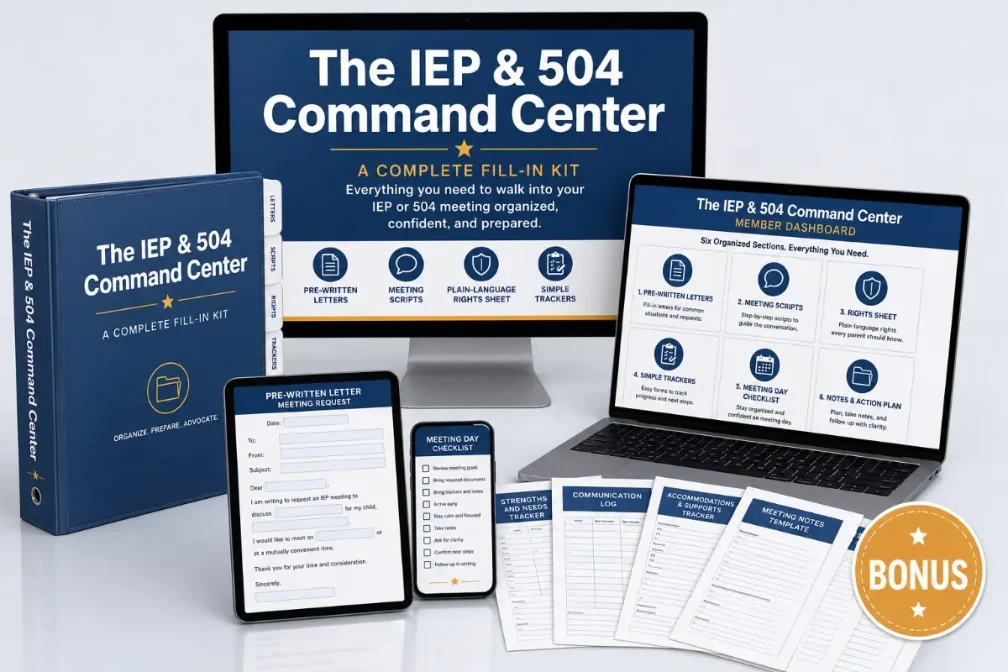
A 504 plan is the written record of what a school will do differently for a child, so this template lays out the sections most district forms use. It runs the whole document rather than the accommodation list alone: who was at the table, what the team identified, where the school day breaks down for this child, each accommodation with the person responsible and the setting it applies to, health procedures where they are needed, the start and review dates, then how anyone will know whether the plan is working. Print it blank to draft your part before the meeting, or read the completed example to see the level of detail that makes a plan usable by the teacher who has to run it in November.

How to use this printable. Your district writes the 504 plan on its own form. This template is here so you can see the sections most of those forms carry, think through what you would want in each one and walk into the meeting with your part already drafted. It is a preparation tool, never a replacement for the district's form. It is not legal or educational advice.
A flat illustration of a document sheet ruled into four sections with tabs down its edge, one row inside it marked in gold and a pen resting beside it

How to use it

Print the blank template and fill in what you already know: the barriers you see, the accommodations you want discussed, who you think would carry each one. Leave the rest for the meeting. Bring it as your working draft rather than a document you are asking the school to sign, because the school writes the actual plan on its own form and the team decides what goes in it. After the meeting, compare the plan that comes home against your draft: a section you filled in that the real plan leaves blank is a specific, fair thing to raise.

The blank template

Before you print this. Section 504 sets requirements for the education a school provides, not a national form for writing them down. There is no federal 504 plan template, so every district and many states use their own layout, their own field names and their own signature rules. Ask your school for its form early. This template covers the ground those forms tend to cover, so use it to prepare, to check that nothing important is missing and to draft your input, never as the plan itself.
What a 504 plan covers, section by section The ten sections most district forms carry, in the order the blank template below follows. Section names vary by district; the ground they cover does not vary much. What a 504 plan covers, section by section The ten sections most district forms carry, in the order the blank template below follows.Section names vary by district; the ground they cover does not vary much. 1 Student and plan details 2 The team at the table 3 The disability and how itaffects school 4 Barriers, one line each 5 Accommodations, one block perbarrier 6 Testing and assessment 7 Health and emergencyprocedures 8 How anyone will know it isworking 9 Dates and review 10 Signatures, copies and whogets told
What a 504 plan covers, section by section The ten sections most district forms carry, in the order the blank template below follows. Section names vary by district; the ground they cover does not vary much. What a 504 plan covers,section by section The ten sections most district forms carry,in the order the blank template belowfollows. Section names vary by district; theground they cover does not vary much. 1 Student and plan details 2 The team at the table 3 The disability and how it affectsschool 4 Barriers, one line each 5 Accommodations, one block perbarrier 6 Testing and assessment 7 Health and emergency procedures 8 How anyone will know it is working 9 Dates and review 10 Signatures, copies and who getstold
The whole document at a glance, before you fill in a word of it. Every label here is the heading of a section in the blank template below. The accommodations section is marked because it is the one that decides whether the plan can be run: an accommodation with no person, no setting and no start date attached is the one most likely to stop happening by the second month. There is no federal 504 form, so your district's own layout will differ in section order and field names.
The 504 Plan Template, from The IEP & 504 Library

The 504 Plan Template. A blank working draft to fill in by hand before your meeting. Your district writes the plan on its own form.

1. Student and plan details

The identifying block at the top of nearly every district form. It exists so the plan can be matched to the right student, the right school year and the right stage of the process.

Student nameAs it appears in school records
Date of birth and grade
School and school year
Date of this meeting
Type of meetingInitial plan, annual review, revision after a change, or a review the parent requested
504 coordinator or case managerThe name and the email of the person who answers questions about this plan

2. The team at the table

Section 504 has eligibility and placement decisions made by a group of people who know the child, understand the evaluation data and know the placement options. Writing down who took part records the group that made the decision.

Parent or guardian
General education teacherThe teacher who sees the child in the setting where the barriers show up
504 coordinator or administrator
School nurseWhere a health need is part of the plan
Counselor, psychologist or specialist
StudentWhere the child is old enough to take part
Others invited by the family

3. The disability and how it affects school

The heart of a 504 plan. The team records what the evaluation showed, which major life activity is substantially limited and what that looks like inside the school day. Everything below this section should trace back to something written here.

What the team identified through the evaluationThe team writes this from the evaluation record, not from a parent's or a teacher's impression alone
Major life activity affectedFor example learning, concentrating, reading, communicating, walking, eating, sleeping, or a major bodily function
How this shows up in the school dayPlain description: what a teacher would actually see, in which class and at which time
Information the team drew onEvaluation reports, medical information the family chose to share, teacher observations, work samples, attendance or nurse records
Strengths to build onWhat already works for this child. A plan written only from difficulties gives the teacher nothing to use

4. Barriers, one line each

The bridge between the description above and the accommodations below. Naming the barrier first keeps the plan from becoming a generic list, because each accommodation can then be read against the exact problem it exists to solve.

Barrier 1: what breaks down, where and whenFor example: loses the thread during multi-step verbal directions in math
Barrier 2
Barrier 3
Barrier 4

5. Accommodations, one block per barrier

The operating instructions. An accommodation that names no person and no setting is the one most likely to quietly stop happening by the second month, so each block carries the wording, the owner, the setting and the date it starts.

Barrier this answers
Accommodation, in wording specific enough to followNot 'extra time' alone: extra time on what, how much, decided by whom
Person responsibleA role, so the plan survives a staff change: for example the classroom teacher, the case manager, the nurse
Setting and frequencyWhich class, which activity, every day or only for tests
Start date
Notes on how it will work in practiceThe detail the teacher needs on a busy Tuesday

6. Testing and assessment

Classroom accommodations and testing accommodations are decided separately in most districts. State testing usually has its own approved list and its own deadlines. A plan that covers only the classroom can leave a child without support on the day it matters most.

Classroom test and quiz accommodations
District assessment accommodations
State assessment accommodationsAsk which supports appear on your state's approved list
College entrance or advanced course testingFor older students, where separate application deadlines apply

7. Health and emergency procedures

Only some plans need this section. The ones that do need it to be exact. It is written so an adult who has never met the child can follow it, including a substitute teacher or a coach on a Saturday.

Health need this covers
Daily routine at schoolFor example medication timing, snacks, water, bathroom access, rest
Warning signs staff should watch forDescribed in plain, observable terms
Step-by-step responseWhat happens first, then next, then who is called
Who is trained and who is the backup
Where supplies and the written procedure are kept
What happens on field trips, at after-school activities and on the busThe settings most often missed
Emergency contacts in order

8. How anyone will know it is working

The section district forms most often leave thin. Without it, a plan can only be reviewed on impressions a year later. With it, the team has something to look at in November.

What we will look atGrades, work completion, nurse visits, missed class time, a short teacher check-in, the child's own report
Who gathers it
How often
Who tells the family what it shows
What we do if the plan is not workingWho the parent contacts to ask for a review before the annual date

9. Dates and review

A plan without dates is hard to hold anyone to. These fields fix when it starts, when the team looks at it again and when the next evaluation is due.

Plan start date
Review dateMost districts review annually. Ask what yours does
Periodic reevaluation dueSection 504 calls for periodic reevaluation, with the schedule set by the district's own procedures
Earlier review requested byEither side can ask for a review before the scheduled date

10. Signatures, copies and who gets told

The last section is the one that decides whether the plan reaches the adults who run it. A plan filed in an office and never sent to the teacher is the most common way a good plan fails.

Team member names, roles and dates
Parent or guardian signature and dateAsk your district what its signature line means: districts differ on whether a parent signature records attendance, agreement or consent
Every teacher and staff member who receives a copyIncluding specials, electives, the bus and after-school staff where relevant
Who tells substitute teachers
Date copies were sent
Where the family's copy is filed

A completed example: a fifth grader with ADHD

Fictional example. Jordan Reyes is not a real child. Every entry below is written to show the level of detail that makes a plan usable, not to suggest what any child should have. What goes in a real plan is a decision the child's own team makes from the child's own evaluation.

The blank template above is easier to fill in once you have seen one filled. This one follows a fictional fifth grader whose team has already found him eligible under Section 504. It shows the sections that carry the weight rather than all ten. Read it for the specificity rather than the content: notice that every accommodation names an owner, a setting and a start date, that the health section could be followed by an adult who has never met him, then that the monitoring section says who looks at what in November.

1. Student and plan details

Nothing interesting here, which is the point. The block exists so the plan can be matched to the right child and the right school year.

StudentJordan Reyes, grade 5, Room 12
School and yearFictional Elementary, 2026 to 2027
Meeting dateSeptember 18
Type of meetingInitial 504 plan
504 coordinatorThe assistant principal, listed with a school email address

3. The disability and how it affects school

The team wrote what it saw rather than a label with nothing attached. The last line matters: a plan built only from what is hard gives a teacher nothing to work with.

What the team identifiedThe evaluation record includes ADHD, combined presentation, identified outside school and shared by the family with written permission, together with the school's own classroom data
Major life activity affectedConcentrating and organizing to complete school work
How it shows up in the school dayJordan starts written work quickly then loses the thread by the second or third step. Across September, six of nine multi-step math assignments came back with the first section finished and the rest blank. He often misses the second half of spoken directions. Two mornings a week he arrives without the materials the lesson needs
Information the team drew onThe evaluation summary, four weeks of classroom work samples, the teacher's own record of assignment completion, the family's description of homework at home
Strengths to build onJordan explains his thinking well out loud, answers accurately when a question is spoken to him one to one, likes being given a job to do for the class

4. Barriers, one line each

Four lines. Each one names what breaks down, in which subject and at what moment, so the accommodations below have something concrete to answer.

Barrier 1Loses the thread partway through multi-step written work, most visibly in math and in writing tasks longer than one paragraph
Barrier 2Misses part of spoken multi-step directions given once to the whole class
Barrier 3Arrives at lessons without the materials the lesson needs, roughly twice a week
Barrier 4Runs out of time on timed tests and quizzes, so the unfinished sections read as not knowing the material

5. Accommodations, one block per barrier

Read the owner column. This is the difference between a plan that is running in November and one that quietly stopped in week three. Every block names a role rather than a person, so a staff change does not empty the plan.

Barrier 1 accommodationAssignments of more than two steps are given to Jordan on a numbered checklist he can tick off. The teacher checks in once after the first step
Owner, setting, frequency, startClassroom teacher. Math and writing. Every assignment of more than two steps. Starts September 21
Barrier 2 accommodationSpoken directions of more than two steps are repeated to Jordan one to one after the whole-class instruction, in the same words
Owner, setting, frequency, startClassroom teacher and any specials teacher. All classes. Daily. Starts September 21
Barrier 3 accommodationA duplicate set of core materials is kept in the classroom so a missing item does not cost Jordan the lesson. A two-minute materials check happens at the end of the day rather than the start
Owner, setting, frequency, startClassroom teacher, materials supplied by the school. Daily at dismissal. Starts September 21
Barrier 4 accommodationExtended time of up to one and a half times the standard time on classroom tests and quizzes, taken in the resource room when the class period ends first
Owner, setting, frequency, startClassroom teacher arranges it, the resource room teacher supervises. All classroom tests and quizzes. Starts September 21

6. Testing and assessment

Written separately from the classroom accommodations because the approved supports for state testing are set by the state rather than by the school, usually with their own deadline.

Classroom tests and quizzesExtended time up to one and a half times, small-group setting where the room is available
State assessmentThe coordinator will check which of these supports appear on the state's approved list for the spring assessment by November 1 and report back to the family

7. Health and emergency procedures

Left blank on purpose in this example. Jordan's plan carries no health procedure, so the section says so rather than sitting empty and ambiguous.

Health need this coversNone identified by this team. Reviewed September 18

8. How anyone will know it is working

The section most often left thin. Four short lines here turn the annual review from a conversation about impressions into a conversation about a number the family has already seen.

What we will look atThe proportion of multi-step assignments completed to the end, counted from the teacher's existing record, plus Jordan's own answer to one question: did the checklist help today
Who gathers it and how oftenThe classroom teacher, using the record she already keeps, summarized every four weeks
Who tells the familyThe 504 coordinator emails the family a two-line summary at the end of each four-week period
If it is not workingThe parent or any teacher can email the coordinator to ask for a review before the annual date. The plan does not have to run a whole year before it is looked at again

9. Dates and review

Three dates. A plan without them can only be reviewed on memory.

Start dateSeptember 21
Review dateSeptember 17 the following year, or earlier at the request of the family or any teacher
Periodic reevaluationScheduled under the district's own reevaluation procedure, with the date written in at the meeting

10. Signatures, copies and who gets told

The last box is the one that decides whether the plan reaches the adults who run it. Jordan has six teachers across the week, so all six are named.

Copies toClassroom teacher, math teacher, both specials teachers, the resource room teacher, the office file, the family
SubstitutesA one-page summary is kept in the substitute folder, with the health section removed since there is none
Date copies sentSeptember 19
What makes it usable. Four things separate this from a plan that reads well but cannot be run. Every accommodation names a role rather than a person. Every one names the setting it applies to instead of applying vaguely everywhere. Every one has a start date. Then the monitoring section names something countable that a teacher is already recording, so nobody has to invent new paperwork to find out whether the plan is working. If you take one thing from this example into your own meeting, take the owner column.
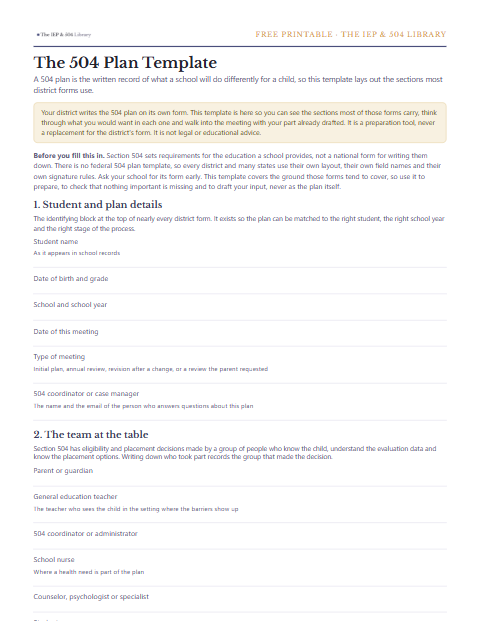
The IEP and 504 Command Center shown across a tabbed binder, a desktop screen, a laptop open at the member dashboard, a tablet holding a pre-written letter, a phone showing a meeting-day checklist and printed tracker and notes pages

From the team behind this library

The IEP & 504 Command Center

This printable is the map. The Command Center is the done pieces: The Command Binder System, The Letter Library, The Meeting Script Deck, The Score-Your-IEP Self-Review, The Plain-Language Rights Cheat Sheet, so you walk in organized, working from the same paperwork the team has.
See the Command Center One-time $27. Yours to keep. 60-day money-back guarantee.
A preview of the free 504 Plan Template, one printable page

Get the free 504 Plan Template (PDF)

The blank 504 plan, section by section, plus a completed example, so you can draft your part before the district writes its own form.

Instant download, plus a note if the guidance on this topic changes. Unsubscribe anytime.

Questions parents ask

Is there an official 504 plan template?

No. Section 504 and its regulations at 34 CFR Part 104 set out what a school owes a student, not a national form for recording it, so there is no federal 504 plan template. Districts write their own, states sometimes publish a model, but the layouts differ a lot. Ask your school for its form before the meeting. Use this template to prepare and to check that nothing important is missing from the draft that comes back.

Can I fill this in and ask the school to use it as the plan?

The school will write the plan on its own form. What this template does is get your thinking onto paper first, in the same shape the meeting will follow, so your input arrives organized instead of remembered halfway through. Bringing a filled draft to a meeting is normal and useful. Presenting it as the plan itself is not how the process works, since the team decides together what goes in and the district records it.

Does a 504 plan have to be in writing?

The Section 504 regulations do not prescribe a written plan document the way IDEA prescribes the contents of an IEP. In practice nearly every district writes one, because a plan that is not written down is hard for six different teachers to follow. If your school describes accommodations verbally, it is reasonable to ask for them in writing so the same understanding reaches everyone.

What is the difference between this and the 504 plan request letter?

The request letter is how a family asks the district to evaluate a child for a 504 plan. It comes first. This template is for after that: it is the shape of the plan itself, useful once an evaluation is under way or a plan already exists and you want to prepare for the meeting or read the current plan critically.

How specific should an accommodation be?

Specific enough that a teacher who was not at the meeting could follow it in November. Compare two versions of the same accommodation. Extended time is the first. Extended time of up to one and a half times on classroom tests and quizzes, arranged by the classroom teacher, taken in the resource room where the period ends first, starting September 21 is the second. Only one of those can be run by a substitute teacher, or checked at a review.

Who should be named as responsible for each accommodation?

Name a role rather than a person where you can: the classroom teacher, the case manager, the school nurse. A plan built on named individuals empties out when someone changes schools. Naming a role also settles the question that quietly stalls accommodations, which is who exactly is supposed to do this thing.

How often is a 504 plan reviewed?

Most districts review annually and reevaluate periodically, with the exact schedule set by the district's own procedures under 34 CFR 104.35. You do not have to wait for the scheduled date. If something is not working, ask the 504 coordinator in writing for a review. It helps to bring the specific thing you have seen rather than a general concern.

Should health procedures go in the 504 plan or a separate health plan?

Districts handle this differently. Some write the health procedure into the 504 plan, some keep a separate nursing or emergency care plan and reference it. Either can work. What matters is that the steps are written somewhere an adult can follow without knowing the child, that the plan says who is trained and who covers when that person is out, then that the field trip, the bus and the after-school hours are covered rather than assumed.

My child has an IEP. Do we need a 504 plan too?

Usually not. Implementing an IEP is one way a district meets its Section 504 obligation to provide a free appropriate public education, which is why most students with an IEP do not carry a separate 504 plan. The comparison guide covers when a family might move between the two.

Field names, section order and signature rules vary by district and sometimes by state. This template follows the ground the common district forms cover rather than any single official layout, so a section here may sit under a different heading or in a different order on the form your school hands you.

Sources

What the facts on this page come from

Last reviewed . That is the day this page was last read against the sources above, not the day the site was rebuilt. How this library is verified

This page is general educational information for parents, not legal or educational advice. It does not tell any family what to do. Every example here is a starting point to discuss and adapt with your child's IEP or 504 team, which decides what fits your child from the evaluation. Confirm anything time-sensitive with your school or district. For a genuinely contested situation, a special education advocate or an attorney who works in your state is the right person to ask.