The IEP and 504 Cheat Sheet (Free Printable)
What is the IEP and 504 Cheat Sheet?
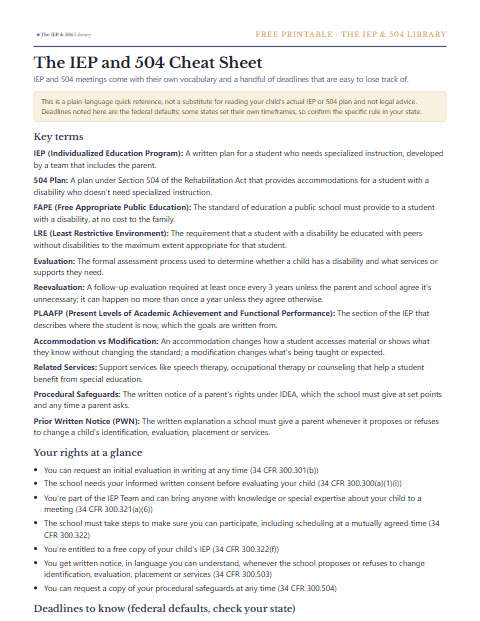
IEP and 504 meetings come with their own vocabulary and a handful of deadlines that are easy to lose track of. This one-page cheat sheet puts the most common terms, a short list of core parent rights and the key federal deadlines in one place, so you can check it quickly instead of hunting through a folder of paperwork.

How to use it
Keep this in the front of your binder or folded in your bag. It's meant for a quick check during a meeting or a phone call, not as a complete explanation of any single topic; the linked guides go deeper on each one.
What is on the printable
Key terms
- IEP (Individualized Education Program): A written plan for a student who needs specialized instruction, developed by a team that includes the parent.
- 504 Plan: A plan under Section 504 of the Rehabilitation Act that provides accommodations for a student with a disability who doesn't need specialized instruction.
- FAPE (Free Appropriate Public Education): The standard of education a public school must provide to a student with a disability, at no cost to the family.
- LRE (Least Restrictive Environment): The requirement that a student with a disability be educated with peers without disabilities to the maximum extent appropriate for that student.
- Evaluation: The formal assessment process used to determine whether a child has a disability and what services or supports they need.
- Reevaluation: A follow-up evaluation required at least once every 3 years unless the parent and school agree it's unnecessary; it can happen no more than once a year unless they agree otherwise.
- PLAAFP (Present Levels of Academic Achievement and Functional Performance): The section of the IEP that describes where the student is now, which the goals are written from.
- Accommodation vs Modification: An accommodation changes how a student accesses material or shows what they know without changing the standard; a modification changes what's being taught or expected.
- Related Services: Support services like speech therapy, occupational therapy or counseling that help a student benefit from special education.
- Procedural Safeguards: The written notice of a parent's rights under IDEA, which the school must give at set points and any time a parent asks.
- Prior Written Notice (PWN): The written explanation a school must give a parent whenever it proposes or refuses to change a child's identification, evaluation, placement or services.
Your rights at a glance
- You can request an initial evaluation in writing at any time (34 CFR 300.301(b))
- The school needs your informed written consent before evaluating your child (34 CFR 300.300(a)(1)(i))
- You're part of the IEP Team and can bring anyone with knowledge or special expertise about your child to a meeting (34 CFR 300.321(a)(6))
- The school must take steps to make sure you can participate, including scheduling at a mutually agreed time (34 CFR 300.322)
- You're entitled to a free copy of your child's IEP (34 CFR 300.322(f))
- You get written notice, in language you can understand, whenever the school proposes or refuses to change identification, evaluation, placement or services (34 CFR 300.503)
- You can request a copy of your procedural safeguards at any time (34 CFR 300.504)
Deadlines to know (federal defaults, check your state)
- Initial evaluation: generally within 60 days of your written consent, unless your state sets its own timeframe (34 CFR 300.301(c)(1))
- Annual review: the IEP Team reviews the IEP at least once a year (34 CFR 300.324(b)(1)(i))
- Triennial reevaluation: at least once every 3 years, unless you and the school agree it's unnecessary (34 CFR 300.303(b)(2))
- Progress reports: the IEP states when periodic progress reports will go home, often concurrent with report cards (34 CFR 300.320(a)(3))
From the team behind this library
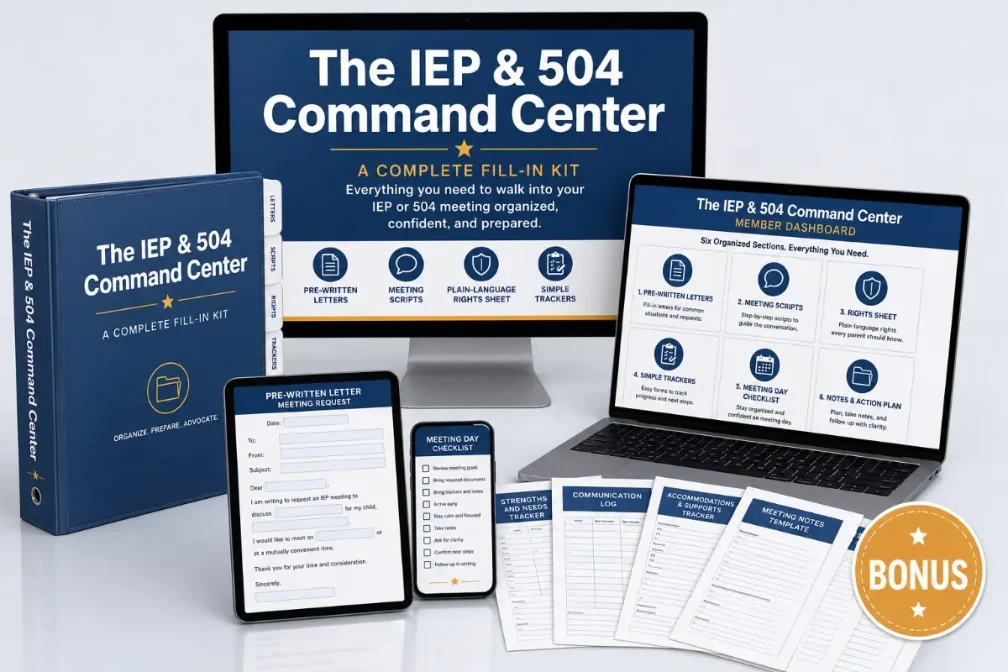
The IEP & 504 Command Center
This printable is the map. The Command Center is the done pieces: The Command Binder System, The Letter Library, The Meeting Script Deck, The Score-Your-IEP Self-Review, The Plain-Language Rights Cheat Sheet, so you walk in organized, working from the same paperwork the team has.