The IEP vs 504 Comparison Chart (Free Printable)
What is the IEP vs 504 Comparison Chart?
An IEP and a 504 plan come from two different federal laws, so this chart puts the eight differences that actually change a conversation on one page. Page one lines the two documents up column by column: the law behind each one, what each is for, who qualifies in concept, what the document contains, whether it delivers instruction or access, who sits on the team, how often it is reviewed and where a disagreement goes. Page two is a short neutral checklist of the things families notice before they ask a school about one plan or the other, worded as questions to bring rather than conclusions to reach. Print both sides, mark what you recognize and take it in.

How to use it
Read page one before your first conversation with the school so the vocabulary is not the thing slowing you down. Then work down page two and tick the lines you recognize in your own child's week. A tick is a prompt to raise something, never a finding. Take the sheet in with the ticks on it, say what you have seen at home and ask the school what it looks at next. The team decides which route fits from the evaluation, so bring observations rather than a verdict.
The comparison, side by side
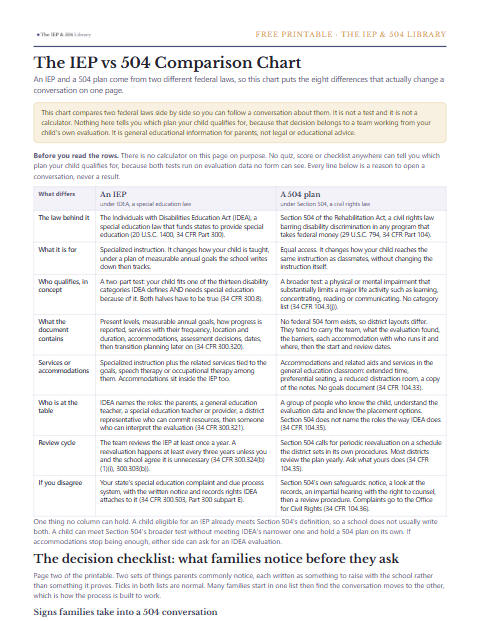
The IEP vs 504 comparison chart. Page one compares the two laws. Page two is the neutral checklist of what families notice before they ask.
| What differs | An IEPunder IDEA, a special education law | A 504 planunder Section 504, a civil rights law |
|---|---|---|
| The law behind it | An IEP (under IDEA, a special education law)The Individuals with Disabilities Education Act (IDEA), a special education law that funds states to provide special education (20 U.S.C. 1400, 34 CFR Part 300). | A 504 plan (under Section 504, a civil rights law)Section 504 of the Rehabilitation Act, a civil rights law barring disability discrimination in any program that takes federal money (29 U.S.C. 794, 34 CFR Part 104). |
| What it is for | An IEP (under IDEA, a special education law)Specialized instruction. It changes how your child is taught, under a plan of measurable annual goals the school writes down then tracks. | A 504 plan (under Section 504, a civil rights law)Equal access. It changes how your child reaches the same instruction as classmates, without changing the instruction itself. |
| Who qualifies, in concept | An IEP (under IDEA, a special education law)A two-part test: your child fits one of the thirteen disability categories IDEA defines AND needs special education because of it. Both halves have to be true (34 CFR 300.8). | A 504 plan (under Section 504, a civil rights law)A broader test: a physical or mental impairment that substantially limits a major life activity such as learning, concentrating, reading or communicating. No category list (34 CFR 104.3(j)). |
| What the document contains | An IEP (under IDEA, a special education law)Present levels, measurable annual goals, how progress is reported, services with their frequency, location and duration, accommodations, assessment decisions, dates, then transition planning later on (34 CFR 300.320). | A 504 plan (under Section 504, a civil rights law)No federal 504 form exists, so district layouts differ. They tend to carry the team, what the evaluation found, the barriers, each accommodation with who runs it and where, then the start and review dates. |
| Services or accommodations | An IEP (under IDEA, a special education law)Specialized instruction plus the related services tied to the goals, speech therapy or occupational therapy among them. Accommodations sit inside the IEP too. | A 504 plan (under Section 504, a civil rights law)Accommodations and related aids and services in the general education classroom: extended time, preferential seating, a reduced-distraction room, a copy of the notes. No goals document (34 CFR 104.33). |
| Who is at the table | An IEP (under IDEA, a special education law)IDEA names the roles: the parents, a general education teacher, a special education teacher or provider, a district representative who can commit resources, then someone who can interpret the evaluation (34 CFR 300.321). | A 504 plan (under Section 504, a civil rights law)A group of people who know the child, understand the evaluation data and know the placement options. Section 504 does not name the roles the way IDEA does (34 CFR 104.35). |
| Review cycle | An IEP (under IDEA, a special education law)The team reviews the IEP at least once a year. A reevaluation happens at least every three years unless you and the school agree it is unnecessary (34 CFR 300.324(b)(1)(i), 300.303(b)). | A 504 plan (under Section 504, a civil rights law)Section 504 calls for periodic reevaluation on a schedule the district sets in its own procedures. Most districts review the plan yearly. Ask what yours does (34 CFR 104.35). |
| If you disagree | An IEP (under IDEA, a special education law)Your state's special education complaint and due process system, with the written notice and records rights IDEA attaches to it (34 CFR 300.503, Part 300 subpart E). | A 504 plan (under Section 504, a civil rights law)Section 504's own safeguards: notice, a look at the records, an impartial hearing with the right to counsel, then a review procedure. Complaints go to the Office for Civil Rights (34 CFR 104.36). |
One thing no column can hold. A child eligible for an IEP already meets Section 504's definition, so a school does not usually write both. A child can meet Section 504's broader test without meeting IDEA's narrower one and hold a 504 plan on its own. If accommodations stop being enough, either side can ask for an IDEA evaluation.
There is no calculator on this page on purpose. No quiz, score or checklist anywhere can tell you which plan your child qualifies for, because both tests run on evaluation data no form can see. Every line below is a reason to open a conversation, never a result.
The decision checklist: what families notice before they ask
Page two of the printable. Two sets of things parents commonly notice, each written as something to raise with the school rather than something it proves. Ticks in both lists are normal. Many families start in one list then find the conversation moves to the other, which is how the process is built to work.
Signs families take into a 504 conversation
Access is the theme here: the same lesson, reached a different way.
- Your child does the same work as the class once one thing changes: a quieter room, a longer window, a printed copy of the notes. Ask what it would take to write that down.
- A health condition or a diagnosis affects the school day. Ask what the school already does about it and who its 504 coordinator is.
- Teachers make informal adjustments for your child already. Ask whether those belong in a written plan so they hold when the teacher changes.
- The support your child needs is about reaching the same lesson rather than being taught a different one. Ask which document covers access at your school.
- The grades look fine. The school day still does not. Ask the school to look at how your child is getting through it rather than only at the marks.
- You want the same supports to travel to a substitute teacher, a field trip or a state test. Ask what a written plan would cover.
Signs families take into an IEP evaluation conversation
Instruction is the theme here: the lesson itself taught differently.
- One area is a long way behind the rest of your child's work even with the informal help already in place. Ask the school to look at whether specialized instruction is needed.
- What your child needs looks like being taught a skill differently rather than being given more time. Ask what an evaluation would look at.
- Accommodations have been in place a while. The gap has not moved. Ask the team what the data since the plan started shows.
- A specialist already works with your child in speech, occupational therapy or reading. Ask how those services are decided then recorded.
- You asked for an evaluation before. You are not sure what happened next. Ask for the written notice explaining that decision (34 CFR 300.503).
- You want the school to write down what your child should be able to do by this time next year. Ask whether measurable annual goals apply here.
From the team behind this library
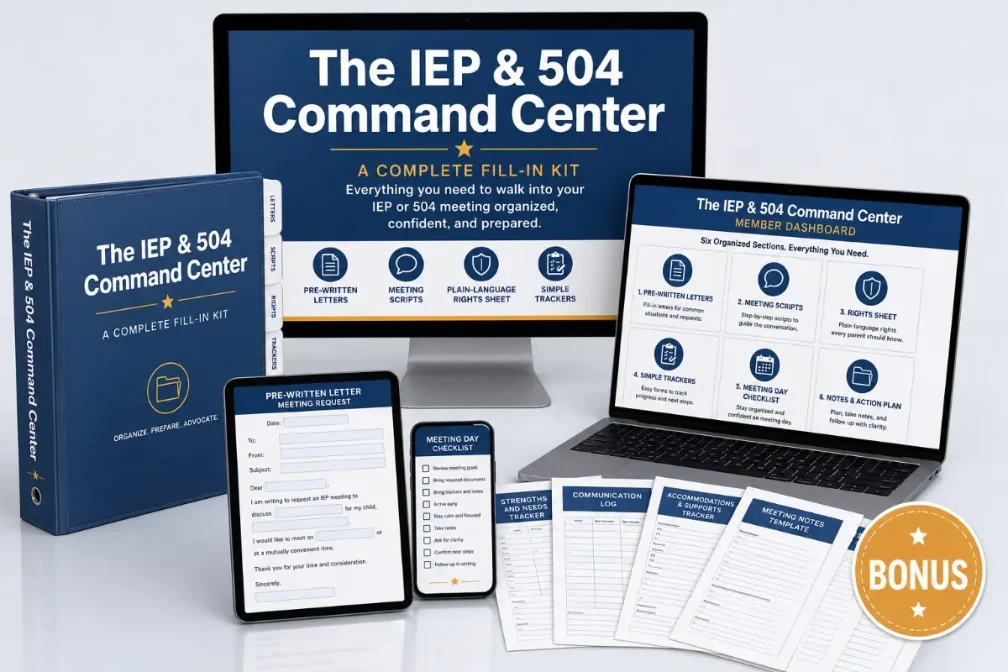
The IEP & 504 Command Center
This printable is the map. The Command Center is the done pieces: The Command Binder System, The Letter Library, The Meeting Script Deck, The Score-Your-IEP Self-Review, The Plain-Language Rights Cheat Sheet, so you walk in organized, working from the same paperwork the team has.