The IEP Template (Free Printable)
What is the IEP Template?
An IEP is a written statement of the special education a child will receive, so this template lays out the sections IDEA requires it to contain. Present levels first, then measurable annual goals, how progress gets reported, the services with their frequency, location and duration, accommodations and modifications, participation with children who do not have disabilities, testing, transition for older students, then signatures. Print it blank to draft your own input before the meeting, or read the annotated example to see what each section is for and what a thin entry looks like next to a usable one.

How to use it
Use it in two directions. Before a meeting, fill in the sections you can speak to: your child's strengths, your concerns, what you have seen at home, the goals you want discussed. After a meeting, sit with the draft IEP the school sends and read it against this template section by section, because the fastest way to find what is missing from a document is to know what is supposed to be in it. Bring your filled copy as your own working notes rather than as a plan you are asking the school to adopt.
The blank template
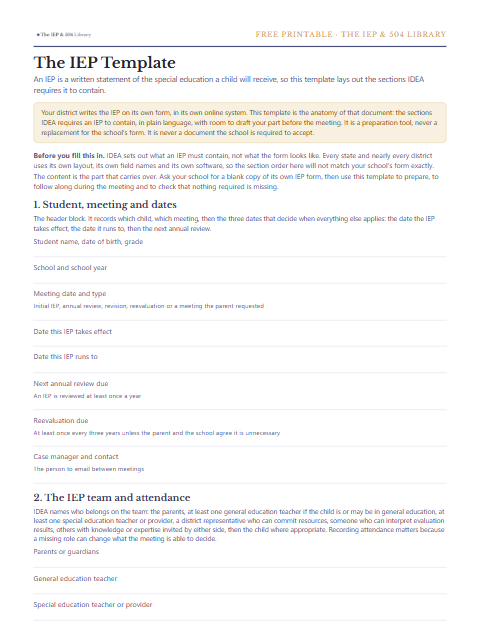
The IEP Template. A blank working draft to fill in by hand before your meeting. Your district writes the IEP on its own form.
1. Student, meeting and dates
The header block. It records which child, which meeting, then the three dates that decide when everything else applies: the date the IEP takes effect, the date it runs to, then the next annual review.
2. The IEP team and attendance
IDEA names who belongs on the team: the parents, at least one general education teacher if the child is or may be in general education, at least one special education teacher or provider, a district representative who can commit resources, someone who can interpret evaluation results, others with knowledge or expertise invited by either side, then the child where appropriate. Recording attendance matters because a missing role can change what the meeting is able to decide.
3. Parent input and the child's strengths
In developing the IEP the team considers the child's strengths, the concerns of the parents for enhancing their child's education, the results of the most recent evaluation, then the child's academic, developmental and functional needs. This is the section where the family's own account belongs. Writing it down before the meeting is the single highest-value use of this template.
4. Present levels of academic achievement and functional performance
The foundation of the document. It states where the child is now, including how the disability affects involvement and progress in the general education curriculum, or for a preschool child how it affects participation in appropriate activities. Every goal, service and accommodation further down should trace back to something described here. A present level with no numbers in it cannot support a measurable goal.
5. Special factors the team considers
IDEA asks the team to consider a short list of factors for any child they apply to, so this section is a set of prompts rather than fields every IEP fills in. Behavior that impedes learning, the language needs of a child with limited English proficiency, braille for a child who is blind or visually impaired, communication needs including those of a child who is deaf or hard of hearing, then whether the child needs assistive technology devices or services.
6. Measurable annual goals
One block per goal. A goal is measurable when someone other than the writer could collect the data and reach the same answer about whether it was met. Four parts do that work: the condition, the observable skill, the criterion, then the method. Write the baseline beside the target so the distance is visible.
7. Progress reporting
The IEP states how progress toward the annual goals will be measured, plus when periodic reports on that progress will be provided, often on the same schedule as report cards. This is the section that decides whether you find out in November or in May.
8. Special education, related services and supports
The commitment section. The IEP states the special education and related services plus supplementary aids and services to be provided, the program modifications, then the supports for school personnel who work with the child. Each entry carries its own frequency, location and duration, so a service written without minutes is worth asking about.
9. Accommodations and modifications
Accommodations change how a child accesses the work. Modifications change what the child is expected to do. Districts often split them across two boxes on the form. The difference matters, because a modification can change what a course or a diploma counts for. Each entry works better with a setting plus a person attached.
10. Participation with children who do not have disabilities
IDEA requires an explanation of the extent, if any, to which the child will not participate with children who do not have disabilities in the regular class plus in extracurricular and other nonacademic activities. The explanation is the point: the form asks the team to say why, not simply to record a placement.
11. State and district assessments
The IEP states the individual accommodations needed to measure academic achievement and functional performance on state and districtwide assessments. Where the team decides on an alternate assessment, the IEP states why the regular assessment is not appropriate plus why the particular alternate one was chosen.
12. Transition, for older students
Beginning with the first IEP in effect when the child turns 16, or younger where the state or the team decides, the IEP carries measurable postsecondary goals based on age-appropriate transition assessments, plus the transition services needed to reach them. Some states start earlier, so ask what yours does.
13. Signatures, consent and copies
The closing block. It records who took part, what the parent agreed to and who receives the document. Districts differ on what a signature line means, so read the wording above it before signing.
IDEA sets out what an IEP must contain, not what the form looks like. Every state and nearly every district uses its own layout, its own field names and its own software, so the section order here will not match your school's form exactly. The content is the part that carries over. Ask your school for a blank copy of its own IEP form, then use this template to prepare, to follow along during the meeting and to check that nothing required is missing.
An annotated example: a third grader, section by section
Reading a blank form teaches you the field names. Reading a filled one teaches you what a usable entry looks like. This fictional third grader's IEP is annotated section by section, so each block below carries both the entry itself plus a short note on what the section exists to do. It walks the sections that carry the weight rather than all thirteen, in the order a reader tends to need them. The annotations are the part to read if you are trying to make sense of the draft your school just sent home.
4. Present levels
What this section is for: it fixes the starting point. Every goal below has to grow out of something stated here, so a present level written as a paragraph of adjectives leaves the goals with nothing to stand on. Notice that each line carries a number plus the date it was taken.
| Reading, decoding | On a curriculum-based measure taken the week of September 8, Maya read grade-level word lists at 62 percent accuracy across five trials. On second-grade lists she read at 88 percent |
|---|---|
| Reading, comprehension | She retells a passage read aloud to her with the main idea plus two details in four of five attempts. Reading the same passage herself, she retells the main idea in one of five |
| Functional performance | Maya asks for help readily one to one. In whole-class reading she stops working and waits rather than asking, in roughly half of observed lessons |
| How the disability affects progress in the general curriculum | Third-grade material is delivered largely through independent reading. Decoding at 62 percent means Maya spends the lesson on the words rather than on the content, which shows up across science and social studies as well as reading |
| Strengths | Strong listening comprehension, a wide spoken vocabulary, works hard in a small group, other children like working with her |
3. Parent input
What this section is for: the team considers the concerns of the parents for enhancing their child's education. It is not a courtesy box. This is a family that wrote its part down beforehand, so the entry has dates in it rather than a general impression.
| Our concerns this year | Homework that should take twenty minutes takes an hour. Maya has started saying she is bad at reading. We want the reading instruction to be specific rather than more of the same practice |
|---|---|
| What we have seen since the last meeting | Between September 3 and October 6 she asked to skip reading homework on eleven of twenty-two school nights. She reads happily when we read the page to her first |
| What works at home | Reading the page aloud to her first, then having her read it. Short sessions with a timer |
6. Measurable annual goals
What this section is for: to state what the year is working toward, in terms anyone can check. Read the goal for its four parts, which are the condition, the observable skill, the criterion, then the method. The baseline sitting beside it is what makes the target meaningful: 90 percent means one thing from 62 percent and something quite different from 85 percent.
| Area | Reading, decoding |
|---|---|
| Baseline | 62 percent accuracy on grade-level word lists, five trials, week of September 8 |
| Goal | Given a list of grade-level words, Maya will read aloud with 90 percent accuracy on four of five consecutive trials by the annual review date, as measured by weekly teacher-recorded decoding probes |
| Benchmarks | 75 percent by the second quarter, 82 percent by the third |
| Progress data | Weekly decoding probe, recorded by the reading specialist, charted |
| What counts as met | Four of five consecutive weekly probes at or above 90 percent |
7. Progress reporting
What this section is for: to say how the family finds out. IDEA has the IEP state how progress toward the annual goals will be measured plus when periodic reports will go home. A schedule written here is the difference between finding out in November and finding out in May.
| How measured | The weekly probe data, summarized as a percentage against the baseline |
|---|---|
| When reports go home | Quarterly, with the report card |
| What the report contains | The current percentage, the baseline, the target, plus whether the trend is on pace for the annual goal |
8. Services, minutes and location
What this section is for: the commitment. Each line carries frequency, location plus duration, because a service written as reading support with no minutes attached cannot be checked by anyone later. Note that the section also covers what the adults receive, not only what the child receives.
| Specialized reading instruction | Thirty minutes, five days a week, small group in the resource room, September 21 through the annual review date, delivered by the reading specialist |
|---|---|
| Speech and language | Not a service in this IEP. The team considered it, noted her spoken vocabulary is strong, then recorded that decision here |
| Supplementary aids in the general classroom | Text read aloud for content-area material, audio versions of grade-level texts, a copy of the reading passage marked up in advance |
| Supports for school personnel | Two coaching sessions for the classroom teacher from the reading specialist during the first quarter, so the same approach runs in both rooms |
9. Accommodations and modifications
What this section is for: to separate how a child gets at the work from what the child is expected to do. The first is an accommodation, the second a modification. Maya's IEP carries accommodations only, which the team wrote down explicitly rather than leaving the modification box blank and ambiguous.
| Accommodations | Text read aloud for any material not being used to assess reading. Extended time up to one and a half times on written work in all subjects. Directions repeated one to one after whole-class instruction |
|---|---|
| Where each applies | All classes, all written work, provided by the classroom teacher |
| Modifications | None. Maya works on grade-level content in every subject. The team recorded this so a later reader does not have to guess whether the box was skipped |
10. Participation with children who do not have disabilities
What this section is for: the explanation, not the placement. IDEA asks for an explanation of the extent, if any, to which a child will not participate with children who do not have disabilities. The reason is what a reviewer reads.
| Time outside the general classroom | Thirty minutes daily for reading instruction, which is 8 percent of the school week |
|---|---|
| Reason | The small-group instruction targets decoding at a level the whole-class lesson does not reach. The team scheduled it opposite independent reading time rather than opposite science, so no content is missed |
| Extracurricular and nonacademic | Full participation, with no supports identified as needed |
11. State and district assessments
What this section is for: to make sure the classroom supports reach the test. Approved supports are set by the state, not by the school, so the answer to what is allowed is a lookup rather than an opinion.
| Accommodations | Text-to-speech on the sections that do not assess reading, extended time, small-group setting |
|---|---|
| Alternate assessment | Not applicable. Maya takes the regular state assessment with accommodations |
| Check | The case manager will match each accommodation against the state's approved list before the winter request deadline |
13. Signatures and copies
What this section is for: to record who took part, what the family agreed to, then who ends up holding the document. The last line is the one that decides whether the plan actually runs.
| Parent signature line | Read the wording above it. On this fictional district's form the line records attendance at the meeting. Consent for the initial provision of services is a separate line further down |
|---|---|
| Copies to | The classroom teacher, the reading specialist, both specials teachers, the office file, the family |
| Date distributed | September 19 |

From the team behind this library
The IEP & 504 Command Center
This printable is the map. The Command Center is the done pieces: The Command Binder System, The Letter Library, The Meeting Script Deck, The Score-Your-IEP Self-Review, The Plain-Language Rights Cheat Sheet, so you walk in organized, working from the same paperwork the team has.