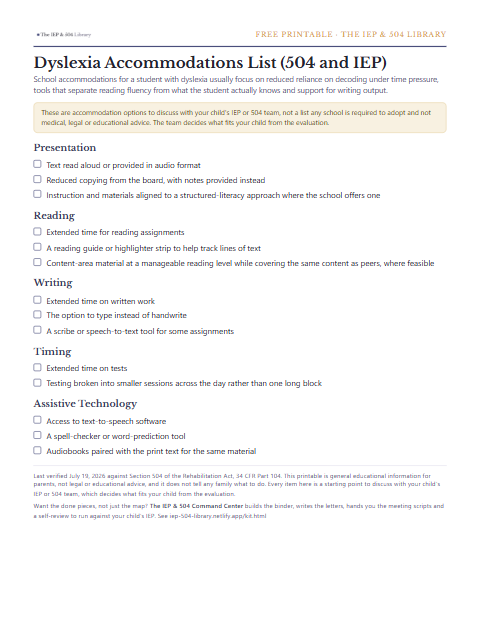
Dyslexia Accommodations for a 504 Plan or IEP
What accommodations help a student with dyslexia?
Common school accommodations for a student with dyslexia focus on getting past the reading and spelling barrier so the child can show what they actually know: hearing text read aloud, having more time and being able to respond in a way that is not blocked by spelling. An IEP or a 504 plan can carry these when the team agrees, from the evaluation, that they are needed. Federal guidance is clear that a school can name dyslexia directly in the evaluation and the IEP, so you can ask for it to be named. Treat the list below as options to talk through with your team, not a checklist the school must adopt.

Common accommodation options for a student with dyslexia, by type
Circle the ones that match what you see with your child and bring them to the team as a starting point, not a demand list. The team decides what fits from the evaluation.
Presentation
- Text and directions available in audio, such as audiobooks or text-to-speech
- Directions read aloud or repeated
- Fewer items on a page and larger or highlighted text
- Key instructions given both out loud and in writing
Response
- Speech-to-text or dictation to a scribe where writing is the barrier
- Answers typed rather than handwritten
- Spelling not counted on work that is not testing spelling
- Answers given orally
Setting
- A reduced-distraction or separate space for reading-heavy tasks
- Small-group or individual test administration
Timing and scheduling
- Extended time on reading and writing tasks
- More frequent breaks during long reading
- A long task split across sessions
The accommodation selector puts these options beside the fields a plan has to fill in for each one: who would carry it out, where and how often it applies and a review date. Filter by the barrier, the task and the setting, then copy or print the short list you want to raise.
Bringing one of these to the team: before and after
The difference between an accommodation that helps and one that quietly disappears by November is usually the wording. Here is the same request twice: once the way it tends to come out at the table and once specific enough for the team to write down and for a teacher to follow months later.
| The way it usually comes out | Can he get extra time on reading? |
|---|---|
| The same ask, specific enough to write down | On assignments and tests where reading is not the skill being graded, could the plan give time and a half plus the option to listen to the passage with text-to-speech, in the classroom, arranged with the teacher at the start of the task? |
The second version answers the four questions a teacher will have in the moment: on which tasks, how much, in what form and who sets it up. It also separates the tasks where reading is the barrier from the ones where reading is the point, which is the distinction that keeps a reading accommodation from being read as a way around a reading test. None of that makes the answer yes. It makes the answer usable if it is yes. It also makes a no much easier to understand.
Does this go in a 504 plan or an IEP?
Dyslexia often calls for specialized reading instruction, which usually points to an IEP under the specific learning disability category. When a child mainly needs accommodations rather than specialized instruction, a 504 plan can carry them. The IEP vs 504 guide explains how the team decides.
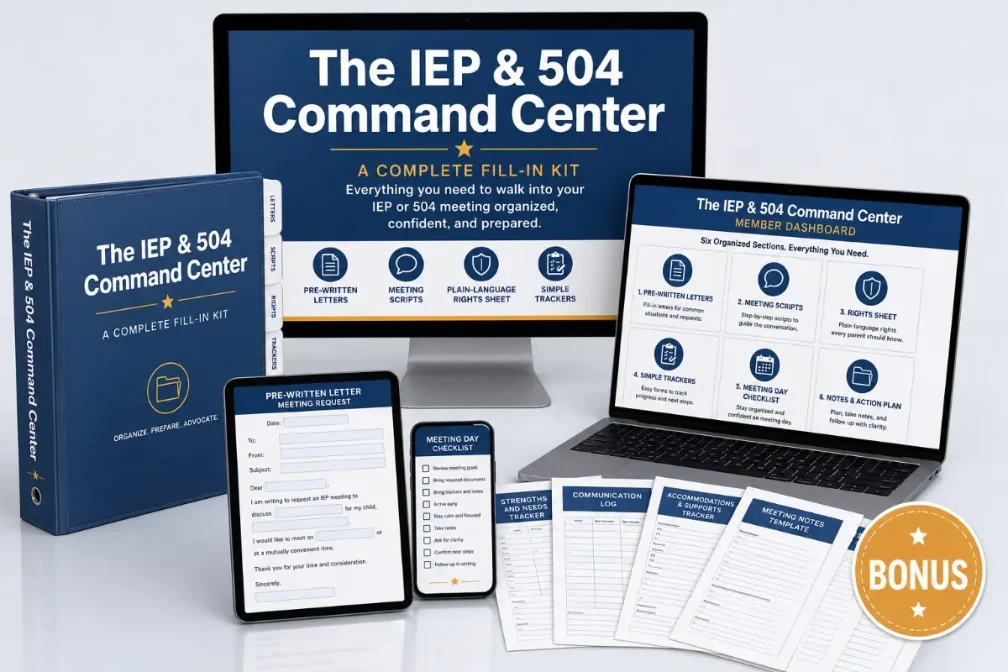
From the team behind this library
The IEP & 504 Command Center
This page shows the options to discuss. The Command Center hands you the done pieces: the binder built, the letters written, the meeting scripts ready and a self-review that shows where your child's plan is strong or thin. The library stays free.