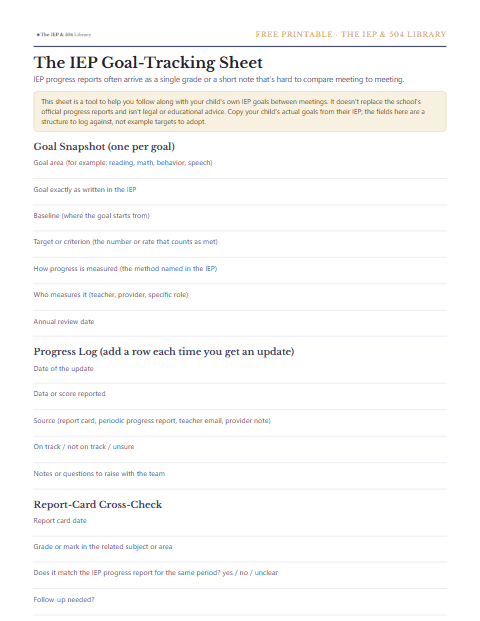
IEP Writing Goals
What are IEP writing goals?
IEP writing goals usually cover two areas: written expression (putting ideas onto the page in sentences, paragraphs and longer pieces) and spelling. A well-written writing goal names where a child is starting, a measurable target and a way to measure it, so progress is something the team can see rather than guess. The examples below are starting points to shape with your child's team, not goals to copy.

What a measurable writing goal looks like
A measurable annual writing goal names the skill, the condition, the criterion and how it is measured. IDEA requires annual goals to be measurable (34 CFR 300.320(a)(2)) and requires the IEP to describe how progress toward each goal will be measured (34 CFR 300.320(a)(3)), so a goal like 'will become a better writer' is not enough; a goal names a rubric score, a percentage of words spelled correctly or a count of the parts a sentence or paragraph needs.
Example goals by grade band
Each goal below is an example to discuss and adapt with your team, never a target your child must meet. The specific rates and percentages are illustrations of what a measurable goal looks like. To see how the parts fit together, try the goal practice builder.
Lower elementary (K-2)
Example · Written expression: sentence writing
Given a picture prompt and a sentence starter, [student] will write a complete sentence with a capital letter at the beginning and correct end punctuation on 4 of 5 writing samples by the annual review date, as measured by scored classroom writing samples.
What to ask your team: Ask what [student] can do today, so the goal starts from a clear baseline and the target sentence fits where they are now.
Example · Spelling: high-frequency words
Given a weekly list of grade-level high-frequency words, [student] will spell 8 of 10 words correctly on 4 of 5 weekly probes by the annual review date, as measured by teacher-recorded spelling probes.
What to ask your team: Ask which word list the goal draws from and how those words are chosen for [student].
Upper elementary (3-5)
Example · Written expression: paragraph writing
Given a writing prompt and a graphic organizer, [student] will write a paragraph that has a topic sentence, at least three supporting details and a closing sentence, scoring 3 of 4 on the class writing rubric on 4 of 5 samples by the annual review date, as measured by rubric-scored writing samples.
What to ask your team: Ask to see the rubric the goal is scored against so you know what each score stands for.
Example · Spelling: accuracy in writing
Given a piece [student] has written, [student] will spell 90 percent of the words correctly on 4 of 5 writing samples by the annual review date, as measured by teacher analysis of spelling accuracy in [student]'s own writing.
What to ask your team: Ask whether spelling is measured on a word list, inside [student]'s own writing or both.
Middle school (6-8)
Example · Written expression: multi-paragraph composition
Given a writing assignment and a planning template, [student] will produce a multi-paragraph composition with a clear introduction, a body and a conclusion, scoring at least 4 of 6 on the school writing rubric on 3 of 4 assignments by the annual review date, as measured by rubric-scored writing assignments.
What to ask your team: Ask how the rubric weighs ideas against mechanics so the goal targets the area [student] needs most.
Example · Written expression: editing and revising
Given a first draft and an editing checklist, [student] will revise the draft for complete sentences, capitalization and end punctuation, correcting 80 percent of the marked errors on 4 of 5 drafts by the annual review date, as measured by a comparison of the drafts before and after editing.
What to ask your team: Ask how the team will record which errors [student] corrected on their own and which needed a prompt.
High school (9-12)
Example · Written expression: text-based response
Given a text-based prompt, [student] will write a response that states a claim and supports it with at least two pieces of evidence from the text, scoring 3 of 4 on the assignment rubric on 3 of 4 tasks by the annual review date, as measured by rubric-scored written responses.
What to ask your team: Ask how this goal connects to the reading and the coursework [student] is doing right now.
Example · Spelling and mechanics: using tools
Given a word-processing tool with spell-check, [student] will turn in a final draft with no more than three uncorrected spelling errors per page on 4 of 5 assignments by the annual review date, as measured by teacher review of the final drafts.
What to ask your team: Ask whether tools like spell-check are part of [student]'s plan and how the goal accounts for them.
What makes a goal measurable
- Names a measurable criterion (a rubric score, a percentage or a count), not just 'will improve'
- States how progress is measured and how often
- Keeps written expression and spelling separate where they are different needs, so each is tracked on its own
- Is written in person-first language
- Is a starting point for the team, never a fixed prescription
Common mistakes to watch for
- A goal with no baseline, so there is no way to judge progress
- Bundling spelling, handwriting and composition into one goal so it is unclear which skill is being measured
- The same goal copied across years with no change in the target
- Deficit-first wording that describes the child by what they cannot do
A writing goals bank organized by strand
The goals bank below groups measurable writing examples by strand rather than by grade band: building a sentence, building a longer piece, spelling and mechanics, then the planning and revising that sits around a draft. IDEA requires annual goals to be measurable (34 CFR 300.320(a)(2)) and requires the IEP to describe how progress toward each one is measured (34 CFR 300.320(a)(3)), so every example names a rubric score, a percentage or a count someone can check.
Each goal here is an example to shape with your child's team, never a goal to copy. The rubric scores and percentages show what measurable looks like. The target that belongs in the plan comes from the baseline writing samples the team collected rather than from a list.

Sentences that hold together
A sentence-level goal should name the parts a sentence needs, since writing better sentences gives the team nothing to count. Ask what the current writing sample shows.
Example · Writing a complete sentence from a prompt
Given a topic and a word bank, [student] will write a complete sentence with a subject, a verb and correct end punctuation on 8 of 10 sentences by the annual review date, as measured by scored classroom writing samples.
Example · Adding detail to a plain sentence
Given a simple sentence and a taught expansion strategy, [student] will rewrite it with at least two added details of who, what, where or when on 4 of 5 samples by the annual review date, as measured by teacher-scored sentence-expansion tasks.
Example · Joining two ideas in one sentence
Given two related simple sentences and a list of taught conjunctions, [student] will combine them into one correct compound sentence with 80 percent accuracy on 4 of 5 tasks by the annual review date, as measured by scored sentence-combining probes.
Paragraphs and longer pieces
A composition goal should say what structure the piece needs and how it will be scored. Ask to see the rubric the school marks it against.
Example · Writing a paragraph that stays on topic
Given a prompt and a planning organizer, [student] will write a paragraph whose sentences all support one stated topic sentence, scoring 3 of 4 or higher on the class writing rubric on 4 of 5 samples by the annual review date, as measured by rubric-scored writing samples.
Example · Writing to inform
Given a short source text and a note-taking organizer, [student] will write an informational piece of at least three paragraphs that names a topic and reports two facts from the source, scoring 4 of 6 or higher on the school writing rubric on 3 of 4 assignments by the annual review date, as measured by rubric-scored assignments.
Example · Writing an opinion with reasons
Given a prompt asking for an opinion, [student] will state a position and give two supporting reasons for it, scoring 3 of 4 or higher on the class writing rubric on 4 of 5 assignments by the annual review date, as measured by rubric-scored written responses.
Spelling and mechanics
Spelling on a word list and spelling inside real writing are two different measures. Ask which one the goal uses and why the team picked it.
Example · Spelling taught patterns in your own writing
Given a piece [student] has drafted, [student] will spell the words that follow the taught spelling patterns correctly with 85 percent accuracy on 4 of 5 drafts by the annual review date, as measured by teacher analysis of spelling in [student]'s own writing.
Example · Capital letters and end punctuation
Given a draft of at least five sentences, [student] will use capital letters at the start of sentences and for proper nouns with 90 percent accuracy on 4 of 5 drafts by the annual review date, as measured by teacher-scored writing samples.
Example · Spelling the words this student needs often
Given a personal list of 20 words [student] uses often in class writing, [student] will spell 18 of 20 correctly on 4 of 5 weekly probes by the annual review date, as measured by teacher-recorded spelling probes.
Planning, revising and editing
An editing goal measures a routine, so it should name the checklist or tool the student uses. Ask how the routine is taught before it is counted.
Example · Planning before drafting
Given a writing assignment and a graphic organizer, [student] will complete the organizer with a topic and at least three supporting points before drafting, on 4 of 5 assignments by the annual review date, as measured by teacher-collected planning organizers.
Example · Editing with a checklist
Given a first draft and a taught editing checklist, [student] will find and correct 80 percent of the capitalization, punctuation and spelling errors in the draft on 4 of 5 drafts by the annual review date, as measured by a comparison of each draft before and after editing.
Example · Revising after a teacher comment
Given a scored draft and one written comment from the teacher, [student] will make a revision that answers the comment on 4 of 5 drafts by the annual review date, as measured by teacher review of the revised drafts.
From the team behind this library
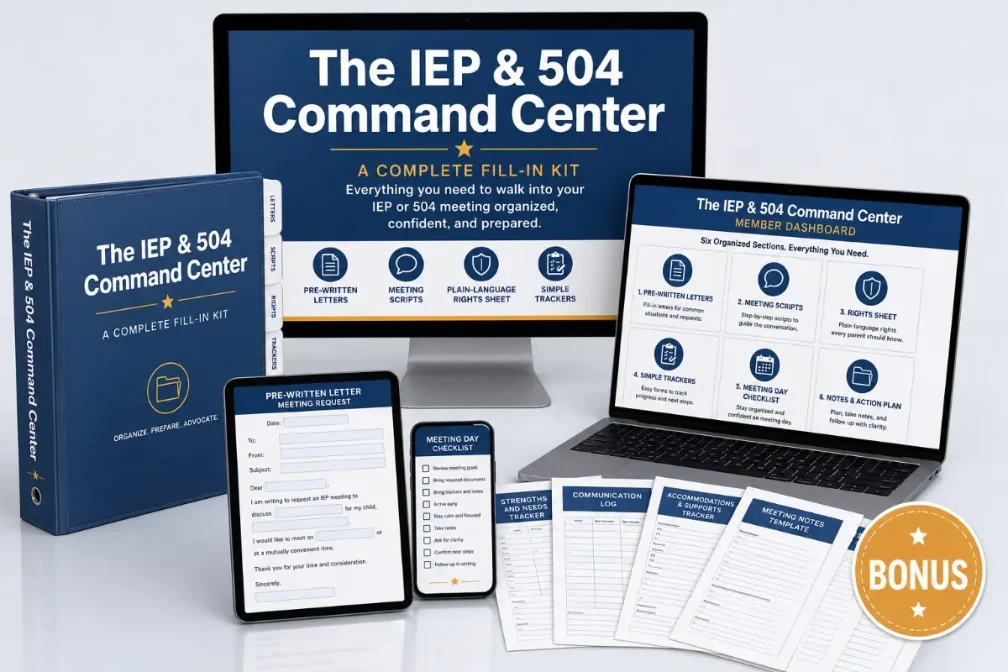
The IEP & 504 Command Center
This page shows what a measurable goal looks like. The Command Center hands you the done pieces: the binder built, the letters written, the meeting scripts ready and a self-review that shows where your child's IEP is strong or thin before you walk in. The library stays free.