IEP Math Goals
What are IEP math goals?
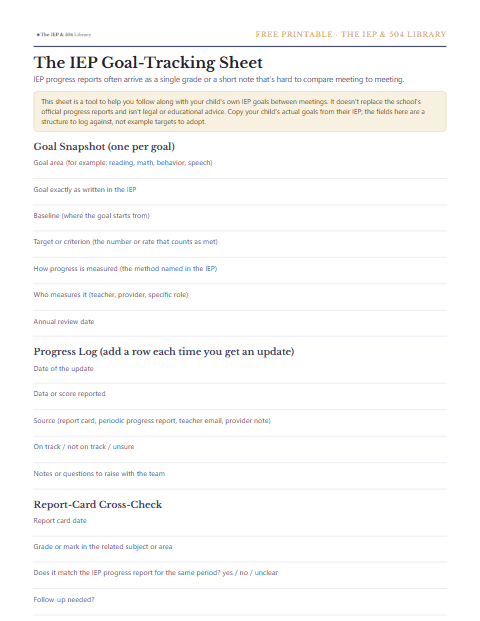
IEP math goals usually cover two areas: computation (working with numbers and operations, such as math facts, multi-digit problems and fractions) and problem-solving (applying math to word problems and real-world situations, such as deciding which operation a problem calls for). A well-written math goal names a baseline, a measurable target and a way to measure it, so progress is something the team can see rather than guess. The examples below are starting points to shape with your child's team, not goals to copy.

What a measurable math goal looks like
A measurable annual math goal names the skill, the condition, the criterion and how it is measured. IDEA requires annual goals to be measurable (34 CFR 300.320(a)(2)), so a goal like 'will get better at math' is not enough; a goal names an accuracy percentage, a number of facts solved in a set time or a success rate across trials. It also names what tools are allowed, since a goal worked with a calculator measures a different skill than one worked without.
Example goals by grade band
Each goal below is an example to discuss and adapt with your team, never a target your child must meet. The specific rates and percentages are illustrations of what a measurable goal looks like. To see how the parts fit together, try the goal practice builder.
Lower elementary (K-2)
Example · Computation (addition and subtraction facts)
Given 20 single-digit addition and subtraction facts within 10, [student] will solve with 80 percent accuracy on 4 of 5 trials by the annual review date, as measured by weekly teacher-scored math probes.
What to ask your team: Ask what baseline the goal starts from, meaning how many facts your child solves now. Then ask how the school will collect data between meetings.
Example · Problem-solving (single-step word problems)
Given a single-step addition or subtraction word problem within 20, [student] will choose the correct operation and solve with 70 percent accuracy on 4 of 5 trials by the annual review date, as measured by teacher-recorded work samples.
What to ask your team: Ask whether the word problem is read aloud to your child or read independently, since that changes what the goal is really measuring.
Upper elementary (3-5)
Example · Computation (multiplication facts)
Given 30 multiplication facts through the tens, [student] will solve with 85 percent accuracy on 4 of 5 trials by the annual review date, as measured by curriculum-based math probes.
What to ask your team: Ask whether the probe is timed, since a timed target measures fluency and an untimed one measures accuracy.
Example · Problem-solving (multi-step word problems)
Given a two-step word problem using addition, subtraction or multiplication, [student] will solve and show each step with 70 percent accuracy on 3 of 4 trials by the annual review date, as measured by scored classroom work samples.
What to ask your team: Ask how partial credit is handled, so a child who sets the problem up correctly gets credit for the reasoning even when the final answer is off.
Middle school (6-8)
Example · Computation (fractions and decimals)
Given 15 problems adding and subtracting fractions with unlike denominators, [student] will solve with 80 percent accuracy on 4 of 5 trials by the annual review date, as measured by teacher-scored unit probes.
What to ask your team: Ask whether a reference sheet or a calculator is allowed, since that accommodation changes which skill the goal is measuring.
Example · Problem-solving (ratios and percentages)
Given a real-world word problem involving a ratio or a percentage, [student] will set up and solve the problem with 70 percent accuracy on 3 of 4 trials by the annual review date, as measured by scored work samples.
What to ask your team: Ask how this goal connects to the grade-level standards your child is working toward and what supports come with it.
High school (9-12)
Example · Computation (one-variable equations)
Given 10 one-variable linear equations, [student] will solve for the variable with 80 percent accuracy on 4 of 5 trials by the annual review date, as measured by teacher-scored problem sets.
What to ask your team: Ask how the goal supports the math class your child is enrolled in and the credits they need toward graduation.
Example · Problem-solving (functional money math)
Given a real-world budgeting task with a set amount of money, [student] will calculate the total cost and the money remaining with 85 percent accuracy on 4 of 5 trials by the annual review date, as measured by scored functional-math tasks.
What to ask your team: Ask how the team weighed a grade-level math goal against a functional-math goal for your child's plans after high school.
What makes a goal measurable
- Names a measurable criterion (an accuracy percentage, a rate or a count), not just 'will improve in math'
- States how progress is measured and how often
- Names the condition, such as whether a calculator, manipulatives or a reference sheet is allowed
- Is written in person-first language
- Is a starting point for the team, never a fixed prescription
Common mistakes to watch for
- A goal with no baseline, so there is no way to judge progress
- A goal that says 'will improve math skills' with no number to measure against
- The same goal copied across years with no change in the target
- Deficit-first wording that describes the child by what they cannot do
A math goals bank organized by strand
The goals bank below groups measurable math examples by strand rather than by grade band: number sense, computation, word problems, then measurement and data. IDEA requires annual goals to be measurable (34 CFR 300.320(a)(2)) and requires the IEP to describe how progress toward each one is measured (34 CFR 300.320(a)(3)), so every example names an accuracy rate or a count plus the record the school keeps. Each one also names what the student is given, because a problem worked with a number line measures something different from the same problem worked without one.
These are examples to individualize with your child's team, never goals to copy. The accuracy percentages illustrate what measurable looks like. The target that belongs in your child's plan starts from the baseline in the present levels statement rather than from a page like this one.

Number sense and place value
A number sense goal should name the range of numbers and the materials the student works with. Ask what the evaluation showed about where counting or place value breaks down.
Example · Comparing numbers
Given 20 pairs of numbers within 1,000, [student] will identify which number is greater using place value with 85 percent accuracy on 4 of 5 trials by the annual review date, as measured by teacher-scored math probes.
Example · Reading and building a number
Given a number spoken aloud within 10,000, [student] will write it in digits and build it with base-ten blocks with 80 percent accuracy on 4 of 5 trials by the annual review date, as measured by teacher-recorded work samples.
Example · Placing fractions on a number line
Given a number line marked in halves, quarters and eighths, [student] will place 10 given fractions in the correct position with 80 percent accuracy on 4 of 5 trials by the annual review date, as measured by scored classroom work samples.
Computation and math facts
A computation goal should say which tools the student may use, since the same problem measures a different skill with a calculator than without one.
Example · Recalling addition and subtraction facts
Given 30 addition and subtraction facts within 20 and two minutes to work, [student] will answer 24 of 30 correctly on 4 of 5 weekly probes by the annual review date, as measured by timed teacher-scored fact probes.
Example · Multi-digit work with regrouping
Given 10 three-digit addition and subtraction problems requiring regrouping and no calculator, [student] will solve them with 80 percent accuracy on 4 of 5 trials by the annual review date, as measured by curriculum-based math probes.
Example · Working with decimals
Given 15 problems adding and subtracting decimals to the hundredths place, [student] will solve them with 80 percent accuracy on 4 of 5 trials by the annual review date, as measured by teacher-scored unit probes.
Word problems and multi-step reasoning
A problem-solving goal should separate reading the problem from doing the arithmetic. Ask which of the two the evaluation pointed at.
Example · Deciding which operation a problem calls for
Given 10 single-step word problems with the numbers already supplied, [student] will name the operation each problem calls for with 80 percent accuracy on 4 of 5 trials by the annual review date, as measured by teacher-scored problem-sorting tasks.
Example · Showing the steps in a multi-step problem
Given a two-step word problem and a taught solution template, [student] will write each step and label the answer with 75 percent accuracy on 4 of 5 trials by the annual review date, as measured by scored classroom work samples.
Example · Checking whether an answer makes sense
Given a solved word problem and a taught estimation strategy, [student] will judge whether the answer is reasonable and say why on 4 of 5 problems by the annual review date, as measured by a teacher-reviewed reasoning log.
Measurement, time and reading data
These goals get practiced in class and at home at the same time, so the setting the goal names matters. Ask where progress will be measured.
Example · Telling and using time
Given an analog clock and the daily class schedule, [student] will state the time to the nearest five minutes and name the activity that comes next with 85 percent accuracy on 4 of 5 trials by the annual review date, as measured by teacher-recorded observation data.
Example · Measuring with the right unit
Given a ruler and 10 objects to measure, [student] will measure each one to the nearest quarter inch and record the measurement with 80 percent accuracy on 4 of 5 trials by the annual review date, as measured by scored measurement tasks.
Example · Reading a graph or a table
Given a bar graph or table from the classroom material and five questions about it, [student] will answer them with 80 percent accuracy on 4 of 5 trials by the annual review date, as measured by curriculum-based data-interpretation probes.
From the team behind this library
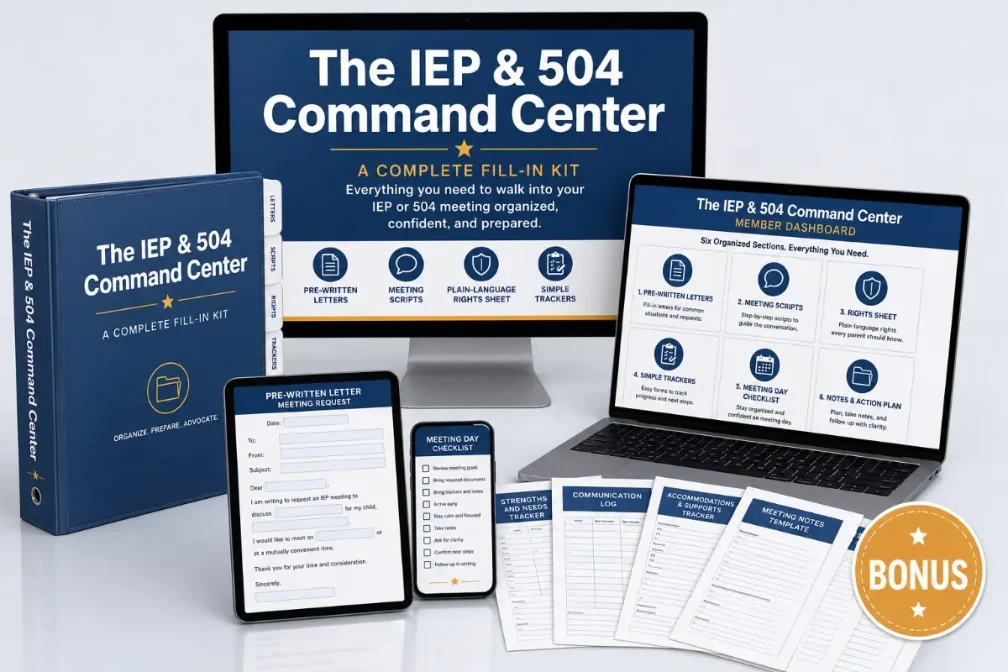
The IEP & 504 Command Center
This page shows what a measurable goal looks like. The Command Center hands you the done pieces: the binder built, the letters written, the meeting scripts ready and a self-review that shows where your child's IEP is strong or thin before you walk in. The library stays free.