IEP Attention and Focus Goals
What are IEP attention and focus goals?
Attention and focus goals help a student stay engaged with schoolwork: starting tasks, staying on task, finishing work and noticing when their focus has drifted so they can bring it back. A well-written attention goal names what on-task behavior looks like for that student, a measurable target and a way to record it, so progress is something the team can see rather than guess. The examples below are starting points to shape with your child's team, not goals to copy.

What a measurable attention and focus goal looks like
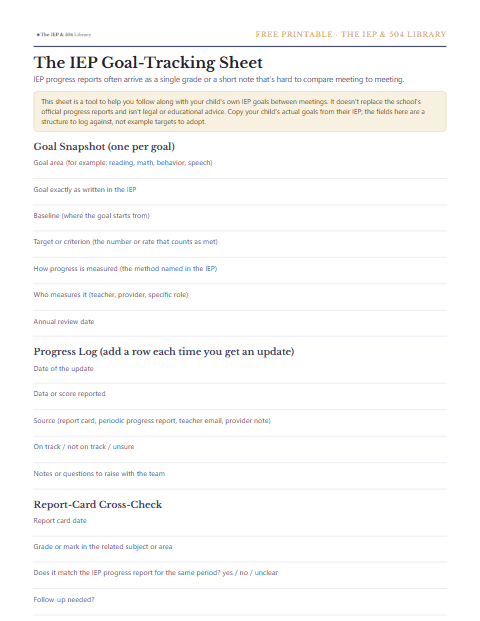
A measurable attention goal names the behavior, the condition, the criterion and how it is measured. IDEA requires annual goals to be measurable (34 CFR 300.320(a)(2)), so a goal like 'will pay better attention' is not enough. A strong attention goal defines on-task behavior in observable terms of what the student is doing (materials in use, work being attempted, following along with the lesson) rather than posture or gaze. It then sets a rate, a percentage or a time target the team can record.
Example goals by grade band
Each goal below is an example to discuss and adapt with your team, never a target your child must meet. The specific rates and percentages are illustrations of what a measurable goal looks like. To see how the parts fit together, try the goal practice builder.
Early elementary (K-2)
Example · Sustained attention during independent work
Given a 10-minute independent work task and a visual timer, [student] will stay on task (materials in use, work being attempted) for at least 8 of the 10 minutes on 4 of 5 observed sessions by the annual review date, as measured by teacher time-sampling records.
What to ask your team: Ask what counts as 'on task' for your child and how the teacher will record it during a busy classroom.
Example · Attending to directions
Given a two-step verbal direction paired with a visual cue, [student] will begin the first step within 1 minute on 4 of 5 opportunities across a school week by the annual review date, as measured by teacher observation logs.
What to ask your team: Ask whether a visual cue or a check-in helps your child start and which one the team will try first.
Upper elementary (3-5)
Example · Task initiation
Given a written assignment and a personal task checklist, [student] will start work within 2 minutes of the direction to begin on 4 of 5 opportunities by the annual review date, as measured by teacher-recorded start-time data.
What to ask your team: Ask what tends to help your child begin (a checklist, a quiet cue or a first-step model) and which one the team will build in.
Example · Self-monitoring attention
Given a self-monitoring checklist and a discreet signal, [student] will check whether they are on task and redirect themselves when needed on 4 of 5 recorded intervals by the annual review date, as measured by matched student self-checks and teacher observation.
What to ask your team: Ask how the team will teach the self-check first, so the goal builds a skill rather than expecting it to appear on its own.
Middle school (6-8)
Example · Work completion
Given a class assignment and the standard class period, [student] will complete at least 80 percent of the assigned work on 4 of 5 assignments across a grading period by the annual review date, as measured by a work-completion log.
What to ask your team: Ask whether the amount of work or the time is the barrier, so the goal targets the right one.
Example · Sustained attention during instruction
During whole-group instruction, [student] will demonstrate on-task behavior (following along with the lesson, using the materials, responding when prompted) for at least 12 of 15 minutes on 4 of 5 observed lessons by the annual review date, as measured by teacher interval recording.
What to ask your team: Ask what on-task behavior looks like for your child specifically, so the observer knows what they are counting.
High school (9-12)
Example · Attention across a multi-part task
Given a multi-part assignment and a task-planning sheet, [student] will break the task into steps and complete each step by its planned checkpoint on 4 of 5 assignments across a grading period by the annual review date, as measured by the completed planning sheets and teacher review.
What to ask your team: Ask how this goal connects to the skills your child will need after high school, so it builds toward independence.
Example · Self-managed refocusing
When [student] notices their attention has drifted during independent work, they will use a chosen refocusing strategy (a short break, a checklist or a movement reset) and return to the task within 2 minutes on 4 of 5 self-recorded occasions by the annual review date, as measured by a student strategy log reviewed with the teacher.
What to ask your team: Ask that your child helps choose the strategies, since a strategy they pick is one they are more likely to use.
What makes a goal measurable
- Names a measurable criterion (a percentage, a rate, a count or a time), not just 'will improve'
- Defines on-task behavior in observable terms, so two people watching would score it the same way
- States how progress is measured and how often
- Is written in person-first language
- Is a starting point for the team, never a fixed prescription
Common mistakes to watch for
- A goal that says 'will pay attention' with no observable definition, so two people watching would score it differently
- A time or percentage target with no baseline, so there is no way to judge progress
- Deficit-first wording that labels the child as distractible instead of naming the skill to build
From the team behind this library
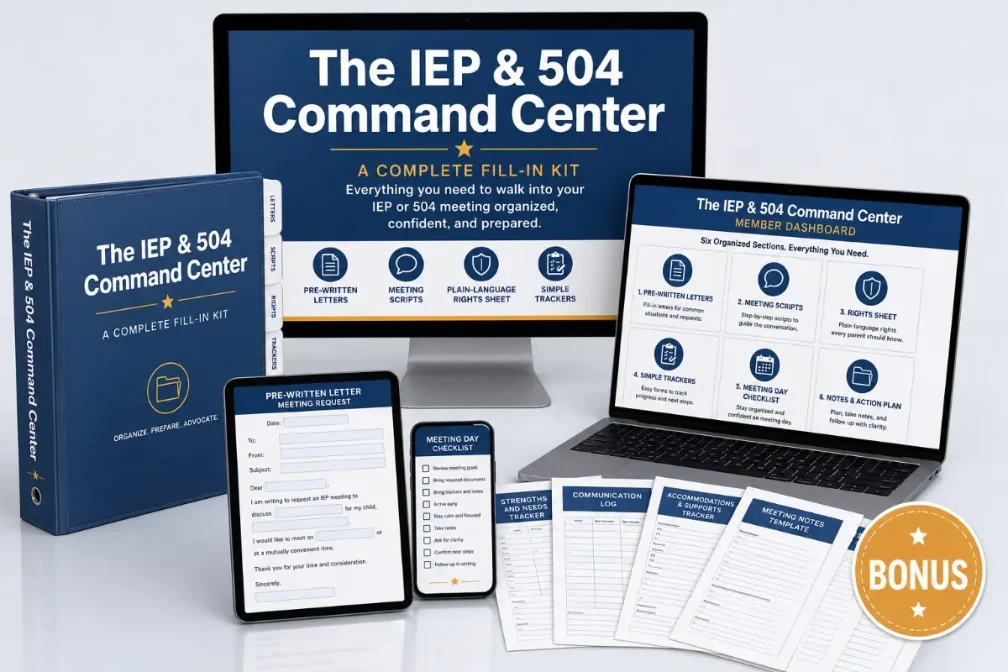
The IEP & 504 Command Center
This page shows what a measurable goal looks like. The Command Center hands you the done pieces: the binder built, the letters written, the meeting scripts ready and a self-review that shows where your child's IEP is strong or thin before you walk in. The library stays free.