The Prior Written Notice Response Letter Template (Free Printable)

A free printable read against IDEA and Section 504, written to help you walk in prepared. Last reviewed . Read against IDEA, 34 CFR 300.503. Jump to sources

What is the Prior Written Notice Response Letter Template?

A prior written notice (PWN) does not have to be the last word. You can acknowledge it, put your disagreement with any part of it in writing, ask for clarification on anything the notice was supposed to cover (federal regulation lists seven things every notice must address) and request an IEP meeting to talk it through, all in one dated letter you keep for your own records. This template gives you the language for each of those four moves so you can use only the parts that fit your situation.

How to use this printable. This is a starting template to help you put your response to a prior written notice in writing. Read it over and adjust it to your child's situation before you send it. It is general educational information, not legal advice. It does not guarantee a particular outcome, a changed decision or a meeting date. Responding to a notice is a normal, routine part of a working relationship with your child's school team, not a legal escalation.

How to use it

This letter has one part you always include (the acknowledgment) and four optional parts you include only if they apply: disagreement, a request for clarification, a request for the notice in a different language or format and a meeting request. Before you fill it in, read the notice you received against the checklist below, which lists the seven things federal regulation requires every prior written notice to address. Check off anything that feels unclear, missing or thin, then use those items to fill in the clarification paragraph.

What is on the printable

Fields in brackets are yours to fill in. Read the letter over and adjust it to your child's situation before you send it.

Subject: Response to Prior Written Notice for [Child's Full Name], dated [Date of Notice]
Dear [Principal / Special Education Coordinator / Case Manager Name],
I am writing in response to the prior written notice dated [Date of Notice] concerning my child, [Child's Full Name], currently in [Grade] at [School Name]. I received the notice on [Date Received]. It addressed [briefly describe the action, for example: the proposal to reduce my child's speech-language therapy minutes; the refusal to conduct the evaluation I requested]. Thank you for sending this in writing.
[Include this paragraph only if you disagree with all or part of the notice.] I want to note my disagreement with this notice in writing so it is part of the record. Specifically, I do not agree with [describe the specific part you disagree with, for example: the proposed reduction in occupational therapy minutes; the decision not to add a reading goal]. My reasons are: [describe your reasons in your own words, for example: this does not match what I am seeing at home and at school; the data described does not match my child's most recent progress report or an outside evaluation].
[Include this paragraph if any part of the notice was unclear or seemed to leave something out.] I would also like to ask for clarification in writing on the following, since federal regulation requires prior written notice to address each of these: [list the specific items from the checklist above that felt unclear or missing, for example: what evaluation data this decision is based on; what other options the team considered and why they were rejected]. Please send this clarification in writing so I can keep it with my records.
[Include this paragraph only if the notice was hard to understand or was not in your preferred language.] Please also let me know whether this notice can be provided in [preferred language] or explained to me directly, since I want to make sure I fully understand the decision described before I respond further.
[Include this paragraph if you want to request an IEP meeting to discuss the notice.] I would like to request an IEP meeting to discuss this notice further. Please contact me so we can find a time and place that works for both of us and let me know who from the team plans to attend.
Please contact me at [phone number] or [email address] with any questions or to follow up. I am keeping a copy of this letter and the notice it responds to for my own records and would appreciate a written or emailed acknowledgment that you received this response.
Thank you for your attention to this.
Sincerely,
[Your Name]
[Your Address]
[Phone Number] / [Email Address]
[Date]

Why this letter says what it says

A school must give you prior written notice a reasonable time before it proposes or refuses to start or change your child's identification, evaluation, educational placement or the services that make up FAPE.
34 CFR 300.503(a)
The notice requirement applies on both sides of a decision, when the school proposes a change and when it refuses one you asked for, which is why this template works whether the notice you received announced a change or turned down a request.
The notice has to include seven specific elements: what is proposed or refused, why, what data it is based on, your procedural safeguards protections, sources for help understanding it, what other options the team considered and any other relevant factors.
34 CFR 300.503(b)(1)-(7)
A notice that leaves one of these out has not fully met the requirement, which is the basis for the clarification checklist and paragraph in this template. You can ask, specifically and in writing, for whichever element feels thin or missing.
The notice must be written in language understandable to the general public and provided in your native language or usual mode of communication unless that is clearly not feasible, with steps taken to translate it orally if your language is not a written one.
34 CFR 300.503(c)
This is the basis for the optional paragraph asking for the notice in a different language or format, or for it to be explained to you directly, if the version you received was not clear.
For any IEP meeting that is held, the school must notify you early enough that you have a chance to attend and must schedule the meeting at a mutually agreed on time and place.
34 CFR 300.322(a)
This is the basis for the meeting-request paragraph. This section governs how a meeting is scheduled once one is being set up rather than promising a meeting on demand, so it does not guarantee the date you want, but it does mean the school cannot simply pick a time without trying to work around your availability. And if the school answers your request by refusing to change your child's identification, evaluation, placement or services, that refusal itself requires a new prior written notice under 34 CFR 300.503(a).
If you still disagree after sending this letter, your procedural safeguards notice describes the formal options for raising a dispute, such as a state complaint, mediation or a due process hearing.
34 CFR 300.504
This letter is a first, informal step, writing your disagreement down and asking questions directly. It is not the same as filing a formal complaint. If a written back-and-forth with the school does not resolve things, the procedural safeguards notice you received at some point this year is where the formal routes are described.

Sending tips

  • Send the letter in a way that gives you a dated record: email with a read receipt or a confirming reply, certified mail with return receipt or hand delivered with a signed and dated copy for your own file
  • Reference the exact date of the notice you are responding to, so there is no question which decision your letter addresses
  • Keep a copy of both the original notice and your response together in your own file
  • IDEA does not set a required format or a fixed deadline for a parent's written response to a prior written notice, but responding while the details are fresh and before any proposed change takes effect keeps the conversation clear for everyone
  • If you do not hear back within a reasonable time, follow up in writing and reference the date of this letter
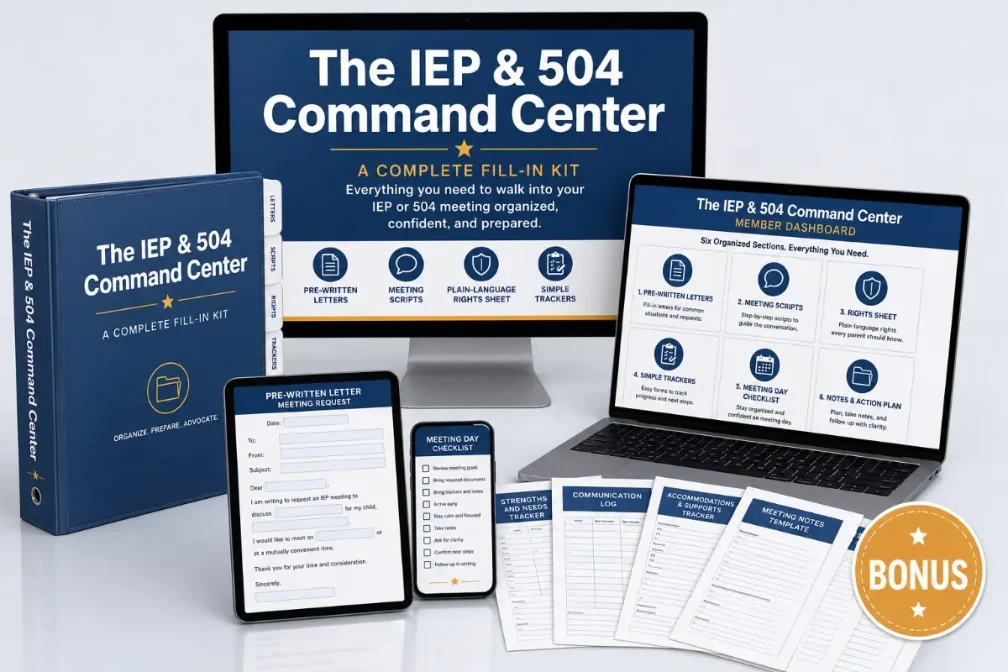
A preview of the free Prior Written Notice Response Letter Template, one printable page

Get the free Prior Written Notice Response Letter Template (PDF)

A letter to answer a prior written notice in writing, plus a checklist of what that notice is supposed to contain.

Instant download, plus a note if the guidance on this topic changes. Unsubscribe anytime.

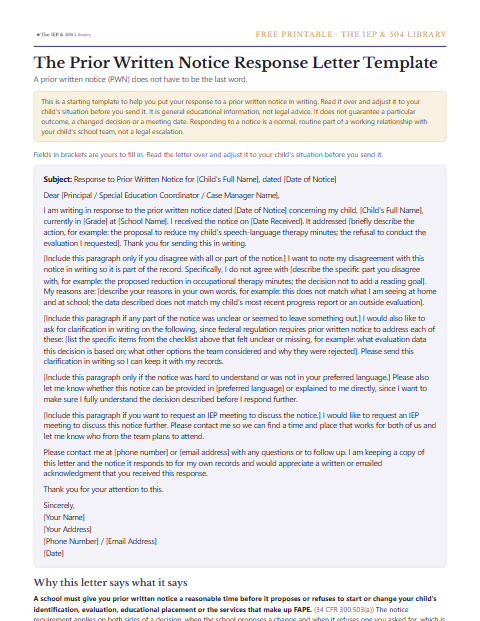
The IEP and 504 Command Center shown as a cover and a member area with its five parts: the Command Binder System, the Letter Library, the Meeting Script Deck, the Score-Your-IEP Self-Review and the Plain-Language Rights Cheat Sheet

From the team behind this library

The IEP & 504 Command Center

This printable is the map. The Command Center is the done pieces: The Command Binder System, The Letter Library, The Meeting Script Deck, The Score-Your-IEP Self-Review, The Plain-Language Rights Cheat Sheet, so you walk in organized, working from the same paperwork the team has.
See the Command Center One-time $27. Yours to keep. 60-day money-back guarantee.

Questions parents ask

What exactly is prior written notice and when will I get one?

Prior written notice is the written explanation a school must give you a reasonable time before it proposes or refuses to start or change your child's identification, evaluation, placement or services (34 CFR 300.503(a)). You can expect one after an eligibility evaluation, whenever the team proposes a change to services or placement and any time the school turns down a request to start or change your child's evaluation, placement or services, whether you asked in writing or out loud.

Do I have to disagree with the notice to use this template?

No. The acknowledgment section is the only part everyone uses. The disagreement, clarification, language and meeting-request paragraphs are each optional, so you can use just the ones that fit, for example requesting a meeting without disagreeing with anything in the notice.

Is there a deadline for me to send this response?

IDEA does not set a required time limit for a parent's written response to a prior written notice. Sending your response while the details are fresh and before any proposed change takes effect keeps the timeline clear for everyone.

What if the notice I received is missing one of the seven required elements?

Point that out specifically in your written response and ask for the complete notice. A notice that skips a required element, such as never naming the data behind the decision, has not fully met the requirement (34 CFR 300.503(b)). Naming the specific gap in writing is more useful than a general complaint that the notice was unclear.

Does sending this letter guarantee the school will change its decision or schedule a meeting right away?

No. This letter creates a clear, dated written record of your response and your requests, which is valuable on its own, but it does not guarantee a particular outcome. If the school does not respond in a reasonable time, follow up in writing and consider the dispute-resolution options described in your procedural safeguards notice.

This template addresses a parent's written response to a prior written notice already received. It does not restate the separate annual procedural safeguards notice in full and does not enumerate state-specific dispute-resolution deadlines or procedures, which vary and belong to each state's own IDEA Part B materials rather than being asserted here. Nothing in 34 CFR 300.503 sets a required format or deadline for a parent's response, so the letter and FAQ say so directly rather than implying one exists.

Sources

What the facts on this page come from

Last reviewed . That is the day this page was last read against the sources above, not the day the site was rebuilt. How this library is verified

This page is general educational information for parents, not legal or educational advice. It does not tell any family what to do. Every example here is a starting point to discuss and adapt with your child's IEP or 504 team, which decides what fits your child from the evaluation. Confirm anything time-sensitive with your school or district. For a genuinely contested situation, a special education advocate or an attorney who works in your state is the right person to ask.