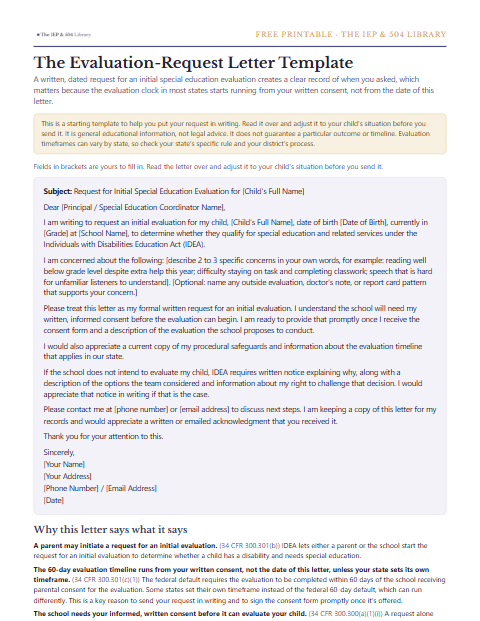
Nebraska IEP Evaluation Timeline, Dispute Routes and Parent Resources (2026)
- Evaluation window
- 45 school days
- The clock starts at
- Parental consent
- State complaint deadline
- One year
- Due process deadline
- Two years
How long does a school in Nebraska have to complete an IEP evaluation?
Nebraska sets its own initial evaluation clock at 45 school days from the day a school district or approved cooperative receives written parental consent to evaluate. School days skip weekends, holidays and breaks, so that count can land later than the federal 60 calendar day limit, which is why the Office of Special Education tells districts the state figure cannot push past the federal one. The department's family guide puts it in plain words for parents: 45 school days or 60 calendar days, whichever is sooner. Once the multidisciplinary team reaches a verification decision, the district has 30 calendar days to hold the meeting that writes the individualized education program. Most referrals reach that clock through a student assistance team step first, though a parent can put a written request for an evaluation in at any point, which starts the consent conversation directly. One change is pending. The department held a rulemaking hearing on Rule 51 on December 17 2025. As of August 2 2026 its rules listing still shows Rule 51 effective May 17 2022 and the 2022 edition is still the version it posts, so nothing from that hearing has taken effect yet.

The evaluation timeline in Nebraska
| Initial evaluation window | 45 school days, capped by the federal 60 calendar days, whichever is stricter |
|---|---|
| The clock starts at | receipt of parental consent |
| Against the federal rule | A timeframe Nebraska sets for itself |
IDEA sets a default of 60 calendar days from parental consent for an initial evaluation (34 CFR 300.301(c)(1)). It also lets a state set its own timeframe instead, which is what Nebraska has done, so the window above is the one that applies here.
Nebraska's Rule 51 sets a 45 school day timeline, but the Nebraska Department of Education has clarified in guidance that this state timeline cannot be used to exceed the federal 60 calendar day limit, so a district must actually meet whichever deadline arrives first.
Source: 92 NAC 51-009.04 www.education.ne.gov/wp-content/uploads/2023/08/SOS_April_2023_45Days_60Days_Memo.pdf
The same window sits beside all fifty-one jurisdictions on the evaluation timelines by state table, which explains where the federal deadline comes from. To pull one state's window on its own, the evaluation deadline checker returns that single result.
Reevaluation and IEP review cadence in Nebraska
Nebraska writes the federal cadence into its own rule rather than changing it. A reevaluation happens at least once every three years unless the parent and the school district or approved cooperative agree it is unnecessary. It happens no more than once a year unless both agree otherwise. A reevaluation also runs when the district decides the child's educational or related service needs warrant one or when a parent or a teacher asks for one. The individualized education program is reviewed at least annually to see whether the annual goals are being achieved. After that annual meeting the parent and the district can agree to amend the program in writing instead of calling the team together again. What Nebraska adds sits inside that annual cycle. Transition content starts two years earlier than the federal floor. The first program to be in effect when the child turns 14 carries measurable postsecondary goals drawn from age appropriate transition assessments covering training, education, employment and, where appropriate, independent living skills, plus the transition services and courses of study needed to reach those goals, updated every year after that. Where a participating agency other than the district does not deliver a transition service described in the program, the district brings the team back together to identify other ways to meet the transition objectives.
Source: 92 NAC 51-006.05B1 for the once a year limit, 006.05B2 for the three year limit, 006.05A1 and 006.05A2 for the other two triggers, 007.09C for the annual review of the individualized education program, 007.09E for amending it by agreement, 007.07A9 and 007.07A9a and 007.07A9b for transition content beginning with the first program in effect at 14, 007.07A9c for an outside agency that does not deliver; federal cadence at 34 CFR 300.303(b) and 34 CFR 300.324(b)(1)(i); federal transition age at 34 CFR 300.320(b) www.education.ne.gov/wp-content/uploads/2017/10/Clean51_2022.pdf
If you disagree in Nebraska
IDEA gives families in every state the same three routes when a disagreement with the school does not resolve at the team table. What changes at the state line is who administers each route, how long you have to file and the local detail below.
The state complaint
Handled by Office of Special Education, Nebraska Department of Education. Time limit to file: the violation has to have happened no more than one year before the department receives the complaint.
A state complaint in Nebraska is a signed written allegation that a public agency broke Rule 51, the federal special education regulations or Part B of the IDEA. It goes to the Office of Special Education at the Nebraska Department of Education, with a copy sent to the school district or approved cooperative serving the child at the same time. The complaint has to allege a violation that happened no more than one year before the department receives it. Nebraska then adds a short exchange at the front that many states leave out of the rule. Within 14 calendar days of receiving the signed complaint, an assigned Office of Special Education official notifies the person who filed it plus the district in writing, sending along a copy of the complaint and the substance of the allegation. The district has its own 14 calendar days to submit a written response. Rule 51 also has the office give the district a chance to propose a resolution at its own discretion, plus an opportunity for the parent who filed and the district to take the disagreement to voluntary mediation. Office of Special Education staff investigate each complaint, can ask for more written or oral information from any party and can run an independent on site investigation. Within 60 calendar days of receiving the complaint the office issues written findings of fact, conclusions and the basis for them to everyone involved. That 60 days stretches only for exceptional circumstances in the particular complaint or where the parent and the district agree to extend it to try mediation or another resolution route. A finding of noncompliance names the specific steps the district takes to fix it, along with a reasonable period to comply. Where an issue in the complaint is already part of a due process hearing, the office sets that issue aside until the hearing ends and resolves the rest on the normal clock. The department's own state complaint page carries the working material: a sample complaint form in English, Chinese, Spanish, French and Vietnamese (the department notes the form is not required), a complaint checklist in the same five languages, a public complaint guideline and the redacted final investigation reports from past complaints going back to the 2020-2021 year, which show how the office writes up findings. The same page points a family who wants help drafting or filing a complaint to PTI Nebraska. The dispute resolution landing page that links it still marks one combined state complaint, due process and appeals item as coming soon.
Source: 92 NAC 51-009.11A for who may file, 009.11B1 through 009.11B4e for what a complaint contains, 009.11B5 for the one year window, 009.11B6 for the copy to the school district or approved cooperative, 009.11C1 for the 14 day acknowledgment and the district's 14 days to respond, 009.11C2a for the proposal to resolve at the district's discretion, 009.11C2b for the opportunity to go to voluntary mediation, 009.11C3 for the investigation, 009.11C4 for the 60 calendar day written findings, 009.11C5a and 009.11C5b for the two grounds to extend, 009.11C6 for corrective action, 009.11C8 for setting aside an issue already in a hearing; Nebraska Department of Education, State Complaint, for the sample form, the checklist, the public complaint guideline and the published investigation reports; Nebraska Department of Education, Dispute Resolution, for the route descriptions and the coming soon item; federal complaint procedures at 34 CFR 300.151 through 300.153 www.education.ne.gov/wp-content/uploads/2017/10/Clean51_2022.pdf
Mediation
Nebraska sends mediation out of the education department. Rule 51 has a parent or a school district that wants mediation contact the Nebraska Office of Dispute Resolution, which arranges the meeting, invites both parties and conducts the mediation. That office sits in the judicial branch, inside the Administrative Office of the Courts and Probation, created by the Dispute Resolution Act and established in the office of the State Court Administrator. It approves the six regional mediation centers that cover the state between them: Central Mediation Center, Concord Mediation Center, The Mediation Center, Mediation West, Nebraska Mediation Center and The Resolution Center, each covering a named list of counties. The department's own mediation page describes a more direct starting point than the rule text does. It says to call an approved mediation center, where an intake coordinator answers questions, helps a family decide whether to mediate, contacts the people the family thinks should be there and arranges a time and place, with the center assigning the mediators. The Nebraska Department of Education bears the cost of the mediation process, so a session costs a family nothing. Taking part is voluntary for both sides. Mediation cannot be used to deny or delay a due process hearing or any other right under Rule 51. It is available for any disagreement about identification, evaluation, placement or the provision of a free appropriate public education, including one raised before any hearing petition is filed. The mediator has to be qualified, impartial and trained in effective mediation techniques. A mediator cannot be an employee of the department or of the district or cooperative involved in the child's education. A mediator also cannot hold a personal or professional interest that conflicts with the person's objectivity. Being paid by an agency to serve as a mediator does not by itself make someone that agency's employee. Discussions stay confidential and cannot be used as evidence in a later hearing or civil proceeding. A resolution goes into a legally binding written agreement signed by the parent and by someone with authority to bind the agency, enforceable in a state court of competent jurisdiction or in federal district court. The department also keeps its own list of qualified mediators for districts, cooperatives and parents. Alongside mediation it publishes individualized education program facilitation as a separate option, where a neutral person keeps a scheduled meeting on track rather than resolving a filed dispute. The department says plainly that facilitation is not required under the IDEA and is not one of the dispute resolution options in the federal procedural safeguards.
Source: 92 NAC 51-009.12A read with 009.05A1 and 009.05A2 for what mediation covers, 009.12A1a for contacting the Nebraska Office of Dispute Resolution, 009.12A1b for arranging and conducting the mediation, 009.12B1 through 009.12B3 for the voluntary process and the impartial trained mediator, 009.12D for the department's list of qualified mediators, 009.12E for the department bearing the cost, 009.12G1 through 009.12G3 for the binding written agreement, 009.12H for confidentiality, 009.12I1a through 009.12I2 for who may not serve; Neb. Rev. Stat. 25-2904 for the Office of Dispute Resolution established in the office of the State Court Administrator under the Dispute Resolution Act; Nebraska Judicial Branch, Office of Dispute Resolution, for the office sitting in the Administrative Office of the Courts and Probation and for the six approved mediation centers by name; Nebraska Department of Education, Mediation, for calling an approved center and the intake coordinator's role; Nebraska Department of Education, IEP Facilitation, for facilitation sitting outside the federal safeguards; federal mediation rule at 34 CFR 300.506 www.education.ne.gov/wp-content/uploads/2017/10/Clean51_2022.pdf
A due process hearing
Time limit to file: Two years from the date the parent or the school district knew or should have known about the alleged action the petition is about, with the two federal exceptions that lift the limit for a parent kept out of filing by a district's specific misrepresentation that it had resolved the problem or by its withholding of information the rules required it to give the parent.
Nebraska calls a due process case a special education contested case. It starts when a parent, a guardian, a competent student at the age of majority or a school district files a petition with the Nebraska Department of Education and serves a copy on the other party. The department assigns the petition to a hearing officer, sends notice of that assignment and serves a notice to file an answer, then each respondent has 10 days from receiving the petition to send the other side an answer addressing the issues raised. Where the district has not already sent prior written notice on the subject of the petition, that answer has to explain why it proposed or refused the action, describe the other options the team considered and rejected, describe what it used as the basis for the decision plus the other factors that were relevant. Hearing officers assigned by the department hold exclusive original jurisdiction over these cases by statute, so a juvenile court cannot take one. A hearing officer cannot be an employee or officer of a state or local agency involved in the child's education or care. Being paid to serve does not by itself make that person an employee. A resolution meeting comes first, within 15 days of the district receiving the complaint, unless both sides waive it in writing or agree to mediate instead. The clock for the final decision begins when the 30 day resolution period ends, with 45 calendar days to the written decision after that. A hearing officer can extend it at a party's timely written request for good cause shown, for which the rule gives illness of a party, counsel or a witness, a change in legal representation or settlement talks under way as examples rather than as a closed list. Two of the state's own texts describe that clock differently. Rule 51, revised in 2022, states the resolution period sequence in its current federal form, which is also what the department's own procedural safeguards notice and its published due process flow chart follow, while Rule 55 sits in its 2012 edition and phrases the 45 days twice as running from the department's receipt of the petition or of the hearing request. Rule 55 also prints a filing address the department has since moved away from, so the current filing address comes from the Office of Special Education rather than from the rule text. Where Nebraska parts company with most states is after the decision. A party who disagrees files a petition for judicial review in the district court of the county holding the school district's main administrative offices, within two years after the decision is served. The federal rule sets 90 days as its default for a civil action, then gives way to a state's own explicit time limitation where the state has one, which is the same thing Rule 55 says in its own words. Filing that petition stays enforcement of the hearing officer's order. The child stays in the current educational placement while the court case runs unless the district and the parent agree otherwise. The court sits without a jury, takes the record of the administrative proceedings, hears additional evidence at a party's request, decides on the preponderance of the evidence and grants the relief it finds appropriate. A further appeal goes to the Nebraska Court of Appeals, taken the way civil appeals are taken and heard anew on the record. Enforcing a hearing officer's order runs on a shorter clock: a petition for appropriate relief in the same district court within one year of the decision. The department publishes the redacted hearing officer decisions themselves, case by case, back to 2010.
Source: 92 NAC 55-004.01 for the two year filing window, 55-001.02H1 and 55-004.02 with 004.02A and 004.02B for the two exceptions, 55-004.03 and 55-004.07 for filing the petition with the department and serving the other party, 55-004.08 for the assignment and the 10 day answer, 55-004.09 with 004.09A through 004.09D for what the answer carries where no prior written notice went out, 55-005.01 and Neb. Rev. Stat. 79-1163 for exclusive original jurisdiction and the exclusion of juvenile courts, 55-005.03 and 55-005.04 for hearing officer independence, 55-004.18 and 55-008.08 for the department's 2012 phrasing of the decision clock, 55-006.03 with 006.03A1 through 006.03A3 for continuances beyond the 45 days on good cause, 55-009.02 and 55-009.04 and 55-009.08 for judicial review, enforcement and the federal civil action window; 92 NAC 51-009.13A1 for the 15 day resolution meeting, 51-009.13A3a and 009.13A3b for waiving it or mediating instead, 51-009.13B1 and 009.13B2 and 009.13C1 for the 30 day resolution period and the 45 day decision timeline; Neb. Rev. Stat. 79-1162 for who may initiate a hearing, 79-1167(2) for the two year judicial review window in district court, 79-1167(3) for the stay and the current placement, 79-1167(5) for how the court decides, 79-1167(6) for the appeal to the Court of Appeals, 79-1167(7) for the one year enforcement window; Nebraska Department of Education, Due Process, for the flow chart and the published decisions; federal two year default at 34 CFR 300.507(a)(2), federal decision timeline at 34 CFR 300.515(a), federal civil action window that defers to state law at 34 CFR 300.516(b) www.education.ne.gov/wp-content/uploads/2017/10/Rule55_2012.pdf
From the team behind this library
The IEP & 504 Command Center
This page shows you the deadlines and the contacts for your state. The Command Center hands you the done pieces: the binder built, the letters written, the meeting scripts ready and a self-review that shows where your child's IEP is strong or thin before you walk in. The library stays free.
Who to contact in Nebraska

- The state special education office. Office of Special Education, Nebraska Department of Education. This is the office that answers questions about Nebraska rules and receives a state complaint.
- Your rights in writing. IDEA Part B Parents' Rights in Special Education (Age 3-21), Procedural Safeguards Notice, revised August 2018, published by the Nebraska Department of Education Office of Special Education (Chinese, Gujarati, Spanish and Vietnamese editions sit beside the English one on the department's parent rights page). Every district hands parents this notice at least once a year (34 CFR 300.504). It is the plain summary of what you can ask for at each step.
- Parent training and information center. PTI Nebraska. A parent center is free and federally funded under IDEA. Staff there talk families through the process in their own state at no cost.
- The state rules themselves. Neb. Rev. Stat. 79-1110 to 79-1167, the Special Education Act, together with Title 92, Nebraska Administrative Code, Chapter 51, Regulations and Standards for Special Education Programs (Rule 51) and Chapter 55, Rules of Practice and Procedure for Due Process Hearings in Special Education Contested Cases (Rule 55). The Special Education Act is where Nebraska writes its own special education law, opening with the Legislature's statement that every child in the state, whatever their physical or mental capacity, is entitled to a meaningful educational program, then running through district duties, hearings and the route to court. Rule 51 carries the operating detail underneath it: definitions, child find, the student assistance team step, multidisciplinary team evaluation and verification, individualized education programs, placement, discipline, procedural safeguards, state complaints, mediation, nonpublic school students and personnel standards. Rule 55 holds the practice and procedure for a due process hearing.
Child Find in Nebraska
Nebraska routes most school age referrals through a general education team before an evaluation starts. Rule 51 has a student assistance team or a comparable problem solving team used before a referral for multidisciplinary team evaluation, documenting the problem solving and intervention strategies tried to support the teacher in general education. When that team decides the viable alternatives have been explored, the referral it completes carries the team's information plus a list of its members. The department's own family guide says state law sets no length for that step and no number of strategies, which is why the wait before testing varies from one district to the next. The same guide states that a parent can put a written request for a special education evaluation in at any time during the process. Rule 51 lists a parent, the Nebraska Department of Education, another state agency, a school district, an approved cooperative or a nonpublic school as parties who can request an initial evaluation. Prior written notice follows either way, explaining why the district proposes or refuses to evaluate and what the team used as the basis for that decision. The statewide duty to identify, locate and evaluate covers children who are homeless or wards of the state, children attending nonpublic schools, highly mobile and migrant children plus a child suspected of having a disability who is advancing from grade to grade. One structural detail shapes who answers a family: many Nebraska districts deliver special education through an approved cooperative, which Rule 51 defines as two or more districts or an Educational Service Unit approved by the department to perform special education functions jointly, so deadlines and paperwork can carry the cooperative's name rather than the district's. Below school age the structure splits again. Rule 52 defines an infant or toddler with a disability as a child under three years of age and runs early intervention through co-lead agencies, the Department of Health and Human Services together with the State Department of Education, while Rule 51 carries early childhood services for children with disabilities birth to age five.
Source: 92 NAC 51-006.01A for the duty to identify, locate and evaluate, 006.01A1 and 006.01A2 for highly mobile children and a child advancing from grade to grade, 006.01B1 and 006.01B2 for the student assistance team step before a referral, 006.01B3 for what the referral carries, 006.02B for who may request an initial evaluation, 003.11 for the approved cooperative and Educational Service Unit definition, 009.05A for prior written notice; 92 NAC 52-003.03 for the co-lead agencies in early intervention read with 52-003.15 for the under three age range; 92 NAC 51-005 for early childhood services birth to age five; Nebraska Department of Education and PTI Nebraska, Family Guide to Special Education in Nebraska, for the department's statement that state law sets no length for the student assistance team step and that a parent may make a written request at any time; federal child find at 34 CFR 300.111 www.education.ne.gov/wp-content/uploads/2017/10/Clean51_2022.pdf