Washington IEP Evaluation Timeline, Dispute Routes and Parent Resources (2026)
- Evaluation window
- 35 school days
- The clock starts at
- Written parental consent
- State complaint deadline
- One year
- Due process deadline
- Two years
How long does a school in Washington have to complete an IEP evaluation?
Washington sets its own evaluation deadline in school days rather than using the federal 60 calendar day default: a district completes an initial evaluation within 35 school days of receiving written parental consent. School days skip weekends, holidays and days the school is closed, so a winter or spring break falling inside that window pushes the finish date further out on the calendar. Since June 11, 2026 a second deadline sits behind the first, because the family receives a copy of the evaluation report by that 35th school day, then the eligibility determination meeting happens no sooner than five school days later and no later than the 40th school day after consent. A separate 25 school day period runs earlier, from the day a district receives a request for an initial evaluation to the day it decides whether to evaluate at all. A family that disagrees has three routes: a written community complaint to OSPI's Special Education Division, free mediation through the cadre OSPI contracts with or a due process hearing before an administrative law judge at the Office of Administrative Hearings, where Washington law puts the burden of proof on the school district.

The evaluation timeline in Washington
| Initial evaluation window | 35 school days |
|---|---|
| The clock starts at | receipt of written parental consent |
| Against the federal rule | A timeframe Washington sets for itself |
IDEA sets a default of 60 calendar days from parental consent for an initial evaluation (34 CFR 300.301(c)(1)). It also lets a state set its own timeframe instead, which is what Washington has done, so the window above is the one that applies here.
Washington measures its evaluation window in school days rather than the federal 60 calendar days. A district completes an initial evaluation within 35 school days of receiving written parental consent. Since June 11, 2026 a second deadline sits behind that one: the district gives the family a copy of the evaluation report by the 35th school day, then holds the eligibility determination meeting no sooner than five school days later and no later than the 40th school day after consent. A separate 25 school day period runs before all of it, from the day the district receives a request for an initial evaluation to the day it decides whether to evaluate at all. OSPI has proposed cutting that 25 school day period to 20, in a rule filed on April 21, 2026 as WSR 26-09-120. The proposal was not adopted as of August 2, 2026, so the published rule still reads 25 school days.
Source: WAC 392-172A-03005(2)(c) and (3)(a); RCW 28A.155.265(1), added by 2026 c 34 s 2 (ESHB 2557) app.leg.wa.gov/wac/default.aspx?cite=392-172A-03005
The same window sits beside all fifty-one jurisdictions on the evaluation timelines by state table, which explains where the federal deadline comes from. To pull one state's window on its own, the evaluation deadline checker returns that single result.
Reevaluation and IEP review cadence in Washington
Washington writes the federal cadence into its own rules: a reevaluation at least once every three years unless the parent and the district agree it is unnecessary, no more than once a year unless both agree otherwise, plus an IEP review at least annually. Washington adds its own clock on top. A reevaluation is completed within 35 school days of written parental consent, the same window that applies to an initial evaluation. Since June 11, 2026 the family also receives a copy of the reevaluation report by that 35th school day, with the eligibility determination meeting held no sooner than five school days after the report arrives and no later than the 40th school day after consent. OSPI states that the date of that meeting sets the next three year due date, so a district may start a reevaluation earlier than it once did to fit both steps in before the deadline.
Source: WAC 392-172A-03015(2)(a), (2)(b) and (3)(a); RCW 28A.155.265(1); annual IEP review at WAC 392-172A-03110(3)(a) and 34 CFR 300.324(b)(1)(i) app.leg.wa.gov/wac/default.aspx?cite=392-172A-03015
If you disagree in Washington
IDEA gives families in every state the same three routes when a disagreement with the school does not resolve at the team table. What changes at the state line is who administers each route, how long you have to file and the local detail below.
The state complaint
Handled by Special Education Division, Office of Superintendent of Public Instruction. Time limit to file: One year back from the date OSPI receives the complaint.
Washington calls this route a special education community complaint rather than a state complaint. Anyone can file one, not only a parent of the student. The written complaint goes by mail or fax to the assistant superintendent of special education at OSPI in Olympia, with a copy going to the school district at the same time. It can raise only a violation that happened within the year before OSPI receives it. The district receives a copy from OSPI, then responds in writing with documentation of its own investigation within 17 calendar days. OSPI makes an independent determination on top of that, which can draw on an independent on-site visit, then issues a written decision addressing each allegation with findings of fact within 60 days of receiving the complaint. That 60 day limit stretches only for exceptional circumstances tied to the complaint or where both sides agree in writing to try mediation or another dispute resolution route first. Where OSPI finds a violation, the decision names the corrective action, which can include compensatory education or monetary reimbursement. OSPI's own guidance notes that no burden of proof applies in a community complaint, since the duty to investigate independently sits with OSPI.
Source: WAC 392-172A-05025(1), (2)(c) and (2)(d); WAC 392-172A-05030(3), (6), (7) and (8); OSPI: File a Community Complaint (the route name plus the mail and fax filing) app.leg.wa.gov/wac/default.aspx?cite=392-172A-05025
Mediation
OSPI does not employ Washington's special education mediators. It contracts the work to a private cadre, Sound Options Cadre. The rule routes a request to OSPI's administrative agents rather than to OSPI itself, in writing or by phone. OSPI's own page gives that cadre's phone number and email address, so families or districts ask for a session directly. Mediation is voluntary for both sides. Either side can end it at any point. OSPI pays for it, including the cost of the meetings. Anything said in mediation stays confidential and cannot be used later as evidence in a due process hearing or a civil case. An agreement reached there is written down, signed by the parent and by someone with authority to bind the district, then enforceable in a state court or in a federal district court. The same contractor runs a lighter route Washington offers alongside mediation, which OSPI calls facilitation, where a neutral facilitator works with the IEP team to set an agenda and keep the discussion on track. Facilitation costs families nothing either.
Source: WAC 392-172A-05060(2) and (4); WAC 392-172A-05070(1), (2) and (3); OSPI pages for Request Mediation and Request Facilitation (the contractor name plus the free facilitation route) app.leg.wa.gov/wac/default.aspx?cite=392-172A-05060
A due process hearing
Time limit to file: Two years from the date the parent or the district knew or should have known about the action the complaint is about.
Washington does not run its own hearing office. A due process hearing is conducted for OSPI by the Office of Administrative Hearings, a separate state agency that hears cases for many Washington agencies. One of its administrative law judges decides the case. The request is served on the other side and filed with that office by mail, fax or its online filing portal rather than with OSPI, so the clock starts when the later of those two receives it. The responding side answers in writing within ten days. Washington also places the burden of proof differently from most states. Since June 6, 2024 the school district carries the burden of persuasion and production whenever it is a party to a due process hearing about identification, evaluation, reevaluation, classification, placement, discipline or the provision of a free appropriate public education, measured by a preponderance of the evidence. One exception runs the other way: a parent seeking tuition reimbursement for a placement they arranged themselves carries the burden on whether that placement was appropriate. The two year filing limit lifts where the district misrepresented that it had resolved the problem or held back information it was required to give the parent.
Source: WAC 392-172A-05080(2); WAC 392-172A-05085(1)(a), (1)(b) and (8); WAC 392-172A-05090(1)(a); WAC 392-172A-05095(1); WAC 392-172A-05160(3)(b)(i); RCW 28A.155.260, added by 2024 c 29 s 1 (SB 5883) app.leg.wa.gov/wac/default.aspx?cite=392-172A-05080
From the team behind this library
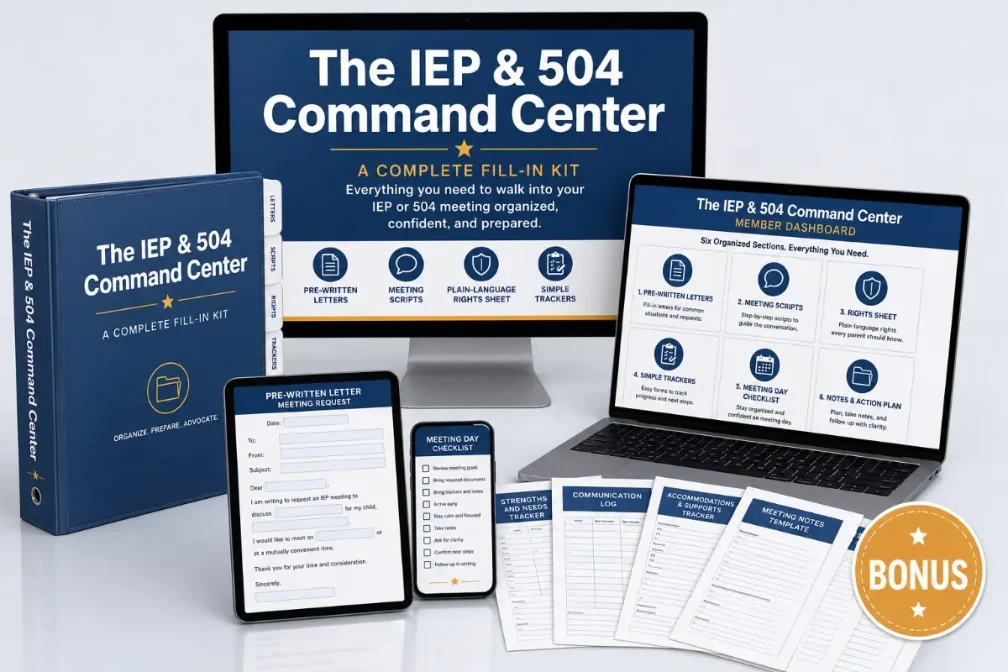
The IEP & 504 Command Center
This page shows you the deadlines and the contacts for your state. The Command Center hands you the done pieces: the binder built, the letters written, the meeting scripts ready and a self-review that shows where your child's IEP is strong or thin before you walk in. The library stays free.
Who to contact in Washington

- The state special education office. Special Education Division, Office of Superintendent of Public Instruction. This is the office that answers questions about Washington rules and receives a state complaint.
- Your rights in writing. Notice of Special Education Procedural Safeguards for Students and Their Families (October 2023 edition), published by the Office of Superintendent of Public Instruction with translated editions posted beside the English one. Every district hands parents this notice at least once a year (34 CFR 300.504). It is the plain summary of what you can ask for at each step.
- Parent training and information center. PAVE (Partnerships for Action, Voices for Empowerment). A parent center is free and federally funded under IDEA. Staff there talk families through the process in their own state at no cost.
- The state rules themselves. Chapter 28A.155 RCW (Special Education); implementing rules at chapter 392-172A WAC. Chapter 28A.155 RCW is Washington's own special education statute, covering who is entitled to services from age three through the end of the school year in which the student turns 22, OSPI's duty to run and enforce the program, the burden of proof in a due process hearing and the evaluation report deadlines added in 2026, with the day to day operating detail carried in chapter 392-172A WAC.
Child Find in Washington
Washington's duty to serve students runs past the usual cut-off. After the Ninth Circuit ruled in N. D. v. Reykdal in May 2024, the legislature passed SSB 5253, which extends special education to the end of the school year in which the student turns 22 rather than stopping at 21. That took effect for the 2025-26 school year. On the front end, districts locate, identify and evaluate students who live inside their boundaries whether or not those students attend the public schools, which reaches students who are homeless as well as other highly mobile students. Students in approved nonprofit private schools sit under a separate rule keyed to where the school is rather than where the student lives, so the district the school sits in runs child find for them even when the student lives in another district or another state. OSPI has said that where a student keeps receiving services to age 22, the IEP and evaluation timelines in chapter 392-172A WAC and the rest of that chapter's requirements apply the same way.
Source: RCW 28A.155.020, as amended by 2025 c 256 s 3 (SSB 5253); WAC 392-172A-02040(1) and (2); WAC 392-172A-04005(1) and (6); OSPI: Questions and Answers, Providing Special Education Services Until Age 22 (the Reykdal ruling, the 2025-26 start plus the timelines statement) app.leg.wa.gov/RCW/default.aspx?cite=28A.155.020