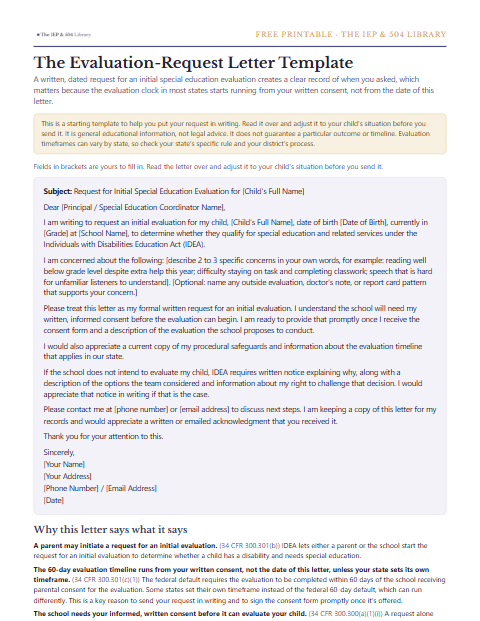
Virginia IEP Evaluation Timeline, Dispute Routes and Parent Resources (2026)
- Evaluation window
- 65 business days
- The clock starts at
- Referral
- State complaint deadline
- One year
- Due process deadline
- Two years
How long does a school in Virginia have to complete an IEP evaluation?
In Virginia a school division has 65 business days from the day the special education administrator receives a referral to finish the evaluation and decide eligibility, which runs longer in real time than the federal default of 60 calendar days from parental consent. Business days here mean Monday through Friday apart from federal and state holidays, so the count keeps moving through school breaks. A parent and the eligibility group can agree in writing to extend that window to gather data that will not arrive in time. A school division is also free to set itself a shorter deadline. A family that disagrees with a decision has three routes: a written state complaint to the Virginia Department of Education, which either party can appeal within 30 calendar days, free mediation that opens when a parent and a school representative jointly ask for it, or a due process hearing before a hearing officer appointed through the Supreme Court of Virginia.

The evaluation timeline in Virginia
| Initial evaluation window | 65 business days |
|---|---|
| The clock starts at | receipt of the referral |
| Against the federal rule | A timeframe Virginia sets for itself |
IDEA sets a default of 60 calendar days from parental consent for an initial evaluation (34 CFR 300.301(c)(1)). It also lets a state set its own timeframe instead, which is what Virginia has done, so the window above is the one that applies here.
Virginia measures from the referral rather than from consent, sets 65 business days rather than 60 calendar days and covers the whole path to the eligibility decision in one window, so it deviates on the start point, the unit and the length all at once.
Source: 8 VAC 20-81-60 law.lis.virginia.gov/admincode/title8/agency20/chapter81/section60/
The same window sits beside all fifty-one jurisdictions on the evaluation timelines by state table, which explains where the federal deadline comes from. To pull one state's window on its own, the evaluation deadline checker returns that single result.
Reevaluation and IEP review cadence in Virginia
Virginia keeps the federal cadence. A reevaluation happens at least once every three years unless the parent and the school division agree it is unnecessary, no more than once a year unless both agree otherwise, with an IEP review at least annually. Virginia then adds clocks of its own around that cycle. A reevaluation run for any reason other than the three year cycle is completed, eligibility decision included, within 65 business days of the day the special education administrator receives the referral. Once an eligibility group decides a child is eligible, or decides after a reevaluation that a child remains eligible where the team sees changes are needed, the IEP is developed within 30 calendar days of that determination. Virginia also writes draft IEPs into the rule: where a school division brings a draft to an IEP meeting, the parent gets a copy at least two business days before the meeting. The finished IEP goes to the parent at the meeting or within 10 calendar days after it.
Source: 8VAC20-81-70 F 1 c, F 2 and H 2; 8VAC20-81-110 B 2 b, B 2 c, B 5, E 7 and E 8 law.lis.virginia.gov/admincode/title8/agency20/chapter81/section70/
If you disagree in Virginia
IDEA gives families in every state the same three routes when a disagreement with the school does not resolve at the team table. What changes at the state line is who administers each route, how long you have to file and the local detail below.
The state complaint
Handled by Office of Dispute Resolution and Administrative Services, Virginia Department of Education. Time limit to file: One year from the action the complaint is about.
A state complaint is written and signed, sets out the facts it rests on and goes to the Virginia Department of Education, with a copy sent to the school division at the same time. The department checks within seven days whether the complaint carries everything the rule asks for. It then has 60 calendar days from a valid complaint to investigate and issue written findings on each issue, with an extension where exceptional circumstances apply or where both sides agree to try mediation. Virginia writes an appeal step into the rule as well: either party can appeal the final decision back to the department within 30 calendar days of the decision being issued. The department's own Complaint Resolution Procedures, revised August 2024, add that an appeal rests on newly discovered information or on an error in fact or law in the findings. A copy of those appeal procedures travels with every letter of findings. The office that runs this route is named in the Code of Virginia as the Office of Dispute Resolution and Administrative Services, while the department's complaint forms and procedures carry the shorter name Office of Dispute Resolution.
Source: 8VAC20-81-200 A, B 1, B 2, B 4, B 6, B 7, C, D 4 c and E; Virginia Department of Education Complaint Resolution Procedures, revised August 2024 law.lis.virginia.gov/admincode/title8/agency20/chapter81/section200/
Mediation
Mediation in Virginia opens on a joint request. The rule makes it available at any time a school representative and a parent both ask the Virginia Department of Education for it, so one side cannot pull the other into a session alone. It stays voluntary for the school division and for the parent. It never delays or denies a due process hearing. The department pays for the process, so a family owes nothing for a session. The department keeps a list of qualified mediators who are assigned on a rotation. A mediator cannot be an employee of a school division or of the department that is providing direct services to the child in the case. An agreement reached in mediation is written, signed by the parent and by someone with authority to bind the school division, then enforceable in a state or federal court. What people say in the session stays confidential.
Source: 8VAC20-81-190 A, B 1, B 2, D 1, D 2, D 3, E 2, E 3 and F 1 law.lis.virginia.gov/admincode/title8/agency20/chapter81/section190/
A due process hearing
Time limit to file: Two years: the request alleges a violation that happened not more than two years before the parent or the school division knew or should have known about the action it rests on.
Virginia runs its hearings on the impartial hearing officer system administered by the Supreme Court of Virginia. The Virginia Department of Education uses the hearing officer list the Court's Office of the Executive Secretary keeps rather than appointing hearing officers itself. Each year the department sends that office the names of the hearing officers it has recertified. After a request is filed the school division contacts the Supreme Court of Virginia for an appointment within five business days for a standard hearing, or three business days for an expedited one, then notifies the hearing officer in writing with a copy to the parent and to the department. A final decision is due no later than 45 calendar days after the 30 calendar day resolution period ends, unless one of the listed adjustments moves the start. The two year limit does not apply where the school division misrepresented that it had resolved the issues, or where it withheld information it was required to give the parent under IDEA. The department publishes past hearing officer decisions by fiscal year with identifying details removed.
Source: 8VAC20-81-210 B, C, E 1, E 1 a, E 1 b, H 1 a, H 1 b, Q 3 and Q 6 law.lis.virginia.gov/admincode/title8/agency20/chapter81/section210/
From the team behind this library
The IEP & 504 Command Center
This page shows you the deadlines and the contacts for your state. The Command Center hands you the done pieces: the binder built, the letters written, the meeting scripts ready and a self-review that shows where your child's IEP is strong or thin before you walk in. The library stays free.
Who to contact in Virginia

- The state special education office. Division of Special Education and Student Services, Virginia Department of Education. This is the office that answers questions about Virginia rules and receives a state complaint.
- Your rights in writing. Your Family's Special Education Rights, the Virginia Procedural Safeguards Notice, revised September 2024 and published by the Virginia Department of Education as a Word document. Every district hands parents this notice at least once a year (34 CFR 300.504). It is the plain summary of what you can ask for at each step.
- Parent training and information center. Parent Educational Advocacy Training Center (PEATC). A parent center is free and federally funded under IDEA. Staff there talk families through the process in their own state at no cost.
- The state rules themselves. Code of Virginia, Title 22.1, Chapter 13, Article 2 (sections 22.1-213 through 22.1-221); implementing rules at 8VAC20-81. Article 2 is Virginia's own special education statute, setting the definitions, the Board of Education's duty to prepare the state program, the duties the Department of Education carries out, each school division's obligation to provide special education, private placements and transportation, with the working detail carried in chapter 81 of title 8 of the Virginia Administrative Code. One dated addition to the article is already on the books. Section 22.1-217.5, enacted in 2026 and effective July 1, 2027, says no student with a disability in kindergarten through grade six is regularly assigned to a setting whose maximum age range is more than four years unless the IEP team decides an exception is appropriate and writes the reason into the IEP.
Child Find in Virginia
Virginia writes short clocks into the steps that come before the evaluation window opens. A referral can be made in writing, electronically or out loud, by a parent, by school staff, through screening or by anyone else. Where it reaches the special education administrator directly, that administrator has three business days to start the evaluation process, send the request to the school based team or deny it with prior written notice that names the right to appeal through a due process hearing. Where the school based team reviews the request, the team meets within 10 business days of receiving it, then refers the child to the special education administrator within three business days if it decides an evaluation is needed. The rule also says intervention efforts have to be documented and cannot needlessly delay an evaluation for a child suspected of having a disability. Each school division runs its child find program for children from birth through age 21 living in its jurisdiction, private school, home instruction and home tutoring included.
Source: 8VAC20-81-50 A 1, D 3, D 3 a, D 3 b, D 4 a, D 5 a and D 5 b law.lis.virginia.gov/admincode/title8/agency20/chapter81/section50/