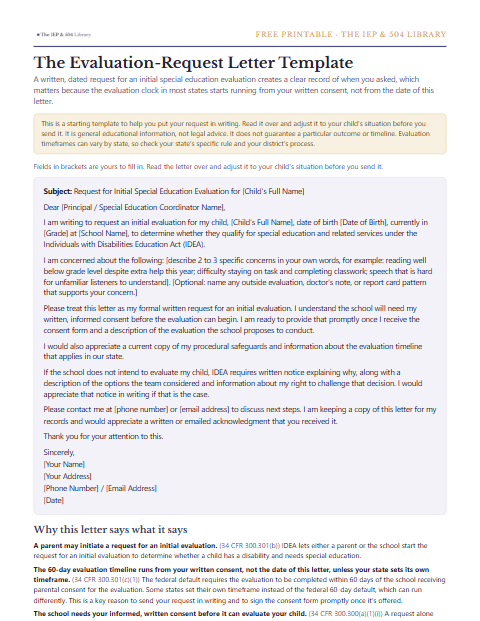
South Carolina IEP Evaluation Timeline, Dispute Routes and Parent Resources (2026)
- Evaluation window
- 60 calendar days
- The clock starts at
- Written parental consent
- State complaint deadline
- Within one year
- Due process deadline
- Two years
How long does a school in South Carolina have to complete an IEP evaluation?
A school district in South Carolina completes an initial special education evaluation within 60 calendar days of receiving written parental consent to evaluate. The state sets no separate clock of its own. State Board of Education Regulation 43-243 adopts the federal special education rules in full, so the federal 60 day figure is the South Carolina figure. The state adds one step right after the evaluation. Its published policies treat an evaluation as concluded once the team verifies it has gathered everything needed to decide eligibility, then allow 15 days from that point for the eligibility decision.
The evaluation timeline in South Carolina
| Initial evaluation window | 60 calendar days |
|---|---|
| The clock starts at | the district's receipt of written parental consent to evaluate |
| Against the federal rule | The federal default, unchanged |
IDEA sets a default of 60 calendar days from parental consent for an initial evaluation (34 CFR 300.301(c)(1)). South Carolina keeps that default rather than setting a timeframe of its own.
South Carolina runs on the federal 60 day evaluation clock, counted in calendar days from the day the district receives written parental consent. State Board of Education Regulation 43-243 adopts the federal Part 300 rules in full and sets no separate state deadline, so the federal figure is the South Carolina figure. The state's published policies under IDEA add two details the federal rule leaves open. An evaluation counts as concluded once the team verifies it has gathered all the information needed to decide eligibility. The eligibility decision then follows within 15 days of that conclusion.
Source: S.C. Code Regs. 43-243 sections I and II, which adopt 34 CFR Part 300 in full, read with the 60 day rule at 34 CFR 300.301(c)(1)(i), plus the South Carolina Policies and Procedures under IDEA at sections 300.301 and 300.306 www.scstatehouse.gov/coderegs/Chapter%2043.pdf
The same window sits beside all fifty-one jurisdictions on the evaluation timelines by state table, which explains where the federal deadline comes from. To pull one state's window on its own, the evaluation deadline checker returns that single result.
Reevaluation and IEP review cadence in South Carolina
South Carolina writes the reevaluation cycle into its own eligibility rule rather than leaving it to the federal text alone. A child is reevaluated at least once every three years. It happens more often when conditions warrant it, when a parent or school staff member asks for one or when the team is weighing whether a child still needs special education. The IEP itself comes up for review at least once a year on the federal schedule.
Source: S.C. Code Regs. 43-243.1(O), with the annual IEP review at 34 CFR 300.324(b)(1)(i) www.scstatehouse.gov/coderegs/Chapter%2043.pdf
If you disagree in South Carolina
IDEA gives families in every state the same three routes when a disagreement with the school does not resolve at the team table. What changes at the state line is who administers each route, how long you have to file and the local detail below.
The state complaint
Handled by Office of Special Education Services, South Carolina Department of Education. Time limit to file: within one year of the date the alleged violation happened.
A written state complaint goes to the Office of Special Education Services, where a complaint investigator takes it up. Whoever files sends the district a copy at the same time the complaint reaches the state. The office finishes its investigation and issues a written decision within 60 calendar days. It can extend that limit in only two situations: exceptional circumstances in the particular complaint, or the family and the district agreeing to take more time to try mediation or another dispute resolution route. Where it finds a district out of step with IDEA, it directs corrective action, which can run to compensatory services or reimbursement. Anyone can file, including an organization or a person unrelated to the child.
Source: 34 CFR 300.153(c), the one year window, as stated in the South Carolina Procedural Safeguards Notice at page 15, with the simultaneous copy to the district at page 16. The 60 calendar day decision and the two grounds for an extension are at 34 CFR 300.152(a) and (b)(1), stated in the notice at pages 13 and 14. The current process is set out by the Office of Special Education Services. oses.ed.sc.gov/family-community/dispute-resolution-information/state-complaint/
Mediation
Mediation is voluntary for both sides and free to families. The South Carolina Department of Education keeps the list of qualified mediators, picks them on a random, rotational or other impartial basis and pays for the process. State law has told the State Board of Education to run a mediation process since 1993, on the express term that agreeing to mediate gives up nobody's right to a hearing. South Carolina also offers a facilitated IEP meeting, where a neutral facilitator sits with the team at no cost to the family or the district.
Source: S.C. Code Ann. Section 59-33-110, with the mediation conditions at 34 CFR 300.506(b) as stated in the South Carolina Procedural Safeguards Notice at page 20. The free facilitated IEP meeting is described by the Office of Special Education Services. www.scstatehouse.gov/code/t59c033.php
A due process hearing
Time limit to file: two years from the date the parent or the district knew or should have known about the issue.
South Carolina keeps a two tier hearing system. The complaint goes to the other party with a copy to the Office of General Counsel at the South Carolina Department of Education. The district appoints a hearing officer from the pool the department has trained and gives the parent and the department notice of that appointment within 10 calendar days, so the first hearing sits at the local level rather than at the state agency. Either side can appeal that decision to the department within 10 calendar days of receiving it. The department appoints a state level administrative review officer, who examines the whole record and issues a written decision within 30 calendar days of the appeal reaching the department. A party who disagrees with the review decision has 90 calendar days from the date of that decision to take the matter to state or federal court.
Source: 34 CFR 300.511(e), the two year window to request a hearing, as stated in the South Carolina Procedural Safeguards Notice at page 23, with the same limit stated as 34 CFR 300.507(a)(2) by the Office of Special Education Services. The two tier appeal at 34 CFR 300.514, the 30 calendar day review decision at 34 CFR 300.515(b) and the 90 calendar day court window at 34 CFR 300.516(b) are stated in the notice at pages 26 and 27. Locally appointed hearing officers are recognized at S.C. Code Ann. Section 59-33-90. oses.ed.sc.gov/family-community/dispute-resolution-information/due-process/
From the team behind this library
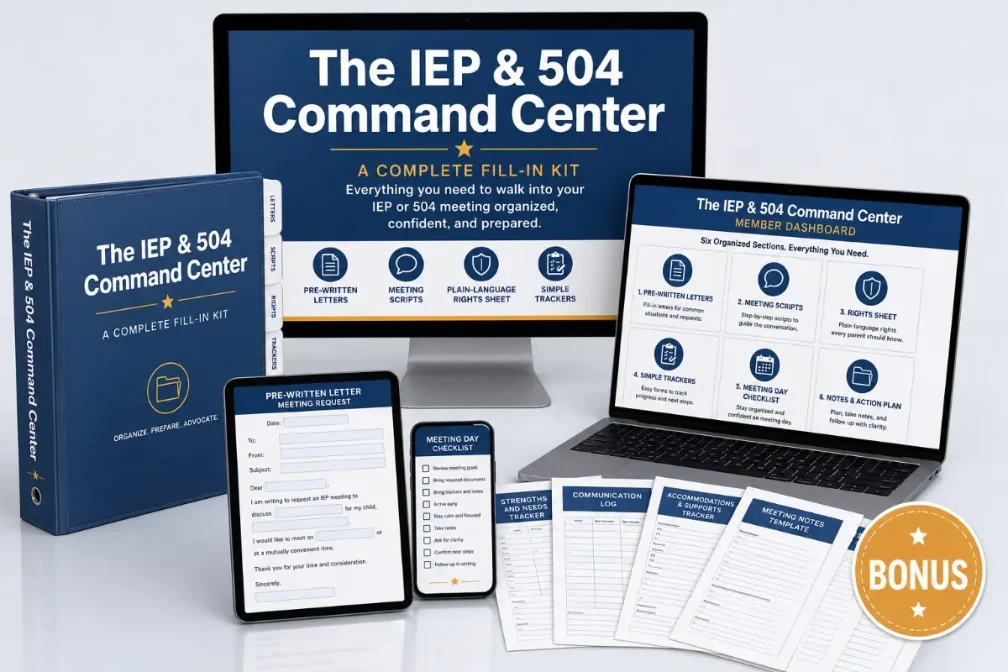
The IEP & 504 Command Center
This page shows you the deadlines and the contacts for your state. The Command Center hands you the done pieces: the binder built, the letters written, the meeting scripts ready and a self-review that shows where your child's IEP is strong or thin before you walk in. The library stays free.
Who to contact in South Carolina

- The state special education office. Office of Special Education Services, South Carolina Department of Education. This is the office that answers questions about South Carolina rules and receives a state complaint.
- Your rights in writing. Procedural Safeguards Notice, which the Office of Special Education Services lists as the sample parents' rights and procedural safeguards document. Every district hands parents this notice at least once a year (34 CFR 300.504). It is the plain summary of what you can ask for at each step.
- Parent training and information center. Family Connection of South Carolina. A parent center is free and federally funded under IDEA. Staff there talk families through the process in their own state at no cost.
- The state rules themselves. S.C. Code Ann. Title 59, Chapter 33 (sections 59-33-10 through 59-33-550), with the operating rules at S.C. Code Regs. 43-243, 43-243.1 and 43-243.2. Chapter 33 is South Carolina's own special education law. It sets the state's duty to educate students with disabilities, gives locally appointed hearing officers subpoena power, tells the State Board of Education to run a mediation process and carries two newer articles: the Adult Students with Disabilities Educational Rights Consent Act of 2016 and the 2018 dyslexia screening law that has districts screen every child in kindergarten and first grade three times a year where funding or a free screening tool allows. Beside the statute sit the State Board's own rules: 43-243 for the special education requirements, 43-243.1 for the eligibility criteria and 43-243.2 for educational interpreter qualifications, added effective February 27, 2026.
Child Find in South Carolina
Child Find in South Carolina runs through the district where a child lives. Two pieces of it are specific to the state. Homeschooled children are treated as private school children for special education purposes, so a district considers them under the proportionate share of federal money set aside for parentally placed private school children. A public charter school that is its own school system carries Child Find for the children enrolled in it. For children under three, the state points families to BabyNet, the early intervention program run by the South Carolina Department of Health and Human Services. Anyone can make a referral at any time. A referral does not by itself start an evaluation, though it does put the concern in front of the school's student assistance team to discuss and decide the next step.
Source: Child Find guidance published by the Office of Special Education Services, with the private school Child Find duty at 34 CFR 300.131 oses.ed.sc.gov/early-childhood/child-find/