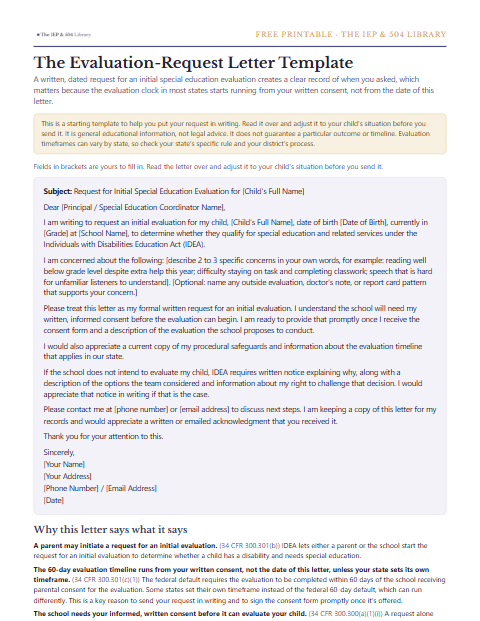
Oklahoma IEP Evaluation Timeline, Dispute Routes and Parent Resources (2026)
- Evaluation window
- 45 school days
- The clock starts at
- Written parental consent
- State complaint deadline
- One year
- Due process deadline
- Two years
How long does a school in Oklahoma have to complete an IEP evaluation?
An Oklahoma school district has 45 school days from the day a parent signs the Special Education Parent Consent form to finish an initial evaluation and decide whether a student is eligible. School days are days students attend for instruction, so weekends, holidays and summer break fall outside the count, which can carry a spring consent into the following school year. Oklahoma adds a step before that clock starts: the team completes a Review of Existing Data form that the parent signs, then the district has 10 school days from that signature to obtain consent when more assessment is needed. Once the team signs the eligibility form, the first IEP follows within 30 calendar days. If a family disagrees with a district, the Office of Special Education Services investigates written complaints reaching back one year, while the Special Education Resolution Center at Oklahoma State University runs mediation, IEP facilitation and the hearing system, with a second tier appeal that goes back to the department.

The evaluation timeline in Oklahoma
| Initial evaluation window | 45 school days |
|---|---|
| The clock starts at | parental written consent |
| Against the federal rule | A timeframe Oklahoma sets for itself |
IDEA sets a default of 60 calendar days from parental consent for an initial evaluation (34 CFR 300.301(c)(1)). It also lets a state set its own timeframe instead, which is what Oklahoma has done, so the window above is the one that applies here.
Oklahoma shortens the federal default to 45 school days, running from consent through the initial eligibility determination.
Source: Oklahoma Special Education Policies and Procedures, 2026 edition, the Oklahoma Policies list item 3 (forty-five school day initial evaluation timeline) with Chapter 5, Section 3, D.1 and the comparison appendix at page 503, which names the state timeframe option at 34 CFR 300.301(c)(1)(ii); approved by the State Superintendent on 24 July 2026 and effective 1 August 2026 oklahoma.gov/content/dam/ok/en/osde/documents/services/special-education/SPED%20P%20and%20P%202026.pdf
The same window sits beside all fifty-one jurisdictions on the evaluation timelines by state table, which explains where the federal deadline comes from. To pull one state's window on its own, the evaluation deadline checker returns that single result.
Reevaluation and IEP review cadence in Oklahoma
Oklahoma keeps the federal cadence. A reevaluation happens at least once every three years, no more than once a year unless the family and the district agree otherwise. The IEP is reviewed at least annually. Oklahoma then writes the arithmetic of that three year clock into its own policies. The anniversary runs from the signature date on the previous eligibility form, called the Multidisciplinary Evaluation and Eligibility Group Summary or MEEGS, to the date of the next one, so finishing a reevaluation early moves the next due date earlier with it. The state policies say a reevaluation happens on or before that anniversary with or without new assessments, since the team still has to look at the existing data and decide whether more is needed. An eligibility determination cannot be amended in Oklahoma, so any change to it takes a fresh determination. The 45 school day initial evaluation clock does not apply to a reevaluation. Two more Oklahoma timelines sit near this one. A student moving between Oklahoma districts has an IEP in place within 10 school days of the first day of attendance, either by adopting the previous district's IEP or by holding a meeting for a new one. Secondary transition services are in effect before the start of ninth grade or by age 15, whichever comes first, which is earlier than the federal age 16.
Source: Oklahoma Special Education Policies and Procedures, 2026 edition, Chapter 5, Section 2, D (evaluation timeline table) and Section 3, D.2, with Chapter 6, Section 2 (IEP timelines) and Section 3, M (secondary transition) plus the Oklahoma Policies list items 5 and 7; the three year and annual cadence is the federal one at 34 CFR 300.303(b) and 34 CFR 300.324(b)(1)(i), restated in the same terms in the 2026 policies comparison appendix at page 503 and pulled in by the State Board rule at Okla. Admin. Code 210:15-13-1, which incorporates federal and state special education law by reference oklahoma.gov/content/dam/ok/en/osde/documents/services/special-education/SPED%20P%20and%20P%202026.pdf
If you disagree in Oklahoma
IDEA gives families in every state the same three routes when a disagreement with the school does not resolve at the team table. What changes at the state line is who administers each route, how long you have to file and the local detail below.
The state complaint
Handled by the Oklahoma State Department of Education, Office of Special Education Services. Time limit to file: one year, counted back from the date the complaint reaches the state department.
Oklahoma calls this route a formal state complaint. Any individual or organization can file one, including someone from another state. A complaint can cover one student or a group. The signed written complaint reaches the Office of Special Education Services by mail, by email to its dispute resolution address or by hand delivery, with a copy going to the district at the same time. A complaint form exists in English, Spanish, Vietnamese and Chinese, though the form is not required. A family who needs help putting a complaint in writing can give it to department staff by phone, who write it into the form for the complainant to sign. The department checks that the complaint carries everything the rules require, notifies the complainant and the district either way, assigns an investigator and gives both sides a chance to add information. A final decision follows within 60 calendar days of receipt unless exceptional circumstances extend it, carrying findings of fact, a discussion of each issue and conclusions on each one. Where the department finds a violation it issues a corrective action plan, which can include compensatory education services for a named student plus training or action steps for the district. The district completes it no later than one year from the finding unless the department sets an earlier date. If the same issue is already in a due process hearing, the department holds that part of the complaint in abeyance until the hearing ends while it resolves the rest on the usual clock. A hearing decision on an issue binds the complaint on that issue.
Source: Oklahoma Special Education Policies and Procedures, 2026 edition, Chapter 13, Section 4, with the one year window at 34 CFR 300.153(c), the copy to the district at 34 CFR 300.153(d) plus the 60 day decision at 34 CFR 300.152(a); the filing addresses, the oral assistance option and the 60 day letter of findings also sit in Parent Rights in Special Education: Notice of Procedural Safeguards, amended September 2024 oklahoma.gov/content/dam/ok/en/osde/documents/services/special-education/SPED%20P%20and%20P%202026.pdf
Mediation
Mediation in Oklahoma runs through a center outside the education department. The Special Education Resolution Center, based at Oklahoma State University in Tulsa, holds the contract for mediation, IEP facilitation and the due process hearing system statewide. Either a parent, an adult student or a district representative can request mediation on a form published on both the department and center websites, submitted online, by mail, by email or by hand delivery to either place. The center then contacts the other side, runs an intake with both and schedules the session. Mediation is voluntary, so both sides have to agree to it. It is free to the family and the district since the state carries the mediator's cost. Each side can bring an attorney at its own expense. The mediator decides nothing and takes no side. An agreement the parties reach is written up, signed by both and enforceable in a state court of competent jurisdiction or in a federal district court. Discussions stay confidential. The mediator is excluded from any later complaint investigation or hearing on the same matter. Nothing said in mediation comes into a due process hearing as evidence. Choosing mediation never delays or denies a due process hearing. Oklahoma also offers IEP facilitation through the same center, a lighter option where a trained neutral sits in on an IEP meeting before a disagreement hardens.
Source: Oklahoma Special Education Policies and Procedures, 2026 edition, Chapter 13, Sections 1 through 3 with Chapter 11, Section 7, A and B (State Complaint, Mediation, Due Process), which carries the attorney at own expense term plus the exclusion of the mediator from any later investigation or hearing; the voluntariness sits at 34 CFR 300.506(b)(1)(i), the no delay or denial term at 34 CFR 300.506(b)(1)(ii), the state bearing the cost at 34 CFR 300.506(b)(4), the binding signed agreement at 34 CFR 300.506(b)(6) with its enforceability in a state or federal court at 34 CFR 300.506(b)(7) plus the confidentiality at 34 CFR 300.506(b)(8) oklahoma.gov/content/dam/ok/en/osde/documents/services/special-education/SPED%20P%20and%20P%202026.pdf
A due process hearing
Time limit to file: two years from the date the parent, adult student or district knew or should have known about the action the complaint is based on.
The two year limit lifts where a district misrepresented that it had resolved the issue or withheld information the family had a right to receive. Oklahoma is one of the states that kept the two tier hearing option IDEA allows. A parent, an adult student, a district or an attorney for a party files the request with the other side plus either the education department or the Special Education Resolution Center. Every hearing clock starts from that filing. Two current Oklahoma sources describe the hearing officer differently. The 2026 state policies say a hearing officer has to be an attorney in good standing with the Oklahoma Bar Association who takes annual training, with no employment at the district or the department, no conflicting personal or professional interest and no seat on the district school board. The State Board rule in place since 2008 sets a wider bar of a law degree or a master's degree in education, special education, psychology or a related field, bars an attorney who currently represents parents or districts, has the department keep the approved list of officers and has them assigned in rotation. The same rule asks a state appeal officer to have served two years as an Oklahoma hearing officer. The party who requested the hearing carries the burden of proof. Oklahoma does not let a non-attorney advocate act as a parent's legal representative at a hearing. A written decision is available within 45 calendar days from the start of the hearing timeline unless a party asks for a specific extension. Decisions go out to the state advisory panel and the public with identifying information removed. Tier two is the state level appeal. Any party can appeal within 30 calendar days, after which the Office of Special Education Services appoints a state reviewing officer who examines the whole record, may take further evidence, gives both sides a chance to argue and reaches an independent decision, generally within 30 calendar days of the request for review. A party who disagrees with the review decision can bring a civil action in a state court of competent jurisdiction or in a federal district court, with the 2026 policies giving 90 calendar days from the appeal officer's decision. Expedited hearings for discipline disputes run on a tighter track, with the Special Education Resolution Center appointing a hearing officer within 4 business days, a resolution meeting within 7 days, a hearing within 20 school days and a decision within 10 school days of the hearing.
Source: Oklahoma Special Education Policies and Procedures, 2026 edition, Chapter 13, Sections 5 through 7, where Section 5, D.2 carries the attorney in good standing requirement and Section 6, B carries the expedited clocks; the wider hearing officer bar, the approved list and the rotation sit in Okla. Admin. Code 210:15-13-5 (added effective 12 May 2008 and not amended since), while the state level review mechanics come from Parent Rights in Special Education: Notice of Procedural Safeguards, amended September 2024; the two year limit sits at 34 CFR 300.507(a)(2) with its exceptions at 34 CFR 300.511(f), the two tier review option at 34 CFR 300.514(b) plus the 45 day hearing clock at 34 CFR 300.515(a) and the 30 day review clock at 34 CFR 300.515(b) oklahoma.gov/content/dam/ok/en/osde/documents/services/special-education/SPED%20P%20and%20P%202026.pdf

From the team behind this library
The IEP & 504 Command Center
This page shows you the deadlines and the contacts for your state. The Command Center hands you the done pieces: the binder built, the letters written, the meeting scripts ready and a self-review that shows where your child's IEP is strong or thin before you walk in. The library stays free.
Who to contact in Oklahoma

- The state special education office. Oklahoma State Department of Education, Office of Special Education Services. This is the office that answers questions about Oklahoma rules and receives a state complaint.
- Your rights in writing. Parent Rights in Special Education: Notice of Procedural Safeguards, amended September 2024. Every district hands parents this notice at least once a year (34 CFR 300.504). It is the plain summary of what you can ask for at each step.
- Parent training and information center. Oklahoma Parents Center. A parent center is free and federally funded under IDEA. Staff there talk families through the process in their own state at no cost.
- The state rules themselves. Okla. Stat. tit. 70, section 13-101 (services for children with disabilities), as amended by Senate Bill 1489 of the 2026 session, approved by the Governor on 12 May 2026; the State Board rules at Okla. Admin. Code 210:15-13-1 and 210:15-13-2 incorporate federal and state special education law by reference and name the state policies and procedures manual, with the hearing officer rule at 210:15-13-5 and the Lindsey Nicole Henry Scholarship at Okla. Stat. tit. 70, section 13-101.2. Section 13-101 is the Oklahoma statute that puts the state department and every school district under IDEA, defines who counts as a child with a disability from age three through twenty-one and, since the 2026 amendment, spells out two parent rights of Oklahoma's own plus a duty on the department to publish the four dispute routes on its website.
Child Find in Oklahoma
Oklahoma splits child find at age three. Birth to three runs through SoonerStart, the state's early intervention program. A request for a child under three goes there rather than to the school district. From three through twenty-one the district carries child find inside its own boundaries, which the state policies read broadly: public and charter and virtual school students, homeschooled students, students in private schools located in the district including out of state families, students in correctional facilities, Head Start, state institutions and residential or treatment facilities, students not enrolled anywhere, highly mobile students, wards of the state plus students who are moving up grade to grade while a disability is suspected. Two Oklahoma specifics stand out for families of young children. When SoonerStart sends a district its notification for a child approaching the third birthday, Oklahoma treats that notification itself as a referral for an initial evaluation under Part B, so the district responds with written notice plus a copy of the safeguards even when the family declines to release the SoonerStart record. Districts also publish their own child find procedures somewhere easy to find and understandable. They keep five school years of documentation showing at least two ongoing public awareness activities. The state policies repeat the federal position that a multi-tiered system of supports cannot be used to delay or deny a timely initial evaluation.
Source: Oklahoma Special Education Policies and Procedures, 2026 edition, Chapter 2, Sections 1 through 4 with Chapter 4, Section 3; the federal duty sits at 34 CFR 300.111 with the transition from early intervention at 34 CFR 300.124; the Oklahoma reading of the SoonerStart notification follows the federal Letter to Nix dated 17 March 2023 oklahoma.gov/content/dam/ok/en/osde/documents/services/special-education/SPED%20P%20and%20P%202026.pdf