New Hampshire IEP Evaluation Timeline, Dispute Routes and Parent Resources (2026)
- Evaluation window
- 60 calendar days
- The clock starts at
- Parental consent
- State complaint deadline
- One year
- Due process deadline
- Two years
How long does a school in New Hampshire have to complete an IEP evaluation?
In New Hampshire a school district completes an initial evaluation within 60 days of receiving the parent's written consent to evaluate, counted as calendar days because the state rules adopt the federal definition of a day. More sits inside that window than the federal deadline alone requires. New Hampshire defines the evaluation process as the assessments, a written summary report, the IEP team meeting that reviews the results plus the eligibility decision itself when that is the purpose of the meeting. A separate clock runs before consent: within 15 business days of a referral the IEP team decides what happens next, then sends the parent written notice of that decision along with a consent request where testing is needed. Families who disagree with a decision have several routes, among them a signed state complaint mailed on paper to the education department within a year of the problem, free mediation or a neutral conference run by the department, or a due process hearing where the school district carries the burden of proof.

The evaluation timeline in New Hampshire
| Initial evaluation window | 60 calendar days |
|---|---|
| The clock starts at | receipt of parental consent to evaluate |
| Against the federal rule | The federal default, unchanged |
IDEA sets a default of 60 calendar days from parental consent for an initial evaluation (34 CFR 300.301(c)(1)). New Hampshire keeps that default rather than setting a timeframe of its own.
New Hampshire follows the federal 60 calendar day default. Rule Ed 1107.01(c) requires the initial evaluation process to be completed within 60 days of receiving parental consent to evaluate. Some parent and advocacy guides circulate an older 45 day figure, but the current rule text sets 60 days.
Source: N.H. Code Admin. R. Ed 1107.01(c) gc.nh.gov/rules/state_agencies/ed1100.html
The same window sits beside all fifty-one jurisdictions on the evaluation timelines by state table, which explains where the federal deadline comes from. To pull one state's window on its own, the evaluation deadline checker returns that single result.
Reevaluation and IEP review cadence in New Hampshire
New Hampshire keeps the federal three year reevaluation cycle plus the annual IEP review, then adds clocks the federal rules leave open. A reevaluation finishes within 60 days of the district receiving parental consent to evaluate, where the federal rule sets no completion deadline for reevaluations at all. Written consent of the parties can extend that 60 days by a stated number of days up to 30. Consent comes up more often in New Hampshire than in most states. The rules list conducting a reevaluation, determining or changing a disability classification, changing the nature or extent of services plus the annual renewal of the IEP and placement among the actions that need informed written parental consent. The IEP team decides how long an IEP runs, capped at 12 months without team review and approval. Near the end of each IEP term the district holds a meeting to judge how the current plan worked and to design the next one. A written request from a parent, guardian or adult student for an IEP team meeting gets scheduled, convened or answered with written prior notice explaining a refusal, all within 21 days of the request.
Source: N.H. Code Admin. R. Ed 1107.01(d) on the 60 day reevaluation clock and Ed 1107.01(e) on the extension; Ed 1109.03(d) on annual review with Ed 1109.03(e) on the 12 month cap; Ed 1109.06(b) and (c) on the 21 day answer to a written meeting request plus Ed 1109.06(d) on the end of term meeting; Ed 1120.04(a)(3) through (a)(6) on consent; the federal cadence at 34 CFR 300.303(b) and 34 CFR 300.324(b), which Ed 1107.01(b) and Ed 1109.03(g) and (h) adopt by reference gc.nh.gov/rules/state_agencies/ed1100.html
If you disagree in New Hampshire
IDEA gives families in every state the same three routes when a disagreement with the school does not resolve at the team table. What changes at the state line is who administers each route, how long you have to file and the local detail below.
The state complaint
Handled by New Hampshire Department of Education, where the Commissioner of Education signs the written decision. Time limit to file: One year before the date the department receives the complaint.
A New Hampshire special education complaint is written, signed and sent on paper. The department states plainly that it does not accept a submission by email and that a complaint sent electronically will not be treated as received. Two official addressee lines are in circulation for the same building. The department's current complaints page asks for the envelope addressed to the New Hampshire Department of Education, Attention: Special Education Complaint Office, 25 Hall Street, Concord, while rule Ed 1121.01(d) plus the department's December 2024 safeguards handbook both address it to the Commissioner of Education. A copy reaches the school district or other public agency named in the complaint at the same time. A model form exists, though any signed letter carrying the required information starts the process. The complaint describes each alleged violation with the facts behind it plus a proposed resolution. The commissioner assigns a department employee, or an independent investigator where no employee is available, to investigate and report back with recommendations. An on site investigation happens where the investigator finds one necessary. The commissioner then signs a written decision addressing each allegation with findings of fact, conclusions plus the reasons behind them, issued within 60 calendar days of receipt unless exceptional circumstances extend it. Where the commissioner finds a failure to provide appropriate services, the order can include monetary reimbursement or other corrective action along with future provision of services. Either party can ask the commissioner in writing to reconsider within 20 days of receiving the decision, with a final written decision following within 15 days, while any corrective action ordered for a child carries on in the meantime. A party still aggrieved after that can appeal to the New Hampshire Supreme Court or a New Hampshire Superior Court. A 2025 law sits on top of all this. Since September 1, 2025 RSA 186-C:5-a has required the department to track every special education state complaint and to post a summary of each one on its website within 30 days of the final decision, with identifying details redacted and with the findings of fact plus any corrective action included, then to publish an annual summary report by July 1 each year beginning in 2026. Several kinds of dispute sit outside this route, among them personnel decisions, teaching methodology, bullying, discrimination or harassment claims plus Section 504 determinations and services.
Source: N.H. Code Admin. R. Ed 1121.01(b), which adopts 34 CFR 300.153, where 34 CFR 300.153(c) states the one year window; Ed 1121.01(d) on where it is sent; Ed 1121.02(a) through (c) on investigation and decision; Ed 1121.03(a) on the 60 day limit; Ed 1121.04(a) through (c) on reconsideration and appeal; RSA 186-C:5-a on complaint tracking and publication; New Hampshire Department of Education page on special education complaints gc.nh.gov/rules/state_agencies/ed1100.html
Mediation
Mediation in New Hampshire runs inside the education department rather than through an outside agency. RSA 186-C:24, II(a) has a written request go to the Commissioner of Education naming the issues in dispute plus the relief sought. The department's own dispute resolution pages point families who want to know more about requesting mediation to the email address governance.unit@doe.nh.gov or the phone line at 603-271-2299. A mediation conference happens within 30 calendar days of the request unless both sides agree to continue it. The commissioner appoints impartial mediators, sees that they are trained and assigns them on a regional basis. In practice a department hearing officer serves as the mediator. Sessions are informal, held at a time and place both sides find workable, with either side free to bring someone who has knowledge or training about the needs of children with disabilities. An agreement reached there becomes a written binding agreement signed by each party. Where no agreement comes, the mediator records only the date and the participants, nothing said there can be used in a later proceeding and the mediator cannot be called as a witness in that case. A mediator can end the process after at least one meeting where no progress is being made. Two things hold while mediation is pending. Nothing changes about the child's classification, program or placement unless both sides agree. The person who mediated cannot later be appointed hearing officer in the same matter. New Hampshire runs two more voluntary options alongside mediation. A neutral conference gives each side an abbreviated presentation to a department hearing officer serving as the neutral, who issues a non binding opinion suggesting a settlement with reasons, after summaries of no more than 4 pages are exchanged at least 5 days ahead and the conference itself is held to no more than 2 hours. IEP facilitation brings an impartial facilitator from the Bureau of Special Education Support to an IEP team meeting at no cost, available for the ordinary business of a team meeting including disposition of a referral, evaluation planning, eligibility, transition planning, extended school year services plus placement.
Source: RSA 186-C:24, paragraphs I, II and III on the mediation mechanism; RSA 186-C:23, I on the menu of routes, II(a) on IEP facilitation plus IV on confidentiality; RSA 186-C:23-b, I and II on the neutral conference; N.H. Code Admin. R. Ed 1122.01 through Ed 1122.03, with Ed 1122.04 barring the mediator from later hearing the same matter, plus Ed 205.03 on mediation procedure; New Hampshire Department of Education page on dispute resolution and complaints gc.nh.gov/rsa/html/XV/186-C/186-C-24.htm
A due process hearing
Time limit to file: Two years from the date the alleged violation was or reasonably should have been discovered. A request to recover the costs of a unilateral placement runs on its own clock of 90 days from the placement. Where a parent, legal guardian or surrogate parent never received proper written notice of special education rights, the limits run from the date that notice is properly given.
A New Hampshire due process complaint goes to the other party and to the department, with the filing party sending a copy to the Office of Legislation and Hearings within 2 business days. That office appoints a hearing officer who is an attorney or who meets the federal standards for hearing officers. New Hampshire law then puts the burden of proof, both persuasion and production, on the school district to show that the child's program or placement, or the one the public agency proposes, is appropriate, met by a preponderance of the evidence. Since August 1, 2025 the same statute has the district deliver a set of core documents to the hearing officer and to the parents at least 5 business days before any prehearing conference, covering the eligibility deliberation where eligibility is at issue, IEPs in place or partially accepted over the last 3 years, any IEP the district now proposes, every written prior notice from the last 3 years, the district's own evaluations, independent evaluations or outside recommendations the team saw plus the progress reports tied to IEP goals. The state timetable is tighter than the federal outline. The party receiving a complaint responds within 10 days, the district convenes a resolution meeting within 15 days, a prehearing conference follows no later than 17 days after that meeting or after written agreement that no settlement is possible, the hearing itself comes no later than 14 days after the prehearing conference and runs no more than 2 days absent good cause, then the decision issues no later than 45 days after the resolution period and travels by certified mail. A hearing officer can extend that period at a party's request on stated grounds, never because of the hearing officer's own schedule. A parent may withdraw a complaint without prejudice up until the point of retaining legal counsel. Expedited discipline hearings run within 20 school days with a decision inside 10 days. After a decision, a district implements it within 30 days unless an appeal is filed, then reports the implementation in writing to the office within 90 days. New Hampshire gives either party 120 days from receipt of the decision to bring a civil action, where the federal default sits at 90 days. The same 120 days applies to a request for attorney fees or expert witness fees. Past decisions are published with identifying details removed.
Source: RSA 186-C:16-b, I on the 2 year limit, II on the 90 day unilateral placement clock, III on notice tolling, III-a on the burden of proof, III-b on the core documents disclosure plus IV and V on the 120 day windows, with the section's own source note reading 2025, 72:1, effective August 1, 2025 and 2025, 73:1, effective June 2, 2025; N.H. Code Admin. R. Ed 1123.02(c) through (g) for the state timetable, with Ed 1123.06(b) on the 2 business day copy, Ed 1123.10 on withdrawal, Ed 1123.12(b) on appointing the hearing officer, Ed 1123.18(e) on the 45 day decision by certified mail, Ed 1123.19 on extensions, Ed 1123.21(b) on published decisions, Ed 1123.22(a) and (b) on implementation plus Ed 1123.25 on expedited hearings; 34 CFR 300.516(b) for the federal 90 day civil action default gc.nh.gov/rsa/html/XV/186-C/186-C-16-b.htm
From the team behind this library
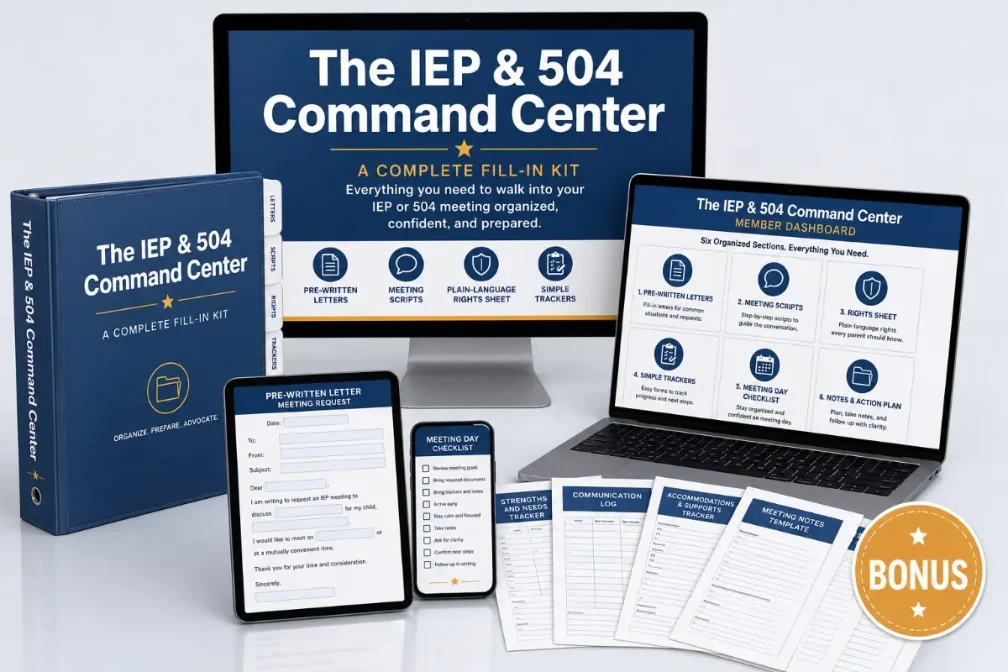
The IEP & 504 Command Center
This page shows you the deadlines and the contacts for your state. The Command Center hands you the done pieces: the binder built, the letters written, the meeting scripts ready and a self-review that shows where your child's IEP is strong or thin before you walk in. The library stays free.
Who to contact in New Hampshire

- The state special education office. Bureau of Special Education Support, Division of Learner Support, New Hampshire Department of Education. This is the office that answers questions about New Hampshire rules and receives a state complaint.
- Your rights in writing. Special Education Procedural Safeguards Handbook, the edition the New Hampshire Department of Education updated on December 20, 2024, which supersedes the April 2018 handbook that many district websites still link. Every district hands parents this notice at least once a year (34 CFR 300.504). It is the plain summary of what you can ask for at each step.
- Parent training and information center. Parent Information Center (PIC). A parent center is free and federally funded under IDEA. Staff there talk families through the process in their own state at no cost.
- The state rules themselves. RSA 186-C, Special Education, New Hampshire Revised Statutes Annotated Title XV, read from the General Court's merged full chapter text, where RSA 186-C:9 plus RSA 186-C:23, I and II(b) plus RSA 186-C:36, I through III are the sections described here; the implementing rules sit at N.H. Code Admin. R. Ed 1100, Standards for the Education of Children with Disabilities. RSA 186-C is New Hampshire's own special education statute, covering who is entitled to special education, how districts and the state pay for it, the dispute routes plus the rulemaking that produced the Ed 1100 standards. Three parts of it shape ordinary family experience. RSA 186-C:9 keeps a child entitled to an approved program until a regular high school diploma or age 21 inclusive, whichever comes first, or until the IEP team decides the child no longer needs special education. RSA 186-C:23 lists neutral conference, mediation and IEP facilitation as the alternative routes, then has a district notify the department in writing when a parent rejects an IEP, placement, identification or evaluation, which opens a 30 day discussion period in which the department describes the available options to the parent. RSA 186-C:36 created an Office of the Advocate for Special Education in 2022 as an independent agency outside the Department of Education, a point of contact for families dealing with districts on IEPs, Section 504 plans plus related supports.
Child Find in New Hampshire
New Hampshire starts child find earlier than the age many families expect. A district's child find system reaches any child from 2.5 years of age up to 22 years of age living in its area, with that early start aimed at having an IEP written and running for an eligible child by the third birthday. Anyone may refer a child under 22 to the IEP team. The rules give examples of what prompts a referral, among them not passing a hearing or vision screening, unsatisfactory performance on group achievement tests, repeated academic or behavior warnings, repeatedly failing one or more subjects plus an inability to take part in developmentally appropriate preschool activities. Districts contact nonpublic schools inside their boundaries every year to explain the duty to identify and evaluate, along with medical, mental health, early intervention, early care, welfare plus other human services programs in the area. Children whose families placed them in nonpublic schools without involving the district sit inside the same system. For a child served by family centered early supports and services, the evaluation process including the written summary report finishes before the third birthday.
Source: N.H. Code Admin. R. Ed 1105.01(b) on the 2.5 to 22 age span, Ed 1105.01(c)(1) on an IEP running by age 3 plus Ed 1105.01(d) on parentally placed nonpublic school children; Ed 1105.02(b) on who may refer with the example triggers, Ed 1105.02(d) and (e) on the annual outreach; Ed 1106.01(c) on immediate written notice of a referral; Ed 1107.01(f) on finishing before the third birthday gc.nh.gov/rules/state_agencies/ed1100.html