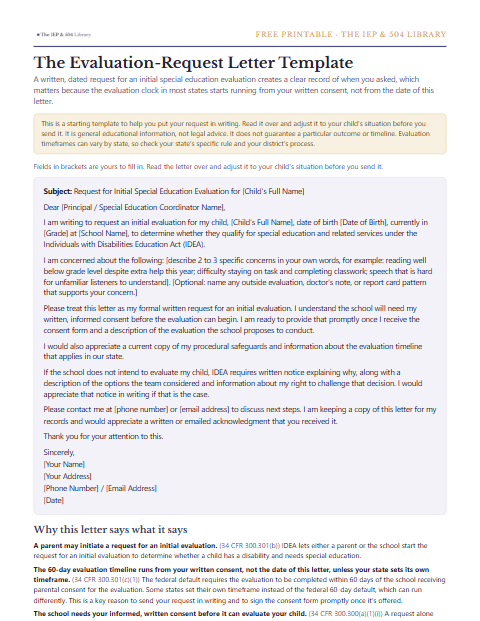
South Dakota IEP Evaluation Timeline, Dispute Routes and Parent Resources (2026)
- Evaluation window
- 25 school days
- The clock starts at
- Parental consent
- State complaint deadline
- One year
- Due process deadline
- Two years
How long does a school in South Dakota have to complete an IEP evaluation?
South Dakota does not use the federal 60 calendar day evaluation clock. Rule 24:05:25:03 gives a school district 25 school days from the day it receives signed parent consent to complete the evaluation, then 30 more calendar days from the end of that window to write the evaluation reports, determine eligibility and hold the IEP team meeting. School days skip weekends, holidays and breaks, so the same 25 school days lands on a later calendar date when a long break falls inside the window, while the 30 day half of the clock counts calendar days because South Dakota's rules define a day that way unless a rule says otherwise. Parents and school administration can agree in writing to a different evaluation window, in which case the 30 day count runs from the end of the window they agreed on. Rule 24:05:25:03.02 lifts the timeline in two situations: a parent repeatedly does not make the child available for the evaluation, or the child enrolls in a school of another school district before the first one decided eligibility, where the new district is making enough progress to finish promptly and has agreed a completion date with the parent.

The evaluation timeline in South Dakota
| Initial evaluation window | 25 school days for the evaluation, plus 30 calendar days to determine eligibility |
|---|---|
| The clock starts at | parental consent to evaluate |
| Against the federal rule | A timeframe South Dakota sets for itself |
IDEA sets a default of 60 calendar days from parental consent for an initial evaluation (34 CFR 300.301(c)(1)). It also lets a state set its own timeframe instead, which is what South Dakota has done, so the window above is the one that applies here.
South Dakota runs a two-part clock instead of the federal 60 calendar days. A district completes the initial evaluation within 25 school days of receiving signed parent consent to evaluate, then has 30 more calendar days from the end of that window to write the evaluation reports, determine eligibility and hold the IEP team meeting. Parents and school administration can agree in writing to a different evaluation window, in which case the 30 day count runs from the end of the window they agreed on. Because South Dakota's rules define a day as a calendar day unless a rule says business day or school day, the second half of the clock includes weekends and breaks while the first half does not. Twenty-five school days is roughly five school weeks on the calendar, so the outside limit of the two windows together usually lands past the 60 calendar day mark rather than inside it. Rule 24:05:25:03.02 sets out two situations where the timeline does not apply to the district.
Source: S.D. Admin. R. 24:05:25:03 (preplacement evaluation) for both windows, 24:05:25:03.02 (exception to initial evaluation timeline) for the two exceptions, read with 24:05:13:01(10) for the calendar day definition sdlegislature.gov/Rules/Administrative/24:05:25:03
The same window sits beside all fifty-one jurisdictions on the evaluation timelines by state table, which explains where the federal deadline comes from. To pull one state's window on its own, the evaluation deadline checker returns that single result.
Reevaluation and IEP review cadence in South Dakota
South Dakota keeps the federal cadence then adds a completion deadline the federal rules leave out. On frequency, Rule 24:05:25:06 matches 34 CFR 300.303(b): a reevaluation happens no more than once a year unless the parent and the district agree otherwise. It happens at least once every three years unless the parent and the district agree it is unnecessary. What South Dakota adds is a clock on the work itself. Once the district receives signed consent to reevaluate, the reevaluation has to be completed within 25 school days, the same window that governs an initial evaluation, unless the parent and school administration agree to other time limits. Rule 24:05:27:02 ties the IEP team meeting that follows a reevaluation back to that same rule. Annual review sits on the federal requirement at 34 CFR 300.324(b). Rule 24:05:27:08 has the team meet at least annually to review the program and determine whether the annual goals are being achieved, while Rule 24:05:27:08.01 lets the parent and the district amend a program in writing after that annual meeting rather than reconvening the whole team. The department's IEP Technical Assistance Guide, updated August 15 2025, describes the constraint families see printed on a South Dakota IEP: the three year reevaluation due date cannot pass three years from the date of the prior eligibility determination, so the reevaluation has to be timed to land inside that. Rule 24:05:25:06.01 requires parental consent before a reevaluation, with the narrow exception where the district documents reasonable measures to obtain consent and the parent did not respond. Where the team decides no additional data are needed, the district tells the parent that and why. The parent can still ask for an assessment.
Source: S.D. Admin. R. 24:05:25:06 (reevaluations) for the frequency limits and the 25 school day completion window, 24:05:25:06.01 (consent for reevaluation), 24:05:27:02 (IEP team meeting date) for the meeting that follows a reevaluation, 24:05:27:08 (yearly review and revision of individual educational programs) and 24:05:27:08.01 (agreement to change IEP) for the annual review; federal cadence at 34 CFR 300.303(b) and 34 CFR 300.324(b) sdlegislature.gov/Rules/Administrative/24:05:25:06
If you disagree in South Dakota
IDEA gives families in every state the same three routes when a disagreement with the school does not resolve at the team table. What changes at the state line is who administers each route, how long you have to file and the local detail below.
The state complaint
Handled by Office of Special Education Programs, South Dakota Department of Education, where the state director of special education makes the final determination. Time limit to file: the violation has to have happened no more than one year before the department receives the complaint.
A South Dakota state complaint is a written signed statement that the department or a school district broke a federal or state special education requirement, together with the facts it rests on. Rule 24:05:15:03 sends it to the state director of special education. The person filing sends a copy to the school district serving the child on the same day the complaint goes to the department. Where the complaint names a specific child, Rule 24:05:15:02 asks for the child's name and home address, the school the child attends, a description of the problem with the facts behind it plus a proposed resolution as far as the family knows one. Homeless families give available contact information instead of an address. What happens next is set out step by step in Rule 24:05:15:05. The state director appoints a complaint investigation coordinator from the department's special education programs. The coordinator can run an independent on-site investigation where one is needed. The family can add information orally or in writing. The district gets to respond, which at a minimum includes the chance to propose a resolution at its own discretion plus an offer of voluntary mediation. The coordinator recommends, then the state director makes an independent determination on whether the complaint is valid, what corrective action follows and how long the district has to complete it. The state director then issues a written report addressing every allegation with findings of fact, conclusions and reasons. Rule 24:05:15:06 sets 60 days from the state director's receipt of the complaint for that decision. Exceptional circumstances can extend it, though no single extension runs longer than 30 days. The clock also extends where the family and the district agree to try mediation on the issues in the complaint. That mediation extension carries no stated cap of its own. Where an issue in a complaint is already the subject of a due process hearing, Rule 24:05:15:08 has the department set that issue aside until the hearing ends while resolving the rest on the normal clock. Complaints alleging a district failed to implement a hearing decision stay with the department. The department publishes a state complaint log for each school year back to 2020-2021. Full decisions come through the state's public records request system rather than as posted documents.
Source: S.D. Admin. R. 24:05:15:02 (complaint) for content and the one year window, 24:05:15:03 (complaint procedure) for filing with the state director of special education plus the copy to the district, 24:05:15:05 (complaint against a school district) for the investigation steps, 24:05:15:06 (time limits) for the 60 day decision and the 30 day extension cap, 24:05:15:08 (complaints and due process hearings); federal complaint procedures at 34 CFR 300.151 through 300.153 sdlegislature.gov/Rules/Administrative/24:05:15
Mediation
Mediation in South Dakota is voluntary on both sides and free to families. Rule 24:05:30:09 has districts keep procedures that let parties resolve any special education dispute through mediation, including a disagreement raised before anyone files a due process complaint. The rule states plainly that mediation cannot be used to deny or delay a hearing or any other right. The same rule puts the cost on the state. Requests go to the Office of Special Education Programs at the South Dakota Department of Education by email, mail or fax. The department posts a sample mediation request form while allowing any other written form that does the job. Rule 24:05:30:09.01 has the department keep the list of qualified mediators, selected on a random, rotational or other impartial basis, with a mediator barred from being an employee of any district or state agency involved in the child's education or care. The same rule bars a department employee from mediating where the department is providing direct services to the child. Being paid by the department to mediate does not by itself make someone an employee of a district or state agency. Under Rule 24:05:30:09.03, an agreement reached in mediation goes into a legally binding signed document that keeps the discussions confidential and out of any later hearing, enforceable in a state court of competent jurisdiction or in federal district court. South Dakota also publishes a fourth option that IDEA does not require: IEP facilitation, where a neutral person keeps an IEP meeting on track without making decisions for the team. Separate sample request forms exist for a district meeting and for a state special school meeting. Rule 24:05:30:09.02 lets a district offer families who decline mediation a meeting with a disinterested party from a parent training and information center or another dispute resolution body to talk through what mediation involves.
Source: S.D. Admin. R. 24:05:30:09 (mediation) for the voluntary process and the state bearing the cost, 24:05:30:09.01 (mediator qualified and impartial), 24:05:30:09.02 (meeting to encourage mediation), 24:05:30:09.03 (mediation agreement); South Dakota Department of Education, Sample Request for Mediation form, for the mail, email and fax addresses and for the sample form being optional; South Dakota Department of Education, Special Education Dispute Resolution overview, for IEP facilitation as a fourth option; federal mediation rule at 34 CFR 300.506 sdlegislature.gov/Rules/Administrative/24:05:30:09
A due process hearing
Time limit to file: Two years from the date the parent or the district knew or should have known about the action the complaint is about, with two exceptions in the same rule that lift the limit for a parent where a district specifically misrepresented that it had resolved the problem or withheld information the rules required it to give the parent.
South Dakota states the two year window twice. Rule 24:05:30:07.02 has the due process complaint allege a violation that happened no more than two years before the date the parent or the district knew or should have known about it. Rule 24:05:30:09.06 then has the party request the hearing within two years of that same knew-or-should-have-known date. Requests go to the South Dakota Department of Education. The department's own dispute resolution overview describes the hearing officer as assigned by the state education agency. The 2025 procedural safeguards notice says the state Special Education Programs office is responsible for assigning an impartial hearing officer. The department posts separate sample request forms for parents and for districts. Rule 24:05:30:10 keeps the hearing officer independent of the department and of the district involved. It also requires knowledge of IDEA plus the ability to run a hearing and write a decision to standard legal practice. Rule 24:05:30:08.09 has a resolution meeting come first within 15 days of the district receiving notice of the complaint. Rule 24:05:30:08.11 removes that meeting where both sides waive it in writing or agree to use mediation instead. Rule 24:05:30:08.12 starts the decision clock when the 30 day resolution period ends. Rule 24:05:30:13, amended effective October 14 2024, gives the hearing officer 45 calendar days from that point to reach a final decision, mailed or emailed to both parties, with specific extensions available at a party's request. Rule 24:05:30:12 carries the hearing rights: being accompanied and advised by counsel and by people with special knowledge or training about the needs of children with disabilities, presenting evidence and cross-examining witnesses, a verbatim record plus written findings of fact and decisions at no cost. The same rule then sets a limit South Dakota states expressly: neither party has the right to be represented by a nonattorney at a hearing. A person with special knowledge or training can sit with a parent and advise under the first right, while representation at the hearing itself is an attorney role. Rule 24:05:30:12.01 requires both sides to disclose evaluations and recommendations at least five business days before the hearing. The distinctive part is what happens after the decision. S.D. Codified Laws 13-37-1.4, added by the Legislature in 2024, gives a party 30 days from the date of the decision to file a civil action in state or federal court, without regard to the amount in controversy. Rule 24:05:30:11, amended effective October 14 2024, states the same window. The federal rule allows 90 days where a state has set no explicit limit of its own, so South Dakota's window is a third of the federal default. The department publishes a due process hearing log for each school year back to 2020-2021, with full decisions available through the state's public records request system.
Source: S.D. Admin. R. 24:05:30:07.02 (timeline for filing a due process complaint) and 24:05:30:09.06 (timeline for requesting a due process hearing) for the two year window and its two exceptions, 24:05:30:08.09 (resolution meeting, participants) and 24:05:30:08.11 (resolution meeting, waive or mediate) for the 15 day resolution meeting, 24:05:30:08.12 (thirty-day resolution period) and 24:05:30:13 (time limit for final decision of hearings) for the 45 calendar day decision, 24:05:30:10 (impartial hearing officer), 24:05:30:12 (hearing rights) for the hearing rights and for the bar on nonattorney representation, 24:05:30:12.01 (additional disclosure of information), 24:05:30:11 (appeal of hearing decision, civil action) with S.D. Codified Laws 13-37-1.4 (appeal through civil action permitted) for the 30 day court window; South Dakota Department of Education, Special Education Dispute Resolution overview plus the 2025 South Dakota Parental Rights and Procedural Safeguards, for the department assigning the hearing officer; federal two year default at 34 CFR 300.507(a)(2) and the federal 90 day civil action window that gives way to state law at 34 CFR 300.516(b) sdlegislature.gov/Rules/Administrative/24:05:30:07.02

From the team behind this library
The IEP & 504 Command Center
This page shows you the deadlines and the contacts for your state. The Command Center hands you the done pieces: the binder built, the letters written, the meeting scripts ready and a self-review that shows where your child's IEP is strong or thin before you walk in. The library stays free.
Who to contact in South Dakota

- The state special education office. Office of Special Education Programs, South Dakota Department of Education. This is the office that answers questions about South Dakota rules and receives a state complaint.
- Your rights in writing. South Dakota Parental Rights and Procedural Safeguards, revised 2025, published by the South Dakota Department of Education (the department posts the same notice in Amharic, Arabic, German, Haitian Creole, Karen, Kwanyama, Nepali, Somali, Spanish, Swahili and Tigrinya beside the English edition). Every district hands parents this notice at least once a year (34 CFR 300.504). It is the plain summary of what you can ask for at each step.
- Parent training and information center. South Dakota Parent Connection. A parent center is free and federally funded under IDEA. Staff there talk families through the process in their own state at no cost.
- The state rules themselves. Article 24:05 of the Administrative Rules of South Dakota, Special Education, adopted by the South Dakota Board of Education Standards under S.D. Codified Laws 13-37-1.1 (rules governing standards for special education), with S.D. Codified Laws chapter 13-37 as the underlying statute, in particular 13-37-1.2 (department as agency responsible for special education) and 13-37-1.3 (free education for children who need special education). Article 24:05 is where South Dakota writes its own special education rules, running from definitions and state complaints through child identification, referral, eligibility criteria, evaluation and consent, the IEP, least restrictive environment, confidentiality, procedural safeguards, private school placement and funding. The statutes underneath it are short by comparison. Section 13-37-1.2 names the Department of Education as the state agency responsible for the education of children who need special education. Section 13-37-1.3 has each school district provide a free appropriate public education to its resident children who need it. Section 13-37-1.1 authorizes the Board of Education Standards to write the rules that carry the detail.
Child Find in South Dakota
South Dakota writes child find as a district-level system with a name attached to it. Rule 24:05:22:01 has each district run a system for identifying, locating and evaluating children, covering everyone residing in its jurisdiction from birth through 21 whatever the severity of the disability. That reach explicitly includes children in public and private agencies and institutions, children in private schools including religious schools, children receiving alternative instruction under S.D. Codified Laws 13-27-3, wards of the state, migrant and homeless children plus children suspected of having a disability who are advancing from grade to grade. Rule 24:05:22:02 then sets what the district's own procedures have to contain: the name and title of the person responsible for coordinating, implementing and documenting the system, a written description of the district's annual public awareness campaign plus procedures for collecting, maintaining and reporting child identification data. That last set has to be in written form inside the district's special education comprehensive plan. Rule 24:05:22:04 also has districts provide special education for children under three years of age who need prolonged assistance, which is younger than the age three floor Part B usually starts at. For a family with a child that age, the department separately runs the South Dakota Birth to Three Early Intervention Program, which serves children from birth to 36 months. Because the responsible person is named in the district's own plan, a family looking for the child find contact in South Dakota is looking for a specific role in a specific district document rather than a statewide intake line. Alongside that, the department divides the state into seven special education regions with an assigned regional representative for each group of districts, published as a list each school year.
Source: S.D. Admin. R. 24:05:22:01 (district required to identify children in need of special education or special education and related services) for the birth through 21 reach, 24:05:22:02 (minimum procedures) for the named coordinator, the annual public awareness campaign and the comprehensive plan, 24:05:22:04 (services for children less than three years of age); South Dakota Department of Education, Parent Resources, Early Childhood, Birth to Age 3, for the Birth to Three Early Intervention Program; South Dakota Department of Education, 2025-2026 SPED Region Representative list, for the seven regions; federal child find at 34 CFR 300.111 sdlegislature.gov/Rules/Administrative/24:05:22