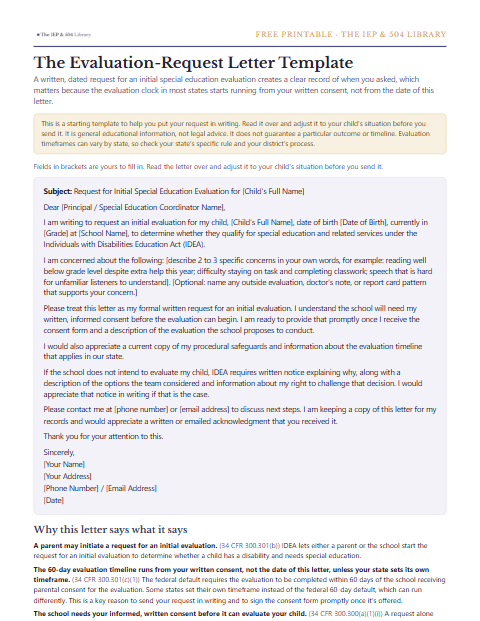
Montana IEP Evaluation Timeline, Dispute Routes and Parent Resources (2026)
- Evaluation window
- 60 calendar days
- The clock starts at
- Written parental consent
- State complaint deadline
- One year
- Due process deadline
- Two years
How long does a school in Montana have to complete an IEP evaluation?
A Montana school district has 60 calendar days to finish an initial special education evaluation, counted from the day it receives the signed Evaluation Plan form giving permission to evaluate. Montana never set a timeline of its own: the state rule on the comprehensive educational evaluation process adopts the federal evaluation rules in full, so the federal 60 day count is what applies. State guidance names two circumstances that lift it, a parent who repeatedly fails or refuses to produce the student for evaluation or a student who moves to another school district while the evaluation is under way. Once the assessments are finished the district holds the Evaluation Report meeting as soon as possible, then the IEP team meets within 30 days of that meeting for a student found eligible. Disagreements run through one place, the Dispute Resolution Office at the Office of Public Instruction, which handles the Early Assistance Program, IEP facilitation, mediation, state complaints reaching back one year plus due process hearings reaching back two years.

The evaluation timeline in Montana
| Initial evaluation window | 60 calendar days |
|---|---|
| The clock starts at | date written parental consent is returned |
| Against the federal rule | The federal default, unchanged |
IDEA sets a default of 60 calendar days from parental consent for an initial evaluation (34 CFR 300.301(c)(1)). Montana keeps that default rather than setting a timeframe of its own.
Montana sets no evaluation timeline of its own, so the federal 60 calendar day count is the one that applies. The state rule on the comprehensive educational evaluation process, ARM 10.16.3321(1), requires an evaluation to be conducted in accordance with 34 CFR 300.301 through 300.311 rather than naming a Montana figure, which leaves 34 CFR 300.301(c)(1)(i) supplying the 60 days. The count starts on the date the district receives the signed Evaluation Plan form back from the family. Two circumstances lift the count, both of them the federal exceptions at 34 CFR 300.301(d) that Montana guidance restates: a parent who repeatedly fails or refuses to produce the student for evaluation, or a student who moves to another school district while the evaluation is under way.
Source: Administrative Rules of Montana 10.16.3321(1), the subsection of the comprehensive educational evaluation process rule that requires an evaluation to be conducted in accordance with 34 CFR 300.301 through 300.311 and 34 CFR 300.321; the day count itself comes from 34 CFR 300.301(c)(1)(i), with 34 CFR 300.11(a) making those days calendar days and 34 CFR 300.301(c)(1)(ii) the state timeframe option Montana has not used; the two exceptions sit at 34 CFR 300.301(d)(1) and (d)(2); the Office of Public Instruction states the same 60 calendar day figure in Special Education in Montana, August 2024, at question 16 of the evaluation section, with the two exceptions at questions 19 and 20; Indicator 11 of the same agency's FFY 2024 annual performance report answers the prompt on which timeline the state uses with the 60 day timeframe rather than a state established one www.law.cornell.edu/regulations/montana/Mont-Admin-r-10.16.3321
The same window sits beside all fifty-one jurisdictions on the evaluation timelines by state table, which explains where the federal deadline comes from. To pull one state's window on its own, the evaluation deadline checker returns that single result.
Reevaluation and IEP review cadence in Montana
Montana does not set its own cadence here, so the federal defaults are what apply. A reevaluation happens at least once every three years unless the parent and the school agree one is not needed. It happens no more often than once a year unless they agree otherwise (34 CFR 300.303(b)). The IEP team reviews the IEP at least once a year to check progress against the annual goals (34 CFR 300.324(b)(1)).
If you disagree in Montana
IDEA gives families in every state the same three routes when a disagreement with the school does not resolve at the team table. What changes at the state line is who administers each route, how long you have to file and the local detail below.
The state complaint
Handled by the Dispute Resolution Office at the Montana Office of Public Instruction, which sits in the agency's Legal Division. Time limit to file: one year, counted back from the date the Dispute Resolution Office receives the complaint.
An organization or an individual can file, including someone from another state, about one student, a group of students or a district wide practice. Montana does not take anonymous complaints, though the office may still use the information through its general supervision work. The signed written complaint goes to the Dispute Resolution Office, Office of Public Instruction, P.O. Box 202501, Helena, Montana 59620-2501, with a copy to the school district or public agency at the same time. A complaint counts as filed on the day the office receives it. Within ten calendar days the office notifies both sides that a complaint has been filed. Montana then puts an informal step in front of the investigation, the Early Assistance Program, which has 15 business days from the filing to help the parties settle the matter. Participation is voluntary, so either side can decline it and the complaint process moves straight on. Where the program runs, the rule keeps those 15 days outside the 60 day clock for the final report. If the program does not resolve the dispute, the district prepares a written response within ten calendar days, the person who filed gets ten calendar days to add information, then the office investigates. The final report comes within 60 days of filing, addressing each allegation with findings of fact plus conclusions of law. Two things can extend that 60 days, exceptional circumstances in the particular complaint or a timeline the parties modified during the Early Assistance Program. The report orders corrective action with implementation timelines where an allegation holds up. If a district misses those timelines, the Superintendent of Public Instruction takes sanctions, which can be a recommendation to the Board of Public Education that state education funds be withheld or that accreditation status change, or denial of federal Part B funds in whole or in part. There is no right to appeal a final report issued on a state complaint.
Source: Administrative Rules of Montana 10.16.3662, with the one year reach at (2)(a), the filing address plus the copy to the district at (3), the ten calendar day notice at (4), the Early Assistance Program step plus the district's ten calendar day response at (5), the investigation at (6), the complainant's ten calendar days at (7), the 60 day final report with its two extension grounds at (8), the findings plus corrective action at (9), the sanctions at (11) and the no appeal sentence at (13); the Early Assistance Program itself sits at ARM 10.16.3660, whose (2) names the unit as the Office of Public Instruction Legal Division Dispute Resolution Office and whose (3) states that its 15 business days are not counted as part of the 60 day timeline, resting that on 34 CFR 300.152(b)(1)(ii), the federal provision allowing an extension where the parties agree to use mediation or another alternative route; that an individual from another state may file, that anonymous complaints are not accepted, that a complaint may allege district wide noncompliance, that a complaint counts as filed when the office receives it plus that either party may decline the informal step are stated in the Office of Public Instruction's Frequently Asked Questions on the IDEA State Complaint, revised April 2024; the federal floor is 34 CFR 300.151 through 300.153 www.law.cornell.edu/regulations/montana/Mont-Admin-r-10.16.3662
Mediation
Montana calls this route voluntary mediation. It is free to families, run through the same Dispute Resolution Office, available before, during or after a due process hearing request. The written request comes by mail signed by all parties, so both sides have to be willing before it starts. The Superintendent of Public Instruction then appoints an impartial mediator. Where the parties have already agreed on a qualified mediator from the state list, that name goes in the request. Where they have not, the Superintendent mails each side the names of three mediators from the list, each side has three business days to review the list and rank its preferences, then the Superintendent appoints from those names if the parties cannot agree. The mediator schedules the session no later than 30 days from the day the request reaches the Superintendent's office. Mediation is not available where a parent has revoked consent for placement. A mediator may not work for the Office of Public Instruction or for the school district involved with the student, nor hold an interest that conflicts with staying neutral. What people say in mediation stays confidential and cannot be used as evidence in a later hearing or court case. A written agreement signed by both sides is enforceable in state or federal court. The same office also offers IEP meeting facilitation, where an impartial facilitator helps a team work through a disagreement inside the meeting itself.
Source: Administrative Rules of Montana 10.16.3506, with the mailed request signed by all parties plus the appointment at (1), the revoked consent limit at (2), the agreed mediator at (3), the three name list with three business days to rank at (4), the 30 day scheduling rule at (5) and compliance with 34 CFR 300.506 at (6); the free and voluntary description sits in the Office of Public Instruction's Frequently Asked Questions on IDEA Mediation, revised April 2024, with the impartiality, confidentiality plus enforceability points restated in the Part B procedural safeguards notice revised August 2024 under Mediation; the federal floor is 34 CFR 300.506(b)(1) for voluntariness, 300.506(b)(4) for the state bearing the cost, 300.506(c) for the impartial mediator, 300.506(b)(6) and (b)(7) for the signed enforceable agreement plus 300.506(b)(8) for confidentiality www.law.cornell.edu/regulations/montana/Mont-Admin-r-10.16.3506
A due process hearing
Time limit to file: two years from the date the parent or the school district knew or should have known about the alleged action the complaint is based on.
A due process complaint goes to the other party, with a copy to the Dispute Resolution Office at the Office of Public Instruction, which runs the hearing system as a single tier, so the hearing officer's decision is the last administrative word. Montana lets the parties shape who hears it. The Superintendent of Public Instruction keeps a list of qualified impartial hearing officers, mails each side the names of three proposed officers with a summary of their qualifications, gives each side three business days to rank them in order of preference, then makes the appointment from those rankings. A party can submit one written request to remove an appointed officer for bias or a conflict of interest, with a supporting affidavit, within ten days of the appointment. An officer can also step aside on their own. A resolution meeting comes within 15 calendar days of the complaint, the resolution period runs 30 calendar days, then the written findings of fact, conclusions of law plus order are due within the federal 45 day window, which a hearing officer can extend at a party's request. Where a decision has not been issued within 90 days of the filing, the Superintendent may remove the hearing officer and appoint another. The state pays the administrative costs of a hearing, including the hearing officer's expenses plus court reporter services, while each side carries its own legal fees. A hearing officer can order reimbursement for a unilateral private placement where the district's placement was inappropriate and the family's was appropriate. The two year reach drops away where a district misrepresented that it had resolved the issue or withheld information IDEA required it to give the family. A district may not request a hearing where a parent has revoked consent for special education evaluation or services. Either side can take an aggrieved decision to a district court or bring a civil action, with 90 calendar days from the date of the decision to file. Discipline disputes run on an expedited track, with a resolution meeting within 7 calendar days, a hearing within 20 school days of the request plus a decision within 10 school days of the hearing, with no extensions on that track.
Source: Administrative Rules of Montana 10.16.3509(1)(b), whose (i) keeps the list of qualified officers, (ii) sends each party three proposed names with their qualification summaries, (iii) gives three business days to rank them plus (iv) makes the appointment from those rankings, with an officer's own withdrawal at (2) and the single written removal request inside ten days at (3); ARM 10.16.3508A(1) requires the resolution meeting within 15 days of notice of the request, in accordance with 34 CFR 300.510; ARM 10.16.3507(2) bars a district from requesting a hearing after a parent revokes consent; ARM 10.16.3523 carries the 45 day written findings with extensions at (1), the removal of an officer where no decision has issued within 90 days at (2), unilateral placement reimbursement at (3), finality unless appealed at (4), the appeal to district court or civil action at (5) plus the state paying hearing officer expenses and court reporter services at (6); the two year reach with its two exceptions, the requirement that the complaint go to the other party with a copy to the Dispute Resolution Office, the 30 calendar day resolution period plus the 90 calendar days to file a civil action are stated in the Part B procedural safeguards notice revised August 2024 under Due Process Complaint Procedures, Resolution Process and Civil Actions; the expedited timings sit in the Montana Special Education Dispute Resolution Comparison Chart; the federal floor is 34 CFR 300.508(a) for where the complaint goes, 300.507(a)(2) for the two years with its exceptions at 300.511(f), 300.510(a) for the resolution meeting, 300.515(a) for the 45 day decision clock, 300.514(a) for finality plus 300.516(b) for the civil action window www.law.cornell.edu/regulations/montana/Mont-Admin-r-10.16.3509
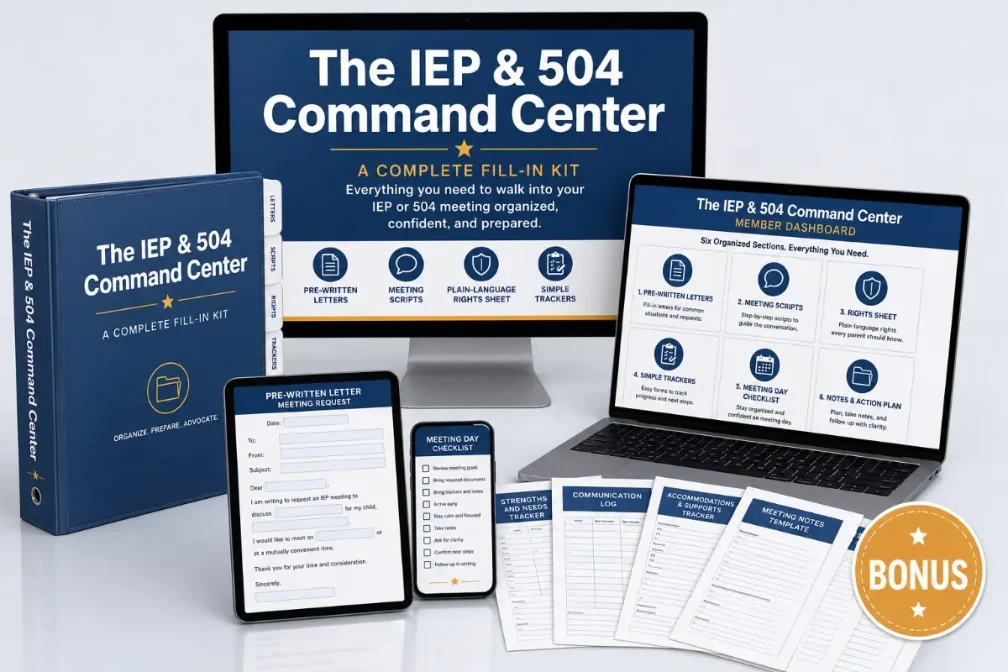
From the team behind this library
The IEP & 504 Command Center
This page shows you the deadlines and the contacts for your state. The Command Center hands you the done pieces: the binder built, the letters written, the meeting scripts ready and a self-review that shows where your child's IEP is strong or thin before you walk in. The library stays free.
Who to contact in Montana

- The state special education office. Montana Office of Public Instruction, Special Education Division. This is the office that answers questions about Montana rules and receives a state complaint.
- Your rights in writing. IDEA Special Education Part B Procedural Safeguards Notice, revised August 2024. Every district hands parents this notice at least once a year (34 CFR 300.504). It is the plain summary of what you can ask for at each step.
- Parent training and information center. Montana Empowerment Center. A parent center is free and federally funded under IDEA. Staff there talk families through the process in their own state at no cost.
- The state rules themselves. Montana Code Annotated, Title 20, chapter 7, part 4 (Special Education for Exceptional Children), with the district obligation to provide or maintain a special education program at 20-7-411(2) and (3), the duties of the superintendent of public instruction at 20-7-403 including establishing identification procedures at (4), the rulemaking authority behind the special education rules at 20-7-402(2) plus the determination of children in need of special education at 20-7-414(1); a 2025 addition to the same part, 20-7-476, was enacted as section 1 of chapter 740, Laws of 2025, effective 1 July 2025. Part 4 is the Montana statute behind special education: it makes school districts responsible for educating children with disabilities, sets the duties of the superintendent of public instruction including establishing procedures for identifying those children, then leaves the operating detail to the special education rules at Title 10, chapter 16 of the Administrative Rules of Montana. The 2025 addition to that part allows the term emotional disability to be used in place of emotional disturbance in Montana law wherever the term relates to special education services.
Child Find in Montana
Montana writes its child find duty into a rule of its own rather than pointing at the federal one. Every district establishes procedures covering children from birth to 21, reaching children in public and private agencies plus children who are highly mobile, migrant, homeless or wards of the state. The rule then sets a minimum list for what those procedures contain. They name the title of the person responsible for coordinating, implementing plus documenting child find. They describe the identification activities, which include audiological, health, speech or language plus visual screening. They describe record review for students being considered for retention, delayed admittance, long term suspension or expulsion or a waiver of learner outcomes under the accreditation standards, alongside regular education intervention with progress monitoring plus procedures for identifying a student who may have a disability even while advancing from grade to grade. Districts publish public notice of those procedures. For children from birth through two, districts coordinate with early intervention agencies. Where a student is parentally enrolled in a private school outside the boundaries of the district the family lives in, the district where the private school sits carries child find plus evaluation, with the elementary district serving elementary students and the high school district serving high school students. Montana adds a reading screen on top of all that. The Montana Dyslexia Screening and Intervention Act has districts screen a child in the first year the child is admitted to a school of the district up to grade 2, plus any child the district has not screened before who is not meeting grade level reading benchmarks in any grade. The screening instrument is administered by someone who understands the signs of dyslexia and is trained to identify them.
Source: Administrative Rules of Montana 10.16.3125, with the district procedures plus the birth to 21 screening method at (1) and (1)(a), the minimum contents at (1)(b) including the named title at (i), the identification activities at (ii) plus the specific learning disability procedures at (iv), the public notice at (2), the private school split at (3) and the birth through two coordination at (4); the dyslexia screen sits at 20-7-469, MCA, the Montana Dyslexia Screening and Intervention Act, with the two screening triggers at (3)(b)(i)(A) and (B) plus the trained administrator requirement at (3)(b)(ii); the federal duty is at 34 CFR 300.111 www.law.cornell.edu/regulations/montana/Mont-Admin-r-10.16.3125