Massachusetts IEP Evaluation Timeline, Dispute Routes and Parent Resources (2026)
- Evaluation window
- 30 school days
- The clock starts at
- Parental consent
- State complaint deadline
- One year
- Due process deadline
- Two years
How long does a school in Massachusetts have to complete an IEP evaluation?
Massachusetts counts this deadline in school working days rather than calendar days. Once a district receives written parental consent, the evaluation assessments are completed within 30 school working days. Within 45 school working days of that same consent the district convenes the Team meeting, decides eligibility and gives the parents two copies of the proposed IEP plus the proposed placement, or a written explanation where the Team finds the student is not eligible. A school working day means any day, including a partial day, that students are in attendance for instructional purposes, so summer, school vacations and snow days fall outside the count. A family that disagrees with what the Team decides has three routes: a state complaint to the education department's Problem Resolution System Office within one year of the events, free mediation through the Bureau of Special Education Appeals or a due process hearing at that same bureau, which sits inside the Division of Administrative Law Appeals rather than inside the education department. The state rewrote 603 CMR 28.00 on June 23 2026 to add English learner requirements to the evaluation and IEP process plus a new discipline section. Those amendments left the 30 and 45 school working day windows unchanged.

The evaluation timeline in Massachusetts
| Initial evaluation window | 30 school days for the evaluation, 45 school days to the eligibility Team meeting |
|---|---|
| The clock starts at | parental consent to evaluate |
| Against the federal rule | A timeframe Massachusetts sets for itself |
IDEA sets a default of 60 calendar days from parental consent for an initial evaluation (34 CFR 300.301(c)(1)). It also lets a state set its own timeframe instead, which is what Massachusetts has done, so the window above is the one that applies here.
Massachusetts sets one of the shortest windows in the country: the evaluation itself is due within 30 school days of consent. The Team meeting that decides eligibility, placement and the IEP must happen within 45 school days of consent.
Source: 603 CMR 28.04; M.G.L. c. 71B, Section 3 www.doe.mass.edu/lawsregs/603cmr28.html?section=04
The same window sits beside all fifty-one jurisdictions on the evaluation timelines by state table, which explains where the federal deadline comes from. To pull one state's window on its own, the evaluation deadline checker returns that single result.
Reevaluation and IEP review cadence in Massachusetts
Massachusetts puts the annual review and the three year reevaluation in one rule. The district reviews each eligible student's IEP and progress at least annually. Every three years, or sooner if necessary, the district conducts a full three year reevaluation with parental consent. The state's own clocks cover reevaluations rather than initial evaluations alone: the 30 school working day assessment window and the 45 school working day window for the Team meeting plus the proposed IEP both run from written parental consent to an initial evaluation or a reevaluation. Federal rules set the outer frame at a reevaluation at least once every three years unless the parent and the district agree one is unnecessary. A reevaluation happens no more often than once a year unless they agree otherwise. The IEP review happens at least annually.
Source: 603 CMR 28.04(3) and 603 CMR 28.05(1); federal baseline at 34 CFR 300.303(b)(1) and (b)(2) plus 34 CFR 300.324(b)(1) www.doe.mass.edu/lawsregs/603cmr28.html?section=04
If you disagree in Massachusetts
IDEA gives families in every state the same three routes when a disagreement with the school does not resolve at the team table. What changes at the state line is who administers each route, how long you have to file and the local detail below.
The state complaint
Handled by Problem Resolution System Office, Massachusetts Department of Elementary and Secondary Education. Time limit to file: One year from the date of the alleged violation.
A state complaint goes to the Problem Resolution System Office, which sits inside the education department in Everett. Any individual or organization may file one, including someone from another state. The person filing signs it then sends a copy to the school district at the same time. The office takes complaints through an online intake form, by email, by fax, by post or in person, with a model intake form translated into nine languages plus other languages on request. The complaint alleges a violation that happened no more than one year before the office received it. The office gives the complainant a chance to add information, gives the district a chance to respond, can carry out an independent on-site investigation where it decides one is needed, then issues a written decision with findings of fact and conclusions within 60 calendar days. That 60 day figure stretches only for exceptional circumstances or where both sides agree to extend it to try mediation. Corrective action can reach compensatory services or monetary reimbursement. The same office handles general education complaints as well, so it is not a special education only route. Its findings are not reviewable by the Bureau of Special Education Appeals.
Source: 603 CMR 28.08(2) for the Problem Resolution System itself, its general education reach and its findings not being reviewable by the Bureau of Special Education Appeals; DESE Special Education Complaint Procedures Guide plus Parent's Notice of Procedural Safeguards section 6.2 (English edition updated May 2025) for the filing channels, the translated model form, the 60 calendar day written decision, the two extension grounds, the on-site investigation power and the corrective action range; 34 CFR 300.152(a) and (b)(1); 34 CFR 300.153(b), (c) and (d) www.doe.mass.edu/prs/guide/
Mediation
Mediation runs through the Bureau of Special Education Appeals in Malden, which employs its own mediators rather than contracting the work out. It costs the family nothing. Both sides have to agree to take part, so no one can be required into it. After a request the mediator schedules a session with the family and the district within 30 days, at a time and place that suits the parties. Discussions stay confidential and cannot be used later at a hearing or in court. An agreement is put in writing, signed by both sides and enforceable in court. Mediation can run alongside a complaint at the Problem Resolution System Office. It is available before a hearing request or after one. The same bureau also mediates early intervention disputes for children under three.
Source: 603 CMR 28.08(4), (4)(a) and (4)(b); M.G.L. c. 71B, Section 2A(a) and (c); Parent's Notice of Procedural Safeguards, section 6.3, English edition updated May 2025, for the confidentiality reaching court proceedings and for the signed agreement being enforceable in court www.mass.gov/mediation-at-the-bsea
A due process hearing
Time limit to file: Two years from the date the parent or the district knew or should have known about the action the complaint is about, with exceptions where the district misrepresented that it had resolved the problem or withheld information it was required to give the parent.
Hearings sit outside the education department. State law places the Bureau of Special Education Appeals in the Division of Administrative Law Appeals as a separate subdivision that is independent of the Department of Elementary and Secondary Education, while the department keeps the general supervision role federal law assigns it. Hearing officers are attorneys hired by the bureau's director under the chief administrative magistrate. The party asking for a hearing sends the request to the other side then sends a copy to the bureau, which names the assigned hearing officer within five days. Where a parent rejects a proposed IEP, a proposed placement or a finding of no eligibility, the district sends that rejection to the bureau within five days, so the bureau learns of the disagreement without the family filing anything. Massachusetts stops at one administrative level. The hearing officer's decision is implemented immediately, neither the bureau nor the department reconsiders it, so an appeal goes to a court of competent jurisdiction. Once a hearing request is on file the parties can also ask for a settlement conference. It is an informal route that runs only where all parties agree to it plus the assigned hearing officer endorses it. It aims to produce a signed settlement in the same sitting. The bureau dropped its earlier condition that both sides have legal representation in May 2025 although one of its own how-to pages still lists that condition.
Source: 603 CMR 28.08(3)(b), (5) and (6); M.G.L. c. 71B, Section 2A(a) and (c); Hearing Rules for Special Education Appeals, Rule I(B) and Rule I(C), revised July 2024, where Rule I(C) states both the two year limit and its two exceptions; Parent's Notice of Procedural Safeguards, section 6.4, English edition updated May 2025; BSEA Reference Manual, revised July 2024, plus the bureau's May 2025 update for the settlement conference; federal frame at 34 CFR 300.507(a)(2) and 34 CFR 300.511(e) and (f) www.mass.gov/doc/hearing-rules-revised-july-2024/download
From the team behind this library
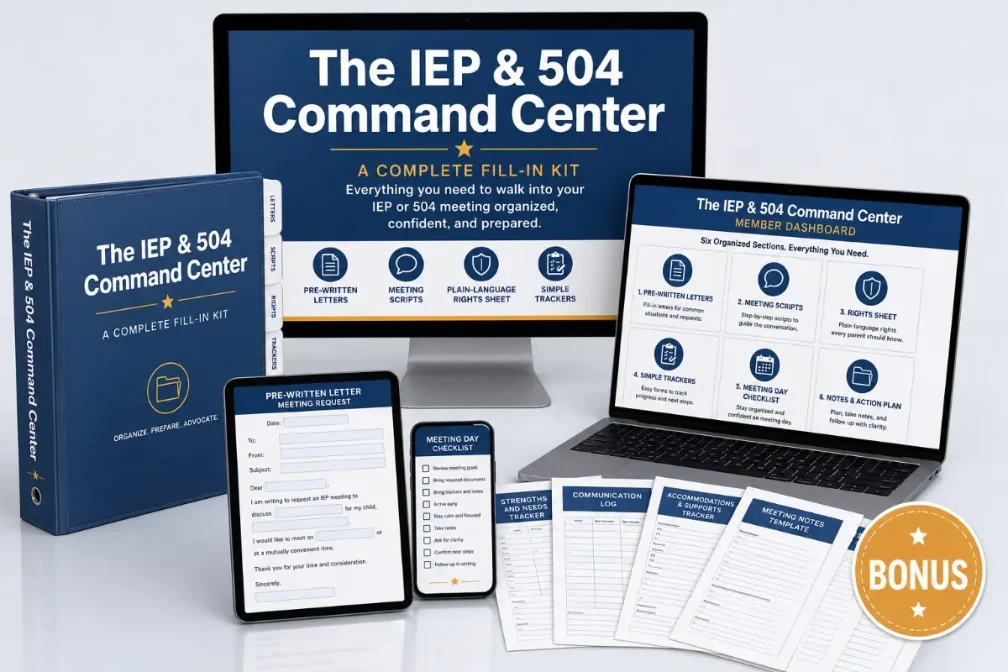
The IEP & 504 Command Center
This page shows you the deadlines and the contacts for your state. The Command Center hands you the done pieces: the binder built, the letters written, the meeting scripts ready and a self-review that shows where your child's IEP is strong or thin before you walk in. The library stays free.
Who to contact in Massachusetts

- The state special education office. Massachusetts Department of Elementary and Secondary Education, Office of Special Education Planning and Policy. This is the office that answers questions about Massachusetts rules and receives a state complaint.
- Your rights in writing. Parent's Notice of Procedural Safeguards, English edition updated May 2025, published by the Massachusetts Department of Elementary and Secondary Education with translations in 19 languages posted beside it. Every district hands parents this notice at least once a year (34 CFR 300.504). It is the plain summary of what you can ask for at each step.
- Parent training and information center. Federation for Children with Special Needs. A parent center is free and federally funded under IDEA. Staff there talk families through the process in their own state at no cost.
- The state rules themselves. M.G.L. c. 71B (Children with disabilities), with the implementing rules at 603 CMR 28.00. Chapter 71B, which the state's own safeguards notice says is popularly known as Chapter 766, sets out who counts as a child with a disability, what school committees owe those students, the education department's duties, the Bureau of Special Education Appeals and the state option for a shared cost independent evaluation, with the working detail carried in 603 CMR 28.00. A statute wide terminology update effective June 12 2026 rewrote the chapter's older wording into person-first language, so guides written before that date may still call it the children with special needs chapter.
Child Find in Massachusetts
Massachusetts starts looking earlier than the age three handoff in two ways. Districts screen three and four year olds plus every child of kindergarten entry age to review development and spot children who should be referred for an evaluation, with participation by three and four year olds left to the parents. A child of two and a half who may be receiving early intervention services is evaluated on referral, so the evaluation happens in time for services to begin at age three where the child is found eligible. A separate rule covers reading: schools assess literacy skills at least twice a year from kindergarten through at least third grade. Where a screening puts a child significantly below the benchmark, the school tells the parent within 30 school days what the result was and how it is responding, then offers a follow up conversation.
Source: 603 CMR 28.03(1)(d) and 28.03(1)(f); 603 CMR 28.04(1)(d) www.doe.mass.edu/lawsregs/603cmr28.html?section=03