North Carolina IEP Evaluation Timeline, Dispute Routes and Parent Resources (2026)
- Evaluation window
- 90 calendar days
- The clock starts at
- Written referral
- State complaint deadline
- One year
- Due process deadline
- One year
How long does a school in North Carolina have to complete an IEP evaluation?
North Carolina works to a single 90 calendar day deadline that starts when a public school unit receives a written referral rather than when a parent signs consent for testing. That one window covers the evaluation, the eligibility decision and, for a child found eligible, writing the IEP and completing placement, which is why it runs longer than the federal 60 day evaluation clock. State policy counts a day as a calendar day, so weekends, school holidays and the summer break stay inside the count, with only three named situations where the 90 days do not apply. A family that disagrees with a school decision has three routes: a signed written state complaint to the Office of Exceptional Children at the Department of Public Instruction, free mediation the department arranges, or a due process petition filed with the Office of Administrative Hearings within one year of learning about the issue. North Carolina repealed its state review officer step in November 2021, so an administrative law judge's decision is now the last administrative word before a civil action in state court within 30 days or federal court within 90 days.

The evaluation timeline in North Carolina
| Initial evaluation window | 90 calendar days |
|---|---|
| The clock starts at | receipt of a written referral |
| Against the federal rule | A timeframe North Carolina sets for itself |
IDEA sets a default of 60 calendar days from parental consent for an initial evaluation (34 CFR 300.301(c)(1)). It also lets a state set its own timeframe instead, which is what North Carolina has done, so the window above is the one that applies here.
North Carolina measures from the written referral rather than from consent and sets one combined 90 calendar day window covering the evaluation, the eligibility decision and, for an eligible child, developing the IEP and placement, longer than the federal 60 days because it starts earlier and bundles more steps into a single clock. The count does not stop for holidays, summer break or school closures.
Source: NC Policies Governing Services for Children with Disabilities, NC 1503-2.2(c)(1), with the three exceptions at NC 1503-2.2(d), the condition on the third of them at NC 1503-2.2(e), the written referral at NC 1503-2.1 and NC 1503-2.2(b) and the calendar day definition at NC 1500-2.7(a) www.dpi.nc.gov/documents/publications/catalog/ec144-policies-governing-services
The same window sits beside all fifty-one jurisdictions on the evaluation timelines by state table, which explains where the federal deadline comes from. To pull one state's window on its own, the evaluation deadline checker returns that single result.
Reevaluation and IEP review cadence in North Carolina
North Carolina keeps the federal cadence for most children. A reevaluation happens at least once every three years, no more than once a year unless the parent and the public school unit agree otherwise, with the IEP reviewed at least once a year. State policy adds one age-specific rule on top. Developmental delay applies in North Carolina only to children aged three through seven, so a child identified with a developmental delay is reevaluated at least once every three years following placement and also before turning eight or entering third grade, whichever comes first.
Source: NC Policies Governing Services for Children with Disabilities, NC 1503-2.4(b)(1) and (b)(2) and NC 1503-2.4(c), with the developmental delay age range at NC 1501-2.9(b)(1) and the annual IEP review at NC 1503-5.1(b)(1)(i) www.dpi.nc.gov/documents/publications/catalog/ec144-policies-governing-services
If you disagree in North Carolina
IDEA gives families in every state the same three routes when a disagreement with the school does not resolve at the team table. What changes at the state line is who administers each route, how long you have to file and the local detail below.
The state complaint
Handled by the Office of Exceptional Children at the North Carolina Department of Public Instruction. Time limit to file: one year from the date of the alleged violation, measured against the date the complaint is received.
A state complaint is written and signed. Anyone can file one, not only a parent. The person filing sends a copy to the superintendent of the public school unit serving the child at the same time it goes to the department, which takes signed complaints by email through the address on its dispute resolution page. The Office of Exceptional Children reviews the allegations, can carry out an independent on-site investigation, gives both sides a chance to add information and issues a written decision with findings of fact within 60 days. That window stretches only where exceptional circumstances exist on a particular complaint, or where both sides agree to extend it to try mediation or another form of alternative dispute resolution. North Carolina adds one opening to the one year rule. The department can accept a complaint about an alleged continuing violation outside that year where extraordinary circumstances exist. The policy gives the example of a family who never received prior written notice or the procedural safeguards notice while the child went without a free appropriate public education. Where the department finds a violation, its own procedures include corrective action to achieve compliance.
Source: NC Policies Governing Services for Children with Disabilities, NC 1501-10.2(a) for the 60 day decision and what it covers, NC 1501-10.2(b)(1) for the two grounds that extend that window and NC 1501-10.2(b)(2)(iii) for corrective action, with the filing channels at NC 1501-10.3(a), the one year limit at NC 1501-10.3(c), the extraordinary circumstances provision at NC 1501-10.3(c)(1) and the same-time copy to the public school unit superintendent at NC 1501-10.3(d); the current email filing address on the Office of Exceptional Children dispute resolution page www.dpi.nc.gov/documents/publications/catalog/ec144-policies-governing-services
Mediation
Mediation runs through the Office of Exceptional Children at no cost to the family when the department assigns the mediator, since state law puts the cost of the process on the State. That cost rule has one limit written into the statute. It stops applying where the parties pick a mediator other than the assigned one or choose a different method of dispute resolution. The State Board of Education keeps a list of qualified mediators and the department assigns one from that list when a request arrives, so the mediator is not an employee of the department or of the school unit involved with the child. The mediation statute still uses the department's older name, the Exceptional Children Division, for the office that makes that assignment. Mediation is voluntary for both sides. Choosing it never delays or replaces a due process petition. Requests go in on the department's mediation request form. The department's own questions and answers say a session is usually scheduled within two to three weeks of the form arriving, with most mediations finishing in a single day. Two other options sit either side of mediation. The department runs a facilitated IEP program where a neutral facilitator joins the IEP team meeting. Once a petition is filed the parties can also use a mediated settlement conference under the state's administrative hearings law.
Source: N.C. Gen. Stat. 115C-109.4, with the voluntary rule at (b)(1) and (b)(2), the mediator list and the assignment at (d), the cost and the limit on it at (e) and the mediated settlement conference option at (i) read with N.C. Gen. Stat. 150B-23.1; NC Policies Governing Services for Children with Disabilities, NC 1504-1.7(b)(4) on cost and NC 1504-1.7(c)(1)(i) on the mediator not being an employee of the department or the school unit involved www.ncleg.gov/EnactedLegislation/Statutes/HTML/BySection/Chapter_115C/GS_115C-109.4.html
A due process hearing
Time limit to file: one year from the date the parent or the public school unit knew or reasonably should have known about the action the petition is about.
A due process petition in North Carolina goes to the Office of Administrative Hearings, a separate state agency, rather than to the education department. The person filing serves a copy on the other party and on the person the State Board of Education designates at the Department of Public Instruction. An administrative law judge hears the case in the county where the child attends school or is entitled to enroll unless both sides agree on a different venue. The hearing is closed to the public unless the parent asks in writing for an open hearing. Before it, the public school unit convenes a resolution meeting within 15 days of the petition, where its attorney takes part only when the parent brings one. A parent planning to bring an attorney gives the agency written notice of that beforehand. A parent can speak for themselves at the hearing or be represented by an attorney. State policy does not allow a non-attorney to represent a party there, though advocates and people with special knowledge can accompany and advise. Since the General Assembly repealed the review officer step on November 18, 2021, the judge's written decision is the final administrative decision. A party who disagrees has 30 days from receiving the notice of the decision to file a civil action in state court. The federal court window is 90 days from the date of the decision, a figure that comes from the federal rule rather than from the state statute. The State Board enforces a final decision, including ordering a public school unit to provide an appropriate education, to place a child in an approved private school or to reimburse reasonable private placement costs.
Source: N.C. Gen. Stat. 115C-109.6, with the filing and service at (a) read with N.C. Gen. Stat. 115C-107.2(b)(9), the one year limit at (b), its two exceptions at (c), venue at (d), the closed hearing at (e), finality at (f), the notice of decision at (g), State Board enforcement at (h1) and the 30 day State court window at (h2); the resolution meeting at N.C. Gen. Stat. 115C-109.7(a); the 90 day federal court window at 34 CFR 300.516(b), restated in the state's July 2026 procedural safeguards notice; the repealed review officer step at N.C. Gen. Stat. 115C-109.9 (repealed by S.L. 2021-180, s. 7.25(c), effective November 18, 2021); the representation rule at NC Policies Governing Services for Children with Disabilities, NC 1504-1.13(a)(1) www.ncleg.gov/EnactedLegislation/Statutes/HTML/BySection/Chapter_115C/GS_115C-109.6.html
From the team behind this library
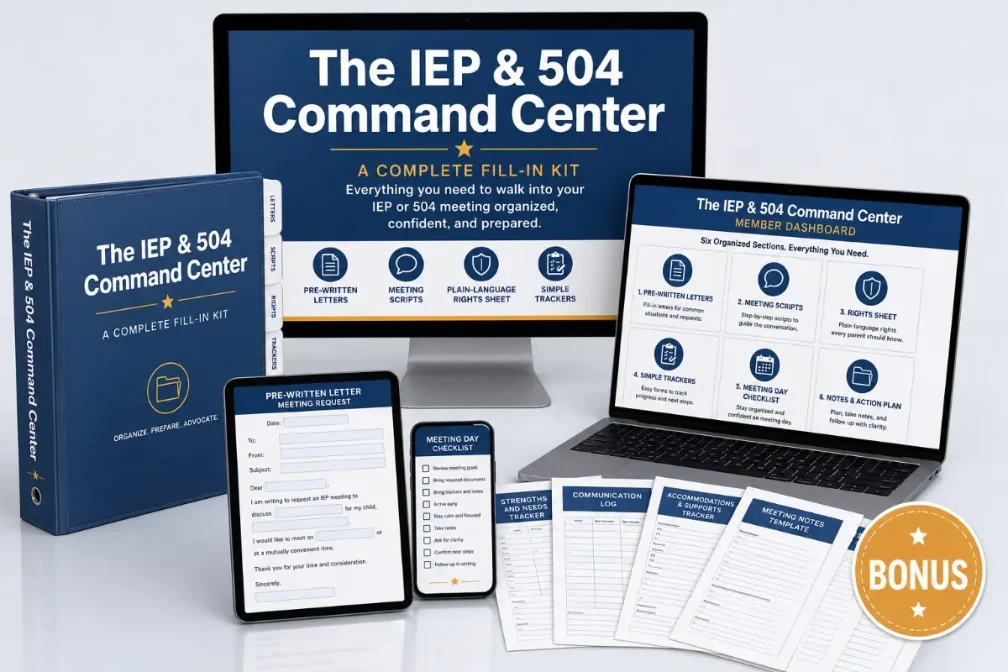
The IEP & 504 Command Center
This page shows you the deadlines and the contacts for your state. The Command Center hands you the done pieces: the binder built, the letters written, the meeting scripts ready and a self-review that shows where your child's IEP is strong or thin before you walk in. The library stays free.
Who to contact in North Carolina

- The state special education office. Office of Exceptional Children, North Carolina Department of Public Instruction. This is the office that answers questions about North Carolina rules and receives a state complaint.
- Your rights in writing. Notice of Procedural Safeguards: Parent Rights and Responsibilities in Special Education, publication EC145, updated July 2026 by the North Carolina Department of Public Instruction. Every district hands parents this notice at least once a year (34 CFR 300.504). It is the plain summary of what you can ask for at each step.
- Parent training and information center. ECAC, Inc. (Exceptional Children's Assistance Center). A parent center is free and federally funded under IDEA. Staff there talk families through the process in their own state at no cost.
- The state rules themselves. N.C. Gen. Stat. Chapter 115C, Article 9 (Education of Children With Disabilities), whose operative sections run 115C-106.1 through 115C-112.1. Article 9 is North Carolina's own special education law, covering the state goal and purposes, the duties of the State Board of Education and of local school units, the Child Find census, the handbook of procedural safeguards for parents, mediation, due process petitions heard by the Office of Administrative Hearings and the funding rules, with the working detail carried in the State Board's Policies Governing Services for Children with Disabilities.
Child Find in North Carolina
North Carolina brands its outreach as Project Child Find and splits it by age. The North Carolina Infant-Toddler Program locates and evaluates children from birth to age three. Public school units carry the duty for children aged three through 21, including children in private schools and home schools, children who are homeless or in foster care and children living in nursing homes or correctional facilities. State policy adds a response deadline the federal rule does not carry. When someone other than a parent or the school unit puts concerns about a child in writing, the unit issues a written response to the child's parent within 30 days, either explaining why it will not pursue the concerns or giving a date for a meeting to review existing data. State law also requires an annual census of children with disabilities living in North Carolina, counted as identified and as suspected, completed each year by October 15 and made public by January 15.
Source: NC Policies Governing Services for Children with Disabilities, NC 1501-2.9(a)(1) on the duty to identify, locate and evaluate children aged three through 21 and NC 1501-2.9(d) on the 30 day written response; the annual census at N.C. Gen. Stat. 115C-107.3(a); the birth to three split, the home school, foster care, nursing home and correctional facility populations and the Project Child Find name from the department's 2025 Project Child Find flyer www.dpi.nc.gov/documents/publications/catalog/ec144-policies-governing-services