New Mexico IEP Evaluation Timeline, Dispute Routes and Parent Resources (2026)
- Evaluation window
- 60 calendar days
- The clock starts at
- Parental consent
- State complaint deadline
- One year
- Due process deadline
- Two years
How long does a school in New Mexico have to complete an IEP evaluation?
A New Mexico school district has 60 calendar days from the day it receives a parent's written consent to finish an initial evaluation and the written evaluation report. Two steps sit in front of that clock: a parent can ask for an evaluation in writing or out loud to any licensed personnel at the child's school, then the district answers within 15 school days by proposing the evaluation with a consent form or by refusing in writing with the safeguards notice. A request that arrives within 15 school days before a scheduled break of at least 14 calendar days carries 30 calendar days for that answer instead. New Mexico also puts the finished evaluation report in the family's hands at least two calendar days before the meeting that decides eligibility, a meeting the rule places within 15 school days of the evaluation being completed. Families who disagree with a district have five routes through the Office of Special Education at the Public Education Department, from a call to its parent liaison up to a due process hearing decided by a contracted independent hearing officer.

The evaluation timeline in New Mexico
| Initial evaluation window | 60 calendar days |
|---|---|
| The clock starts at | parental consent to evaluate |
| Against the federal rule | The federal default, unchanged |
IDEA sets a default of 60 calendar days from parental consent for an initial evaluation (34 CFR 300.301(c)(1)). New Mexico keeps that default rather than setting a timeframe of its own.
New Mexico follows the federal 60 calendar day default, measured by the actual number of calendar days between consent and the evaluation being completed.
Source: 6.31.2.10(F)(2) NMAC (timelines for evaluations) for the 60 calendar days, with the two exceptions at 6.31.2.10(F)(3), the request route and the 15 school day answer at 6.31.2.10(D)(2) and (D)(3) NMAC, the written report two calendar days before the meeting at 6.31.2.10(G)(4) NMAC, then the eligibility determination meeting within 15 school days at 6.31.2.10(J)(1) NMAC, in part 6.31.2 NMAC (Children with Disabilities), sections replaced effective July 14 2020 with sections 6, 7, 11 and 13 amended effective July 31 2023; the federal 60 day default sits at 34 CFR 300.301(c)(1)(i) with the state timeframe option at 34 CFR 300.301(c)(1)(ii) www.srca.nm.gov/parts/title06/06.031.0002.html
The same window sits beside all fifty-one jurisdictions on the evaluation timelines by state table, which explains where the federal deadline comes from. To pull one state's window on its own, the evaluation deadline checker returns that single result.
Reevaluation and IEP review cadence in New Mexico
New Mexico keeps the federal reevaluation cycle. The state rule asks for a reevaluation at least once every three years unless the parent and the public agency agree one is unnecessary, more often where the agency decides the child's educational or related service needs warrant it or where a parent or teacher asks, never more than once a year unless both sides agree otherwise. New Mexico then adds steps around that cycle. A request for a reevaluation carries the same answer clock as a request for an initial evaluation: the public agency responds no later than 15 school days after it receives the request, or 30 calendar days where the request arrives within 15 school days before the start of a scheduled period of at least 14 calendar days when students do not attend. Families receive the written evaluation or reevaluation report at least two calendar days before the meeting that decides eligibility. A child stops being eligible only after an evaluation, except where the student graduates with a regular diploma through the standard program of study or reaches age 22, in which case a summary of academic achievement and functional performance goes to the student instead. The annual IEP review follows the federal rule. New Mexico moves one piece of it earlier: measurable post-school goals appear no later than the first IEP in effect when the child turns 14, or younger where the team decides that fits, updated every year after that, where the federal rule starts at 16. A student keeps the right to a free appropriate public education through age 21. A student who turns 22 during the school year finishes that school year with services, while a student who turns 22 before the first day of the school year is no longer eligible.
Source: 6.31.2.10(C)(2)(a) through (c) NMAC for the three year and once a year cadence, 6.31.2.10(C)(3) NMAC for evaluation before termination of eligibility, 6.31.2.10(D)(2) and (D)(3) NMAC for the request and the 15 school day answer, 6.31.2.10(G)(4) NMAC for the report two calendar days before the eligibility meeting, plus 6.31.2.11(G)(3) NMAC for the age 14 post-school goals, 6.31.2.11(G)(5) NMAC for the standard-program diploma wording with the summary of performance, then 6.31.2.11(G)(6) NMAC for the age end point; federal cadence at 34 CFR 300.303(b) and 34 CFR 300.324(b)(1)(i) with federal transition planning at 34 CFR 300.320(b) www.srca.nm.gov/parts/title06/06.031.0002.html
If you disagree in New Mexico
IDEA gives families in every state the same three routes when a disagreement with the school does not resolve at the team table. What changes at the state line is who administers each route, how long you have to file and the local detail below.
The state complaint
Handled by the Office of Special Education, New Mexico Public Education Department. Time limit to file: one year, counted back from the day the department receives the complaint.
Any individual or organization can file a state complaint in New Mexico, including someone from another state, about one student or about a group. The signed written complaint reaches the Office of Special Education through the department's online dispute resolution system, by email to dispute.resolution@ped.nm.gov or by mail, with a copy going to the public agency serving the child at the same time. The department treats the filing date as the later of the two dates the complaint reached the department and the public agency. The rule lists what a complaint carries: it is in writing, submitted to the office, signed with contact information, naming the child and the school the child attends where the complaint concerns one student, stating that a public agency or the department violated a state or federal requirement, stating the facts behind that allegation, plus describing a proposed resolution as far as the person filing knows one. A complaint missing an element is declined with an explanation and further guidance. An investigator reviews the documents, interviews witnesses, can run an on-site review, then the department issues a Complaint Resolution Report with findings of fact and conclusions within 60 calendar days. Two things extend that clock: exceptional circumstances, or an agreement between the person who filed the complaint and the public agency to extend the time so they can use mediation or a facilitated IEP meeting. Where the report finds noncompliance it sets corrective action with a timeline for correction, which can reach compensatory services or reimbursement, monitored by the department afterwards. Redacted reports are published on the department's website. A complaint against the department itself goes to the secretary of education, who appoints an impartial investigator. The same route reaches state-run agencies, so published reports name the New Mexico School for the Deaf, the New Mexico School for the Blind and Visually Impaired plus other state agencies alongside school districts and charter schools. An issue already before a due process hearing officer is set aside until that hearing and any civil action end, while the rest of the complaint runs on the usual clock. One issue sits here rather than in a hearing: the department's due process manual states that the qualifications of a special education teacher are not subject to a cause of action including due process, then points that issue to a state complaint instead.
Source: 6.31.2.13(H) NMAC, with the required elements at (H)(2)(a), the one year limit at (H)(2)(d), the copy to the public agency at (H)(2)(c), an issue also before a hearing officer set aside at (H)(4)(a), the investigation at (H)(5)(a), the 60 day written decision and corrective action at (H)(5)(b), complaints against the department at (H)(6) plus the extensions at (H)(7); the department's State Administrative Complaints Manual, December 2025, for the filing date rule, the Complaint Resolution Report name, the online system, the email address, the compensatory services or reimbursement remedies, the corrective action plan plus the publication policy at its Appendix A; the department's Dispute Resolution Options for Students with Disabilities quick reference guide for the investigator interviewing witnesses and for corrective actions monitored by the department; the department's Due Process Complaints and Hearings Manual, page 5, for the special education teacher qualifications point; the department's state complaint page for filing by mail and for the published reports; federal minimums at 34 CFR 300.151 through 300.153 with the 60 day decision at 34 CFR 300.152(a) and the one year limit at 34 CFR 300.153(c) web.ped.nm.gov/wp-content/uploads/2025/12/State-Administrative-Complaints-Manual_Final.pdf
Mediation
Mediation in New Mexico starts with a request both sides have already signed. The department honors a request that is in writing, submitted to the Office of Special Education, signed by both parties or their designated representatives as a mutual request, plus carrying a statement of the matters in dispute and a description of any earlier attempts to resolve them at the local level. A request missing one of those pieces is declined with an explanation. The department then assigns a mediator from a list it keeps, on a rotational basis, drawn from contracted mediation services rather than department or district staff. The state pays the mediator, so mediation costs a family nothing. Where mediation runs alongside a state complaint it is completed within 14 days of the mediator being assigned unless the department grants a brief extension for exceptional circumstances. Alongside a due process request the same 14 days apply, with any extension granted by the hearing officer on a joint request from both sides. Discussions stay confidential and cannot be used as evidence in a later hearing or civil proceeding. An agreement is written up, signed by the parent and by a representative who can bind the public agency, then enforceable in a state court of competent jurisdiction or in a district court of the United States, with the mediator sending each side a copy within seven days. Where the agreement touches the IEP, the public agency convenes an IEP meeting to tell the child's service providers what they now do. Choosing mediation never delays or denies a due process hearing. New Mexico's own Mediation Procedures Act does not apply to mediation under these rules. The department funds a lighter option beside it: a facilitated IEP meeting, where a trained neutral runs the meeting itself so the team can finish an IEP everyone signs.
Source: 6.31.2.13(G)(2)(b) NMAC for the criteria, with the mutual signed request at (G)(2)(b)(iii) and the declined request at (G)(2)(b)(v), 6.31.2.13(G)(2)(c) NMAC for the formal routes, 6.31.2.13(G)(2)(d) NMAC for the Mediation Procedures Act at Section 44-7B-1 et seq. NMSA 1978 not applying, 6.31.2.13(H)(3)(a) and (H)(3)(b) NMAC for the 14 day completion alongside a state complaint plus the mediation requirements, then 6.31.2.13(I)(7)(b) NMAC for the same 14 days alongside a due process request with the hearing officer granting any extension, plus 6.31.2.13(I)(6)(e)(iii) NMAC for mediation never being used to deny or delay a hearing; the department's State Administration of Mediation Manual, December 2025, for the rotational assignment from the department's list, the contracted mediation services plus the department paying the mediator's fee; the department's Dispute Resolution Options for Students with Disabilities quick reference guide for the facilitated IEP meeting being run by a department-assigned trained facilitator at no cost to families; federal mediation rules at 34 CFR 300.506 web.ped.nm.gov/wp-content/uploads/2025/12/Mediation-Manual_Final.pdf
A due process hearing
Time limit to file: two years from the date the parent or the public agency knew or should have known about the action the request is based on.
New Mexico runs a single tier. A parent or a public agency sends the written request to the other party at the same time as the Office of Special Education. The department does not start the timeline until the receiving party has a copy. The department appoints an impartial hearing officer from the independent hearing officers it contracts with, keeps the list of officers with a statement of their qualifications, then appoints a replacement where an officer steps aside. No state level review officer sits above that decision, so the hearing officer's written decision ends the administrative stage. A resolution session comes within 15 days of the other party receiving the request unless both sides waive it in writing or agree to use mediation or a facilitated IEP meeting instead, inside a 30 day resolution period, after which the 45 day decision clock begins. The department's own quick reference guide adds those two clocks together: a final hearing decision within 75 days of the request being received, unless the hearing officer grants an extension. Discipline cases run on a tighter track with no extensions: the hearing within 20 school days of the request reaching the department, a written decision within 10 school days of the hearing being completed. The public agency pays the administrative costs, including the hearing officer's fees, the verbatim record plus its transmission, with each side carrying its own legal costs unless a court awards fees. New Mexico does not permit non-attorneys to represent a party at a due process hearing, though a parent can be accompanied and advised by counsel plus by people with special knowledge or training about children with disabilities. The two year filing limit lifts where a public agency misrepresented that it had resolved the problem or withheld information the parent had a right to receive. One New Mexico number differs sharply from the federal fallback: a party who wants a court to review the decision has 30 days, where 34 CFR 300.516(b) sets 90 days for a state that has not fixed a limit of its own. The rule counts those 30 days from the appealing party's receipt of the decision. An action for attorney fees carries the same 30 day window from receipt of the last administrative decision. Redacted decisions are published on the department's website.
Source: 6.31.2.13(I) NMAC, with the filing to both the other party and the department at (I)(4), the appointment of the hearing officer at (I)(6)(a), the roster with qualifications and the replacement officer at (I)(6)(e)(i) and (ii), the 45 day decision at (I)(6)(e)(iv) and (I)(9)(d), the resolution session at (I)(7)(a) with the 30 day resolution period at (I)(7)(c)(i), the bar on non-attorney representation at (I)(8)(f), the decision being final unless a party brings a civil action at (I)(9)(f), the hearing rights at (I)(14), the two year limit and its exceptions at (I)(17)(b) and (c), the expedited 20 school day and 10 school day counts at (I)(18)(a), the expenses of the hearing at (I)(22), the 30 day civil action at (I)(23) plus the 30 day attorney fee action at (I)(24)(b); the department's State Administration of Due Process Complaints and Hearings Manual, December 2025, for the contracted independent hearing officers, the timeline not starting until the receiving party has a copy, then the civil action measured from the date of the decision; the department's Dispute Resolution Options for Students with Disabilities quick reference guide for the 75 day total and for the public agency paying the hearing costs; the publication of redacted decisions at Appendix A of the department's State Administrative Complaints Manual and on the department's due process hearings page; federal rules at 34 CFR 300.507(a)(2), 300.511(c) and (f), 300.515 plus 300.516(b) web.ped.nm.gov/wp-content/uploads/2025/12/State-Administration-of-Due-Process-Complaints-and-Hearings-Manual_FINAL.pdf
From the team behind this library
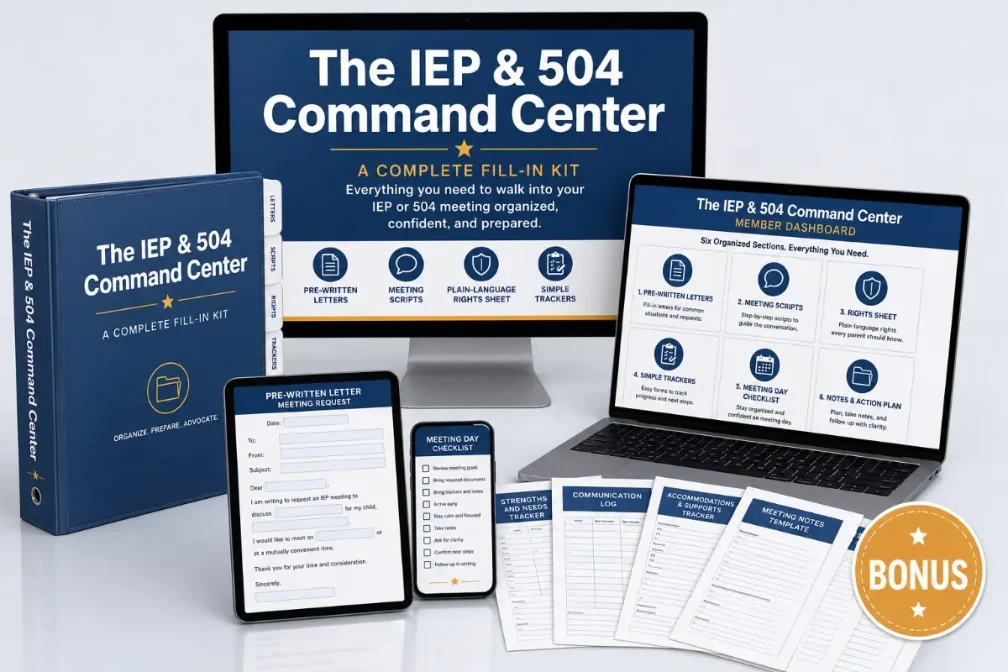
The IEP & 504 Command Center
This page shows you the deadlines and the contacts for your state. The Command Center hands you the done pieces: the binder built, the letters written, the meeting scripts ready and a self-review that shows where your child's IEP is strong or thin before you walk in. The library stays free.
Who to contact in New Mexico

- The state special education office. Office of Special Education, New Mexico Public Education Department. This is the office that answers questions about New Mexico rules and receives a state complaint.
- Your rights in writing. Parent and Child Rights Procedural Safeguard Notice, published by the New Mexico Public Education Department as Special Education Procedural Safeguards for Students With Disabilities and Their Families Required Under IDEA Part B, revised December 2020. Every district hands parents this notice at least once a year (34 CFR 300.504). It is the plain summary of what you can ask for at each step.
- Parent training and information center. Parents Reaching Out. A parent center is free and federally funded under IDEA. Staff there talk families through the process in their own state at no cost.
- The state rules themselves. Special Education Act, Laws 2026, Chapter 55, Sections 2 through 6, enacted by Senate Bill 64 of the 2026 regular session, signed March 9 2026 with an effective date of July 1 2026 at Section 9; the office and its duties sit at Section 4, the act recompiles Sections 22-13-7, 22-13-8 and 22-13-32 NMSA 1978 into itself at Sections 5 through 7, then repeals Section 22-13-6 NMSA 1978 at Section 8; Section 22-13-5 NMSA 1978 is left untouched and stays one of the rule's named authorities; the department rules sit at 6.31.2 NMAC, whose statutory authority section names Sections 22-2-1, 22-2-2, 22-13-5 and 22-13-6.1 NMSA 1978; the Legislative Education Study Committee analysis of the bill carries the gifted education and Section 504 point. New Mexico gathered its special education law into one place in 2026. The Special Education Act creates the office of special education inside the Public Education Department under a deputy secretary who reports to the secretary, gives that office the job of enforcing state and federal law on the education of students with disabilities, then requires it to build and maintain one statewide uniform online system for writing IEPs that school districts use to document services, monitor progress and keep to the federal timelines. The same act takes gifted students out of special education in statute. That change followed the rules rather than driving them: the department had already moved gifted education into its own rule at 6.31.3 NMAC on July 31 2023, leaving 6.31.2 NMAC to cover children with disabilities. The legislature's own analysis describes the act as aligning the law with that practice, then states that it changes neither the administration nor the funding of gifted education or Section 504.
Child Find in New Mexico
New Mexico writes its child find duty broadly. The rule names children with disabilities attending private schools or facilities such as residential treatment centers, day treatment centers, hospitals, mental health institutions, detention and correctional facilities, children who are schooled at home, highly mobile children, children who reside on Indian reservations plus children who are advancing from grade to grade. Two New Mexico points matter for younger children. For preschool children the rule states that child find screenings serve as the interventions under the multi-layered system of supports, so the screening itself is the intervention step for that age group. At every age the rule states that taking part in that system does not prevent a full and individual evaluation, that a parent may ask for one at any time, plus that a student who is suspected of having a disability and shows an obvious need is referred without undue delay. Birth to age three sits with a different department: the Family Infant Toddler Program at the Early Childhood Education and Care Department runs New Mexico's early intervention system under Part C for children from birth to age three, with services the department describes as always free whatever a family's income or citizenship status. At the third birthday the school district runs a full initial comprehensive evaluation before Part B services start, counting assessments from the previous six months as current, so a child who turns three during the school year can enter a Part B preschool program on that birthday where the family chooses it. Districts survey local Part C programs as part of child find and bring families into transition planning at least six months before a child is eligible for the district preschool program. One more New Mexico screening sits outside special education: state law has every first grade student screened for dyslexia. A parent whose child is then referred to a student assistance team is told about the right to ask for an initial special education evaluation at any point during the interventions that follow. The same section sets 60 days from parental consent for that evaluation, matching the rule.
Source: 6.31.2.10(A) NMAC for the child find list and the preschool screening sentence, 6.31.2.10(B)(1) through (B)(3) NMAC for the multi-layered system of supports never blocking an evaluation, plus 6.31.2.11(A)(1) through (A)(5) NMAC for the third birthday, the comprehensive evaluation, the six month currency rule and the Part C transition steps; first grade dyslexia screening at Subsection A with the parent notice, the right to request an evaluation and the 60 day count at Subsection D of Section 22-13-32 NMSA 1978, recompiled into the Special Education Act by Laws 2026, Chapter 55, Section 6; federal child find at 34 CFR 300.111 with the Part C transition at 34 CFR 300.124; the Family Infant Toddler Program is described on the Early Childhood Education and Care Department's own program page www.srca.nm.gov/parts/title06/06.031.0002.html