Ohio IEP Evaluation Timeline, Dispute Routes and Parent Resources (2026)
- Evaluation window
- 60 calendar days
- The clock starts at
- Parental consent
- State complaint deadline
- One year
- Due process deadline
- Two years
How long does a school in Ohio have to complete an IEP evaluation?
An Ohio school district has 60 calendar days from the day a parent signs consent to finish an initial evaluation, the same headline number as the federal default. Ohio puts a step in front of that clock. Once a district receives a request for an evaluation, it has 30 calendar days to either obtain parental consent or send prior written notice explaining that it does not suspect a disability. A family that disagrees with a decision also has an informal route written into Ohio law, which is a complaint to the district superintendent, who reviews the case and answers in writing within 20 school days. Ohio does not require a family to use that step before anything else. The formal routes run through the Office for Exceptional Children at the Ohio Department of Education and Workforce: a written state complaint about something in the past year, free mediation the department pays for, or a due process complaint filed with the district superintendent with a copy to the department. Ohio then adds a second administrative step that many states do not have, since either side can ask a state level review officer appointed by the department to review the hearing decision before anyone reaches a court.

The evaluation timeline in Ohio
| Initial evaluation window | 60 calendar days |
|---|---|
| The clock starts at | parental consent to evaluate |
| Against the federal rule | The federal default, unchanged |
IDEA sets a default of 60 calendar days from parental consent for an initial evaluation (34 CFR 300.301(c)(1)). Ohio keeps that default rather than setting a timeframe of its own.
Ohio follows the federal 60 calendar day default. Before that clock starts, the district has a separate 30 day window to propose an evaluation and obtain consent.
Source: Ohio Admin. Code 3301-51-06(B)(4)(a) codes.ohio.gov/ohio-administrative-code/rule-3301-51-06
The same window sits beside all fifty-one jurisdictions on the evaluation timelines by state table, which explains where the federal deadline comes from. To pull one state's window on its own, the evaluation deadline checker returns that single result.
How a parent requests a special education evaluation in Ohio
A parent starts the process by asking the district to evaluate the child. Ohio's rule then puts a clock on the district's answer rather than on the parent's wording. Within thirty calendar days of receiving a request for an evaluation, the district either obtains parental consent for an initial evaluation or sends prior written notice explaining that it does not suspect a disability and will not evaluate. The rule says a request, without requiring that it be written, so what a family asks for at a meeting starts the same thirty day clock a letter does. Signing the consent form is the separate event that starts the sixty calendar day evaluation window above.
- Send the request to the district. The request goes to the school district that educates the child, usually through the principal or the district's special education office. Ohio's thirty day clock runs from the district receiving it, so a dated email or a posted letter with a copy kept at home fixes the day the clock started.
- Say what the concern is. The decision the district makes inside those thirty days is whether it suspects a disability, so a request that names what a family is seeing, how long it has been going on and where it shows up at school gives the district something specific to weigh. Ohio sets no form and no wording for this.
- Expect one of two answers within thirty calendar days. One answer is a consent form for an initial evaluation. The other is prior written notice, the document a district sends when it declines to evaluate, setting out what it decided, why it decided that then what it relied on. Either answer is due inside the same thirty day window.
- The sixty day evaluation window starts at consent. Ohio counts the initial evaluation in sixty calendar days from the day the district receives parental consent, which is the window at the top of this page. A request on its own does not start that window, so the two Ohio clocks run in order rather than together.
Because Ohio sets no form for the request, what a request needs is only what makes the ask clear and leaves a record of its date: the child's full name, date of birth, school and grade, a short description of the concern, the words asking for an initial special education evaluation under IDEA, a line asking for the consent form plus the current procedural safeguards notice, then contact details and the date it was sent.
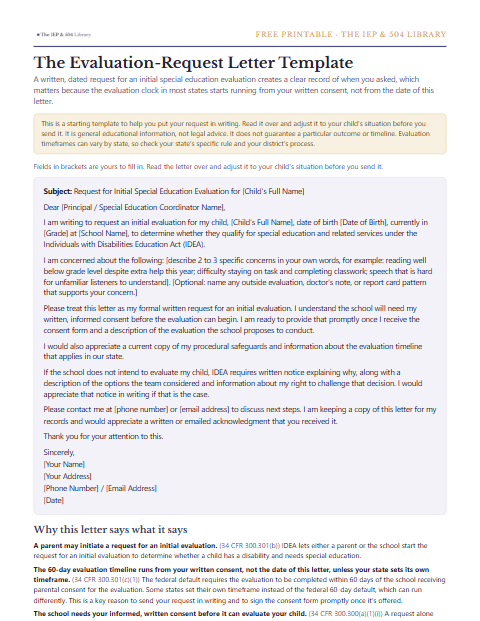
The library's evaluation request letter template is that letter already written, with the blanks marked. The guide to requesting an evaluation walks the same request through step by step. If the answer that comes back is a refusal, prior written notice explained covers what that document has to say.
Source: Ohio Admin. Code 3301-51-06(B)(3) for the thirty calendar day window to obtain consent or send prior written notice, with (B)(4)(a) for the sixty day evaluation window that follows consent and (A)(4) for the calendar day unit codes.ohio.gov/ohio-administrative-code/rule-3301-51-06
Ohio IEP law at a glance
Ohio's IEP rules sit in two places. Chapter 3323 of the Ohio Revised Code is the statute the legislature passed. Chapter 3301-51 of the Ohio Administrative Code is the working rule set, which the Ohio Department of Education and Workforce publishes for families and schools as the Operating Standards for the Education of Children with Disabilities. Guidelines and law point at the same material here, since the operating standards are the rules themselves rather than a summary of them. These are the parts of the chapter every figure on this page rests on.
- Ohio Admin. Code 3301-51-03. Child Find, the duty on districts to identify children who may need special education, including children who are not enrolled in a public school.
- Ohio Admin. Code 3301-51-05. Procedural safeguards: consent, prior written notice, the parent rights notice, Ohio's superintendent administrative review then the three dispute routes with their filing windows and appeal steps.
- Ohio Admin. Code 3301-51-06. Evaluations and reevaluations: the thirty calendar day window for the district's answer to a request, the sixty day evaluation window from consent, the two exceptions to it then the three year reevaluation cadence.
- Ohio Admin. Code 3301-51-07. The IEP itself: what the document contains, who sits on the team then the review at least once a year at paragraph (I)(2)(a)(i).
- Ohio Admin. Code 3301-51-11. Preschool children, including the handover from Ohio Early Intervention to the school district at age three plus the timelines that apply to a late referral.
- Ohio Rev. Code Chapter 3323. Education of Children with Disabilities, the statute behind the rules, including the safeguards, the administrative review then the hearing and appeal route at section 3323.05.
Rule 3301-51-07 is the one that governs the IEP document itself, which is where a child's annual goals live. The library's goal bank shows what a measurable annual goal looks like written out.
Ohio law and Ohio guidelines are not two different sources here. The statute sets the duty. The operating standards set how it runs. The department then writes the parent facing version of both in its procedural safeguards notice, which districts hand families at least once a year. Each rule above links to the state's own text, so a family can read the paragraph rather than a summary of it. Where the state prints an effective date on a rule, that date is listed beside the rule in the sources at the foot of this page.
Source: Ohio Admin. Code Chapter 3301-51, the Operating Standards for the Education of Children with Disabilities, with the statute at Ohio Rev. Code Chapter 3323. Each rule above links to its own text on the state's site
The Ohio forms in an IEP evaluation
Ohio runs each step of an evaluation on a numbered form the department publishes, so the paper that arrives tells a parent where the process has reached. The department calls this set the required forms and posts every one of them on its own site, together with the planning forms that travel with the evaluation team report. These are the ones a family meets during an initial evaluation, roughly in the order they arrive.
- PR-01, prior written notice to parents. The notice a district sends when it proposes or refuses to act. After a request for an evaluation, this is the form that arrives when the district does not suspect a disability and will not evaluate.
- PR-04, referral for evaluation. The department's required form titled Referral for Evaluation. Ohio's rule sits behind it: every educational agency adopts and implements a written referral process for deciding whether a child is a child with a disability.
- PR-05, parent consent for evaluation. The consent form a parent signs. Ohio's sixty day evaluation window runs from the day the district receives it. Ohio's own rule adds that consenting to an evaluation is not consent to services, which is a separate consent later on.
- The ETR planning form. The form the team uses to plan the evaluation, published in a school age version and a preschool version alongside the evaluation team report. Ohio's rule has the evaluation team develop an evaluation plan that gets summarized in that report. The department's roadmap for families describes the parent taking part in the planning before assessments are carried out, with the district naming the areas it plans to evaluate rather than the specific tests it will use.
- PR-02, parent invitation. The invitation to the meeting where the team reviews the evaluation results. The department's roadmap says the invitation states who the district will bring. It also tells families that a parent can bring anyone to that meeting.
- PR-06, the evaluation team report. The report itself, which Ohio families and schools call the ETR. It carries the evaluation data, a summary of each evaluation that was done and the eligibility decision.
- PR-07, the individualized education program. The IEP document, which the department publishes as a numbered form as well.
The department has revised this set of forms. Its July 2026 update on the forms page says the revised versions are not required for the 2026-2027 school year and that educational agencies will be required to use them during the 2027-2028 school year, so a form arriving this school year may still be the earlier version.
Once the report itself arrives, understanding your child's evaluation report covers what the scores inside it mean.
Source: Ohio Department of Education and Workforce, Office for Exceptional Children, Ohio Required and Optional Forms, for every form number and title plus the July 2026 rollout note; the department's Parent Rights Evaluation Roadmap, published September 2025, for where each form falls in the process; Ohio Admin. Code 3301-51-06(A)(2) for the written referral process, (F)(1) for the evaluation plan summarized in the evaluation team report, with 3301-51-05(C)(1)(b) for consent to evaluate not being consent to services education.ohio.gov/Topics/Special-Education/Federal-and-State-Requirements/Ohio-Required-and-Optional-Forms-Updated
From the evaluation report to the first IEP in Ohio
Ohio sets three deadlines between a finished evaluation and the first day of services. The eligibility decision comes first, then the report reaches the family, then the IEP gets written. Each one sits in Ohio's own rules with its own count of days.
- Who decides eligibility. A group of qualified professionals plus the parent decides whether the child is a child with a disability. The report carries the names, titles and signatures of every team member, the parent included, with an indication of whether each one agrees. A team member who does not agree with the determination submits a statement of disagreement.
- The report reaches you within fourteen days. The district gives the family a copy of the evaluation team report and the eligibility documentation at no cost. Ohio requires that copy before the next IEP meeting and in no case later than fourteen days from the date of the eligibility determination.
- The first IEP runs on whichever window closes first. Ohio develops the initial IEP inside the shortest of three windows: thirty calendar days from the determination that the child needs special education and related services, ninety calendar days from parental consent for the evaluation, or one hundred twenty calendar days from the district receiving a request for an evaluation. The meeting that develops it sits inside the same thirty days.
- Services start with your consent. Ohio requires informed parental consent before special education and related services are provided for the first time. A parent who later revokes that consent does it in writing. The district then sends prior written notice before the services stop.
- Your copy of the IEP. Within thirty calendar days after the IEP meeting the district gives the parent a copy of the IEP at no cost.
- One Ohio step after services begin. Once a child receives services under an IEP for the first time, the district notifies the family that the child is required to have a comprehensive eye exam within three months.
Where the team decides a child is not eligible, a family can ask for an independent educational evaluation, which is an evaluation by someone who does not work for the district. Ohio's parent rights guide explains that the district pays for one only where it has already evaluated the child and the family disagrees with what it found, though a family can arrange and pay for an outside evaluation at any time.
The IEP meeting walkthrough covers what happens in the meeting where that first IEP gets written.
Source: Ohio Admin. Code 3301-51-06(G)(1)(a) for the eligibility group, (G)(1)(b) for the copy at no cost, (G)(1)(b)(i) for the report contents and the statement of disagreement, then (G)(1)(b)(ii) for the fourteen day deadline; Ohio Admin. Code 3301-51-07(H)(2) for the three initial IEP windows, (H)(3)(a) for the meeting inside thirty days, (H)(3)(c) with Ohio Rev. Code 3323.19 for the eye exam notice and (G)(6) for the parent's copy of the IEP; Ohio Admin. Code 3301-51-05(C)(2)(a) for consent before the initial provision of services and (C)(3)(a) for revocation with prior written notice; the department's April 2025 parent rights guide for the independent educational evaluation codes.ohio.gov/ohio-administrative-code/rule-3301-51-06
Reevaluation and IEP review cadence in Ohio
Ohio keeps the federal cadence. A reevaluation happens at least once every three years unless the family and the district agree one is not needed. It happens no more than once a year unless both sides agree otherwise. The IEP team reviews the IEP at least once a year. Ohio adds one rule for families who move inside the state. When a child transfers from one Ohio educational agency to another, the new agency has 30 days from the date it receives the previous agency's evaluation to either accept that evaluation or ask for consent to reevaluate. A reevaluation started that way is completed within 60 days of the parent's consent.
Source: Ohio Admin. Code 3301-51-06(D)(2)(a) and (D)(2)(b) for the reevaluation cadence, 3301-51-06(D)(3)(a) and (D)(3)(b) for the in-state transfer rule, then Ohio Admin. Code 3301-51-07(I)(2)(a)(i) for the annual IEP review, which states the same requirement as 34 CFR 300.324(b)(1) codes.ohio.gov/ohio-administrative-code/rule-3301-51-06
If you disagree in Ohio
IDEA gives families in every state the same three routes when a disagreement with the school does not resolve at the team table. What changes at the state line is who administers each route, how long you have to file and the local detail below.
The state complaint
Handled by the Office for Exceptional Children at the Ohio Department of Education and Workforce. Time limit to file: one year from the date of the alleged violation.
A signed written complaint goes to the Office for Exceptional Children in Columbus, with a copy going to the educational agency at the same time it is filed. Anonymous complaints are not accepted. The office reviews the allegations, carries out an independent on-site investigation where it decides one is needed, offers both sides mediation or facilitation as an alternative route then issues a written decision with findings of fact within 60 calendar days of receiving the complaint. That window stretches only for exceptional circumstances or when both sides agree to more time for mediation or another alternative route. Where the same issue is already before a hearing officer, the office holds that part of the complaint until the hearing ends. A complaint can raise a federal requirement or an Ohio requirement.
Source: Ohio Admin. Code 3301-51-05(K)(4) to (K)(6), with the 60 day decision at (K)(5)(a), the on-site investigation at (K)(5)(a)(i), the extension grounds at (K)(5)(b)(i), the hold for a pending hearing at (K)(5)(c)(i), the signed complaint at (K)(6)(a), the one year limit at (K)(6)(c) and the copy to the agency at (K)(6)(d); Ohio Rev. Code 3323.05(E) for the statutory route; the filing address, the point that anonymous complaints are not accepted and the offer of mediation or facilitation from the April 2025 procedural safeguards notice codes.ohio.gov/ohio-administrative-code/rule-3301-51-05
Mediation
Mediation is voluntary for both sides and free to families. The Ohio Department of Education and Workforce keeps the list of qualified mediators, picks them on a random, rotational or otherwise impartial basis then pays for the sessions, so neither the family nor the district carries the cost. Requests go to the Office for Exceptional Children once both sides agree to take part. A mediator cannot be an employee of the department or of any agency involved in the child's education or care. Sessions stay confidential and cannot be recorded. When a mediation agreement calls for changes to the IEP, the IEP team meets to write those changes in within 20 school days of the agreement or on the timeline the agreement sets. Ohio runs a second free option beside mediation. In facilitation the same office assigns a trained neutral facilitator to sit in on an IEP team meeting, an evaluation planning meeting or an evaluation team meeting, at no cost to either side.
Source: Ohio Admin. Code 3301-51-05(K)(3), with the voluntary process at (K)(3)(b)(i)(a), the mediator list at (K)(3)(b)(iii), impartial selection at (K)(3)(b)(iv), the department bearing the cost at (K)(3)(b)(v), the 20 school day window for IEP changes at (K)(3)(b)(ix), confidentiality and the recording ban at (K)(3)(b)(x) and the employee bar at (K)(3)(c)(i)(a); Ohio Rev. Code 3323.05(F); facilitation, the point that it carries no cost and the request route described in the April 2025 procedural safeguards notice and on the department's dispute resolution page codes.ohio.gov/ohio-administrative-code/rule-3301-51-05
A due process hearing
Time limit to file: two years from the date the parent or the educational agency knew or should have known about the action the complaint is about.
A due process complaint goes to the superintendent of the school district of residence, with a copy forwarded to the Ohio Department of Education and Workforce. Ohio's rule puts the appointment of the hearing officer with the department, which picks one from a list of attorneys it maintains. That person has to be an attorney licensed to practice law in Ohio who has finished the department's training and who works for neither the department nor any agency involved in the child's education or care. The educational agency holds the hearing and covers its costs, including the hearing officer's fee for up to 50 hours of hearing time unless the officer files a written rationale for more. Ohio then adds a second administrative step. Either side can appeal the hearing decision in writing to the department within 45 days of receiving it. The department appoints a state level review officer who examines the whole record and issues an independent decision, due within 30 days of the request unless that officer grants an extension at the request of the family or the educational agency. The department pays the review officer. After the review decision, a party can appeal to a court of common pleas within 45 days of notice of that order or file in a federal district court within 90 days of the decision. Ohio's rule and the state's parent guide name the county where the child's educational agency sits, while the statute names the county where the child's school district of residence is located. The two year filing limit does not apply where the agency misrepresented that it had resolved the problem or held back information it was required to give the family.
Source: Ohio Admin. Code 3301-51-05(K)(7)(a)(ii) and (K)(10)(e) for the two year limit, (K)(10)(f) for the exceptions to it, (K)(8)(a)(ii) for the copy to the department, (K)(8)(d) for the department appointing the hearing officer from its list of attorneys, (K)(10)(b) for the educational agency conducting the hearing, (K)(10)(c)(i)(a) and (K)(10)(c)(i)(e) for the impartiality and attorney requirements, (K)(13)(b)(i) and (K)(13)(b)(ii) for the 45 day appeal and the state level review officer, (K)(14)(b) and (K)(14)(c) for the 30 day review decision and extensions, (K)(15)(b) and (K)(15)(d) for the hearing costs and the fifty hour limit, (K)(15)(e) for the department paying the review officer then (K)(16)(b) for the court routes; Ohio Rev. Code 3323.05(G) and 3323.05(H) codes.ohio.gov/ohio-administrative-code/rule-3301-51-05

From the team behind this library
The IEP & 504 Command Center
This page shows you the deadlines and the contacts for your state. The Command Center hands you the done pieces: the binder built, the letters written, the meeting scripts ready and a self-review that shows where your child's IEP is strong or thin before you walk in. The library stays free.
Who to contact in Ohio

- The state special education office. Office for Exceptional Children, Ohio Department of Education and Workforce. This is the office that answers questions about Ohio rules and receives a state complaint.
- Your rights in writing. A Guide to Parent Rights in Special Education, the special education procedural safeguards notice published by the Ohio Department of Education and Workforce, April 2025 edition, posted with translations in more than twenty languages. Every district hands parents this notice at least once a year (34 CFR 300.504). It is the plain summary of what you can ask for at each step.
- Parent training and information center. Ohio Coalition for the Education of Children with Disabilities. A parent center is free and federally funded under IDEA. Staff there talk families through the process in their own state at no cost.
- The state rules themselves. Ohio Rev. Code Chapter 3323 (Education of Children with Disabilities), with the operating rules at Ohio Admin. Code Chapter 3301-51. Chapter 3323 is Ohio's own special education law, covering who counts as a child with a disability, what districts and the state owe that child, the safeguards a family holds plus the hearing and appeal route. The working detail sits in Chapter 3301-51 of the Administrative Code, which the department publishes for families and schools as the Operating Standards for the Education of Children with Disabilities.
Child Find in Ohio
Ohio splits the early years between two state agencies. For a child under three the route is Ohio Early Intervention, the state's Part C system, which the Ohio Department of Children and Youth leads through county Family and Children First Council coordinators and a statewide referral line rather than through school districts. School districts pick up at age three, with the handover written into interagency agreements each district reviews every year. One Ohio rule covers late referrals. When Early Intervention refers a child who is 45 days or fewer from the third birthday, the district completes the evaluation within 60 days of consent, though an IEP is not required to be in place by the birthday itself. A child referred to Early Intervention between 46 and 90 days before turning three falls under shared evaluation responsibilities in the same agreement. The preschool rule holding these transition timelines reached its five year state review date on July 1, 2026, so the version described here is the one effective December 1, 2023.
Source: Ohio Admin. Code 3301-51-11(D)(2)(b)(ii) and 3301-51-11(D)(2)(b)(iii), with the annual interagency agreement duty at 3301-51-11(D)(2) and the general child find duty at Ohio Admin. Code 3301-51-03(B); the Ohio Department of Children and Youth named as Part C lead agency on the Early Childhood Technical Assistance Center's Part C coordinator listing, with the county contact route on Ohio Early Intervention's own county contacts page codes.ohio.gov/ohio-administrative-code/rule-3301-51-11