Alabama IEP Evaluation Timeline, Dispute Routes and Parent Resources (2026)
- Evaluation window
- 60 calendar days
- The clock starts at
- Parental consent
- State complaint deadline
- One year
- Due process deadline
- Two years
How long does a school in Alabama have to complete an IEP evaluation?
An Alabama school district has 60 calendar days from the day it receives a parent's signed consent to complete an initial evaluation. The state rule keeps that count running through scheduled breaks plus summer vacation. Two shorter clocks follow: 30 calendar days after the evaluation is finished to decide whether a student is eligible, then 30 calendar days after that decision to hold the IEP meeting. Around the referral, Alabama expects documented interventions in the general education classroom through the school's Problem Solving Team for at least eight weeks, either before the referral or alongside the evaluation, a step the rule waives for several groups of children including any child whose own parent makes the referral. When a family disagrees with a district, Special Education Services at the Alabama State Department of Education investigates written state complaints going back one year and assigns mediators from a list it keeps in rotation. Due process cases stay inside the department too, heard by a hearing officer the State Superintendent of Education appoints from that same kind of rotating list.

The evaluation timeline in Alabama
| Initial evaluation window | 60 calendar days |
|---|---|
| The clock starts at | parental consent to evaluate |
| Against the federal rule | The federal default, unchanged |
IDEA sets a default of 60 calendar days from parental consent for an initial evaluation (34 CFR 300.301(c)(1)). Alabama keeps that default rather than setting a timeframe of its own.
Alabama follows the federal 60 calendar day default measured from signed parental consent. The public agency then has 30 more calendar days after the evaluation is complete to determine initial eligibility.
Source: Ala. Admin. Code r. 290-8-9-.02 www.law.cornell.edu/regulations/alabama/Ala-Admin-Code-r-290-8-9-.02
The same window sits beside all fifty-one jurisdictions on the evaluation timelines by state table, which explains where the federal deadline comes from. To pull one state's window on its own, the evaluation deadline checker returns that single result.
Reevaluation and IEP review cadence in Alabama
Alabama keeps the federal cadence. A reevaluation happens at least once every three years unless the family and the district agree one is not needed. It happens no more than once a year unless both sides agree otherwise. The IEP team reviews the IEP at least once a year. Around that cadence the state rule adds paperwork the federal regulations do not spell out. The district keeps written documentation of the team's decision about whether to reevaluate, with a copy going to the family. Where the team decides no new testing is needed, written notice goes to the family stating the reasons plus the family's option to ask for an assessment of continued eligibility anyway. An eligibility report is written every time a student is reevaluated for continued eligibility. Each team member certifies in writing whether the report matches their own conclusion. A member who disagrees files a separate statement that goes into the student's special education record. One Alabama rule sits inside the emotional disability category: at a first reevaluation where a student no longer meets every criterion, the team may keep eligibility in place once on the strength of a continued need for intensive support, with the behavior strategies already in place written into the eligibility report. That option is available one time only. Between annual reviews, a written request from a parent or a teacher who believes the IEP needs revision brings the team together within 30 calendar days.
Source: Ala. Admin. Code r. 290-8-9-.02(6)(b) through (d), where (6)(c) states the three year cycle plus the once a year limit, with the annual IEP review at 290-8-9-.05(11)1., the requested meeting at 290-8-9-.05(11)3., the eligibility report plus the member certification at 290-8-9-.04(2) with (2)(a), the emotional disability option at 290-8-9-.03(4)(d) plus its one time limit at (4)(d)2.; the federal rule states the same cadence at 34 CFR 300.303(b) and 34 CFR 300.324(b)(1)(i) admincode.legislature.state.al.us/api/chapter/290-8-9
If you disagree in Alabama
IDEA gives families in every state the same three routes when a disagreement with the school does not resolve at the team table. What changes at the state line is who administers each route, how long you have to file and the local detail below.
The state complaint
Handled by the Alabama State Department of Education, through Special Education Services under the State Superintendent of Education. Time limit to file: one year, counted back from the date the department receives the complaint.
A parent, an organization or an individual can file, including someone from another state. The signed written complaint goes to the State Superintendent of Education marked for Special Education Services, with a copy reaching the school district at the same time. Alabama accepts complaints by email under a 2024 department policy, which looks for the same signature it would expect on a mailed submission, with an exception for a person who cannot sign their name. That policy sets a review window rather than a filing date: staff read e-filings from 7:00 a.m. to 3:30 p.m. Central time Monday through Friday, so anything arriving outside those hours, on a weekend or on a holiday is read the next business day, then date stamped once it carries everything the rules require. The department will not issue a written decision on an anonymous complaint. The State Superintendent assigns a staff member to investigate. Where an on-site investigation is needed, it is carried out by someone who does not work for the agency under review. The person filing gets a chance to add information orally or in writing. The written decision addresses each allegation with findings of fact, conclusions plus the reasons behind them. It lands within 60 calendar days of receipt. That window stretches only for exceptional circumstances or where both sides agree to try mediation. Where the department finds services were denied, it says how that gets remedied, which can include compensatory services or reimbursement. One Alabama detail is worth knowing before filing: once the written decision is issued it is final, since the state rule provides no appeal step inside the department.
Source: Ala. Admin. Code r. 290-8-9-.08(9)(a), which states the one year window at (a)1.(ii), the copy to the district at (a)1.(iv), the assigned staff member at (a)2.(i), the outside on-site investigator at (a)2.(vi), the written decision with findings of fact at (a)2.(viii), the 60 calendar day limit plus its two extension grounds at (a)2.(x), the remedies at (a)2.(xi) and the finality line at (a)2.(xv); the same one year window sits at 34 CFR 300.153(c) with the 60 day limit at 34 CFR 300.152(a); the email route comes from the department's Policy for Accepting Electronic Submissions of Written State Complaints and Due Process Hearing Requests revised 12 March 2024 plus the anonymous complaint line from Alabama's Procedural Safeguards (Special Education Rights) approved January 2025 admincode.legislature.state.al.us/api/rule/290-8-9-.08
Mediation
The State Superintendent of Education provides mediation through the same office that takes state complaints. It is voluntary for both sides, free to the family, confidential plus never a reason to delay or deny a due process hearing. The department keeps a list of mediators who know special education law and assigns them from that list in rotation, so neither side picks the mediator. A mediator cannot be an employee of the department or of the district involved with the student. The department bears the cost of the process including the meetings, which are scheduled promptly at a place convenient to both sides. An agreement reached in mediation is signed by the family plus someone who can bind the district. It is enforceable in a state court or in a federal district court. Nobody has to sign a confidentiality pledge before mediation starts. Two Alabama specifics sit around the edges of this route. The federal rules let a state set up meetings where a disinterested party explains the benefits of mediation to families who decline it. The Alabama rule says plainly that the department will not establish those procedures, leaving that option to individual districts. Alabama also runs a facilitated IEP meeting outside the three federal routes: when everyone agrees, a department coordinator assigns a trained, state funded facilitator who joins the IEP meeting to keep the conversation moving without making any decisions about the IEP.
Source: Ala. Admin. Code r. 290-8-9-.08(9)(b), which states the rotation from the department's list at (b)3., the department bearing the cost at (b)4., the timely convenient sessions at (b)5., the enforceable signed agreement at (b)6., the mediator conflict bar at (b)8. plus the declined encouragement procedures at (b)9.; the federal counterpart to (b)9. is 34 CFR 300.506(b)(2); the line that no confidentiality pledge is required before mediation begins comes from Alabama's Procedural Safeguards (Special Education Rights) approved January 2025 rather than from the rule; the facilitated meeting option comes from the department's Alabama Facilitated Individualized Education Program Team Meeting brochure plus its Facilitated IEP Request form admincode.legislature.state.al.us/api/rule/290-8-9-.08
A due process hearing
Time limit to file: two years from the date the parent or the district knew or should have known about the action the complaint is based on.
The signed request goes to the State Superintendent of Education marked for Special Education Services, with a copy to the other side. The timelines start when the department receives it. Alabama does not send these cases to a separate hearings office. The State Superintendent appoints the hearing officer from a list the department keeps, in rotation, then sends a letter of appointment to both parties. The department also arranges the court reporter plus any interpreter and pays for all three. The state rule puts the burden of proof on whoever files the request. It also keeps hearing officers to questions arising under IDEA rather than other state or federal law. The shape of the case follows the federal pattern: a resolution meeting within 15 calendar days, a 30 calendar day resolution period, then a decision within 45 calendar days of the end of that period. A hearing officer can extend that for good cause in writing, no more than 45 days at a time, weighing six factors the state notice lists including how much a child's education is delayed by waiting. Decisions go to the Special Education Advisory Panel plus the public with identifying details removed. Alabama runs one level of hearing rather than two, so a party who disagrees goes to court. The state rule sets its own court deadline, which is shorter than the 90 days the federal rule allows a state to replace: a notice of intent to file within 30 days of receiving the decision, then the civil action within 30 days of filing that notice. The two year filing limit lifts where a district misrepresented that it had resolved the problem or withheld information it was required to give the family.
Source: Ala. Admin. Code r. 290-8-9-.08(9)(c), whose opening paragraph states the two year limit, both of its exceptions plus the burden of proof, with the appointment on a rotational basis at (c)4., the department keeping the hearing officer list at (c)11.(i)(IV), the court reporter plus interpreter duties at (c)11.(i)(II) and (III), the payment duty at (c)11.(ii)(IV), the 45 day decision at (c)11.(ii)(I), the transmission of decisions at (c)11.(ii)(III), the bar on non IDEA claims at (c)12.(iv)(I)X., the extension provision at (c)12.(v), the single tier finality at (c)15. plus the court deadline at (c)16.; the same two year limit sits at 34 CFR 300.507(a)(2) with 34 CFR 300.511(e), its exceptions at 34 CFR 300.511(f) plus the federal 90 day default a state may replace at 34 CFR 300.516(b); the letter of appointment comes from the department's New Due Process Hearing Procedures as Required by IDEA 2004 flowchart; the six extension factors, the 45 days per extension plus the written good cause response come from Alabama's Procedural Safeguards (Special Education Rights) approved January 2025 admincode.legislature.state.al.us/api/rule/290-8-9-.08
From the team behind this library
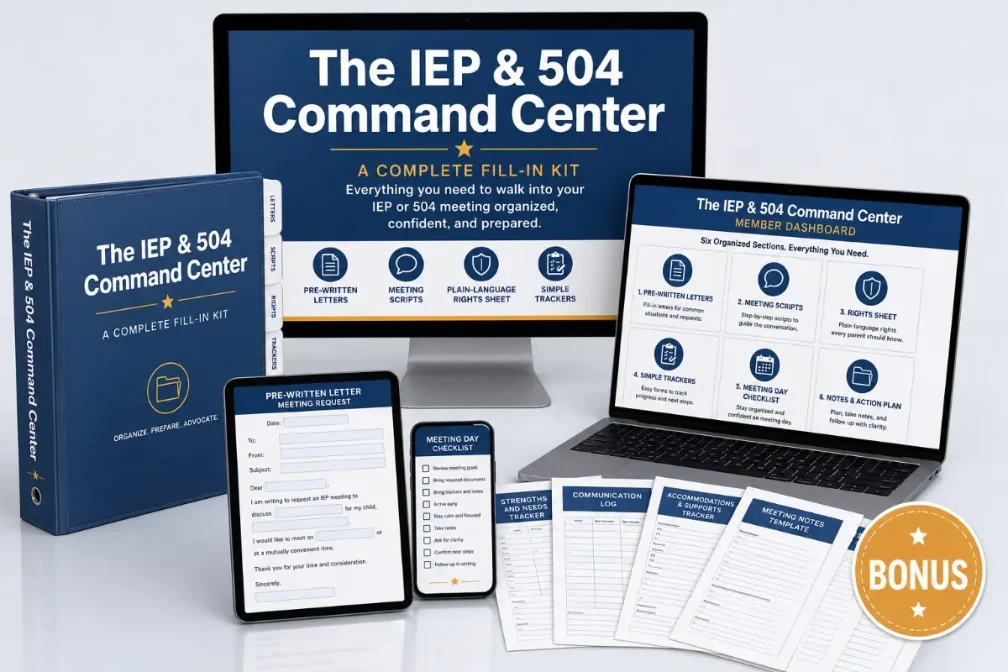
The IEP & 504 Command Center
This page shows you the deadlines and the contacts for your state. The Command Center hands you the done pieces: the binder built, the letters written, the meeting scripts ready and a self-review that shows where your child's IEP is strong or thin before you walk in. The library stays free.
Who to contact in Alabama

- The state special education office. Alabama State Department of Education, Special Education Services. This is the office that answers questions about Alabama rules and receives a state complaint.
- Your rights in writing. Alabama's Procedural Safeguards (Special Education Rights), the edition the department approved in January 2025. Every district hands parents this notice at least once a year (34 CFR 300.504). It is the plain summary of what you can ask for at each step.
- Parent training and information center. Alabama Parent Education Center, which runs the Alabama Parent Training and Information Center. A parent center is free and federally funded under IDEA. Staff there talk families through the process in their own state at no cost.
- The state rules themselves. Ala. Admin. Code Chapter 290-8-9 (Special Education Services), adopted by the Alabama State Board of Education under the authority the rule text names, Code of Ala. 1975, Title 16, Chapter 39, together with 20 U.S.C. 1400 and 34 CFR Part 300. Chapter 290-8-9 is the single chapter behind almost everything on this page: child identification, evaluations, the disability categories Alabama recognizes with the testing each one requires, eligibility, IEP content and review, least restrictive environment, procedural safeguards, discipline, case managers plus gifted education. It also sets the age at which rights transfer from parents to the student, which Alabama puts at 19 rather than 18. The state law it rests on is Code of Alabama Title 16, Chapter 39, the Alabama Exceptional Child Education Act of 1971, which counts children who are intellectually gifted among the children it covers. That is the same law the gifted rule points to for the age gifted services begin.
Child Find in Alabama
Alabama puts child find on the school district for children from birth through age 21 inside its boundaries, which reaches children in private and religious schools, children who move often, children who are homeless, children who are wards of the state plus children who are passing from grade to grade. For a child leaving early intervention, the district makes services available by the third birthday, with the team deciding when services start where that birthday falls in the summer. The step families ask about most sits around the referral. Alabama expects intervention strategies in the general education classroom, monitored by the school's Problem Solving Team for a minimum of eight weeks, before a special education evaluation or alongside the evaluation process. The rule then waives that step for a list of children: a child with severe problems needing immediate attention, three and four year olds, five year olds who have not been in kindergarten, children with articulation, voice or fluency concerns only, a child with a medical diagnosis of traumatic brain injury plus any child referred by a parent. Two other referral rules help families. A district cannot cap referrals by number or limit them to certain times of year. Where a parent cannot put the referral in writing, the district gathers the information from that parent then completes the written referral itself. The team reviews the referral then decides in a timely manner whether to evaluate. Where the answer is no, the rule calls for written notice to the family plus a referral to the building based student support team. Where the answer is yes, the district asks the family for written consent, which is the moment the 60 day clock starts.
Source: Ala. Admin. Code r. 290-8-9-.01(1)(a) for the birth to 21 duty, (1)(d) for the third birthday transition, (4) for the eight week Problem Solving Team step plus its six waivers, (6)(b) for the district written referral, (6)(c) for the ban on capping referrals and (6)(e) for what follows the referral admincode.legislature.state.al.us/api/rule/290-8-9-.01