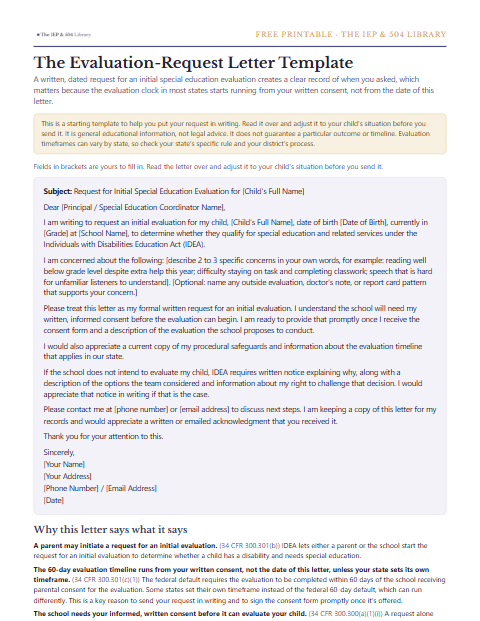
West Virginia IEP Evaluation Timeline, Dispute Routes and Parent Resources (2026)
- Evaluation window
- 80 calendar days
- The clock starts at
- Parental consent
- State complaint deadline
- One year
- Due process deadline
- Two years
How long does a school in West Virginia have to complete an IEP evaluation?
In West Virginia a school district has 80 calendar days from the day it documents written parental consent to complete an initial evaluation and hold the eligibility committee meeting that decides whether a student qualifies. That runs 20 days longer than the federal default of 60 calendar days, with the testing plus the eligibility decision inside the same window. West Virginia counts in calendar days, so weekends and holidays sit inside the 80 while school is in session, though summer break, a state of emergency declared by the Governor and a county weather closure where no remote option is required each lift or extend the count. The same 80 days covers a gifted evaluation, because Policy 2419 covers students who are gifted in grades one through eight and students who are exceptional gifted in grades nine through 12 alongside students with disabilities. A family that disagrees has one address for every route: the Office of Special Education at the West Virginia Department of Education takes state complaints filed within a year, runs free mediation plus facilitated IEP meetings, then assigns due process complaints to a contracted hearing officer, with two years to file one.

The evaluation timeline in West Virginia
| Initial evaluation window | 80 calendar days |
|---|---|
| The clock starts at | parental consent to evaluate |
| Against the federal rule | A timeframe West Virginia sets for itself |
IDEA sets a default of 60 calendar days from parental consent for an initial evaluation (34 CFR 300.301(c)(1)). It also lets a state set its own timeframe instead, which is what West Virginia has done, so the window above is the one that applies here.
West Virginia sets a longer combined window of 80 calendar days from consent, covering the evaluation through the eligibility decision, longer than the federal 60 days.
Source: West Virginia Policy 2419 (126CSR16), Chapter 3, Section 2.A, read with Chapter 4, Section 1 apps.sos.wv.gov/adlaw/csr/ruleview.aspx?document=17785
The same window sits beside all fifty-one jurisdictions on the evaluation timelines by state table, which explains where the federal deadline comes from. To pull one state's window on its own, the evaluation deadline checker returns that single result.
Reevaluation and IEP review cadence in West Virginia
West Virginia keeps the federal three year reevaluation cycle then wraps its own clocks around it. A reevaluation happens within three years of the date of the last eligibility determination, or sooner when a parent or a teacher asks for one or conditions warrant it. It happens no more than once a year unless the district and the parent agree otherwise. The eligibility committee meets after the reevaluation is complete and before the established reevaluation date. Where the team decides a full multidisciplinary evaluation is needed to look at a different exceptionality, that evaluation runs on the same 80 day clock as an initial one. Other additional evaluations the eligibility committee or the IEP team requests are completed with the committee or team meeting held within 60 days of consent, a count that stops on the last day of instruction for the school year then restarts on the first instructional day of the next one. Students who are gifted have one extra checkpoint, a reevaluation during the eighth grade year to decide eligibility for exceptional gifted in high school. On the IEP side West Virginia writes the annual review as once every 365 days, develops the first IEP within 30 days of the eligibility decision, then convenes an IEP meeting within 21 days of a written request from any team member including the parent.
Source: West Virginia Policy 2419 (126CSR16), Chapter 3, Section 2.B and Section 2.C; Chapter 4, Section 1; Chapter 5, Section 1.C and Section 3.A apps.sos.wv.gov/adlaw/csr/ruleview.aspx?document=17785
If you disagree in West Virginia
IDEA gives families in every state the same three routes when a disagreement with the school does not resolve at the team table. What changes at the state line is who administers each route, how long you have to file and the local detail below.
The state complaint
Handled by Office of Special Education, Division of Federal Programs and Support, West Virginia Department of Education. Time limit to file: One year: the complaint alleges a violation that occurred not more than one year before the department receives it.
A state complaint in West Virginia is written, signed and sent to the Office of Special Education at the West Virginia Department of Education in Charleston, with a copy going to the district at the same time. It sets out the facts it rests on and covers something that happened within the past year. The department investigates and issues a written decision addressing each allegation within 60 days, longer only where exceptional circumstances apply to that complaint or where both sides agree to extend the time to try mediation or another resolution route. Decisions carry corrective action with timelines where the department finds a violation. West Virginia also puts an early resolution step in front of the investigation. Either side may ask the other for a local conference. Where the issues are settled within 15 days of the district being notified of the complaint, the district files a signed verification of early resolution form instead of a written response, so the complaint closes there. Any allegation left unsettled goes on to investigation. Any part of a complaint that is already the subject of a due process hearing is set aside until the hearing ends, then the remaining issues are investigated on the normal timeline.
Source: West Virginia Policy 2419 (126CSR16), Chapter 11, Section 2, parts A through D; Procedural Safeguards, revised August 2024, pages 21 through 23, with the filing office named at page 47 apps.sos.wv.gov/adlaw/csr/ruleview.aspx?document=17785
Mediation
Mediation in West Virginia stays voluntary for the family and for the district, with the department paying for the process so a session costs a family nothing. A parent or a district asks in writing, using the department form or a letter of their own. Both sides have to agree before a session goes ahead. Mediators come from a list the department maintains and are assigned on rotation. A mediator cannot be an employee of the department or of the district involved in the child's care and education. A mediator also cannot hold an interest that conflicts with staying neutral. What people say in a session stays confidential and cannot be used later in a hearing or in court. An agreement is written, signed by the parent and by someone with authority to bind the district, then enforceable in state and federal court. Mediation can be requested at any point, whether or not a state complaint or a due process complaint has been filed. West Virginia runs a fourth free option in front of all this, the facilitated IEP team meeting, where an impartial facilitator who is not a team member guides the process so the team can communicate and reach agreement. The rule asks for a facilitated meeting request to reach the department at least two weeks before the scheduled meeting.
Source: West Virginia Policy 2419 (126CSR16), Chapter 11, Section 1 and Section 3, parts A through C; Procedural Safeguards, revised August 2024, pages 19 through 20 apps.sos.wv.gov/adlaw/csr/ruleview.aspx?document=17785
A due process hearing
Time limit to file: Two years: the complaint is filed within two years of the date the parent, the adult student or the district knew or should have known about the decision or action it rests on.
West Virginia runs its hearings out of the same office that takes complaints. Impartial hearing officers under contract with the department conduct every hearing. Each one holds a law degree plus admission to the West Virginia State Bar. The department picks them from its list on rotation then screens for conflicts. Either party may challenge an assignment for cause in writing. After a complaint is filed the district convenes a resolution meeting within 15 days, a timeline that is not suspended while schools are closed for breaks or holidays. Where nothing is resolved inside the 30 day resolution period, the hearing officer issues a final decision no later than 45 days after that period ends, with extensions granted only at a party's request. The two year limit does not apply where the district misrepresented that it had resolved the problem or withheld information it was required to give the parent. West Virginia has no state level appeal step, so a party who disagrees with a decision files a civil action in state or federal court within 90 days of the written decision. The department publishes past hearing decisions with identifying details removed. It also sends findings and decisions to the West Virginia Advisory Council for the Education of Exceptional Children.
Source: West Virginia Policy 2419 (126CSR16), Chapter 11, Section 4, the section introduction plus parts A, E, F, G, H, K, M and N apps.sos.wv.gov/adlaw/csr/ruleview.aspx?document=17785
From the team behind this library
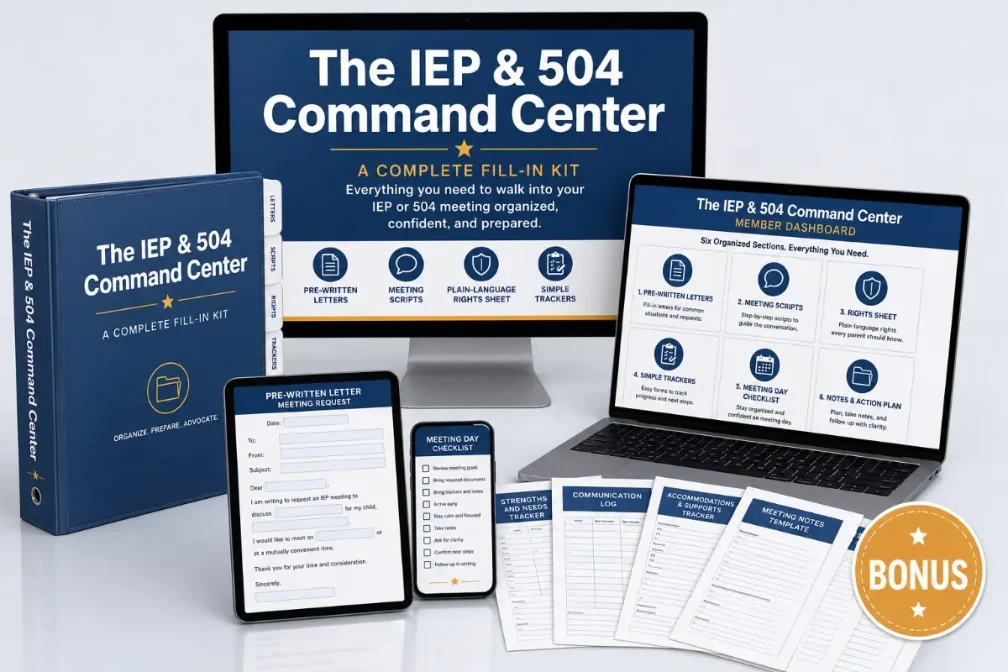
The IEP & 504 Command Center
This page shows you the deadlines and the contacts for your state. The Command Center hands you the done pieces: the binder built, the letters written, the meeting scripts ready and a self-review that shows where your child's IEP is strong or thin before you walk in. The library stays free.
Who to contact in West Virginia

- The state special education office. Office of Special Education, West Virginia Department of Education. This is the office that answers questions about West Virginia rules and receives a state complaint.
- Your rights in writing. Procedural Safeguards Available to Parents and Students with Exceptionalities, revised August 2024, published by the West Virginia Department of Education, with a Spanish edition published beside it. Every district hands parents this notice at least once a year (34 CFR 300.504). It is the plain summary of what you can ask for at each step.
- Parent training and information center. West Virginia Parent Training and Information (WVPTI). A parent center is free and federally funded under IDEA. Staff there talk families through the process in their own state at no cost.
- The state rules themselves. W. Va. Code chapter 18, article 20 (sections 18-20-1 through 18-20-12), read with section 18A-3-13, carried out through West Virginia Policy 2419 (126CSR16). Article 20 is West Virginia's own special education statute, requiring local educational agencies, meaning county boards of education, schools and facilities under the supervision of the State Board plus public charter schools acting as their own agency, to run special education services for students with exceptionalities between five and 21 years of age, setting the state superintendent's duties, creating the advisory council for the education of exceptional children, capping special education staffing ratios with a waiver process at section 18-20-12 and requiring video cameras in self-contained classrooms at section 18-20-11. A 2025 addition sits outside the article at section 18A-3-13, enacted by House Bill 2499 and effective July 1, 2025, which requires in person training on IDEA and Policy 2419 for principals, central office staff, superintendents plus county board members. It also directs a school representative to explain the identification process, the parent or guardian due process rights and local advocacy contacts at every IEP meeting.
Child Find in West Virginia
West Virginia routes most referrals through a school based student assistance team. A parent, a teacher or any other interested person or agency can refer a student. A written referral for a special education evaluation, a parent's written request included, goes to that team, which notifies the people it needs within five school days then meets within 10 school days of receiving the referral to decide what happens next. The team can request an initial evaluation straight away where the situation warrants it, such as a sensory impairment or another significant disability needing immediate attention. It can run a problem solving process with interventions it reviews inside 45 school days. It can also decline a parent's request. Either way the parent receives prior written notice plus a copy of the procedural safeguards within five days of the decision. The rule states that problem solving activities cannot be used to delay a request for an initial evaluation where immediate action is warranted. Child find here reaches students from age three through 21 who are home schooled, enrolled in private schools, homeless, highly mobile, wards of the state or not enrolled anywhere, plus students who are gifted in grades one through eight and students who are exceptional gifted in grades nine through 12. Districts screen vision, hearing, speech and language each year for children starting kindergarten or preschool and for students entering a West Virginia school for the first time. A parent of a child under compulsory attendance age can ask in writing for developmental screening, which happens within 30 school days. The policy states there are no exemptions from child find during national emergencies or health crises.
Source: West Virginia Policy 2419 (126CSR16), Chapter 2, the chapter introduction plus Section 1 and Section 3, parts A through D apps.sos.wv.gov/adlaw/csr/ruleview.aspx?document=17785