Idaho IEP Evaluation Timeline, Dispute Routes and Parent Resources (2026)
- Evaluation window
- 45 school days
- The clock starts at
- Written parental consent
- State complaint deadline
- One year
- Due process deadline
- Two years
How long does a school in Idaho have to complete an IEP evaluation?
An Idaho school district or charter school has 45 school days from the day it receives written parental consent to finish an initial evaluation and decide whether a student is eligible for special education. That figure is new. Idaho counted 60 calendar days until July 1, 2026, when the revised Idaho Special Education Manual took effect and swapped the calendar count for a school day count, so weekends, holidays and summer now fall outside the clock instead of being carved out of it. Once the team determines a student is eligible, the IEP is developed and implemented within 30 calendar days, while a child coming from the Infant Toddler Program has eligibility decided plus an IEP or IFSP in place by the third birthday. When a family and a school disagree, one office handles every route: Special Education Dispute Resolution at the Idaho Department of Education runs facilitation, informal conflict resolution, mediation, state administrative complaints reaching back one year plus due process hearings reaching back two years.

The evaluation timeline in Idaho
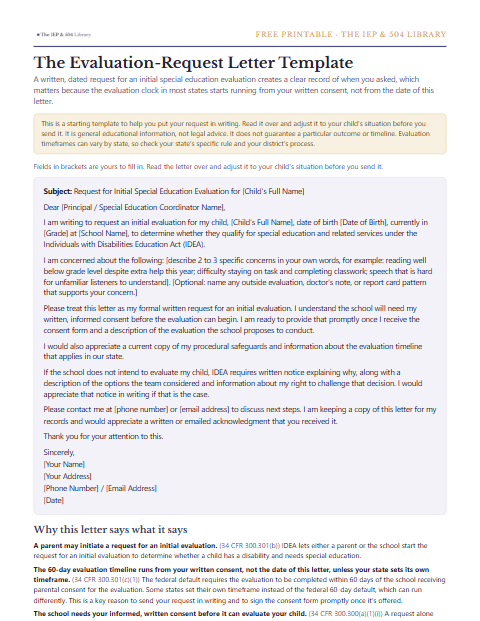
| Initial evaluation window | 45 school days |
|---|---|
| The clock starts at | written parental consent for the initial assessment or evaluation |
| Against the federal rule | A timeframe Idaho sets for itself |
IDEA sets a default of 60 calendar days from parental consent for an initial evaluation (34 CFR 300.301(c)(1)). It also lets a state set its own timeframe instead, which is what Idaho has done, so the window above is the one that applies here.
Idaho counts 45 school days from written parental consent to the eligibility decision. That state timeline replaced the older 60 calendar day count on July 1, 2026. School days are days students attend for instruction, so weekends, holidays and summer sit outside the count rather than being carved out of a calendar day clock.
Source: Idaho Special Education Manual 2025, Chapter 4, Section 3.F (Timeline), with the same figure stated in Chapter 1, Section 8.D and repeated in Chapter 4, Section 3.B.2 for a later consent; the manual is incorporated into Idaho rule at IDAPA 08.02.03.004.04 as adopted by the State Board of Education on November 20, 2025 with a July 1, 2026 effective date; 34 CFR 300.301(c)(1)(ii) is the federal provision that lets a state set a timeframe of its own in place of the 60 calendar day default www.sde.idaho.gov/wp-content/uploads/2026/07/Idaho-Special-Education-Manual-2025.pdf
The same window sits beside all fifty-one jurisdictions on the evaluation timelines by state table, which explains where the federal deadline comes from. To pull one state's window on its own, the evaluation deadline checker returns that single result.
Reevaluation and IEP review cadence in Idaho
Idaho keeps the federal cadence. A reevaluation happens at least once every three years, more often if the student's needs warrant it or if a parent or teacher asks. It happens no more than once a year unless the family and the school agree otherwise. The IEP team reviews the IEP at least annually, which Idaho spells out as once every 365 days. Idaho then adds steps of its own around that clock. The evaluation team works through a reevaluation consideration process on a state form to decide whether new assessments are needed. An updated eligibility report is finished by the reevaluation due date even where the team decides no new testing is required. Transfer students get their own timeline. When a student arrives from outside Idaho with eligibility paperwork that does not show the student meets Idaho criteria, the team seeks written consent for a reevaluation, puts an interim IEP in place straight away then completes the reevaluation inside 45 school days. Expired paperwork triggers the same steps whether the student came from another Idaho district or from out of state. That interim IEP does not run longer than 45 school days while the reevaluation is under way.
Source: Idaho Special Education Manual 2025, Chapter 4, Section 6.A (Reevaluation Requirements), which carries the three year cadence, the once-a-year ceiling, the reevaluation consideration process with its form plus the updated Eligibility Report due by the reevaluation due date; Chapter 5, Section 3.A (Annual Reviews) states the annual review as once every 365 days; the transfer rules sit at Chapter 5, Section 4.B items 3 and 4 (Transfer Process for Reviewing and Determining Eligibility) with the 45 school day cap on an interim IEP at Chapter 5, Section 4.C.2.b; the three year and annual figures match the federal ones at 34 CFR 300.303(b) and 34 CFR 300.324(b)(1)(i) www.sde.idaho.gov/wp-content/uploads/2026/07/Idaho-Special-Education-Manual-2025.pdf
If you disagree in Idaho
IDEA gives families in every state the same three routes when a disagreement with the school does not resolve at the team table. What changes at the state line is who administers each route, how long you have to file and the local detail below.
The state complaint
Handled by the Special Education Dispute Resolution office at the Idaho Department of Education. Time limit to file: one year (365 days) before the date the complaint is received.
Idaho calls this route a state administrative complaint. Any individual or organization can file one, including someone from outside Idaho. The complaint is signed and in writing. It arrives by mail, by hand delivery or as a scan attached to an email, with a copy going to the school district or charter school at the same time. Reasonable accommodations are available for anyone who needs help filing. The Dispute Resolution office checks within five business days whether the filing carries what the rules require, then tells the district within ten business days, naming the superintendent, the special education director plus the school board chair. The district gets a chance to respond. The office appoints a complaint investigator who gathers information from both sides and may interview people or review files. A written report follows within 60 calendar days of a sufficient complaint, carrying findings of fact, conclusions, reasons plus any corrective action. That deadline moves only for exceptional circumstances the office documents, or where both sides agree to extend it to try mediation, which cannot push the complaint past 90 days. Where the investigator verifies a violation, corrective action can include compensatory services, monetary reimbursement or other remedies suited to the student. The department verifies the correction no later than one year after it identifies the noncompliance. An Idaho complaint report is final on the date it carries and carries no appeal. The same issue can still go to a due process hearing. The corrective action keeps running if it does.
Source: Idaho Special Education Manual 2025, Chapter 13, Section 3.A (Definition of State Complaint) for the one year reach plus the copy to the LEA; Section 3.B (Filing a State Complaint) carries the five business day sufficiency check, the ten business day notice to the superintendent, special education director plus board chair, the 60 calendar day report with its exceptional-circumstances extension, the compensatory service or monetary reimbursement remedies plus the one year correction check; the 90 day ceiling on a mediation extension sits at Chapter 13, Section 2.B.2, not in Section 3; the federal floor is 34 CFR 300.153(c) for the one year window, 34 CFR 300.153(d) for the copy to the LEA plus 34 CFR 300.152(a) for the 60 day decision; the report being final with no appeal is stated in the Procedural Safeguards Notice revised 2026 under State complaint procedures; that any individual or organization including one from out of state may file is stated in the Idaho Dispute Resolution Comparison Chart, reviewed January 2023 www.sde.idaho.gov/wp-content/uploads/2026/07/Idaho-Special-Education-Manual-2025.pdf
Mediation
Mediation in Idaho runs through the same Dispute Resolution office, at no cost to the family or the district. Either side can ask for it in person, in writing or by phone at any point a disagreement comes up. The office screens each request before assigning a mediator from a list of trained professionals on a rotational basis with geography taken into account. Both sides have to agree for it to go ahead. A mediator cannot work for the Idaho Department of Education or for the district involved with the student. Nor can a mediator carry a personal or professional interest that conflicts with the job. Either side can turn down a mediator it believes could not stay neutral. Idaho sets a few ground rules parents notice. Nobody records the session by audio or video. Each side brings no more than three people who can make final decisions, though the mediator can allow more if everyone agrees. Lawyers are discouraged. A district may not have legal representation present where the parent or adult student does not. What people say in mediation cannot be used as evidence in a later hearing or court case. The mediator cannot be called to testify about it. A written agreement is signed by both sides and enforceable in a state or federal court. An IEP can be amended as part of that agreement where everyone agrees. Mediation is offered automatically once a state complaint about an individual student or a due process request is filed. Taking it up does not delay either timeline unless both sides agree in writing. Idaho also offers IEP facilitation plus informal conflict resolution through the same office, both free, for teams that want help before a disagreement hardens.
Source: Idaho Special Education Manual 2025, Chapter 13, Section 2.B (Mediation Requests) for the request routes, the screening, the automatic offer alongside a state complaint or due process request plus the no-cost point, Section 2.C (Mediation Procedures) for the recording ban, the three-participant limit plus the legal representation rules, Section 2.D (Dispute Resolution Mediators) for the rotational assignment with geography considered plus the three bars on who may serve, Section 2.G (Confidentiality) and Section 2.H (Mediation Agreement); facilitation sits at Section 1, whose Section 1.A carries the no-cost sentence; the federal floor is 34 CFR 300.506(b)(1)(i) for voluntariness, 34 CFR 300.506(b)(1)(iii) with 300.506(c) for the impartial mediator, 34 CFR 300.506(b)(4) for the state bearing the cost, 34 CFR 300.506(b)(6) and (b)(7) for the signed enforceable agreement plus 34 CFR 300.506(b)(8) for confidentiality www.sde.idaho.gov/wp-content/uploads/2026/07/Idaho-Special-Education-Manual-2025.pdf
A due process hearing
Time limit to file: two years from the date the parent or adult student knew or should have known about the alleged action the request is based on.
Idaho runs a single tier hearing system, so a hearing officer's decision is the final administrative decision with no state level review officer above it. The request goes to the Idaho Department of Education. The Dispute Resolution office then assigns a hearing officer from a list of trained, neutral professionals whose qualifications the office keeps on file. From that point the office stops discussing the case with either side and sends every inquiry to the assigned officer. A hearing officer cannot work for the department or for the district involved with the student. No party can have an assigned officer removed without cause. The public agency that is party to the hearing, usually the school district or charter school, pays the hearing officer's compensation plus the cost of the verbatim transcript. The two year lookback drops away where a district misrepresented that it had resolved the issue or withheld information IDEA required it to give the family. A resolution meeting comes within 15 days of the request, the resolution period runs up to 30 days and a decision follows within 45 days after that. The student stays in the current placement while the case runs unless both sides agree otherwise. Discipline disputes go on an expedited track, with an officer appointed within five business days, a resolution session within seven days, a hearing within 20 school days plus a decision within 10 school days of the hearing, with no extensions available on that track. Idaho sets its own windows for going to court after a decision. The notice of appeal rights that every final order carries says an action for state court review is filed within 28 days from the date the decision issues, while an action in federal district court is filed within 42 days.
Source: Idaho Special Education Manual 2025, Chapter 13, Section 4 opening paragraph plus the Single-Tier System heading inside Section 4.B, which both state that the department administers a single-tier due process hearing system; Section 4.B also carries the hearing officer assignment and qualification bars, the rule that no party may disqualify an assigned officer without cause, the sentence putting the officer's compensation plus the verbatim transcript on the public agency that is party to the hearing, plus the Notice of Appeal Rights paragraph with its 28 day state court window plus its 42 day federal court window; the two year reach with its misrepresentation and withholding exceptions sits at Section 4.C, the 15 day resolution meeting and the 45 day decision after the 30 day resolution period also at Section 4.C, with the expedited timings at Section 4.D; the federal floor is 34 CFR 300.507(a)(2) for the two year limit with its exceptions at 34 CFR 300.511(f), 34 CFR 300.510(a) for the resolution meeting, 34 CFR 300.515(a) for the 45 day decision clock, 34 CFR 300.514(a) for the finality of a hearing decision read with 34 CFR 300.514(b)(1), which opens an appeal to the state education agency only where some other public agency ran the hearing, plus 34 CFR 300.516(b) for a state's own explicit time limitation on a civil action; the 28 day and 42 day windows are repeated in the Procedural Safeguards Notice revised 2026 under Time limitation www.sde.idaho.gov/wp-content/uploads/2026/07/Idaho-Special-Education-Manual-2025.pdf
From the team behind this library
The IEP & 504 Command Center
This page shows you the deadlines and the contacts for your state. The Command Center hands you the done pieces: the binder built, the letters written, the meeting scripts ready and a self-review that shows where your child's IEP is strong or thin before you walk in. The library stays free.
Who to contact in Idaho

- The state special education office. Idaho Department of Education, Special Education Department. This is the office that answers questions about Idaho rules and receives a state complaint.
- Your rights in writing. Procedural Safeguards Notice for Students with Disabilities and their Parents Under the Individuals with Disabilities Education Act, Revised 2026. Every district hands parents this notice at least once a year (34 CFR 300.504). It is the plain summary of what you can ask for at each step.
- Parent training and information center. Idaho Parents Unlimited, Inc. (IPUL). A parent center is free and federally funded under IDEA. Staff there talk families through the process in their own state at no cost.
- The state rules themselves. Idaho Code, Title 33, Chapter 20 (Education of Exceptional Children), in particular section 33-2002 (Responsibility of School Districts for Education of Children With Disabilities); the operating detail sits in the Idaho Special Education Manual 2025, which Idaho rule pulls in at IDAPA 08.02.03.004.04. Chapter 20 is the short Idaho statute that makes each public school district responsible for the special education of the children with disabilities enrolled there. It covers instruction for people between the ages of three and twenty-one, leaves eligibility criteria, teacher qualifications, programs of instruction plus classroom standards to the State Board of Education acting through its department of education, then requires a district to tell a student at least a year ahead that parent rights under IDEA transfer at the age of majority.
Child Find in Idaho
Idaho splits child find at age three. Birth through age two runs through the Idaho Infant Toddler Program at the Department of Health and Welfare, so a question about a baby or a toddler starts there while the school district coordinates through interagency agreements. From age three through the semester in which a student turns twenty-one, the district or charter school carries child find inside its own boundaries, reaching students in alternative and charter schools, students in private schools located in the district including families from out of state, students not enrolled anywhere, students moving up grade to grade, highly mobile students plus wards of the state. Homeschooled students sit inside that duty and get a chapter of their own in the state manual, which treats them as nonpublic school students rather than private school students. Child find activities for homeschooled students look like the ones for public school students. A district that identifies a homeschooled student who may need services offers an evaluation once a parent gives written consent. Where the student is found eligible and the family is still weighing enrollment, the district of residence writes an IEP offering a free appropriate public education so the family can make an informed decision. The district may not require enrollment before it makes that offer, though it has no duty to carry the IEP out unless the student enrolls. Idaho draws two limits alongside that. A homeschooled student has no individual right to the services they would receive if enrolled in the public school, so where a parent makes clear they will keep homeschooling the district of residence is not required to write an IEP offering that education. Due process hearings are open to families of homeschooled students on child find and evaluation questions only, with other concerns about services going to the state complaint route instead. A homeschooled student can also dually enroll in a public school or a public charter school under Idaho law, with special education services provided in the school setting.
Source: Idaho Special Education Manual 2025, Chapter 3, Section 1 (LEA Responsibility), which lists the nine groups the child find system covers plus the coordination with the Department of Health and Welfare for children birth through two, with Chapter 3, Section 2.A (Coordination) naming the Idaho Infant/Toddler Program; the homeschool layer sits in Chapter 10, Section 2.A (Child Find Requirements), Section 2.B (Provision of Special Education Services) for the offer of a free appropriate public education, the no-enrollment-first rule plus the limit where a parent will keep homeschooling, Section 2.C (Dispute Resolution) for the child find and evaluation limit on due process, plus Section 3 (Dual Enrollment of Homeschool Students); the chapter's legal citations table names Idaho Code 33-202 and 33-203; the federal duty is at 34 CFR 300.111 www.sde.idaho.gov/wp-content/uploads/2026/07/Idaho-Special-Education-Manual-2025.pdf