Louisiana IEP Evaluation Timeline, Dispute Routes and Parent Resources (2026)
- Evaluation window
- 60 business days
- The clock starts at
- Parental consent
- State complaint deadline
- Two years in the state rule text
- Due process deadline
- Two years in the state rule text
How long does a school in Louisiana have to complete an IEP evaluation?
A Louisiana school system has 60 business days from the day a parent signs consent to finish an initial special education evaluation. Business days means Monday through Friday apart from federal and state holidays, so the window runs longer on a calendar than the federal 60 calendar day default. Two extensions sit in the rule itself, one that pauses the count over the summer with the parent's permission, one that lets a parent and the school system agree on a later completion date where the work is progressing but needs more time. Once the written evaluation report reaches the special education administrator, the system has up to 30 calendar days to complete the IEP and placement document. When a family disagrees with a decision, Louisiana offers IEP facilitation, mediation, an early resolution process run at the school system level, a formal written complaint to the department's Legal Division, or a due process hearing that the Louisiana Division of Administrative Law dockets and assigns. The complaint filing window is one place Louisiana's own sources disagree, because the rule text says two years where the department's own guidance says one.

The evaluation timeline in Louisiana
| Initial evaluation window | 60 business days |
|---|---|
| The clock starts at | parental consent to evaluate |
| Against the federal rule | A timeframe Louisiana sets for itself |
IDEA sets a default of 60 calendar days from parental consent for an initial evaluation (34 CFR 300.301(c)(1)). It also lets a state set its own timeframe instead, which is what Louisiana has done, so the window above is the one that applies here.
Louisiana counts its 60 day evaluation window in business days rather than the federal calendar days. The state rules define a business day as Monday through Friday apart from federal and state holidays, so 60 of them run about twelve weeks on a calendar before holidays stretch the window further. Two extensions sit inside the rule itself. Where consent arrives with fewer than 60 business days left in the school year, a school system can pause the count over the summer with the parent's permission, subtracting the days already used before June 1 then restarting the count on September 1. A parent and a school system can also agree on a specific later completion date where the system is making sufficient progress but needs more time to assess every area of suspected need. Neither extension is available for the expedited evaluation of a student facing disciplinary removal.
Source: Louisiana Administrative Code Title 28, Part CI, Section 511(A) for the 60 business day window and its two extensions plus Section 511(B) for the expedited evaluation carve-out, the evaluation timelines rule of Bulletin 1508 Pupil Appraisal Handbook, restated at Title 28, Part XLIII, Section 302(C)(1)(a) of Bulletin 1706, with business day defined at Title 28, Part XLIII, Section 905 of Bulletin 1706 under the term Day; Business Day; School Day, plus the requirement to explain any extension in the evaluation report at Title 28, Part CI, Section 513(B)(1)(m) www.law.cornell.edu/regulations/louisiana/La-Admin-Code-tit-28-SS-CI-511
The same window sits beside all fifty-one jurisdictions on the evaluation timelines by state table, which explains where the federal deadline comes from. To pull one state's window on its own, the evaluation deadline checker returns that single result.
Reevaluation and IEP review cadence in Louisiana
Louisiana keeps the federal three year reevaluation cycle along with the annual IEP review, then adds its own list of events that call for a reevaluation. Beyond a school system deciding that a student's needs warrant one or a parent or teacher asking for one, the state rule requires a reevaluation when a significant change in placement is proposed, meaning a move to a setting where the student would be in the regular class less than 40 percent of the day or, for a child aged four or five, in the regular early childhood program less than 40 percent of the time. The rule also requires one when a student is no longer suspected of having an exceptionality or of needing a related service such as speech or language therapy, occupational therapy, physical therapy or adapted physical education. A reevaluation may also happen in the year before a student enters high school. Where a student's only exceptionality is gifted or talented, the reevaluation can run through the IEP review meeting itself, with informed parental consent sent ahead of that meeting. Louisiana also asks school systems to avoid running back to back reevaluation data reviews without any new formal or informal assessment unless a parent declines the extra testing.
Source: Louisiana Administrative Code Title 28, Part CI, Section 1101 of Bulletin 1508, including 1101(A) for the trigger events, 1101(C)(1) for the three year cycle, 1101(C)(1)(c) for gifted or talented students, 1101(C)(3) for the high school entry review and 1101(E) for consecutive data reviews; annual IEP review at Title 28, Part XLIII, Section 324(B)(1)(a) of Bulletin 1706, restating 34 CFR 300.324(b)(1)(i) www.doa.la.gov/media/g0jbnrxn/28v101.pdf
If you disagree in Louisiana
IDEA gives families in every state the same three routes when a disagreement with the school does not resolve at the team table. What changes at the state line is who administers each route, how long you have to file and the local detail below.
The state complaint
Handled by Legal Division, Louisiana Department of Education. Time limit to file: Two years in the state rule text, one year in the department's own published guidance.
A formal state complaint goes in writing to the Legal Division of the Louisiana Department of Education, signed, with a copy sent to the school system at the same time. The department accepts a signed complaint by email, by mail, by fax or by TDD. It treats an emailed complaint arriving after 4:30 p.m. as received on the next business day. It publishes a model complaint form in English plus Arabic, Chinese, French, Portuguese, Spanish, Urdu and Vietnamese. The filing window is where Louisiana's own sources part company. The rule says a complaint has to allege a violation that occurred not more than two years before the department receives it. The May 2025 procedural safeguards notice says the same. The department's dispute resolution page and its published dispute resolution comparison chart both say one year, which is the figure federal law uses at 34 CFR 300.153(c). The Louisiana Legislative Auditor described the department's practice as one year in a September 2023 performance audit. Which window applies to a violation older than one year is a question for the Legal Division. Louisiana routes the complaint through a local step first. Every school system names an Early Resolution Process representative. The state rule holds the department's investigation until that 15 calendar day early resolution period ends. The department then issues a written decision within 45 days of the period ending. Its dispute resolution page states the outcome as 45 days after the early resolution period or, where that period is waived, 60 days from receipt of the complaint, with extensions for exceptional circumstances or by agreement to allow mediation or other local resolution. Either side can ask the Legal Division to reconsider a decision within 10 calendar days of receiving the investigative report. A panel appointed by the division director reviews a timely request then answers in writing within 30 calendar days. Any corrective action the first decision ordered goes ahead in the meantime. One change is in progress. After a 2024 review by the federal Office of Special Education Programs, the state board approved a notice of intent on 15 April 2026 to amend Bulletin 1508, Bulletin 1530, Bulletin 1573 and Bulletin 1706, described on its own docket as clarifying that early resolution programs are voluntary and aligning the rules with IDEA. The department's account of the same work names removing routine school holidays as allowable extensions to the 60 day investigation timeline. The board's docket projects publication of the final rule in the Louisiana Register on 20 August 2026, so which version applies depends on the filing date.
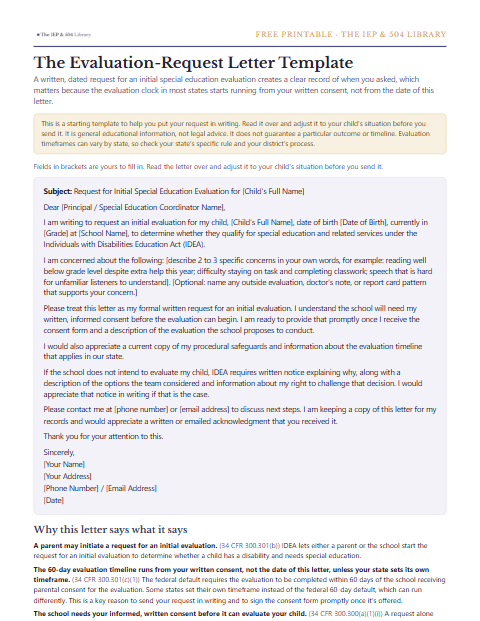
Source: Louisiana Administrative Code Title 28, Part XLIII of Bulletin 1706, Section 151 for the early resolution process including 151(C)(2)(a) for the two calendar day referral and 151(C)(3) for the 15 calendar day period, Section 152(C) for the two year filing window in the rule, Section 152(D) for the copy to the school system, Section 153(A)(1) and Section 153(E) for the 45 day decision, Section 153(F) for extensions and Section 153(I) for reconsideration; 34 CFR 300.153(c) for the federal one year figure; Louisiana Department of Education dispute resolution page and its dispute resolution comparison chart; Louisiana Legislative Auditor performance audit of September 2023; Louisiana Board of Elementary and Secondary Education rulemaking docket www.law.cornell.edu/regulations/louisiana/La-Admin-Code-tit-28-SS-XLIII-152
Mediation
Mediation in Louisiana is voluntary for both sides. A request goes to the Legal Division of the Louisiana Department of Education on a published form, by email, by mail or by fax. The department keeps a list of qualified mediators who are knowledgeable in the laws covering special education and related services, then assigns them on a rotational basis. Its dispute resolution page describes them as impartial department attorney-mediators assigned by the Legal Division. An employee of the department or of the school system involved in the child's education or care cannot serve as the mediator. Neither can a person whose personal or professional interest conflicts with being objective. A person is not treated as an employee merely because the agency pays them to mediate. The department bears the cost, so a session costs a family nothing. An agreement reached in mediation is written, signed by both sides and enforceable in a state court of competent jurisdiction or in a federal district court. What people say during a session stays confidential and cannot be used as evidence in a later due process hearing or civil proceeding. A family can ask for mediation before, at the same time as, or after a due process request or a complaint investigation. Asking for it never delays or replaces those routes. Following the same 2024 federal review, the department told mediators to stop requiring a separate confidentiality agreement before a session while keeping the confidentiality that federal law already provides.
Source: Louisiana Administrative Code Title 28, Part XLIII, Section 506 of Bulletin 1706, including 506(B)(1)(a) for the voluntary process, 506(B)(3)(a) and (b) for the mediator list and rotational assignment, 506(B)(4) for the state bearing the cost, 506(B)(6) and (7) for the written enforceable agreement, 506(B)(8) for confidentiality and 506(C) for impartiality; Louisiana Department of Education dispute resolution page for the filing routes and the attorney-mediator description; Louisiana Department of Education notice of procedural safeguards, May 2025 edition; Louisiana Department of Education news release of 3 March 2026 www.law.cornell.edu/regulations/louisiana/La-Admin-Code-tit-28-SS-XLIII-506
A due process hearing
Time limit to file: Two years in the state rule text, measured from the date the parent or the school system knew or should have known about the action the request is about, with exceptions where the school system misrepresented that it had resolved the problem or held back information it was required to give the parent. The department's own dispute resolution page and comparison chart state this limit as one year.
The written hearing request goes to the Louisiana Department of Education, which sends a copy to the other party. Within two business days the department transmits the request to the Louisiana Division of Administrative Law, a separate state agency that dockets the case then assigns a hearing officer. The rule heads its two year limit with the word prescription, the civil law term Louisiana uses where other states say statute of limitations. That two year figure sits in the rule twice, once in the filing section and once in the hearing section. It came in with a January 2025 amendment. The department's dispute resolution page still tells families the limit is one year, so the two sources disagree. The Legal Division is the office that takes the filing. Louisiana requires the hearing officer to hold a law degree. Someone who represented a school system or a parent as an attorney in education litigation within the previous three years cannot take the case, nor can an employee of a public agency involved in the child's education or care. Either side has three business days from the notice of the assigned hearing officer to send the department a written challenge to that officer's impartiality. The Division of Administrative Law reviews the challenge then answers in writing within three business days. It assigns a new hearing officer where doubt exists. A prehearing conference is required. The rule asks the hearing officer to give a party appearing without a lawyer a detailed explanation of trial procedure, the burden of proof, the elements of the claim and the available remedies. The burden of proof sits with the party seeking relief. A resolution period runs up to 30 days, then a final decision is reached and mailed to both parties within 45 days of that period ending. Parents can have the child present and can have the hearing open to the public. The department publishes hearing decisions by school year.
Source: Louisiana Administrative Code Title 28, Part XLIII of Bulletin 1706, Section 507(A)(2) for the two year prescription period and Section 511(F) restating it, Section 508(A)(4) for transmission to the Division of Administrative Law within two business days, Section 511(C) for hearing officer designation and qualifications, Section 511(D) for impartiality challenges, Section 511(G) for the exceptions to the timeline, Section 511(I)(2) for the prehearing conference explanation, Section 511(J) for the burden of proof, Section 512(C) for parental rights at hearings and Section 515(A) for the 45 day decision; Louisiana Department of Education dispute resolution page and its dispute resolution comparison chart for the one year figure www.law.cornell.edu/regulations/louisiana/La-Admin-Code-tit-28-SS-XLIII-511

From the team behind this library
The IEP & 504 Command Center
This page shows you the deadlines and the contacts for your state. The Command Center hands you the done pieces: the binder built, the letters written, the meeting scripts ready and a self-review that shows where your child's IEP is strong or thin before you walk in. The library stays free.
Who to contact in Louisiana

- The state special education office. Diverse Learners, Louisiana Department of Education. This is the office that answers questions about Louisiana rules and receives a state complaint.
- Your rights in writing. Louisiana's Educational Rights of Children with Disabilities: Special Education Processes and Procedural Safeguards, the May 2025 edition of the notice the state rule requires school systems to give parents once a school year. Every district hands parents this notice at least once a year (34 CFR 300.504). It is the plain summary of what you can ask for at each step.
- Parent training and information center. Louisiana Parent Training and Information Center, a project of Families Helping Families of Greater New Orleans. A parent center is free and federally funded under IDEA. Staff there talk families through the process in their own state at no cost.
- The state rules themselves. La. R.S. 17:1941 et seq., the Children with Exceptionalities Act, carried out through Louisiana Administrative Code Title 28, Part XLIII of Bulletin 1706, Part CI of Bulletin 1508 and Part XCVII of Bulletin 1530, with the definition of a student with an exceptionality at La. R.S. 17:1942. The Children with Exceptionalities Act places the duty to provide a free appropriate public education in the least restrictive environment on state and local education agencies for every resident student with an exceptionality from age three through twenty-one. Louisiana's definition of that term covers students who are deemed gifted or talented alongside students with disabilities, so a gifted student in Louisiana has an IEP and a parallel set of procedural safeguards under the same act.
Child Find in Louisiana
Louisiana's rules put a School Building Level Committee in every school, made up of at least the principal or a designee, a classroom teacher and the referring teacher, with the parent invited when the committee discusses their child. For a student already enrolled, the pupil appraisal rules ask that committee to work through a response to intervention process and review the data before the school identifies the student as suspected of having a disability, then to refer the student to pupil appraisal staff for an individual evaluation when it does suspect one. The committee reports to parents on the student's response to those interventions at least once each grading period until it reaches a decision. A parent who disagrees with what it decides receives a copy of their rights, which include asking for an evaluation. A separate immediate referral path skips the intervention step for students suspected of low incidence impairments such as deafness, hearing loss, visual impairment, deaf-blindness, traumatic brain injury, moderate or severe intellectual disability, multiple disabilities and some students with severe autism, orthopedic impairments or significant health concerns. Where a parent asks for a special education evaluation in writing, the school system has no longer than 10 business days to either request consent to evaluate or give written notice that it is refusing.
Source: Louisiana Administrative Code Title 28, Part CI of Bulletin 1508, Section 303(A) for the School Building Level Committee and its options plus Section 303(B) for the grading period reports to parents, Section 305(A)(1) for the response to intervention step and Section 307(B) and (C) for referrals; Title 28, Part XLIII, Section 301(A)(4) of Bulletin 1706 for the 10 business day response to a written parent request www.doa.la.gov/media/g0jbnrxn/28v101.pdf