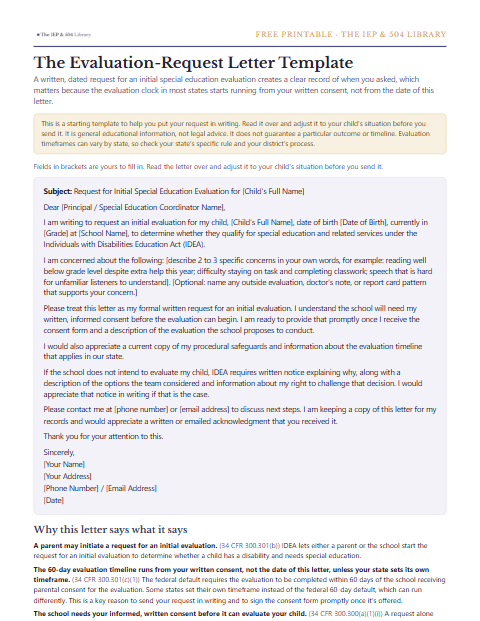
District of Columbia IEP Evaluation Timeline, Dispute Routes and Parent Resources (2026)
- Evaluation window
- 60 calendar days
- The clock starts at
- Parental consent
- State complaint deadline
- One year
- Due process deadline
- Two years
How long does a school in the District of Columbia have to complete an IEP evaluation?
In the District of Columbia the school system a child attends completes the initial evaluation and makes the eligibility decision within 60 calendar days of the day a parent gives consent for the assessments. A separate 30 calendar day window sits in front of that one. From the day a school system receives a referral it has 30 days to make and document reasonable efforts to obtain that consent, with those efforts starting within 10 business days of the referral date. Enrollment decides which school system owes those deadlines, because District of Columbia Public Schools and each public charter school both answer as local school systems for special education, while the Office of the State Superintendent of Education sits above them as the state agency. Families who disagree with a decision have three routes: a written complaint to the State Complaint Office at that state agency within a year of the problem, free mediation through its Office of Dispute Resolution, or a due process complaint filed with that same office within two years.

The evaluation timeline in the District of Columbia
| Initial evaluation window | 60 calendar days |
|---|---|
| The clock starts at | the date the parent gives consent for the evaluation, with a separate 30 calendar day window running from the referral for the school system to seek that consent |
| Against the federal rule | A timeframe District of Columbia sets for itself |
IDEA sets a default of 60 calendar days from parental consent for an initial evaluation (34 CFR 300.301(c)(1)). It also lets a state set its own timeframe instead, which is what District of Columbia has done, so the window above is the one that applies here.
The District counts the same 60 calendar days as the federal rule, measured from the date a parent gives consent, then asks more of that window. The federal count covers conducting the evaluation. The rule here has the school system evaluate the child and make the eligibility decision inside the same 60 days, so the decision itself sits under the deadline rather than after it. A second count runs before that one. From the day a school system receives a referral it has 30 calendar days to make and document reasonable efforts to obtain consent, with those efforts starting no later than 10 business days after the referral date. A referral can be spoken or written. The date the school system received it starts the clock whatever day the referral is later entered into the District's special education database. Days here are calendar days unless a rule says school day or business day, so weekends, holidays and school breaks sit inside the 60. The deadline lifts in two situations: a parent who repeatedly does not produce the child for assessments, or a child who enrolls in a different District school system mid-evaluation, where the new system is making enough progress toward prompt completion and both sides agree on a completion date no more than 30 days further out.
Source: 5-A DCMR Section 3005.4(a) and (b), with the exceptions at Section 3005.5 and the calendar day definition at Section 3099.1; D.C. Code Section 38-2561.02(a)(2)(A) osse.dc.gov/sites/default/files/dc/sites/osse/service_content/attachments/5-A%20DCMR%20Chapter%2030_Full%20Text.pdf
The same window sits beside all fifty-one jurisdictions on the evaluation timelines by state table, which explains where the federal deadline comes from. To pull one state's window on its own, the evaluation deadline checker returns that single result.
Reevaluation and IEP review cadence in the District of Columbia
The three year reevaluation cycle and the annual IEP review match the federal pattern. A reevaluation happens at least once every three years unless the parent and the school system agree it is unnecessary, no more than once a year unless they agree otherwise in writing, with the IEP team meeting at least once a year to look at progress toward the annual goals. The District writes two clocks of its own around that pattern. When a parent asks for a reevaluation, the school system answers within 10 business days, either by starting reasonable efforts to obtain consent along with written notice proposing to go ahead, or by written notice explaining a refusal. When a reevaluation is agreed before the three year one falls due, the school system completes it and makes the eligibility decision within 60 days of the parent's consent, where the federal rule sets no completion deadline for a reevaluation at all. One limit sits on the shortcut for changing an IEP between annual reviews. A school system and a parent can agree in writing to revise an IEP without calling the whole team together, though that written agreement route cannot change eligibility status, disability category or a placement to a more restrictive setting outside the school system. A copy of the amendment reaches the IEP team no later than 5 business days after the meeting or the signed agreement. OSSE also tells teams that adding a new area of concern before the three year date reopens the eligibility process, which resets the three year due date.
Source: 5-A DCMR Sections 3007.1, 3007.2, 3007.4 and 3007.5; Sections 3018.1, 3019.1 and 3019.4; OSSE Special Education Process Handbook for the 2025-26 school year, the reevaluation timeline section; 34 CFR 300.303(b) and 300.324(b) for the federal cadence osse.dc.gov/sites/default/files/dc/sites/osse/service_content/attachments/5-A%20DCMR%20Chapter%2030_Full%20Text.pdf
If you disagree in the District of Columbia
IDEA gives families in every state the same three routes when a disagreement with the school does not resolve at the team table. What changes at the state line is who administers each route, how long you have to file and the local detail below.
The state complaint
Handled by State Complaint Office, part of the Office of Special Education within the Division of Systems and Supports, K-12, at the Office of the State Superintendent of Education. Time limit to file: One year before the date the State Complaint Office receives the complaint.
A state complaint in the District is signed, written and sent to the State Complaint Office at OSSE, with a copy going to the school system named in it at the same time. Any individual or organization can file one. The alleged violation happened no more than one year before the office received the complaint. Where the complaint concerns a District of Columbia Public Schools campus, the copy goes to the DCPS central office. Where it concerns a public charter school, the charter school or the State Complaint Office can say where the copy goes, since District law has made each public charter school its own school system for special education since August 1, 2017. The office investigates and issues a written Letter of Decision within 60 days unless exceptional circumstances apply to that particular complaint. Both sides can also agree to extend that count in order to try mediation. Any part of a complaint that is already the subject of a due process hearing is set aside until the hearing ends. An issue already decided in a hearing between the same parties stays decided. A Letter of Decision cannot be appealed to OSSE, though a family that still disagrees can ask for mediation or file a due process complaint. Past decisions are published with identifying details removed.
Source: 5-A DCMR Sections 3048.1, 3048.2, 3048.3, 3048.4, 3048.5 and 3048.6; 34 CFR 300.153(d) for the copy that goes to the school system; District of Columbia Formal State Complaint Policy and Procedures, revised November 2009, the filing and limitations sections at pages 3 and 4; D.C. Code Section 38-1802.10(c) for the charter school school-system rule osse.dc.gov/sites/default/files/dc/sites/osse/service_content/attachments/5-A%20DCMR%20Chapter%2030_Full%20Text.pdf
Mediation
Mediation in the District runs through the Office of Dispute Resolution at OSSE, the same office that runs due process hearings. A request goes to that office in writing, on its mediation request form or in a letter carrying the same information, by mail, hand delivery, email or fax. Either a parent or the school system can ask. Mediation stays voluntary for both sides. It cannot be used to deny or delay a hearing. Sessions are scheduled at a time and place convenient to both sides, with a confidentiality statement signed before the session starts, so what people say there stays out of any later hearing or civil case. Mediators are trained in mediation technique as well as special education law. An agreement reached there is written down and signed by the parent plus someone with authority to bind the school system. The office pays for mediation, so a session costs a family nothing. Two related services sit alongside it at the same cost. A facilitated IEP meeting puts a neutral person in the room to help the team communicate while the team itself keeps every decision. A facilitated resolution meeting does the same for the meeting that follows a due process complaint. A contractor sitting as hearing officer in a case does not also mediate or facilitate for that same student.
Source: 5-A DCMR Sections 3047.1 through 3047.9; OSSE Office of Dispute Resolution Standard Operating Procedures Manual, effective February 2, 2023, sections 301 through 304 osse.dc.gov/sites/default/files/dc/sites/osse/page_content/attachments/Office%20of%20Dispute%20Resolution%20Standard%20Operating%20Procedures%20(SOP)(UPDATED).pdf
A due process hearing
Time limit to file: Two years from the date the filing party knew or should have known about the action behind the complaint, the federal window, with the federal exceptions at 34 CFR 300.511(f) where the school system misrepresented that it had resolved the problem or withheld information it was required to give the parent.
A due process complaint in the District goes to the school system named in it and to the Office of Dispute Resolution at OSSE, by mail, hand delivery, email or fax. That office publishes a model complaint form, though a written complaint carrying the required details works the same way. Hearing officers here are attorneys who contract with OSSE rather than work for it, each a member in good standing of the District of Columbia Bar with at least five years of legal experience, assigned on a rotating basis from a cadre the office publishes. Cases run on the federal shape: a resolution meeting within 15 calendar days of the complaint, a 30 calendar day resolution period, then a written decision within 45 calendar days of the end of that period, with specific extensions available for good cause at a party's request. One part of the hearing works differently here than under the federal default. The party who filed still carries the burden of production. Where the argument is about whether an IEP or a placement is appropriate, the burden of persuasion sits with the school system once the filing party has made out a prima facie case, decided on a preponderance of the evidence. A family seeking reimbursement for a placement they arranged themselves keeps both burdens on whether that placement was appropriate. District law applies this arrangement to hearings on complaints filed after July 1, 2016. A decision is final on the parties, appealable to a court of competent jurisdiction, then published with identifying details removed. District law also lets a court award expert witness fees to a prevailing parent, capped at $6,000 per proceeding.
Source: D.C. Code Section 38-2571.03(6)(A), (6)(B) and (7)(B); 5-A DCMR Sections 3049.1, 3049.2, 3052.1, 3053.1, 3053.3, 3053.4, 3053.6, 3053.7, 3053.8 and 3054.2; OSSE Office of Dispute Resolution Standard Operating Procedures Manual, effective February 2, 2023, sections 203, 503 and 601 for the filing route and the hearing officers; 34 CFR 300.507(a)(2) for the two year window with the exceptions at 34 CFR 300.511(f) code.dccouncil.gov/us/dc/council/code/sections/38-2571.03
From the team behind this library
The IEP & 504 Command Center
This page shows you the deadlines and the contacts for your state. The Command Center hands you the done pieces: the binder built, the letters written, the meeting scripts ready and a self-review that shows where your child's IEP is strong or thin before you walk in. The library stays free.
Who to contact in the District of Columbia

- The state special education office. Office of Special Education, part of the Division of Systems and Supports, K-12, at the Office of the State Superintendent of Education. This is the office that answers questions about District of Columbia rules and receives a state complaint.
- Your rights in writing. District of Columbia IDEA Part B Notice of Procedural Safeguards: Rights of Parents of Students with Disabilities, the August 2018 revision published by the Office of the State Superintendent of Education. Every district hands parents this notice at least once a year (34 CFR 300.504). It is the plain summary of what you can ask for at each step.
- Parent training and information center. Advocates for Justice and Education, Inc.. A parent center is free and federally funded under IDEA. Staff there talk families through the process in their own state at no cost.
- The state rules themselves. 5-A DCMR Chapter 30, Sections 3000 through 3099, effective July 1, 2022 by final rulemaking published at 69 DCR 005902; D.C. Code Section 38-2561.02(a)(2)(A); D.C. Code Section 38-2571.03(2), (3), (4)(A) and (5) in Title 38 Chapter 25C, Special Education Students Rights; the pending repeal at Section 3 of D.C. Act 26-368, published at 73 DCR 9419. Chapter 30 is the District's own special education rulebook for children between the ages of 3 and 22 in District of Columbia Public Schools and public charter schools, covering child find, referrals, evaluation and reevaluation timelines, eligibility categories, IEP content and review, placement, discipline, restraint and seclusion, parent observation plus all three dispute routes. It replaced an older chapter numbered 5-E on July 1, 2022. Two pieces of District law sit under it. Section 38-2561.02 carries the 60 day evaluation deadline and the 30 day consent window. Chapter 25C, the Special Education Students Rights provisions, carries several rules a family meets in ordinary IEP work: an accessible copy of every document the team will discuss at least 5 business days before the meeting, a copy of the IEP within 5 business days after it, the right to observe a child's current or proposed program, a requirement that written notices list contacts for the parent training center along with the Ombudsman for Public Education and the Office of the Student Advocate, plus the burden of persuasion arrangement in hearings. One dated change to Chapter 30 is pending. D.C. Act 26-368, the Leading Education Access for Reentry and Necessary Success Amendment Act of 2026, published in the D.C. Register on July 10, 2026 at 73 DCR 9419, repeals Sections 3001.16 and 3001.17, the two subsections that set out when a school system owes a free appropriate public education to a young person aged 18 to 22 held in an adult correctional facility. That responsibility moves to the Department of Corrections. The act projects an effective date of December 12, 2026, after the 60 day congressional review the Home Rule Act requires. Nothing else on this page changes with it.
Child Find in the District of Columbia
Child find here splits along the District's school system structure. Every local school system publishes and runs a child find policy for the children it enrolls. DCPS carries a wider job as the geographical school system of right: public awareness across the District, child find for resident children who are homeschooled, plus child find for resident and nonresident children over age three attending religious and other private schools in the District. DCPS cannot require a child to enroll before evaluating them or writing an IEP. The District also screens early for reading. Under the Addressing Dyslexia and Other Reading Difficulties Amendment Act of 2020, every local school system screens all students in kindergarten through second grade for reading difficulties using a screener from OSSE's approved list, with written notice to the family where a screen shows a student at risk. Screening is not evaluation. A school system cannot use screenings or pre-referral interventions to delay or deny a timely initial evaluation once a child is suspected of having a disability.
Source: 5-A DCMR Sections 3003.1 through 3003.5, 3004.1, 3004.2 and 3004.3; D.C. Code Sections 38-2581.04 and 38-2581.05, enacted by D.C. Law 23-191 effective March 16, 2021 osse.dc.gov/sites/default/files/dc/sites/osse/service_content/attachments/5-A%20DCMR%20Chapter%2030_Full%20Text.pdf