Texas IEP Evaluation Timeline, Dispute Routes and Parent Resources (2026)
- Evaluation window
- 45 school days
- The clock starts at
- Written parental consent
- State complaint deadline
- One calendar year
- Due process deadline
- Two years
How long does a school in Texas have to complete an IEP evaluation?
Texas measures its initial special education evaluation in school days, so a district completes the written report of a full individual and initial evaluation by the 45th school day after it receives a parent's written consent. Three or more absences during that window push the deadline out by the number of school days the student missed. Because school days skip weekends, holidays and school closures, that 45 school day window often covers more of the calendar than the federal default of 60 calendar days. The ARD committee, the Texas name for the IEP team, then meets within 30 calendar days of the finished report to decide eligibility. Parents who disagree with a school decision have several routes through the Texas Education Agency: a state complaint within one calendar year of the events, mediation at TEA's cost at any point, a due process hearing request within two years, or a state facilitator when an ARD meeting ends without agreement.

The evaluation timeline in Texas
| Initial evaluation window | 45 school days |
|---|---|
| The clock starts at | receipt of parental written consent |
| Against the federal rule | A timeframe Texas sets for itself |
IDEA sets a default of 60 calendar days from parental consent for an initial evaluation (34 CFR 300.301(c)(1)). It also lets a state set its own timeframe instead, which is what Texas has done, so the window above is the one that applies here.
Texas shortens the federal default to 45 school days. If a student is absent 3 or more school days during the evaluation window, the deadline extends by that many days.
Source: 19 Tex. Admin. Code Section 89.1011(d) spedsupport.tea.texas.gov/sites/default/files/2023-08/special-education-full-and-individual-initial-evaluation-timeline.pdf
The same window sits beside all fifty-one jurisdictions on the evaluation timelines by state table, which explains where the federal deadline comes from. To pull one state's window on its own, the evaluation deadline checker returns that single result.
Reevaluation and IEP review cadence in Texas
Texas does not set its own cadence here, so the federal defaults are what apply. A reevaluation happens at least once every three years unless the parent and the school agree one is not needed. It happens no more often than once a year unless they agree otherwise (34 CFR 300.303(b)). The IEP team reviews the IEP at least once a year to check progress against the annual goals (34 CFR 300.324(b)(1)).
If you disagree in Texas
IDEA gives families in every state the same three routes when a disagreement with the school does not resolve at the team table. What changes at the state line is who administers each route, how long you have to file and the local detail below.
The state complaint
Handled by Texas Education Agency, Office of Special Populations and Student Supports. Time limit to file: One calendar year: the violation alleged has to have happened no more than one calendar year before TEA receives the complaint.
A complaint has to be in writing with the signature and contact details of the person filing. TEA accepts it by email, mail, hand delivery or fax. The agency publishes an online form alongside an optional model complaint form. The same complaint goes to the school district or charter school named in it at the time it is filed with TEA. TEA then has 60 calendar days from a valid written complaint to investigate and resolve it, with extensions for exceptional circumstances or when both sides agree to try mediation.
Source: 19 Texas Administrative Code Section 89.1195(b)(6) for the one calendar year limit, Section 89.1195(b)(1) and (b)(2) for the written signed complaint, Section 89.1195(b)(7) for the copy to the district, Section 89.1195(c) for the filing methods and Section 89.1195(e)(4) for the 60 calendar day investigation www.law.cornell.edu/regulations/texas/19-Tex-Admin-Code-SS-89-1195
Mediation
The TEA Office of General Counsel runs the special education mediation program. Taking part is voluntary for both sides, TEA bears the cost of the mediation process and a request can be made at any time, including while a state complaint investigation or a due process hearing is already under way. A written mediation agreement signed by the parent and by an authorized school representative is enforceable in any state or federal court of competent jurisdiction.
Source: 19 Texas Administrative Code Section 89.1193(a) for availability at any time, Section 89.1193(b)(1) for the voluntary nature, Section 89.1193(h) for the cost and Section 89.1193(k) for enforceability, with the Texas Education Agency dispute resolution processes page stating that both parties must agree www.law.cornell.edu/regulations/texas/19-Tex-Admin-Code-SS-89-1193
A due process hearing
Time limit to file: Two years from the date the parent or the school district knew or should have known about the action at issue.
Texas used a one year deadline until September 1, 2022. House Bill 1252 of the 87th Legislature moved it to two years for requests made on or after that date, which puts Texas on the federal default. Texas runs a one-tier system, so a hearing officer's decision is final except that a party who disagrees can bring a civil action in a state court of competent jurisdiction or a federal district court instead of going to a second administrative review. The TEA Office of General Counsel administers the hearing program.
Source: 19 Texas Administrative Code Section 89.1151(b) for the one-tier system, Section 89.1151(c) for the two year filing deadline and Section 89.1185(n) for the right to bring a civil action in state or federal court www.law.cornell.edu/regulations/texas/19-Tex-Admin-Code-SS-89-1151

From the team behind this library
The IEP & 504 Command Center
This page shows you the deadlines and the contacts for your state. The Command Center hands you the done pieces: the binder built, the letters written, the meeting scripts ready and a self-review that shows where your child's IEP is strong or thin before you walk in. The library stays free.
Who to contact in Texas

- The state special education office. Texas Education Agency, Office of Special Populations and Student Supports. This is the office that answers questions about Texas rules and receives a state complaint.
- Your rights in writing. Notice of Procedural Safeguards (2025 edition), published by the Texas Education Agency through SPEDTex in more than 30 languages plus an American Sign Language video series. Every district hands parents this notice at least once a year (34 CFR 300.504). It is the plain summary of what you can ask for at each step.
- Parent training and information center. Partners Resource Network, the nonprofit that operates the four Texas Parent Training and Information projects. A parent center is free and federally funded under IDEA. Staff there talk families through the process in their own state at no cost.
- Parent training and information center. PATH Project, Partners Resource Network (education service center regions 2 through 6).
- Parent training and information center. PEN Project, Partners Resource Network (education service center regions 9, 12 and 14 through 19).
- Parent training and information center. TEAM Project, Partners Resource Network (education service center regions 1, 13 and 20).
- Parent training and information center. PACT Project, Partners Resource Network (education service center regions 7, 8, 10 and 11).
- The state rules themselves. 19 Texas Administrative Code Chapter 89, Subchapter AA (Commissioner's Rules Concerning Special Education Services). Subchapter AA holds the Texas commissioner's special education rules. Division 2 carries the referral and evaluation timelines plus ARD committee procedure, Division 4 carries special education funding and Division 7 carries the state's dispute resolution routes.
Child Find in Texas
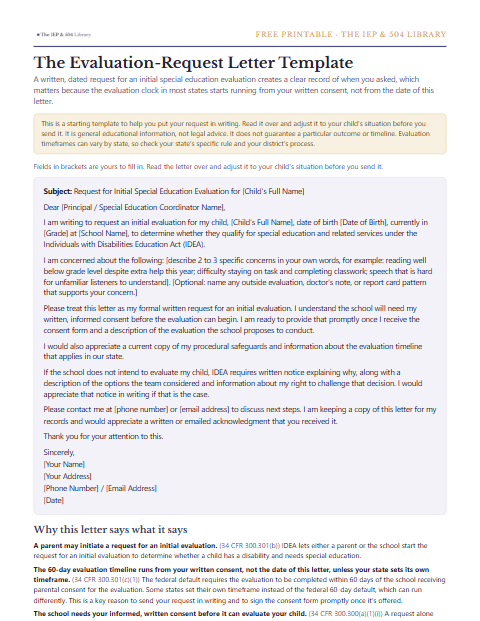
Texas puts a clock on the first step. When a parent sends a written request for an evaluation to the district's special education director or to a district administrative employee such as a campus principal, the district has until the 15th school day after it receives the request to answer in writing. That answer is either prior written notice that it proposes to evaluate, sent with the procedural safeguards notice, the state's Overview of Special Education for Parents form and an opportunity to give written consent, or prior written notice that it refuses, sent with those same two documents. Families of children under three usually start with Early Childhood Intervention rather than with the school district.
Source: 19 Texas Administrative Code Section 89.1011(b)(1) and (b)(2), with SPEDTex Child Find guidance for children under three www.law.cornell.edu/regulations/texas/19-Tex-Admin-Code-SS-89-1011