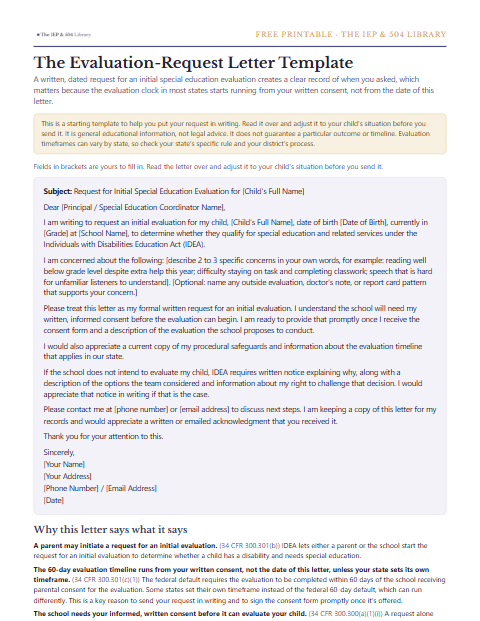
Minnesota IEP Evaluation Timeline, Dispute Routes and Parent Resources (2026)
- Evaluation window
- 30 school days
- The clock starts at
- Parental consent
- State complaint deadline
- One year
- Due process deadline
- Two years
How long does a school in Minnesota have to complete an IEP evaluation?
Minnesota counts the initial evaluation window in school days rather than calendar days: once a district receives a parent's written permission to evaluate, the state rule allows a reasonable time that cannot exceed 30 school days, so snow days, breaks and other days without instruction sit outside the count. The same clock covers a reevaluation, where it can start when the 14 calendar day parental response window closes rather than at signed permission, with one written exception in the rule for a case where someone has asked for a conciliation conference or a hearing. Minnesota also gives families a step of its own ahead of the three federal routes: a conciliation conference the district holds within 10 calendar days of the request, closing with a written memorandum of the district's final offer within five school days. After that sit a written state complaint the Minnesota Department of Education investigates within 60 calendar days, free mediation with a neutral the state provides, then a due process complaint filed with the department and forwarded to the Court of Administrative Hearings. The complaint route got its own Minnesota statute in 2025, so the one year look back, the 60 day clock and the remedies now sit in state law rather than in federal regulation alone.

The evaluation timeline in Minnesota
| Initial evaluation window | 30 school days |
|---|---|
| The clock starts at | parental consent to evaluate |
| Against the federal rule | A timeframe Minnesota sets for itself |
IDEA sets a default of 60 calendar days from parental consent for an initial evaluation (34 CFR 300.301(c)(1)). It also lets a state set its own timeframe instead, which is what Minnesota has done, so the window above is the one that applies here.
Minnesota shortens the federal default sharply to 30 school days for the evaluation and the eligibility determination.
Source: Minn. R. 3525.2550, subp. 2 (conduct before evaluation), which states the 30 school day limit; Minn. R. 3525.2710, subp. 6, which has the evaluation report, including the documentation of whether the pupil has a disability, completed and delivered inside that same evaluation timeline; the district's underlying duty to provide special instruction and services at Minn. Stat. Section 125A.03(a) www.revisor.mn.gov/rules/3525.2550/
The same window sits beside all fifty-one jurisdictions on the evaluation timelines by state table, which explains where the federal deadline comes from. To pull one state's window on its own, the evaluation deadline checker returns that single result.
Reevaluation and IEP review cadence in Minnesota
Minnesota keeps the federal cadence and adds two turns of its own. The state rule has a reevaluation happen when conditions warrant one or when a parent or a teacher asks for one, but at least once every three years, with the IEP team reviewing the IEP periodically and at least once a year. What Minnesota adds first is a completion clock. The same 30 school day limit that covers an initial evaluation covers a reevaluation. For a reevaluation the count can begin when the 14 calendar day parental response window closes rather than when the district receives signed permission. The second addition is about consent. A Minnesota district may not override a parent's written refusal to consent to an initial evaluation or to a reevaluation. The federal rule leaves that door open, since it lets a public agency choose to pursue a reevaluation through the consent override procedures after a parent refuses. Minnesota closes it in statute for both.
Source: Minn. R. 3525.2710, subp. 2 for the three year cycle; Minn. R. 3525.2810, subp. 3, item A for the annual IEP review; Minn. R. 3525.2550, subp. 2 for the 30 school day limit and the 14 calendar day response window; Minn. Stat. Section 125A.091, subd. 5(a) and Minn. R. 3525.2710, subp. 1 for the refusal a district cannot override; MDE Part B Notice of Procedural Safeguards for the same two limits in parent-facing words; federal cadence at 34 CFR 300.303(b) and 34 CFR 300.324(b)(1)(i); the federal override option at 34 CFR 300.300(c)(1)(ii) www.revisor.mn.gov/rules/3525.2710/
If you disagree in Minnesota
IDEA gives families in every state the same three routes when a disagreement with the school does not resolve at the team table. What changes at the state line is who administers each route, how long you have to file and the local detail below.
The state complaint
Handled by Minnesota Department of Education, Office of General Counsel, dispute resolution. Time limit to file: The violation must have happened not more than one year before the department receives the complaint.
Minnesota moved its state complaint process into its own statute in 2025. Minn. Stat. Section 125A.092 now states what a complaint has to contain, the one year look back, the 60 day clock and the remedies. A complaint is signed and written. It goes to the Minnesota Department of Education, Office of General Counsel, dispute resolution, with a copy to the district or provider serving the child at the same time. An organization or an individual may file one. The department's own complaints page describes the grounds as a violation of federal or state special education requirements. Inside 60 days the department investigates on site where it decides an investigation is needed, gives the person who filed a chance to add information, gives the agency a chance to respond and to propose a resolution, offers both sides voluntary mediation, then issues a written decision addressing each allegation with findings of fact and conclusions. The clock stretches only where the department finds exceptional circumstances in that particular complaint or where the parties agree to take time for mediation or a facilitated team meeting. Time spent in those processes does not count against the 60 days. Where the department finds a failure to provide appropriate services, the decision has to address that failure with corrective action fitted to the child, which the statute says can take the form of compensatory services or monetary reimbursement, plus the future provision of services for all children with disabilities. Three Minnesota specifics sit around the edges of that. Where a complaint and a due process hearing raise the same issues, the department sets the shared part aside until the hearing ends. An issue a hearing already decided between the same parties is binding, which the department has to tell the person who filed. A district that does not carry out a hearing officer's decision can be raised through this same complaint route. The department's notice of procedural safeguards also states that a parent or a district injured in fact by the final complaint decision may appeal it to the Minnesota Court of Appeals within 60 days of receiving notice of that decision.
Source: Minn. Stat. Section 125A.092, subd. 1 for who may file, the contents, the one year look back and the copy to the district; subd. 2 for the remedies; subd. 3 for the 60 day clock, the investigation steps and the two extension grounds; subd. 4 for the hold where a hearing raises the same issues, the binding effect of a prior hearing decision and the complaint route for a decision a district did not carry out; enacted by Laws 2025, First Special Session, chapter 10, article 7, section 5; federal baseline at 34 CFR 300.151 through 300.153; MDE Special Education Complaints page and MDE Dispute Resolution State Complaint Procedures, posted June 2 2026, for the grounds, the filing address and current practice; MDE Part B Notice of Procedural Safeguards, posted March 13 2023, for the appeal to the Minnesota Court of Appeals by a party injured in fact www.revisor.mn.gov/statutes/cite/125A.092
Mediation
Minnesota runs its informal routes through neutrals the state provides, at no cost to the family. Mediation puts a neutral party from the state between a parent and a district on identification, evaluation, placement, discipline placement questions or the provision of a free appropriate public education. A facilitated team meeting is the quieter sibling: an impartial state facilitator leads an IEP, IFSP or multiagency team meeting to keep the conversation working rather than to settle a filed dispute. Both are voluntary. Neither can be used to delay or deny a hearing. Mediation is asked for on a request form that goes to the department's alternative dispute resolution coordinator. Two protections are written into Minnesota law. Mediation discussions stay confidential and inadmissible in a later proceeding unless the parties agree otherwise, the evidence is available elsewhere or it goes to a witness's bias. State provided mediators and facilitators cannot be subpoenaed to testify at a hearing or a civil action. Their records are closed to the parties. An agreement reached in mediation is written, signed by both sides, legally binding and enforceable in state or federal district court, with a further mediation available if the parties later disagree about carrying it out. One Minnesota route sits outside the voluntary set. The state rule makes mediation and the other alternatives voluntary for both parties while naming conciliation as the exception, so a district holds a conciliation conference when a parent asks even though the parent is free to decline conciliation entirely.
Source: Minn. Stat. Section 125A.091, subd. 6 for the voluntary character and the no cost rule, subd. 8 for the subpoena bar and the closed records, subd. 9 for the state provided neutral and the confidentiality exceptions, subd. 10 for the binding written agreement, subd. 11 for the facilitated team meeting; Minn. R. 3525.3750 for the voluntary rule, the conciliation exception and the pointer to 34 CFR 300.506; MDE Special Education Mediation page, overview document posted March 2 2026, for the no cost statement and the request route through the alternative dispute resolution coordinator www.revisor.mn.gov/statutes/cite/125A.091
A due process hearing
Time limit to file: Two years from the date the parent or the district knew or should have known about the action the complaint is about.
Filing and deciding sit in two different buildings. A parent files the written due process complaint with the Minnesota Department of Education and gives a copy to the district. The department then forwards it to the Court of Administrative Hearings, the state's centralized administrative court, which the 2025 legislature renamed from the Office of Administrative Hearings. The department's page for districts says an administrative law judge at that court conducts the hearing. Its page for families says the department and the court keep a list of qualified independent hearing officers, with the hearing officer for a case appointed from that list. Underneath both, the state rule has the department appoint a hearing officer within two business days of the filing. The statute has the commissioner keep the list the appointment comes from. The steps after filing run on short clocks. The hearing officer opens a prehearing conference within five business days of appointment. The district convenes a resolution meeting within 15 calendar days of receiving the complaint unless both sides waive it in writing or agree to mediate. There is no resolution meeting where the district filed. If the matter is unresolved after 30 calendar days, a 45 calendar day clock to a written decision begins. An expedited complaint about discipline gets a hearing within 20 school days and a decision within 10 school days. The party seeking relief carries the burden of proof. The hearing officer can order an independent educational evaluation at district expense. The hearing officer can also order compensatory educational services where a district did not offer or make available a free appropriate public education in the least restrictive environment and the child lost educational benefit as a result. Appeals leave the administrative system for a court: 60 days from receiving the decision to the Minnesota Court of Appeals, or 90 days to federal district court. The department monitors final decisions and enforces them, so a district that does not carry one out can be raised through the state complaint route. Two limits on the two year window are worth naming. The federal rule that supplies the limit lifts it where a district misrepresented that it had resolved the problem or withheld information it had to give the parent. Running the other way, the department's notice of procedural safeguards carries a Minnesota specific warning: under an interpretation of state law by the Eighth Circuit, a family that enrolls the child in a new district without filing first may lose the right to a hearing about issues that arose in the previous district, while keeping the right to file about issues in the new one.
Source: Minn. Stat. Section 125A.091, subd. 12 through subd. 21, subd. 24 and subd. 25; Minn. R. 3525.3900, subp. 1 for filing with the department, subp. 4 for the safeguards statement including the hearings agency route where the department is the service provider, subp. 5 for the two business day appointment; Minn. R. 3525.4700 for enforcement and the 60 calendar day appeal; two year limit at 34 CFR 300.511(e) with the exceptions at 34 CFR 300.511(f), stated for families on MDE's Special Education Due Process Hearings page; resolution meeting at 34 CFR 300.510(a), stated in calendar days on that same MDE page; MDE Part B Notice of Procedural Safeguards, posted March 13 2023, for the Eighth Circuit district change warning; Minn. Stat. Section 14.48, subd. 1 as amended by Laws 2025, chapter 39, article 2, section 17, for the Court of Administrative Hearings name education.mn.gov/MDE/dse/sped/conf/due/index.htm
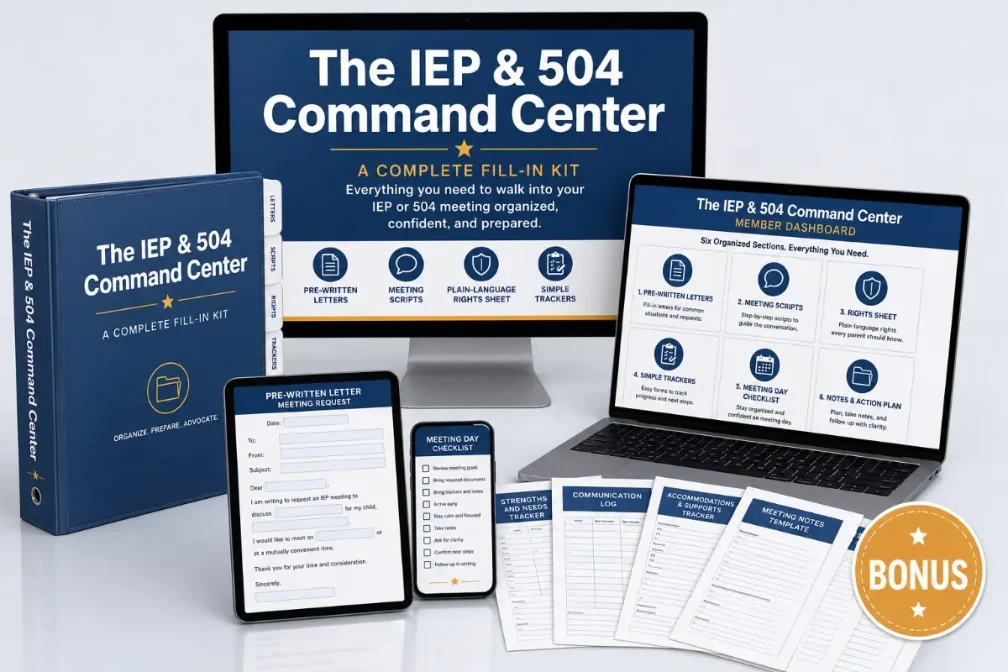
From the team behind this library
The IEP & 504 Command Center
This page shows you the deadlines and the contacts for your state. The Command Center hands you the done pieces: the binder built, the letters written, the meeting scripts ready and a self-review that shows where your child's IEP is strong or thin before you walk in. The library stays free.
Who to contact in Minnesota

- The state special education office. Special Education Division, Minnesota Department of Education. This is the office that answers questions about Minnesota rules and receives a state complaint.
- Your rights in writing. Procedural Safeguards Notice: Part B, published as the Part B Notice of Procedural Safeguards Parental Rights for Public School Special Education Students (posted March 13 2023), with an annotated edition carrying the state and federal citations posted March 14 2023. Every district hands parents this notice at least once a year (34 CFR 300.504). It is the plain summary of what you can ask for at each step.
- Parent training and information center. PACER Center. A parent center is free and federally funded under IDEA. Staff there talk families through the process in their own state at no cost.
- The state rules themselves. Minn. Stat. ch. 125A (children with a disability), with the operating detail in Minn. R. ch. 3525 (children with a disability). Chapter 125A is Minnesota's special education chapter. Chapter 3525 of the rules is where its day to day requirements live. Section 125A.03 has every district provide special instruction and services to resident children with disabilities from birth until the child turns 22, without running past secondary school. Section 125A.08 sets what a Minnesota IEP must contain, with transition needs addressed during grade 9. Section 125A.091 holds most of the dispute layer: the extra content a prior written notice carries, the parent's 14 day objection window, the conciliation conference, mediation, facilitated team meetings, the hearing itself and the appeal. Section 125A.092, added in 2025, holds the state complaint process, which until then sat only in federal regulation and department practice. On the rules side, part 3525.2550 carries the 30 school day evaluation limit, part 3525.2710 the evaluation and reevaluation requirements, part 3525.2810 the IEP, then parts 3525.3600 through 3525.4770 the run from prior written notice to expedited hearings. Part 3525.3790 sets how the chapter's periods are counted, leaving out the first day and pushing a deadline that lands on a Saturday, Sunday or legal holiday to the next day that is not one. One numbering trap is worth naming: Minn. Stat. Section 125A.09 was repealed in 2003 and the dispute provisions moved to Section 125A.091, so an older document citing 125A.09 points at nothing in force.
Child Find in Minnesota
Minnesota starts child find at birth and runs it through the school district. The state rule has each district build a system that identifies children with disabilities beginning at birth, children attending public and nonpublic schools, plus school age children attending no school at all, built to a nondiscrimination standard and written into the district's total special education system plan. Statute matches the span: special instruction and services run from birth until the child turns 22, so the district that manages a fourth grader's IEP is also where an infant's early intervention sits. The same paragraph has local health, education and social service agencies refer children under five who are known to need or suspected of needing services to the school district. Help Me Grow is the public front door for the youngest children. It takes referrals online or by phone, with separate forms for a parent or guardian, a professional and anyone else such as a friend or a family member. A referral can also go straight to the district. The referral connects the family to the school district where the child lives, then that district contacts the family to arrange a screening or an evaluation. Someone who is not the parent can refer a child from birth to age five without parental consent, after which the district asks the family for permission to go ahead. Separately, school boards provide early childhood developmental screening at least once before school entrance, aimed at children between three and four years old, covering development, hearing, vision, immunization review, height and weight, with a follow up and referral process where the screening turns up something that needs attention. The screening record goes to the principal not later than 30 days after the first day of attendance. Statute makes the screening a condition of continuing in kindergarten or first grade. One limit runs the other way: a district is not found in violation of its child find duty, or of its duty to evaluate and reevaluate, where a parent refuses consent for an initial evaluation or does not respond to the request for it.
Source: Minn. R. 3525.0750 for the identification system beginning at birth; Minn. Stat. Section 125A.03(b) for the birth to age 22 span and the referral duty for children under five; Minn. Stat. Section 142D.091, subd. 1 for the screening program and the kindergarten or first grade condition, subd. 2 for the 30 day record filing, subd. 3 for the components, subd. 4 for the follow up (renumbered from Minn. Stat. Section 121A.17 by the revisor instruction in Laws 2024, chapter 80, article 4, section 26); Help Me Grow Minnesota Refer a Child and How to Refer pages for the routing to the local district; MDE Part B Notice of Procedural Safeguards for the consent limit on child find www.revisor.mn.gov/rules/3525.0750/