North Dakota IEP Evaluation Timeline, Dispute Routes and Parent Resources (2026)
- Evaluation window
- 60 calendar days
- The clock starts at
- Parental consent
- State complaint deadline
- One year
- Due process deadline
- Two years
How long does a school in North Dakota have to complete an IEP evaluation?
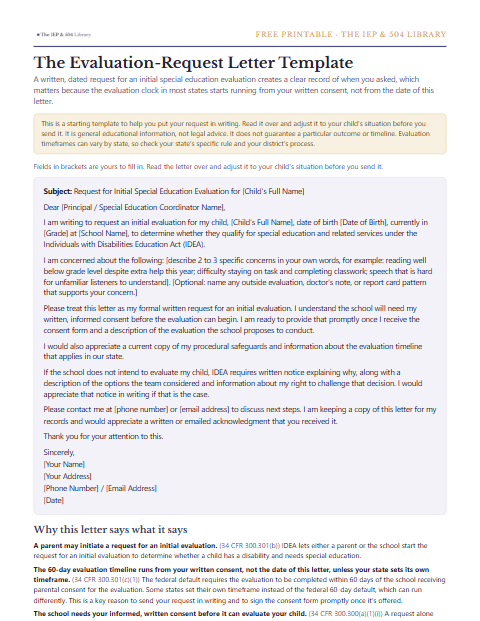
A North Dakota district completes an initial special education evaluation within sixty calendar days of obtaining parental consent, the same count the federal rule uses, written into the state's own rule at N.D. Admin. Code 67-23-01-03. North Dakota then adds two extension grounds the federal regulation does not list: documented extreme weather that prevented or interfered with the evaluation, plus limited access to a qualified evaluator where either party satisfies the department that testing cannot happen inside the first sixty days. Even with an extension, that rule holds the whole evaluation period to ninety calendar days. The department counts the sixty days straight through school breaks and holidays, so consent signed in late spring does not pause over the summer. Eligibility itself is settled at the meeting that reviews the assessment results. The department's evaluation guideline treats written documentation of that eligibility decision as part of completing the evaluation, so the Integrated Written Assessment Report sits inside the same sixty days.

The evaluation timeline in North Dakota
| Initial evaluation window | 60 calendar days |
|---|---|
| The clock starts at | parental consent to evaluate |
| Against the federal rule | The federal default, unchanged |
IDEA sets a default of 60 calendar days from parental consent for an initial evaluation (34 CFR 300.301(c)(1)). North Dakota keeps that default rather than setting a timeframe of its own.
North Dakota keeps the federal 60 calendar day count and writes it into its own rule, then adds two extension grounds the federal regulation does not carry. N.D. Admin. Code 67-23-01-03 states that a district evaluates a referred child within sixty calendar days after obtaining parental consent for the evaluation, unless an extension is necessary because of extreme weather that prevented or interfered with the evaluation and the weather is documented, or unless either party establishes to the department's satisfaction that access to a qualified evaluator is so limited that the evaluation cannot occur in the initial sixty days. The same section caps the evaluation period, any extension included, at ninety calendar days. The department's own evaluation guideline counts those sixty days straight through school breaks and holidays and states that a district that does not meet the timeline documents the reasons for the delay.
Source: N.D. Admin. Code 67-23-01-03, the timelines section stating the exception to the sixty-day time frame for an initial evaluation, effective October 1 2009, in article 67-23 of the North Dakota Administrative Code; the same sixty calendar day count with all four of its exceptions appears in the North Dakota Department of Public Instruction Guidelines: Evaluation Process; federal default at 34 CFR 300.301(c)(1) with the two federal exceptions at 34 CFR 300.301(d) ndlegis.gov/information/acdata/pdf/67-23-01.pdf
The same window sits beside all fifty-one jurisdictions on the evaluation timelines by state table, which explains where the federal deadline comes from. To pull one state's window on its own, the evaluation deadline checker returns that single result.
Reevaluation and IEP review cadence in North Dakota
North Dakota does not set its own cadence here, so the federal defaults are what apply. A reevaluation happens at least once every three years unless the parent and the school agree one is not needed. It happens no more often than once a year unless they agree otherwise (34 CFR 300.303(b)). The IEP team reviews the IEP at least once a year to check progress against the annual goals (34 CFR 300.324(b)(1)).
If you disagree in North Dakota
IDEA gives families in every state the same three routes when a disagreement with the school does not resolve at the team table. What changes at the state line is who administers each route, how long you have to file and the local detail below.
The state complaint
Handled by Office of Specially Designed Services, North Dakota Department of Public Instruction. Time limit to file: the violation has to have happened no more than one year before the department receives the complaint.
A state complaint in North Dakota goes to the Office of Specially Designed Services at the Department of Public Instruction, as a signed letter, an email or the Request for State Complaint Investigation form (SFN 58618). Any person or organization may file. A copy goes to the district or public agency serving the student at the same time the complaint reaches the department. Where the person filing is not the parent, guardian, surrogate parent or adult student, the department sends a release of information form before any education records move. After the department checks that the complaint is complete, everyone involved gets a letter confirming receipt. A second letter names the assigned complaint investigator with the issues to be investigated. The person who filed has five calendar days to say the issues were framed wrongly. The district has twenty calendar days to respond with its own account plus any proposal to resolve. Mediation is offered at no cost at that point; where both sides take it, the complaint is put on hold with the written consent of the person who filed. The investigator interviews the parties, can review student files and can decide an on-site investigation is needed. A written decision follows within sixty calendar days addressing each allegation, with findings of fact, conclusions and the reasons behind them, mailed to the person who filed, the district superintendent plus the special education unit director. Where the department finds a violation, the report names corrective action with a completion timeline. The complaint closes once the district shows the correction is done. Final decisions are public records with personally identifiable information removed. The department runs no appeal of its own decision; a party who disagrees may file a due process complaint instead. North Dakota also keeps a separate systemic route, the Request for State Systemic Complaint Investigation (SFN 61397), for allegations about a group of students rather than one child. In the year ending June 30 2025 the department received fifteen complaint investigation requests, seven of which met the criteria for a full investigation.
Source: North Dakota Department of Public Instruction Special Education State Complaint Procedure Manual, October 2023 edition, for who may file, the one year window, the five calendar day and twenty calendar day steps, the sixty calendar day written decision, corrective action, the public record status, the absence of an appeal route plus the separate systemic complaint form; N.D. Admin. Code 67-23-05-01 for North Dakota pointing these procedures at federal law; Parental Rights for Public School Students Receiving Special Education Services, Notice of Procedural Safeguards, for the same one year window in parent-facing words; Annual Report for IDEA Dispute Resolution, July 1 2024 through June 30 2025, for the fifteen requests with seven investigations; federal complaint procedures at 34 CFR 300.151 through 34 CFR 300.153, with the one year window stated at 34 CFR 300.153(c) www.nd.gov/dpi/sites/www/files/documents/SpeEd/State%20Complaint%20Procedure%20Manual2023.pdf
Mediation
The Department of Public Instruction arranges special education mediation in North Dakota, contracting with independent mediators rather than employing them. A mediator cannot be an employee of the department or of the child's district, cannot hold a personal or professional conflict with the parties and is not one of the people who serve as facilitators or hearing officers. The department assigns mediators on a random rotation, with location and availability taken into account. One North Dakota step is easy to miss. Both sides complete and sign the Request for Mediation form (SFN 58601) listing the issues before the department assigns anyone, so a request from one party alone does not start the process. Taking part stays voluntary throughout. Either side may decline at the outset or withdraw later without giving a reason. The department pays the cost, so mediation is free to families and to districts. Sessions usually run two to four hours, sometimes across more than one meeting. An agreement is written up, signed by both sides, legally binding and enforceable in a state court of competent jurisdiction or in a United States district court. Recording a session is never allowed. The mediator's notes stay confidential and are not subject to disclosure, including by subpoena, unless law allows it. Nothing from the mediation becomes evidence in a later due process hearing. Mediation can run at any stage, including while a state complaint or a due process complaint is already filed, on any matter under the federal special education regulations. Section 504 sits differently here: a school may ask the department to help arrange a mediator for a Section 504 dispute, though the district pays for that one. In the year ending June 30 2025 the department recorded seven mediation requests, three of which ended in a signed agreement.
Source: North Dakota Department of Public Instruction Special Education Mediation Procedure Manual, July 2025 edition, for the contracted mediators, the random rotation, the requirement that both parties sign the request form, the department paying the cost, the binding enforceable agreement, confidentiality plus the Section 504 cost split; N.D. Admin. Code 67-23-05-01 for mediation sitting under the federal procedures; Annual Report for IDEA Dispute Resolution, July 1 2024 through June 30 2025, for the seven requests with three agreements; federal mediation rule at 34 CFR 300.506, with the bar on mediation discussions being used as evidence stated at 34 CFR 300.506(b)(8) www.nd.gov/dpi/sites/www/files/documents/SpeEd/NDDPI%20Mediation%20Procedure%20Manual%20July%202025.pdf
A due process hearing
Time limit to file: Two years from the date the parent or the public agency knew or should have known about the action the complaint is about, with the two federal exceptions that lift the limit where a district specifically misrepresented that it had resolved the problem or withheld information the rules required it to give the parent.
A due process complaint in North Dakota goes to the Director of Special Education at the Department of Public Instruction in Bismarck, on the Due Process form (SFN 9461) or in a letter carrying the same content, with a copy to the other party. The department then asks the North Dakota Office of Administrative Hearings to assign an administrative law judge to preside. That office calls itself North Dakota's central panel of administrative law judges. State law creates it with a director appointed by the governor and confirmed by the senate. The judges it appoints are attorneys licensed in this state who work for the office rather than for the agency whose case they hear. The department pays the office's charges for the judge's time and travel. Each side pays for its own lawyer. Within about a week the department writes to the parties naming the assigned judge. The office writes separately about hearing procedures and timelines. Where the district has not already sent prior written notice on the issues raised, it responds within ten calendar days. A resolution meeting comes first, within fifteen calendar days of the district receiving the complaint, unless both sides waive it in writing or agree to mediate instead. The written decision follows no later than forty-five calendar days after the thirty day resolution period ends, or after a properly adjusted period. Discipline cases run faster. That hearing happens within twenty school days of the filing, the judge decides within ten school days after it, the resolution meeting sits inside seven calendar days. A decision is written in the primary language of the child's home where that is not English, or transcribed in braille where a parent needs that, at the department's cost. A party who disagrees has ninety calendar days from the decision to bring a civil action in a state court with authority to hear the case or in a United States district court. One inconsistency sits inside the department's own documents here. The comparison table printed in both the due process manual and the state complaint manual carries a thirty calendar day appeal line, where the due process manual's own text sets ninety calendar days and cites 34 CFR 300.516, which is also what the parent-facing safeguards notice tells families. North Dakota adds a fee provision of its own: in a judicial proceeding to enforce the rights of an individual with disabilities to receive educational services, a court may award reasonable attorney's fees and costs to a prevailing parent or to the individual with disabilities. Hearings are rare here. The department's dispute resolution report for the year ending June 30 2025 records no due process complaint notices at all. Its site publishes two redacted hearing decisions, one from 2022 with one from 2023.
Source: N.D. Admin. Code 67-23-05-02(1) for the hearing request going to the Director of Special Education at the Department of Public Instruction and 67-23-05-02(2) for an administrative law judge from the office of administrative hearings conducting the hearing; N.D.C.C. 54-57-01(1) for the creation of the office of administrative hearings, 54-57-01(2) for its director being appointed by the governor and confirmed by the senate plus 54-57-01(3) for the additional judges it appoints being attorneys licensed in North Dakota and employed in that office, with the central panel description taken from the office's own site; N.D.C.C. 15.1-32-22 for a court awarding fees to a prevailing parent or to the individual with disabilities; North Dakota Department of Public Instruction Special Education Due Process Complaint Procedure Manual, October 2024 edition, for the ten day response, the fifteen day resolution meeting, the forty-five day decision, the expedited timelines, the translation and braille costs, the department paying the office's charges, the ninety day civil action window plus the thirty day appeal line in its own comparison table that reads against that ninety days; Annual Report for IDEA Dispute Resolution, July 1 2024 through June 30 2025, for no due process complaint notices that year; federal two year default at 34 CFR 300.507(a)(2), district response at 34 CFR 300.508(e), resolution meeting at 34 CFR 300.510(a)(1), decision timeline at 34 CFR 300.515, civil action at 34 CFR 300.516 plus fees at 34 CFR 300.517 www.nd.gov/dpi/sites/www/files/documents/SpeEd/2024%20Due%20Process%20Procedure%20Manual.pdf
From the team behind this library
The IEP & 504 Command Center
This page shows you the deadlines and the contacts for your state. The Command Center hands you the done pieces: the binder built, the letters written, the meeting scripts ready and a self-review that shows where your child's IEP is strong or thin before you walk in. The library stays free.
Who to contact in North Dakota

- The state special education office. Office of Specially Designed Services, North Dakota Department of Public Instruction. This is the office that answers questions about North Dakota rules and receives a state complaint.
- Your rights in writing. Parental Rights for Public School Students Receiving Special Education Services, Notice of Procedural Safeguards, published by the North Dakota Department of Public Instruction Specially Designed Services (a Spanish edition sits beside the English one on the department's special education page). Every district hands parents this notice at least once a year (34 CFR 300.504). It is the plain summary of what you can ask for at each step.
- Parent training and information center. Pathfinder Services of North Dakota. A parent center is free and federally funded under IDEA. Staff there talk families through the process in their own state at no cost.
- The state rules themselves. North Dakota Century Code chapter 15.1-32, Special Education, read with article 67-23 of the North Dakota Administrative Code, Special Education, which the superintendent of public instruction adopts under N.D.C.C. 15.1-32-09. Chapter 15.1-32 is where North Dakota writes its own special education law: who counts as a student with a disability, the superintendent's duty to adopt rules, the multidisciplinary team that develops an individualized education program, extended school year eligibility, transportation, high-cost and out-of-district placements, dyslexia screening plus a court's power to award fees to a prevailing parent. Article 67-23 of the administrative code holds the operating detail underneath it, including the evaluation timeline, the dispute resolution chapter, response to intervention and postsecondary transition programs.
Child Find in North Dakota
North Dakota routes most school age referrals through a general education step first. The department's evaluation guideline describes screening, then a building level team or the response to intervention framework the state calls NDMTSS, before a referral for a comprehensive evaluation. What keeps that step from running on indefinitely is a rule of North Dakota's own. N.D. Admin. Code 67-23-06-06 states that a local education agency conducts an evaluation when a preponderance of the evidence indicates the child is not responding to interventions and a disability is suspected, or when a parent requests an evaluation, unless the agency determines an evaluation is not warranted and gives the parent written notice of that determination. A parent request therefore sits in the state rule text itself, not only in federal law. Two more North Dakota pieces shape who gets identified. Districts provide a universal dyslexia screening covering phonemic awareness, decoding and spelling for children seven years of age and younger. The same statute has a district or special education unit provide that screener on request by a parent, a legal guardian or a teacher. North Dakota also keeps a noncategorical delay category for a child at least three years old and less than ten whose development sits significantly below same-age peers and who needs special education, which is why some North Dakota paperwork names no single disability category. Below school age the structure splits. Early intervention for children under three runs through North Dakota Health and Human Services, with the superintendent of public instruction cooperating on the planning under state law. The North Dakota Early Intervention System carries two programs, one of which, Right Track, offers free developmental screening and follow-along to every family with a child from birth through two rather than only to families whose child already shows a delay. The early intervention program notifies the local education agency about a child who may be eligible for school age services by the age of two years six months, with an opt-out a family can reverse up to two years eleven months.
Source: North Dakota Department of Public Instruction Guidelines: Evaluation Process for public awareness, child find, screening, the building level team and NDMTSS step, the written referral process plus the Part C notification at two years six months with the post opt out contact form; North Dakota Health and Human Services, Early Intervention, for the North Dakota Early Intervention System with Right Track open to every family of a child from birth through two; N.D. Admin. Code 67-23-06-06 for when an evaluation is required including on a parent request; N.D.C.C. 15.1-32-26(3)(a) for the universal dyslexia screening covering phonemic awareness, decoding and spelling for children seven years of age and younger, with 15.1-32-26(4) for that same screener on request by a parent, legal guardian or teacher; N.D.C.C. 15.1-32-24 for noncategorical delay from three years to under ten; N.D.C.C. 15.1-32-05 for the two agencies cooperating on early intervention under the age of three; federal child find at 34 CFR 300.111 www.nd.gov/dpi/sites/www/files/documents/SpeEd/Guidelines/Evaluation%20Process%209-2017.pdf